EP0000833B1 - Derivatives of phosphonoacyl prolines and their pharmaceutical use - Google Patents
Derivatives of phosphonoacyl prolines and their pharmaceutical use Download PDFInfo
- Publication number
- EP0000833B1 EP0000833B1 EP78300245A EP78300245A EP0000833B1 EP 0000833 B1 EP0000833 B1 EP 0000833B1 EP 78300245 A EP78300245 A EP 78300245A EP 78300245 A EP78300245 A EP 78300245A EP 0000833 B1 EP0000833 B1 EP 0000833B1
- Authority
- EP
- European Patent Office
- Prior art keywords
- hydrogen
- lower alkyl
- proline
- phosphinyl
- compound according
- Prior art date
- Legal status (The legal status is an assumption and is not a legal conclusion. Google has not performed a legal analysis and makes no representation as to the accuracy of the status listed.)
- Expired
Links
- 235000013930 proline Nutrition 0.000 title description 8
- 150000003148 prolines Chemical class 0.000 title description 2
- 125000000217 alkyl group Chemical group 0.000 claims description 45
- 150000001875 compounds Chemical class 0.000 claims description 44
- 229910052739 hydrogen Inorganic materials 0.000 claims description 34
- 239000001257 hydrogen Substances 0.000 claims description 34
- UFHFLCQGNIYNRP-UHFFFAOYSA-N Hydrogen Chemical compound [H][H] UFHFLCQGNIYNRP-UHFFFAOYSA-N 0.000 claims description 17
- 125000003342 alkenyl group Chemical group 0.000 claims description 13
- 125000004435 hydrogen atom Chemical class [H]* 0.000 claims description 13
- 125000001797 benzyl group Chemical group [H]C1=C([H])C([H])=C(C([H])=C1[H])C([H])([H])* 0.000 claims description 11
- 125000002496 methyl group Chemical group [H]C([H])([H])* 0.000 claims description 9
- 229910021645 metal ion Inorganic materials 0.000 claims description 6
- 229910052783 alkali metal Inorganic materials 0.000 claims description 5
- WHXSMMKQMYFTQS-UHFFFAOYSA-N Lithium Chemical compound [Li] WHXSMMKQMYFTQS-UHFFFAOYSA-N 0.000 claims description 4
- 150000001340 alkali metals Chemical class 0.000 claims description 4
- 125000004432 carbon atom Chemical group C* 0.000 claims description 4
- 125000001495 ethyl group Chemical group [H]C([H])([H])C([H])([H])* 0.000 claims description 4
- 229910052744 lithium Inorganic materials 0.000 claims description 4
- 150000003839 salts Chemical class 0.000 claims description 4
- 125000001931 aliphatic group Chemical group 0.000 claims description 3
- 125000000449 nitro group Chemical group [O-][N+](*)=O 0.000 claims description 3
- 125000006503 p-nitrobenzyl group Chemical group [H]C1=C([H])C(=C([H])C([H])=C1[N+]([O-])=O)C([H])([H])* 0.000 claims description 3
- 125000001997 phenyl group Chemical group [H]C1=C([H])C([H])=C(*)C([H])=C1[H] 0.000 claims description 3
- 241000124008 Mammalia Species 0.000 claims description 2
- 239000002220 antihypertensive agent Substances 0.000 claims description 2
- 125000000286 phenylethyl group Chemical group [H]C1=C([H])C([H])=C(C([H])=C1[H])C([H])([H])C([H])([H])* 0.000 claims description 2
- UQDJGEHQDNVPGU-UHFFFAOYSA-N serine phosphoethanolamine Chemical compound [NH3+]CCOP([O-])(=O)OCC([NH3+])C([O-])=O UQDJGEHQDNVPGU-UHFFFAOYSA-N 0.000 claims description 2
- 125000000094 2-phenylethyl group Chemical group [H]C1=C([H])C([H])=C(C([H])=C1[H])C([H])([H])C([H])([H])* 0.000 claims 1
- 125000001475 halogen functional group Chemical group 0.000 claims 1
- XEKOWRVHYACXOJ-UHFFFAOYSA-N Ethyl acetate Chemical compound CCOC(C)=O XEKOWRVHYACXOJ-UHFFFAOYSA-N 0.000 description 86
- 229960002429 proline Drugs 0.000 description 36
- WEVYAHXRMPXWCK-UHFFFAOYSA-N Acetonitrile Chemical compound CC#N WEVYAHXRMPXWCK-UHFFFAOYSA-N 0.000 description 33
- OKKJLVBELUTLKV-UHFFFAOYSA-N Methanol Chemical compound OC OKKJLVBELUTLKV-UHFFFAOYSA-N 0.000 description 33
- 235000019439 ethyl acetate Nutrition 0.000 description 32
- 239000000203 mixture Substances 0.000 description 28
- RTZKZFJDLAIYFH-UHFFFAOYSA-N Diethyl ether Chemical compound CCOCC RTZKZFJDLAIYFH-UHFFFAOYSA-N 0.000 description 24
- 239000000243 solution Substances 0.000 description 23
- VYPSYNLAJGMNEJ-UHFFFAOYSA-N Silicium dioxide Chemical compound O=[Si]=O VYPSYNLAJGMNEJ-UHFFFAOYSA-N 0.000 description 21
- QTBSBXVTEAMEQO-UHFFFAOYSA-N Acetic acid Chemical compound CC(O)=O QTBSBXVTEAMEQO-UHFFFAOYSA-N 0.000 description 18
- YMWUJEATGCHHMB-UHFFFAOYSA-N Dichloromethane Chemical compound ClCCl YMWUJEATGCHHMB-UHFFFAOYSA-N 0.000 description 18
- ZMANZCXQSJIPKH-UHFFFAOYSA-N Triethylamine Chemical compound CCN(CC)CC ZMANZCXQSJIPKH-UHFFFAOYSA-N 0.000 description 18
- VLKZOEOYAKHREP-UHFFFAOYSA-N n-Hexane Chemical compound CCCCCC VLKZOEOYAKHREP-UHFFFAOYSA-N 0.000 description 18
- -1 for example Chemical group 0.000 description 17
- XLYOFNOQVPJJNP-UHFFFAOYSA-N water Chemical compound O XLYOFNOQVPJJNP-UHFFFAOYSA-N 0.000 description 17
- 125000002777 acetyl group Chemical group [H]C([H])([H])C(*)=O 0.000 description 16
- 125000005328 phosphinyl group Chemical group [PH2](=O)* 0.000 description 15
- PFKFTWBEEFSNDU-UHFFFAOYSA-N carbonyldiimidazole Chemical compound C1=CN=CN1C(=O)N1C=CN=C1 PFKFTWBEEFSNDU-UHFFFAOYSA-N 0.000 description 14
- 239000000741 silica gel Substances 0.000 description 14
- 229910002027 silica gel Inorganic materials 0.000 description 14
- UHOVQNZJYSORNB-UHFFFAOYSA-N Benzene Chemical compound C1=CC=CC=C1 UHOVQNZJYSORNB-UHFFFAOYSA-N 0.000 description 12
- VEXZGXHMUGYJMC-UHFFFAOYSA-N Hydrochloric acid Chemical compound Cl VEXZGXHMUGYJMC-UHFFFAOYSA-N 0.000 description 12
- HEMHJVSKTPXQMS-UHFFFAOYSA-M Sodium hydroxide Chemical compound [OH-].[Na+] HEMHJVSKTPXQMS-UHFFFAOYSA-M 0.000 description 12
- 239000000047 product Substances 0.000 description 12
- 125000000999 tert-butyl group Chemical group [H]C([H])([H])C(*)(C([H])([H])[H])C([H])([H])[H] 0.000 description 12
- 239000011541 reaction mixture Substances 0.000 description 11
- WMFOQBRAJBCJND-UHFFFAOYSA-M Lithium hydroxide Chemical compound [Li+].[OH-] WMFOQBRAJBCJND-UHFFFAOYSA-M 0.000 description 9
- KDLHZDBZIXYQEI-UHFFFAOYSA-N Palladium Chemical compound [Pd] KDLHZDBZIXYQEI-UHFFFAOYSA-N 0.000 description 9
- KWYUFKZDYYNOTN-UHFFFAOYSA-M Potassium hydroxide Chemical compound [OH-].[K+] KWYUFKZDYYNOTN-UHFFFAOYSA-M 0.000 description 9
- PMZURENOXWZQFD-UHFFFAOYSA-L Sodium Sulfate Chemical compound [Na+].[Na+].[O-]S([O-])(=O)=O PMZURENOXWZQFD-UHFFFAOYSA-L 0.000 description 9
- 229910052938 sodium sulfate Inorganic materials 0.000 description 9
- 125000000051 benzyloxy group Chemical group [H]C1=C([H])C([H])=C(C([H])=C1[H])C([H])([H])O* 0.000 description 8
- 239000012267 brine Substances 0.000 description 8
- HPALAKNZSZLMCH-UHFFFAOYSA-M sodium;chloride;hydrate Chemical compound O.[Na+].[Cl-] HPALAKNZSZLMCH-UHFFFAOYSA-M 0.000 description 8
- JTNCEQNHURODLX-UHFFFAOYSA-N 2-phenylethanimidamide Chemical compound NC(=N)CC1=CC=CC=C1 JTNCEQNHURODLX-UHFFFAOYSA-N 0.000 description 7
- UIIMBOGNXHQVGW-UHFFFAOYSA-M Sodium bicarbonate Chemical class [Na+].OC([O-])=O UIIMBOGNXHQVGW-UHFFFAOYSA-M 0.000 description 7
- 239000010410 layer Substances 0.000 description 7
- 229910000343 potassium bisulfate Inorganic materials 0.000 description 7
- IJGRMHOSHXDMSA-UHFFFAOYSA-N Atomic nitrogen Chemical compound N#N IJGRMHOSHXDMSA-UHFFFAOYSA-N 0.000 description 6
- WVDDGKGOMKODPV-UHFFFAOYSA-N Benzyl alcohol Chemical compound OCC1=CC=CC=C1 WVDDGKGOMKODPV-UHFFFAOYSA-N 0.000 description 6
- ONIBWKKTOPOVIA-UHFFFAOYSA-N Proline Natural products OC(=O)C1CCCN1 ONIBWKKTOPOVIA-UHFFFAOYSA-N 0.000 description 6
- DTQVDTLACAAQTR-UHFFFAOYSA-N Trifluoroacetic acid Chemical compound OC(=O)C(F)(F)F DTQVDTLACAAQTR-UHFFFAOYSA-N 0.000 description 6
- RDOXTESZEPMUJZ-UHFFFAOYSA-N anisole Chemical compound COC1=CC=CC=C1 RDOXTESZEPMUJZ-UHFFFAOYSA-N 0.000 description 6
- BOXGOHXIRVVNFS-UHFFFAOYSA-N 2-bis(prop-2-enoxy)phosphorylacetic acid Chemical compound C=CCOP(=O)(CC(=O)O)OCC=C BOXGOHXIRVVNFS-UHFFFAOYSA-N 0.000 description 5
- 239000007832 Na2SO4 Substances 0.000 description 5
- 230000002378 acidificating effect Effects 0.000 description 5
- 238000006243 chemical reaction Methods 0.000 description 5
- 239000000706 filtrate Substances 0.000 description 5
- 229910052943 magnesium sulfate Inorganic materials 0.000 description 5
- 239000000725 suspension Substances 0.000 description 5
- INTCIXKGKIBKDT-UHFFFAOYSA-N 2-[(4-nitrophenyl)methoxy-(2-phenylethoxy)phosphoryl]acetic acid Chemical compound C=1C=C([N+]([O-])=O)C=CC=1COP(=O)(CC(=O)O)OCCC1=CC=CC=C1 INTCIXKGKIBKDT-UHFFFAOYSA-N 0.000 description 4
- GUXRZQZCNOHHDO-UHFFFAOYSA-N 2-phosphonopropanoic acid Chemical compound OC(=O)C(C)P(O)(O)=O GUXRZQZCNOHHDO-UHFFFAOYSA-N 0.000 description 4
- NMUYVMDEIGMVPM-UHFFFAOYSA-N 3-bis(prop-2-enoxy)phosphorylpropanoic acid Chemical compound OC(=O)CCP(=O)(OCC=C)OCC=C NMUYVMDEIGMVPM-UHFFFAOYSA-N 0.000 description 4
- 239000012154 double-distilled water Substances 0.000 description 4
- 150000002148 esters Chemical class 0.000 description 4
- 239000011521 glass Substances 0.000 description 4
- 150000002431 hydrogen Chemical class 0.000 description 4
- 238000000034 method Methods 0.000 description 4
- UHZYTMXLRWXGPK-UHFFFAOYSA-N phosphorus pentachloride Chemical compound ClP(Cl)(Cl)(Cl)Cl UHZYTMXLRWXGPK-UHFFFAOYSA-N 0.000 description 4
- 235000011152 sodium sulphate Nutrition 0.000 description 4
- LMBFAGIMSUYTBN-MPZNNTNKSA-N teixobactin Chemical compound C([C@H](C(=O)N[C@@H]([C@@H](C)CC)C(=O)N[C@@H](CO)C(=O)N[C@H](CCC(N)=O)C(=O)N[C@H]([C@@H](C)CC)C(=O)N[C@@H]([C@@H](C)CC)C(=O)N[C@@H](CO)C(=O)N[C@H]1C(N[C@@H](C)C(=O)N[C@@H](C[C@@H]2NC(=N)NC2)C(=O)N[C@H](C(=O)O[C@H]1C)[C@@H](C)CC)=O)NC)C1=CC=CC=C1 LMBFAGIMSUYTBN-MPZNNTNKSA-N 0.000 description 4
- 238000012800 visualization Methods 0.000 description 4
- DZWLWXNBYUMTSL-UHFFFAOYSA-N (1-methoxy-1-oxopropan-2-yl)phosphonic acid Chemical compound COC(=O)C(C)P(O)(O)=O DZWLWXNBYUMTSL-UHFFFAOYSA-N 0.000 description 3
- SUYWGHUPUYYKAC-UHFFFAOYSA-N 2-[ethoxy(phenylmethoxy)phosphoryl]acetic acid Chemical compound CCOP(=O)(CC(O)=O)OCC1=CC=CC=C1 SUYWGHUPUYYKAC-UHFFFAOYSA-N 0.000 description 3
- QOJLTIJRCYTUDQ-UHFFFAOYSA-N 2-dimethoxyphosphorylacetic acid Chemical compound COP(=O)(OC)CC(O)=O QOJLTIJRCYTUDQ-UHFFFAOYSA-N 0.000 description 3
- 125000005975 2-phenylethyloxy group Chemical group 0.000 description 3
- 206010020772 Hypertension Diseases 0.000 description 3
- 239000007864 aqueous solution Substances 0.000 description 3
- VVCLBQFBKZQOAF-NSHDSACASA-N benzyl (2s)-pyrrolidine-2-carboxylate Chemical compound O=C([C@H]1NCCC1)OCC1=CC=CC=C1 VVCLBQFBKZQOAF-NSHDSACASA-N 0.000 description 3
- 239000003054 catalyst Substances 0.000 description 3
- 238000004587 chromatography analysis Methods 0.000 description 3
- 238000001035 drying Methods 0.000 description 3
- 125000001301 ethoxy group Chemical group [H]C([H])([H])C([H])([H])O* 0.000 description 3
- BVSRWCMAJISCTD-UHFFFAOYSA-N ethyl 2-diethoxyphosphorylpropanoate Chemical compound CCOC(=O)C(C)P(=O)(OCC)OCC BVSRWCMAJISCTD-UHFFFAOYSA-N 0.000 description 3
- 239000000284 extract Substances 0.000 description 3
- 125000005843 halogen group Chemical group 0.000 description 3
- 125000004356 hydroxy functional group Chemical group O* 0.000 description 3
- 239000007788 liquid Substances 0.000 description 3
- UZKWTJUDCOPSNM-UHFFFAOYSA-N methoxybenzene Substances CCCCOC=C UZKWTJUDCOPSNM-UHFFFAOYSA-N 0.000 description 3
- 229910052757 nitrogen Inorganic materials 0.000 description 3
- 238000010992 reflux Methods 0.000 description 3
- 239000007787 solid Substances 0.000 description 3
- NWUYHJFMYQTDRP-UHFFFAOYSA-N 1,2-bis(ethenyl)benzene;1-ethenyl-2-ethylbenzene;styrene Chemical compound C=CC1=CC=CC=C1.CCC1=CC=CC=C1C=C.C=CC1=CC=CC=C1C=C NWUYHJFMYQTDRP-UHFFFAOYSA-N 0.000 description 2
- BAZWULHWXQSOHH-UHFFFAOYSA-N 2-bis(phenylmethoxy)phosphorylpropanoic acid Chemical compound C=1C=CC=CC=1COP(=O)(C(C(O)=O)C)OCC1=CC=CC=C1 BAZWULHWXQSOHH-UHFFFAOYSA-N 0.000 description 2
- IAPOPMBAUZCDTA-UHFFFAOYSA-N 2-dichlorophosphorylacetic acid Chemical compound OC(=O)CP(Cl)(Cl)=O IAPOPMBAUZCDTA-UHFFFAOYSA-N 0.000 description 2
- WRMNZCZEMHIOCP-UHFFFAOYSA-N 2-phenylethanol Chemical compound OCCC1=CC=CC=C1 WRMNZCZEMHIOCP-UHFFFAOYSA-N 0.000 description 2
- CUGDFDWMNKYVMV-UHFFFAOYSA-N 2-phosphorosoacetic acid Chemical compound OC(=O)CP=O CUGDFDWMNKYVMV-UHFFFAOYSA-N 0.000 description 2
- 125000003903 2-propenyl group Chemical group [H]C([*])([H])C([H])=C([H])[H] 0.000 description 2
- 239000005541 ACE inhibitor Substances 0.000 description 2
- HEDRZPFGACZZDS-UHFFFAOYSA-N Chloroform Chemical compound ClC(Cl)Cl HEDRZPFGACZZDS-UHFFFAOYSA-N 0.000 description 2
- LFQSCWFLJHTTHZ-UHFFFAOYSA-N Ethanol Chemical compound CCO LFQSCWFLJHTTHZ-UHFFFAOYSA-N 0.000 description 2
- ONIBWKKTOPOVIA-BYPYZUCNSA-N L-Proline Chemical compound OC(=O)[C@@H]1CCCN1 ONIBWKKTOPOVIA-BYPYZUCNSA-N 0.000 description 2
- CSNNHWWHGAXBCP-UHFFFAOYSA-L Magnesium sulfate Chemical compound [Mg+2].[O-][S+2]([O-])([O-])[O-] CSNNHWWHGAXBCP-UHFFFAOYSA-L 0.000 description 2
- LRHPLDYGYMQRHN-UHFFFAOYSA-N N-Butanol Chemical compound CCCCO LRHPLDYGYMQRHN-UHFFFAOYSA-N 0.000 description 2
- GNMSLDIYJOSUSW-LURJTMIESA-N N-acetyl-L-proline Chemical compound CC(=O)N1CCC[C@H]1C(O)=O GNMSLDIYJOSUSW-LURJTMIESA-N 0.000 description 2
- UIIMBOGNXHQVGW-DEQYMQKBSA-M Sodium bicarbonate-14C Chemical class [Na+].O[14C]([O-])=O UIIMBOGNXHQVGW-DEQYMQKBSA-M 0.000 description 2
- FAPWRFPIFSIZLT-UHFFFAOYSA-M Sodium chloride Chemical compound [Na+].[Cl-] FAPWRFPIFSIZLT-UHFFFAOYSA-M 0.000 description 2
- WYURNTSHIVDZCO-UHFFFAOYSA-N Tetrahydrofuran Chemical compound C1CCOC1 WYURNTSHIVDZCO-UHFFFAOYSA-N 0.000 description 2
- 239000002253 acid Substances 0.000 description 2
- 229940044094 angiotensin-converting-enzyme inhibitor Drugs 0.000 description 2
- 239000002585 base Substances 0.000 description 2
- 235000019445 benzyl alcohol Nutrition 0.000 description 2
- 125000000484 butyl group Chemical group [H]C([*])([H])C([H])([H])C([H])([H])C([H])([H])[H] 0.000 description 2
- 239000003729 cation exchange resin Substances 0.000 description 2
- 239000003795 chemical substances by application Substances 0.000 description 2
- 238000007796 conventional method Methods 0.000 description 2
- 238000000354 decomposition reaction Methods 0.000 description 2
- XBDQKXXYIPTUBI-UHFFFAOYSA-N dimethylselenoniopropionate Natural products CCC(O)=O XBDQKXXYIPTUBI-UHFFFAOYSA-N 0.000 description 2
- 238000001962 electrophoresis Methods 0.000 description 2
- 125000004185 ester group Chemical group 0.000 description 2
- WYCJZRVLKUBJBT-UHFFFAOYSA-N ethyl 2-[ethoxy(phenylmethoxy)phosphoryl]acetate Chemical compound C(C)OC(CP(=O)(OCC1=CC=CC=C1)OCC)=O WYCJZRVLKUBJBT-UHFFFAOYSA-N 0.000 description 2
- 239000007789 gas Substances 0.000 description 2
- 229910003002 lithium salt Inorganic materials 0.000 description 2
- 159000000002 lithium salts Chemical class 0.000 description 2
- DWYBZOBVJOPUTP-UHFFFAOYSA-N methyl 2-bis(phenylmethoxy)phosphorylpropanoate Chemical compound C=1C=CC=CC=1COP(=O)(C(C)C(=O)OC)OCC1=CC=CC=C1 DWYBZOBVJOPUTP-UHFFFAOYSA-N 0.000 description 2
- SIGOIUCRXKUEIG-UHFFFAOYSA-N methyl 2-dimethoxyphosphorylacetate Chemical compound COC(=O)CP(=O)(OC)OC SIGOIUCRXKUEIG-UHFFFAOYSA-N 0.000 description 2
- 150000004702 methyl esters Chemical class 0.000 description 2
- IWCGEJKKDAJKJE-UHFFFAOYSA-N n-(benzyldiazenyl)-4-methylaniline Chemical compound C1=CC(C)=CC=C1NN=NCC1=CC=CC=C1 IWCGEJKKDAJKJE-UHFFFAOYSA-N 0.000 description 2
- XUYJLQHKOGNDPB-UHFFFAOYSA-N phosphonoacetic acid Chemical compound OC(=O)CP(O)(O)=O XUYJLQHKOGNDPB-UHFFFAOYSA-N 0.000 description 2
- 108090000765 processed proteins & peptides Proteins 0.000 description 2
- 125000001501 propionyl group Chemical group O=C([*])C([H])([H])C([H])([H])[H] 0.000 description 2
- 238000006722 reduction reaction Methods 0.000 description 2
- 239000011734 sodium Substances 0.000 description 2
- 235000017557 sodium bicarbonate Nutrition 0.000 description 2
- 229910000030 sodium bicarbonate Inorganic materials 0.000 description 2
- 159000000000 sodium salts Chemical class 0.000 description 2
- 238000003756 stirring Methods 0.000 description 2
- 239000000126 substance Substances 0.000 description 2
- XJJBXZIKXFOMLP-ZETCQYMHSA-N tert-butyl (2s)-pyrrolidine-2-carboxylate Chemical compound CC(C)(C)OC(=O)[C@@H]1CCCN1 XJJBXZIKXFOMLP-ZETCQYMHSA-N 0.000 description 2
- KJWHEZXBZQXVSA-UHFFFAOYSA-N tris(prop-2-enyl) phosphite Chemical compound C=CCOP(OCC=C)OCC=C KJWHEZXBZQXVSA-UHFFFAOYSA-N 0.000 description 2
- 238000001665 trituration Methods 0.000 description 2
- RYHBNJHYFVUHQT-UHFFFAOYSA-N 1,4-Dioxane Chemical compound C1COCCO1 RYHBNJHYFVUHQT-UHFFFAOYSA-N 0.000 description 1
- JKTYGPATCNUWKN-UHFFFAOYSA-N 4-nitrobenzyl alcohol Chemical compound OCC1=CC=C([N+]([O-])=O)C=C1 JKTYGPATCNUWKN-UHFFFAOYSA-N 0.000 description 1
- 102400000344 Angiotensin-1 Human genes 0.000 description 1
- 101800000734 Angiotensin-1 Proteins 0.000 description 1
- 108010064733 Angiotensins Proteins 0.000 description 1
- 102000015427 Angiotensins Human genes 0.000 description 1
- WKBOTKDWSSQWDR-UHFFFAOYSA-N Bromine atom Chemical compound [Br] WKBOTKDWSSQWDR-UHFFFAOYSA-N 0.000 description 1
- ATQOUIYHICKDBS-UHFFFAOYSA-N C(C)OC(CP(=O)OCCCl)=O Chemical compound C(C)OC(CP(=O)OCCCl)=O ATQOUIYHICKDBS-UHFFFAOYSA-N 0.000 description 1
- ZAMOUSCENKQFHK-UHFFFAOYSA-N Chlorine atom Chemical compound [Cl] ZAMOUSCENKQFHK-UHFFFAOYSA-N 0.000 description 1
- QOSSAOTZNIDXMA-UHFFFAOYSA-N Dicylcohexylcarbodiimide Chemical compound C1CCCCC1N=C=NC1CCCCC1 QOSSAOTZNIDXMA-UHFFFAOYSA-N 0.000 description 1
- CZGUSIXMZVURDU-JZXHSEFVSA-N Ile(5)-angiotensin II Chemical group C([C@@H](C(=O)N[C@@H]([C@@H](C)CC)C(=O)N[C@@H](CC=1NC=NC=1)C(=O)N1[C@@H](CCC1)C(=O)N[C@@H](CC=1C=CC=CC=1)C([O-])=O)NC(=O)[C@@H](NC(=O)[C@H](CCCNC(N)=[NH2+])NC(=O)[C@@H]([NH3+])CC([O-])=O)C(C)C)C1=CC=C(O)C=C1 CZGUSIXMZVURDU-JZXHSEFVSA-N 0.000 description 1
- DGAQECJNVWCQMB-PUAWFVPOSA-M Ilexoside XXIX Chemical compound C[C@@H]1CC[C@@]2(CC[C@@]3(C(=CC[C@H]4[C@]3(CC[C@@H]5[C@@]4(CC[C@@H](C5(C)C)OS(=O)(=O)[O-])C)C)[C@@H]2[C@]1(C)O)C)C(=O)O[C@H]6[C@@H]([C@H]([C@@H]([C@H](O6)CO)O)O)O.[Na+] DGAQECJNVWCQMB-PUAWFVPOSA-M 0.000 description 1
- JLTDJTHDQAWBAV-UHFFFAOYSA-N N,N-dimethylaniline Chemical compound CN(C)C1=CC=CC=C1 JLTDJTHDQAWBAV-UHFFFAOYSA-N 0.000 description 1
- ZLMJMSJWJFRBEC-UHFFFAOYSA-N Potassium Chemical compound [K] ZLMJMSJWJFRBEC-UHFFFAOYSA-N 0.000 description 1
- XBDQKXXYIPTUBI-UHFFFAOYSA-M Propionate Chemical compound CCC([O-])=O XBDQKXXYIPTUBI-UHFFFAOYSA-M 0.000 description 1
- 239000007983 Tris buffer Substances 0.000 description 1
- 150000007513 acids Chemical group 0.000 description 1
- 239000013543 active substance Substances 0.000 description 1
- 150000001298 alcohols Chemical class 0.000 description 1
- 239000003513 alkali Substances 0.000 description 1
- 229910001413 alkali metal ion Inorganic materials 0.000 description 1
- 125000005907 alkyl ester group Chemical group 0.000 description 1
- 229940024606 amino acid Drugs 0.000 description 1
- 235000001014 amino acid Nutrition 0.000 description 1
- 150000001413 amino acids Chemical class 0.000 description 1
- 238000010171 animal model Methods 0.000 description 1
- NEDMOHHWRPHBAL-MERQFXBCSA-N benzyl (2s)-pyrrolidin-1-ium-2-carboxylate;chloride Chemical compound Cl.O=C([C@H]1NCCC1)OCC1=CC=CC=C1 NEDMOHHWRPHBAL-MERQFXBCSA-N 0.000 description 1
- LDECUSDQMXVUMP-UHFFFAOYSA-N benzyl 3-[6-[[2-(butylamino)-1-[3-methoxycarbonyl-4-(2-methoxy-2-oxoethoxy)phenyl]-2-oxoethyl]-hexylamino]-6-oxohexyl]-4-methyl-2-oxo-6-(4-phenylphenyl)-1,6-dihydropyrimidine-5-carboxylate Chemical compound O=C1NC(C=2C=CC(=CC=2)C=2C=CC=CC=2)C(C(=O)OCC=2C=CC=CC=2)=C(C)N1CCCCCC(=O)N(CCCCCC)C(C(=O)NCCCC)C1=CC=C(OCC(=O)OC)C(C(=O)OC)=C1 LDECUSDQMXVUMP-UHFFFAOYSA-N 0.000 description 1
- 239000011230 binding agent Substances 0.000 description 1
- 230000036772 blood pressure Effects 0.000 description 1
- 238000009835 boiling Methods 0.000 description 1
- GDTBXPJZTBHREO-UHFFFAOYSA-N bromine Substances BrBr GDTBXPJZTBHREO-UHFFFAOYSA-N 0.000 description 1
- 229910052794 bromium Inorganic materials 0.000 description 1
- RDHPKYGYEGBMSE-UHFFFAOYSA-N bromoethane Chemical compound CCBr RDHPKYGYEGBMSE-UHFFFAOYSA-N 0.000 description 1
- 239000002775 capsule Substances 0.000 description 1
- 229910052799 carbon Inorganic materials 0.000 description 1
- 238000010531 catalytic reduction reaction Methods 0.000 description 1
- 239000000460 chlorine Substances 0.000 description 1
- 229910052801 chlorine Inorganic materials 0.000 description 1
- 230000001419 dependent effect Effects 0.000 description 1
- 239000002027 dichloromethane extract Substances 0.000 description 1
- WBKFWQBXFREOFH-UHFFFAOYSA-N dichloromethane;ethyl acetate Chemical compound ClCCl.CCOC(C)=O WBKFWQBXFREOFH-UHFFFAOYSA-N 0.000 description 1
- 239000002552 dosage form Substances 0.000 description 1
- 230000032050 esterification Effects 0.000 description 1
- 238000005886 esterification reaction Methods 0.000 description 1
- WNTVBLCZFFRAFS-UHFFFAOYSA-N ethyl 2-[chloro(ethoxy)phosphoryl]acetate Chemical compound C(C)OC(CP(=O)(Cl)OCC)=O WNTVBLCZFFRAFS-UHFFFAOYSA-N 0.000 description 1
- ARFLASKVLJTEJD-UHFFFAOYSA-N ethyl 2-bromopropanoate Chemical compound CCOC(=O)C(C)Br ARFLASKVLJTEJD-UHFFFAOYSA-N 0.000 description 1
- 239000002024 ethyl acetate extract Substances 0.000 description 1
- OAYLNYINCPYISS-UHFFFAOYSA-N ethyl acetate;hexane Chemical compound CCCCCC.CCOC(C)=O OAYLNYINCPYISS-UHFFFAOYSA-N 0.000 description 1
- 238000002474 experimental method Methods 0.000 description 1
- 239000000796 flavoring agent Substances 0.000 description 1
- 235000019634 flavors Nutrition 0.000 description 1
- 239000006260 foam Substances 0.000 description 1
- 238000005187 foaming Methods 0.000 description 1
- 229910052736 halogen Inorganic materials 0.000 description 1
- 150000002367 halogens Chemical class 0.000 description 1
- 238000010438 heat treatment Methods 0.000 description 1
- 230000003301 hydrolyzing effect Effects 0.000 description 1
- 230000001631 hypertensive effect Effects 0.000 description 1
- 239000012535 impurity Substances 0.000 description 1
- 125000001449 isopropyl group Chemical group [H]C([H])([H])C([H])(*)C([H])([H])[H] 0.000 description 1
- 235000019341 magnesium sulphate Nutrition 0.000 description 1
- 229910052751 metal Inorganic materials 0.000 description 1
- 239000002184 metal Substances 0.000 description 1
- 229910000000 metal hydroxide Inorganic materials 0.000 description 1
- 150000004692 metal hydroxides Chemical class 0.000 description 1
- YDCHPLOFQATIDS-UHFFFAOYSA-N methyl 2-bromoacetate Chemical compound COC(=O)CBr YDCHPLOFQATIDS-UHFFFAOYSA-N 0.000 description 1
- LIFRULKEHSTWBW-UHFFFAOYSA-N methyl 3-bis(prop-2-enoxy)phosphorylpropanoate Chemical compound COC(=O)CCP(=O)(OCC=C)OCC=C LIFRULKEHSTWBW-UHFFFAOYSA-N 0.000 description 1
- KQEVIFKPZOGBMZ-UHFFFAOYSA-N methyl 3-bromopropanoate Chemical compound COC(=O)CCBr KQEVIFKPZOGBMZ-UHFFFAOYSA-N 0.000 description 1
- 239000012044 organic layer Substances 0.000 description 1
- 239000003960 organic solvent Substances 0.000 description 1
- 238000010647 peptide synthesis reaction Methods 0.000 description 1
- 239000000546 pharmaceutical excipient Substances 0.000 description 1
- OJMIONKXNSYLSR-UHFFFAOYSA-N phosphorous acid Chemical compound OP(O)O OJMIONKXNSYLSR-UHFFFAOYSA-N 0.000 description 1
- 229910052700 potassium Inorganic materials 0.000 description 1
- 239000011591 potassium Substances 0.000 description 1
- 238000001556 precipitation Methods 0.000 description 1
- 239000003755 preservative agent Substances 0.000 description 1
- 230000002335 preservative effect Effects 0.000 description 1
- 102000004196 processed proteins & peptides Human genes 0.000 description 1
- 150000003147 proline derivatives Chemical class 0.000 description 1
- 235000019260 propionic acid Nutrition 0.000 description 1
- 125000001436 propyl group Chemical group [H]C([*])([H])C([H])([H])C([H])([H])[H] 0.000 description 1
- IUVKMZGDUIUOCP-BTNSXGMBSA-N quinbolone Chemical compound O([C@H]1CC[C@H]2[C@H]3[C@@H]([C@]4(C=CC(=O)C=C4CC3)C)CC[C@@]21C)C1=CCCC1 IUVKMZGDUIUOCP-BTNSXGMBSA-N 0.000 description 1
- 229920006395 saturated elastomer Polymers 0.000 description 1
- 229910052708 sodium Inorganic materials 0.000 description 1
- 239000011780 sodium chloride Substances 0.000 description 1
- 239000002904 solvent Substances 0.000 description 1
- 239000003381 stabilizer Substances 0.000 description 1
- 239000007858 starting material Substances 0.000 description 1
- 239000008174 sterile solution Substances 0.000 description 1
- 238000003786 synthesis reaction Methods 0.000 description 1
- YLQBMQCUIZJEEH-UHFFFAOYSA-N tetrahydrofuran Natural products C=1C=COC=1 YLQBMQCUIZJEEH-UHFFFAOYSA-N 0.000 description 1
- BDZBKCUKTQZUTL-UHFFFAOYSA-N triethyl phosphite Chemical compound CCOP(OCC)OCC BDZBKCUKTQZUTL-UHFFFAOYSA-N 0.000 description 1
- GGUBFICZYGKNTD-UHFFFAOYSA-N triethyl phosphonoacetate Chemical compound CCOC(=O)CP(=O)(OCC)OCC GGUBFICZYGKNTD-UHFFFAOYSA-N 0.000 description 1
Classifications
-
- C—CHEMISTRY; METALLURGY
- C07—ORGANIC CHEMISTRY
- C07F—ACYCLIC, CARBOCYCLIC OR HETEROCYCLIC COMPOUNDS CONTAINING ELEMENTS OTHER THAN CARBON, HYDROGEN, HALOGEN, OXYGEN, NITROGEN, SULFUR, SELENIUM OR TELLURIUM
- C07F9/00—Compounds containing elements of Groups 5 or 15 of the Periodic Table
- C07F9/02—Phosphorus compounds
- C07F9/547—Heterocyclic compounds, e.g. containing phosphorus as a ring hetero atom
- C07F9/553—Heterocyclic compounds, e.g. containing phosphorus as a ring hetero atom having one nitrogen atom as the only ring hetero atom
- C07F9/572—Five-membered rings
-
- A—HUMAN NECESSITIES
- A61—MEDICAL OR VETERINARY SCIENCE; HYGIENE
- A61P—SPECIFIC THERAPEUTIC ACTIVITY OF CHEMICAL COMPOUNDS OR MEDICINAL PREPARATIONS
- A61P9/00—Drugs for disorders of the cardiovascular system
- A61P9/12—Antihypertensives
Definitions
- This invention provides phosphonoacyl prolines which have the formula R 1 and R 2 each is hydrogen, a monovalent metal ion, lower alkyl, lower alkenyl, unsubstituted or mono-substituted phenyl-lower alkyl (the phenyl substituent being nitro, halo or lower alkyl); R 3 is hydrogen or lower alkyl; R 4 is hydrogen, lower alkyl, phenyl-lower alkyl or a monovalent metal ion; and n is 0 or 1.
- the lower alkyl groups represented by the symbols are straight or branched chain saturated aliphatic hydrocarbon groups having up to seven carbon atoms, for example, methyl, ethyl, propyl, isopropyl, butyl, sec. butyl, t-butyl and the like.
- the C 1 -C 4 members and especially the C 1 -C 2 members are preferred.
- the phenyl-lower alkyl groups are aralkyl radicals of the same type, phenylmethyl (i.e. benzyl) and phenylethyl being especially preferred.
- the phenyl substituent of these groups can (in the case of R, and R 2 ) also be mono substituted, bearing a nitro, halo or lower alkyl group preferably in the 4-position.
- the nitrophenyl-lower alkyl groups are aralkyl radicals of the same type, (4-nitrophenyl)methyl (i.e. 4-nitrobenzyl) being especially preferred.
- the four common halogens are contemplated by the term halo, chlorine and bromine being preferred.
- the lower alkenyl groups are similar monounsaturated, straight or branched chain aliphatic hydrocarbon groups having up to seven carbon atoms. Those having up to four carbons are preferred, especially allyl.
- the metal ions represented by R j , R 2 and R 4 are monovalent metal ions, preferably the alkali metal ions, especially sodium, potassium and lithium.
- Preferred embodiments of this invention are those compounds of formula I wherein n is 0 or 1, especially 0; R 1 and R 2 each is hydrogen, lower alkyl, especially methyl or ethyl, or alkali metal, especially lithium; R 3 is hydrogen or lower alkyl, especially methyl; and R 4 is hydrogen or alkali metal, especially lithium. Compounds in which at least one of the groups R, and R 2 is hydrogen are especially preferred.
- the compounds of this invention are produced by reacting proline, preferably in the form of a lower alkyl or phenyl-lower alkyl ester in which the ester group is easily removed, e.g., the t-butyl ester, phenylmethyl ester or the like, with a phosphonoacetic acid or phosphonopropionic acid of the formula in the presence of a condensing agent e.g. 1,1'-carbonyldiimidazole or dicyclohexylcarbodiimide and in an inert organic solvent e.g. acetonitrile, dichloromethane, ether, tetrahydrofuran, dioxane or the like.
- a condensing agent e.g. 1,1'-carbonyldiimidazole or dicyclohexylcarbodiimide
- an inert organic solvent e.g. acetonitrile, dichloromethane, ether
- R 1 and/or R 2 is benzyl, 2-propenyl, or 4-nitrobenzyl or R 4 is benzyl, for example, these can be converted to hydrogen by catalytic reduction, e.g., with palladium on carbon or palladium on barium sulfate according to conventional methods.
- R 4 is an easily removable ester group such as t-butyl
- treatment of the ester with trifluoroacetic acid and anisole yields the free acid, i.e., R 4 is hydrogen.
- the acids form metal salts e.g. alkali metal salts by treatment with a metal hydroxide, e.g., in aqueous solution, according to conventional methods.
- the substituted proline esters are produced by any of a variety of known esterification methods utilizing a lower alkanol, or phenyl-lower alkanol R 4- OH (particularly in peptide syntheses) as illustrated in U.S. Patent 4,046,889, September 6, 1977; J. Org. Chem. 28, 176(1963); Pettit, Synthetic Peptides, Vol. 3 (Academic Press, 1975) pgs.1 7-24; Bodanszky et al., Peptide Synthesis, 2nd ed. (Wiley & Sons, 1976), pgs. 49-56; Greenstein et al., Chemistry of the Amino Acids, Vol.
- the starting materials of formula II can be produced by various methods.
- R 1 and R 2 are the same and are lower alkyl, lower alkenyl or phenyl-lower alkyl other than benzyl
- compounds of formula II can be made by reacting the corresponding tris phosphite with a bromo ester of the formula wherein R 5 is lower alkyl, preferably methyl or ethyl, to obtain a compound of the formula and saponifying the compound of formula IV with alkali to obtain the compound of formula II.
- the compounds of this invention are angiotensin converting enzyme inhibitors and are useful as hypotensive agents, particularly for the reduction of angiotensin dependent hypertension.
- a composition containing one or a combination of angiotensin converting enzyme inhibitors of this invention to a hypertensive mammal, it intervenes in the renin- angiotensinogen- angiotensin I ⁇ angiotensin II sequence and the hypertension is reduced or alleviated.
- a single dose, or preferably two to four divided daily doses, provided on a basis of 30 to 300 mg. per kilogram per day and especially about 10 to 100 mg. per kilogram per day is appropriate to bring about a reduction in elevated blood pressure.
- the animal model experiments described by Engel., Proc. Soc. Exp. Biol. Med. 143, 483 (1973) provide a valuable guide.
- composition is preferably administered subcutaneously, intramuscularly, intravenously or intraperitoneally, but it can also be administered orally with a dose of 10-1000 mg. per kilogram per day.
- the compound or compounds of formula I can be formulated as tablets, capsules or elixirs for oral administration. Sterile solutions or suspensions can be used for parenteral use.
- a compound or compounds of formula I can be compounded with a physiologically acceptable vehicle, carrier, excipient, binder, preservative, stabilizer, flavor, etc., in a conventional unit dosage form as called for by accepted pharmaceutical practice.
- the amount of active substance is selected so as to provide a dosage in the range indicated.
- Triallyl phosphite (20.2 g., 0.01 mol) and methyl bromoacetate (14.4 g., 0.01 mol) are combined and heated at 110° under a slow stream of nitrogen for 2.5 hours. The mixture is then distilled and the fraction with b.p. 95 ⁇ 102°/0.05 mm is collected to obtain a total of 9.0 g (38%) of [bis(2-propenyloxy)phosphinyl]acetic acid, methyl ester.
- the ester obtained in part a (9.0 g., 0.038 mol.) is dissolved in 40 ml of 1N potassium hydroxide and let stand overnight. The mixture is extracted with ether, then the aqueous layer is acidified and extracted with ethyl acetate. The acidic extracts are washed with brine, dried (MgS0 4 ) and evaporated in vacuo to a viscous liquid.
- the (bis(2-propenyloxy)phosphinyl]-acetic acid weighs 7.1 g (85%).
- a suspension of 5% palladium on barium sulfate catalyst (200 mg) in 75 ml of water and 75 ml of acetic acid is equilibrated with hydrogen at atmospheric pressure.
- the proline ester from part c (10.7 g., 0.028 mol.) in 150 ml of methanol is added and the mixture is hydrogenated overnight.
- the total decrease in gas volume is 700 ml.
- the mixture is filtered through Celite and the filtrate evaporated in vacuo to a viscous residue; Celite is a Registered Trade Mark at least in the United Kingdom. Trituration with ethyl acetate causes precipitation of a white solid which is filtered and washed with ethyl acetate, m.p.
- the tert-butyl ester from part d (1.2 g., 0.0041 mol) is dissolved in 36 ml of trifluoroacetic acid and 4 ml of anisole and let stand for 1 hour. The solution is evaporated in vacuo, the residue is taken up in water and the aqueous solution is washed with ether. Two-thirds of the aqueous solution is then lyophilized, yielding 480 mg (74%) of white solid, 1-(phosphonoacetyl)-L-proline, which is transferred into vials in a glove bag under nitrogen After drying to constant weight at 40°, The substance cannot be dried completely without decomposition.
- a solution of 1.184 g (0.005 mol.) of 1-(phosphonoacetyl)-L-proline in 90 ml of redistilled water is adjusted to pH 9.2 by the addition of 148 ml of 0.1 N lithium hydroxide.
- the resultant solution is filtered through a millipore filter and then lyophilized.
- the weight of lyophilizate, 1-(phosphonoacetyl)-L- proline, lithium salt is 1.219 g (93%).
- Triallylphosphite (21 g., 0.01 mole) and methyl-3-bromopropionate (16.7 g., 0.01 mole) are stirred at 110° for six hours while a stream of nitrogen is bubbled through the reaction mixture.
- the mixture is then distilled to yield a main fraction comprising 3-[bis(2-propenyloxy)phosphinyl]propionic acid, methyl ester, b.p. 124-130 1 /0.05 mm., yield 8.4 g (44%).
- the methyl ester from part a (4.2 g., 0.016 mole) is stirred with 18 ml of potassium hydroxide for 18 hours.
- the solution is extracted with ether, and the aqueous layer is acidified with concentrated hydrochloric acid, saturated with sodium chloride and extracted with ethyl acetate.
- the acidic extracts are dried (Na 2 SO 4 ) and evaporated in vacuo to a clear oil, 3-[bis(2-propenyloxy)phosphinyl]propionic acid, yield 3.4 g (85%).
- a suspension of 5% palladium on barium sulfate catalyst (80 mg) in 30 ml of water and 30 ml of acetic acid is equilibrated with hydrogen at atmospheric pressure.
- the proline ester from part c (3.0 g., 0.008 mol) in 40 ml of methanol is added and the mixture hydrogenated overnight.
- the total change in gas volume is 340 ml.
- the mixture is filtered through Celite and the filtrate evaporated in vacuo to a viscous oil; Celite is a Registered Trade Mark at least in the United Kingdom.
- Trituration with ethyl acetate yields 460 mg. (19% yield) of crystalline 1-(1-oxo-3-phosphonopropyl)-L-proline, tert-butyl ester, m.p. 157-158° (d).
- the tert-butyl ester from part d (460 mg., 0.0015 mol.) is dissolved in 15 ml of trifluoroacetic acid and 1.5 ml. of anisole and stirred for one hour at room temperature. The solution is evaporated in vacuo, the residue is taken up in water and washed with ether. The aqueous layer (18 ml) is lyophilized to amorphous, white solid 1-( 1-oxo-3-phosphonopropyl)-L-proline. Total yield 395 mg. (quantitative).
- the oil from part a is taken up in 100 ml of ether and added to an ice-cooled solution of triethylamine (7.7 ml., 0.055 mol.) and benzyl alcohol (6.0 ml., 0.056 mol.) in 100 ml. of ether. After stirring overnight, the mixture is washed with water, brine, dried (MgS0 4 ) and evaporated in vacuo. The resulting oil is distilled and a main fraction, b.p. 126 ⁇ 140°/0.04 mm., comprising ethyl[ethoxy[benzyloxy]phosphinyl]-acetate is collected, yield 7.0 gm. (49%).
- a suspension of 10% palladium on carbon catalyst (60 mg.) in 50 ml. methanol is equilibrated with hydrogen and the ester from part d (2.0 gm., 0.0045 mol.) in 100 ml methanol is added and stirred 3 hours. Hydrogen uptake amounts to 195 ml (0.0085 mol.).
- the mixture is filtered through Celite, the filtrate evaporated and the residue taken up in water; Celite is a Registered Trade Mark at least in the United Kingdom.
- the solution is filtered through a millipore filter and lyophilized into vials, affording the product, 1-[(ethoxyhydroxy-phosphinyl)acetyl]-L-proline, as an extremely hygroscopic white foam (0.9 gm., 75%).
- Methyl (dimethoxyphosphinyl)acetate (18.2 g., 0.1 mole) and 1 N sodium hydroxide (100 ml., 0.1 mole) are combined and stirred at room temperature overnight.
- the reaction mixture is poured onto AG50W-X2 cation exchange resin (200 ml) and eluted with double distilled water.
- the acidic fractions are combined and concentrated in vacuo.
- the residue is dissolved in dichloromethane, dried over magnesium sulfate and concentrated in vacuo to yield 16.8 g of product, (dimethoxyphosphinyl)-acetic acid, yield quantitative.
- Triethylphosphite (83 g., 0.5 moles) is heated to 14O° and treated dropwise over ninety minutes with ethyl 2-bromopropionate (90.5 g., 0.5 moles). As ethyl bromide distills off, the temperature is gradually raised to 160°. After the addition is complete, the temperature is raised to 190°. After heating the reaction mixture an additional forty-five minutes at 190°, the mixture is distilled in vacuo to yield 105 g. of ethyl-2-(diethoxyphosphinyl)propionate, b.p. 105-110 0 C/2 mm.
- the solution is then filtered through a millipore filter and lyophilized to yield 640 mg of 1-(1-oxo-2-phosphonopropyt)-L-pro)ine, trilithium salt, m.p. ⁇ 330°.
- Methyl(dimethoxyphosphinyl)acetate (36.4 gm., 0.2 mol) is treated with phosphorus pentachloride (83.2 gm, 0.4 mol). An exothermic reaction raises the temperature of the mixture to 80°. The reaction mixture is maintained at 80° for one hour, then distilled in vacuo to obtain 13.5 gm. of (dichlorophosphinyl)acetic acid, methyl ester, b.p. 95-100° /1.5 mm.
- the phosphinyl acetic acid ester obtained in part b (4.48 gm., 0.011 mol) is stirred with 1 N sodium hydroxide (12 ml.) overnight. The mixture is extracted with ether and the aqueous layer acidified, then extracted with dichloromethane. The dichloromethane extracts are dried (Na 2 SO 4 ) and evaporated to 3.6 gm. of viscous oil. Chromatography on 300 ml. silica gel with acetic acid/benzene (1:10) yields 3.0 gm. of product, [4-nitrobenzyloxy[2-phenylethyloxy]phosphinyl]-acetic acid as a viscous glass.
- the phosphinyl acetic acid obtained in part c (2.65 gm., 0.007 mol) and 1,1'-carbonyldiimidazole (1.14 gm., 0.007 mol) are combined in 125 ml. of acetonitrile at 6° and stirred for 1 hour.
- L-proline benzyl ester (1.44 gm., 0.007 mol) is added and the mixture is stirred overnight at room temperature.
- the reaction mixture is concentrated in vacuo and partitioned between ethyl acetate and water. The ethyl acetate layer is washed with 5% potassium bisulfate and saturated sodium bicarbonate, then dried (Na 2 SO 4 ) and evaporated to an oil.
- proline ester from part d is substituted for the 1-[[ethoxy[benzyloxy]phosphinyl]acetyl]-L-proline benzyl ester in the procedure of part e, Example 4, to obtain 1-[[hydroxy[2-phenylethyloxy]phosphinyl]acetyl]-L-proline.
- 0.1 N sodium hydroxide is substituted for the 0.1 N lithium hydroxide in the procedure of Example 2 to obtain 1-(phosphonoacetyl)-L-proline, sodium salt.
Landscapes
- Chemical & Material Sciences (AREA)
- Organic Chemistry (AREA)
- Health & Medical Sciences (AREA)
- General Health & Medical Sciences (AREA)
- Life Sciences & Earth Sciences (AREA)
- Biochemistry (AREA)
- Molecular Biology (AREA)
- Engineering & Computer Science (AREA)
- Animal Behavior & Ethology (AREA)
- Nuclear Medicine, Radiotherapy & Molecular Imaging (AREA)
- Chemical Kinetics & Catalysis (AREA)
- Bioinformatics & Cheminformatics (AREA)
- Heart & Thoracic Surgery (AREA)
- Medicinal Chemistry (AREA)
- Public Health (AREA)
- Pharmacology & Pharmacy (AREA)
- Veterinary Medicine (AREA)
- Cardiology (AREA)
- General Chemical & Material Sciences (AREA)
- Pharmaceuticals Containing Other Organic And Inorganic Compounds (AREA)
- Peptides Or Proteins (AREA)
- Pyrrole Compounds (AREA)
Description
- This invention provides phosphonoacyl prolines which have the formula

- In formula I, the lower alkyl groups represented by the symbols are straight or branched chain saturated aliphatic hydrocarbon groups having up to seven carbon atoms, for example, methyl, ethyl, propyl, isopropyl, butyl, sec. butyl, t-butyl and the like. The C1-C4 members and especially the C1-C2 members are preferred. The phenyl-lower alkyl groups are aralkyl radicals of the same type, phenylmethyl (i.e. benzyl) and phenylethyl being especially preferred. The phenyl substituent of these groups can (in the case of R, and R2) also be mono substituted, bearing a nitro, halo or lower alkyl group preferably in the 4-position. The nitrophenyl-lower alkyl groups are aralkyl radicals of the same type, (4-nitrophenyl)methyl (i.e. 4-nitrobenzyl) being especially preferred. The four common halogens are contemplated by the term halo, chlorine and bromine being preferred.
- The lower alkenyl groups are similar monounsaturated, straight or branched chain aliphatic hydrocarbon groups having up to seven carbon atoms. Those having up to four carbons are preferred, especially allyl.
- The metal ions represented by Rj, R2 and R4 are monovalent metal ions, preferably the alkali metal ions, especially sodium, potassium and lithium.
- Preferred embodiments of this invention are those compounds of formula I wherein n is 0 or 1, especially 0; R1 and R2 each is hydrogen, lower alkyl, especially methyl or ethyl, or alkali metal, especially lithium; R3 is hydrogen or lower alkyl, especially methyl; and R4 is hydrogen or alkali metal, especially lithium. Compounds in which at least one of the groups R, and R2 is hydrogen are especially preferred.
- The compounds of this invention are produced by reacting proline, preferably in the form of a lower alkyl or phenyl-lower alkyl ester in which the ester group is easily removed, e.g., the t-butyl ester, phenylmethyl ester or the like, with a phosphonoacetic acid or phosphonopropionic acid of the formula

- When R1 and/or R2 is benzyl, 2-propenyl, or 4-nitrobenzyl or R4 is benzyl, for example, these can be converted to hydrogen by catalytic reduction, e.g., with palladium on carbon or palladium on barium sulfate according to conventional methods.
- When R4 is an easily removable ester group such as t-butyl, treatment of the ester with trifluoroacetic acid and anisole yields the free acid, i.e., R4 is hydrogen.
- The acids form metal salts e.g. alkali metal salts by treatment with a metal hydroxide, e.g., in aqueous solution, according to conventional methods.
- The substituted proline esters are produced by any of a variety of known esterification methods utilizing a lower alkanol, or phenyl-lower alkanol R4-OH (particularly in peptide syntheses) as illustrated in U.S. Patent 4,046,889, September 6, 1977; J. Org. Chem. 28, 176(1963); Pettit, Synthetic Peptides, Vol. 3 (Academic Press, 1975) pgs.1 7-24; Bodanszky et al., Peptide Synthesis, 2nd ed. (Wiley & Sons, 1976), pgs. 49-56; Greenstein et al., Chemistry of the Amino Acids, Vol. 2 (Wiley & Sons, 1961), pg. 782 et seq.; J. Chromatog 44, 269 (1969); and sources cited therein. Preferred are those compounds wherein the proline portion of the molecule is in the L-form. When R3 is other than hydrogen, the carbon atom to which it is attached is asymmetric so that stereoisomeric or racemic mixtures thereof occur. Here also the L-isomeric form is preferred.
- The starting materials of formula II can be produced by various methods. For example, when R1 and R2 are the same and are lower alkyl, lower alkenyl or phenyl-lower alkyl other than benzyl, compounds of formula II can be made by reacting the corresponding tris phosphite with a bromo ester of the formula


- Compounds of formula II wherein R1 and R2 are benzyl are produced by hydrolyzing a compound of formula IV, e.g., with boiling aqueous hydrochloric acid, to obtain a compound of formula IV wherein R1, R2 and R5 each is hydrogen. The compound so obtained is reacted with methanol and hydrochloric acid to yield a compound of formula IV wherein R1 and R2 are both hydrogen and R5 is methyl. The compound so obtained is reacted with an agent such as 1-benzyl-3-p-tolyltriazene or a-diazotoluene to obtain a compound of formula IV wherein R1 and R2 are benzyl and R5 is methyl. The compound so obtained is converted to a compound of formula II as described above.
- Compounds of formula II wherein R2 is benzyl and R1 is lower alkyl, lower alkenyl or phenyl-lower alkyl other than benzyl are obtained by reacting a compound of formula IV, wherein R1 and R2 are lower alkyl, lower alkenyl or phenyl-lower alkyl with phosphorus pentachloride to obtain a compound of the formula

- Compounds of formula II wherein R1 is lower alkyl, phenyl-lower alkyl, substituted phenyl-lower alkyl, or lower alkenyl and R2 is lower alkyl, phenyl-lower alkyl, substituted phenyl-lower alkyl or lower alkenyl, different from R,, can be made by reacting a compound of formula IV, wherein R1 and R2 are lower alkyl, with phosphorus pentachloride to obtain a compound of the formula

- The compound so obtained is converted to a compound of formula II as described above.
- Additional experimental details are provided in the illustrative examples which follow below.
- The compounds of this invention are angiotensin converting enzyme inhibitors and are useful as hypotensive agents, particularly for the reduction of angiotensin dependent hypertension. By administering a composition containing one or a combination of angiotensin converting enzyme inhibitors of this invention to a hypertensive mammal, it intervenes in the renin- angiotensinogen- angiotensin I→ angiotensin II sequence and the hypertension is reduced or alleviated.
- A single dose, or preferably two to four divided daily doses, provided on a basis of 30 to 300 mg. per kilogram per day and especially about 10 to 100 mg. per kilogram per day is appropriate to bring about a reduction in elevated blood pressure. The animal model experiments described by Engel., Proc. Soc. Exp. Biol. Med. 143, 483 (1973) provide a valuable guide.
- The composition is preferably administered subcutaneously, intramuscularly, intravenously or intraperitoneally, but it can also be administered orally with a dose of 10-1000 mg. per kilogram per day. The compound or compounds of formula I can be formulated as tablets, capsules or elixirs for oral administration. Sterile solutions or suspensions can be used for parenteral use.
- About 100 to 500 mg. of a compound or compounds of formula I can be compounded with a physiologically acceptable vehicle, carrier, excipient, binder, preservative, stabilizer, flavor, etc., in a conventional unit dosage form as called for by accepted pharmaceutical practice. The amount of active substance is selected so as to provide a dosage in the range indicated.
- The following examples are illustrative of the invention and represent preferred embodiments. All temperatures are in degrees Celsius.
- Triallyl phosphite (20.2 g., 0.01 mol) and methyl bromoacetate (14.4 g., 0.01 mol) are combined and heated at 110° under a slow stream of nitrogen for 2.5 hours. The mixture is then distilled and the fraction with b.p. 95―102°/0.05 mm is collected to obtain a total of 9.0 g (38%) of [bis(2-propenyloxy)phosphinyl]acetic acid, methyl ester.
- The ester obtained in part a (9.0 g., 0.038 mol.) is dissolved in 40 ml of 1N potassium hydroxide and let stand overnight. The mixture is extracted with ether, then the aqueous layer is acidified and extracted with ethyl acetate. The acidic extracts are washed with brine, dried (MgS04) and evaporated in vacuo to a viscous liquid. The (bis(2-propenyloxy)phosphinyl]-acetic acid weighs 7.1 g (85%).
- [Bis(2-propenyloxy)phosphinyl]acetic acid (7.0 g., 0.032 mol.) is dissolved in 200 ml of acetonitrile and stirred in an ice bath under a drying tube. 1,1'-Carbonyldiimidazole (5.5 g., 0.032 mol.) is then added and the mixture is stirred for 45 minutes. L-Proline t-butyl ester (5.5 g., 0.032 mol.) is then added, the ice bath removed, and the mixture stirred overnight. The solution is then evaporated in vacuo and the residue taken up in ethyl acetate and washed with 5% potassium bisulfate, saturated sodium bicarbonate, and brine, then dried (MgS04) and evaporated to a viscous liquid (10.7 g., 89%). The product [Bis(2-propenyloxy)-phosphinyl]acetyl-L-proline, tert-butyl ester is substantially pure by tic (Rf=0.35, silica gel, ethyl acetate; several trace impurities).
- A suspension of 5% palladium on barium sulfate catalyst (200 mg) in 75 ml of water and 75 ml of acetic acid is equilibrated with hydrogen at atmospheric pressure. The proline ester from part c (10.7 g., 0.028 mol.) in 150 ml of methanol is added and the mixture is hydrogenated overnight. The total decrease in gas volume is 700 ml. The mixture is filtered through Celite and the filtrate evaporated in vacuo to a viscous residue; Celite is a Registered Trade Mark at least in the United Kingdom. Trituration with ethyl acetate causes precipitation of a white solid which is filtered and washed with ethyl acetate, m.p. 130° (decomposition, vigorous foaming). The product, 1-(phosphonoacetyl)-L-proline, tert-butyl ester is homogeneous by tic (Rf=0.45, silica gel, n-butanol/acetic acid/water 3:1:1); total yield 5.4 g 64%.
- The tert-butyl ester from part d (1.2 g., 0.0041 mol) is dissolved in 36 ml of trifluoroacetic acid and 4 ml of anisole and let stand for 1 hour. The solution is evaporated in vacuo, the residue is taken up in water and the aqueous solution is washed with ether. Two-thirds of the aqueous solution is then lyophilized, yielding 480 mg (74%) of white solid, 1-(phosphonoacetyl)-L-proline, which is transferred into vials in a glove bag under nitrogen


- A solution of 1.184 g (0.005 mol.) of 1-(phosphonoacetyl)-L-proline in 90 ml of redistilled water is adjusted to pH 9.2 by the addition of 148 ml of 0.1 N lithium hydroxide. The resultant solution is filtered through a millipore filter and then lyophilized. The weight of lyophilizate, 1-(phosphonoacetyl)-L- proline, lithium salt is 1.219 g (93%).
- Triallylphosphite (21 g., 0.01 mole) and methyl-3-bromopropionate (16.7 g., 0.01 mole) are stirred at 110° for six hours while a stream of nitrogen is bubbled through the reaction mixture. The mixture is then distilled to yield a main fraction comprising 3-[bis(2-propenyloxy)phosphinyl]propionic acid, methyl ester, b.p. 124-1301/0.05 mm., yield 8.4 g (44%).
- The methyl ester from part a (4.2 g., 0.016 mole) is stirred with 18 ml of potassium hydroxide for 18 hours. The solution is extracted with ether, and the aqueous layer is acidified with concentrated hydrochloric acid, saturated with sodium chloride and extracted with ethyl acetate. The acidic extracts are dried (Na2SO4) and evaporated in vacuo to a clear oil, 3-[bis(2-propenyloxy)phosphinyl]propionic acid, yield 3.4 g (85%).
- 3-[Bis(2-propenyloxy)phosphinyl]propionic acid (3.4 g., 0.014 mol.) is dissolved in 75 ml of acetonitrile and stirred in an ice bath under a drying tube. 1,1'-Carbonyldiimidazole (2,26 g., 0.014 mole) in 25 ml of acetonitrile is added and the mixture is stirred for 1 hour. L-Proline t-butyl ester (2.38 g., 0.014 mole) is added, the ice bath is removed, and the mixture is stirred overnight. The solution is evaporated in vacuo, the residue dissolved in ethyl acetate and washed with 5% potassium bisulfate, saturated sodium bicarbonate solution and brine, then dried (Na2SO4) and evaporated to a viscous liquid, 1-[3-[bis(2-propenyloxy)phosphinyl)]-1-oxopropyl]-L-proline, têrt-butyl ester, yield 4.2 g., 77%.
- A suspension of 5% palladium on barium sulfate catalyst (80 mg) in 30 ml of water and 30 ml of acetic acid is equilibrated with hydrogen at atmospheric pressure. The proline ester from part c (3.0 g., 0.008 mol) in 40 ml of methanol is added and the mixture hydrogenated overnight. The total change in gas volume is 340 ml. The mixture is filtered through Celite and the filtrate evaporated in vacuo to a viscous oil; Celite is a Registered Trade Mark at least in the United Kingdom. Trituration with ethyl acetate yields 460 mg. (19% yield) of crystalline 1-(1-oxo-3-phosphonopropyl)-L-proline, tert-butyl ester, m.p. 157-158° (d).
- The tert-butyl ester from part d (460 mg., 0.0015 mol.) is dissolved in 15 ml of trifluoroacetic acid and 1.5 ml. of anisole and stirred for one hour at room temperature. The solution is evaporated in vacuo, the residue is taken up in water and washed with ether. The aqueous layer (18 ml) is lyophilized to amorphous, white solid 1-( 1-oxo-3-phosphonopropyl)-L-proline. Total yield 395 mg. (quantitative).
- Ethyl (diethoxyphosphinyl)acetate (11.2 gm., 0.05 mol.) and phosphorus pentachloride (10.5 gm., 0.05 mol.) are dissolved in 200 ml of benzene and refluxed overnight. The solvent is removed in vacuo, leaving yellow, oily ethyl(ethoxychlorophosphinyl)acetate as residue (11.5 gm.).
- The oil from part a is taken up in 100 ml of ether and added to an ice-cooled solution of triethylamine (7.7 ml., 0.055 mol.) and benzyl alcohol (6.0 ml., 0.056 mol.) in 100 ml. of ether. After stirring overnight, the mixture is washed with water, brine, dried (MgS04) and evaporated in vacuo. The resulting oil is distilled and a main fraction, b.p. 126―140°/0.04 mm., comprising ethyl[ethoxy[benzyloxy]phosphinyl]-acetate is collected, yield 7.0 gm. (49%).
- The ester from part b (5.0 gm., 0.0175 mol.) is stirred overnight with 19.2 ml. 1 N potassium hydroxide. The mixture is extracted with ether, acidified with concentrated hydrochloric acid, and extracted with ethyl acetate. The acidic extracts are washed with brine, dried (Na2SO4) and evaporated to an oil, [ethoxy[benzyloxy]phosphinyl]acetic acid (5.1 gm., 91%).
- L-Proline benzyl ester hydrochloride (3.74 gm., 0.0155 mol.) is dissolved in 35 ml. of chloroform at 0° and treated with triethylamine (1.58 g.m., 0.0155 mol.). Ether is then added and the resulting suspension is filtered. The filtrate is evaporated in vacuo to an oil (3.1 gm., 95%).
- [Ethoxy[benzyloxy]phosphinyl]acetic acid (4.0 gm., 0.0155 mol.) is dissolved in 100 ml. acetonitrile at 0°. 1,1'-Carbonyldiimidazole (2.5 gm., 0.0155 mol.) is added and stirred for 1 hour. The above oil in 30 ml acetonitrile is added and the mixture is stirred overnight at room temperature, then evaporated in vacuo. The residue is taken up in ethyl acetate, washed with 5% potassium bisulfate, saturated sodium bicarbonate and brine, dried (Na2S04) and evaporated.
- The residue is chromatographed on 250 gm. of silica gel using ethyl acetate/hexane-ethyl acetate. The main fraction (Rf=0.25, silica gel, ethyl acetate) amounts to 2.7 mg. (40%) of 1-[[ethoxy[benzyloxy]phosphinyl]-acetyl]-L-proline, benzyl ester.
- A suspension of 10% palladium on carbon catalyst (60 mg.) in 50 ml. methanol is equilibrated with hydrogen and the ester from part d (2.0 gm., 0.0045 mol.) in 100 ml methanol is added and stirred 3 hours. Hydrogen uptake amounts to 195 ml (0.0085 mol.). The mixture is filtered through Celite, the filtrate evaporated and the residue taken up in water; Celite is a Registered Trade Mark at least in the United Kingdom. The solution is filtered through a millipore filter and lyophilized into vials, affording the product, 1-[(ethoxyhydroxy-phosphinyl)acetyl]-L-proline, as an extremely hygroscopic white foam (0.9 gm., 75%).
- Methyl (dimethoxyphosphinyl)acetate (18.2 g., 0.1 mole) and 1 N sodium hydroxide (100 ml., 0.1 mole) are combined and stirred at room temperature overnight. The reaction mixture is poured onto AG50W-X2 cation exchange resin (200 ml) and eluted with double distilled water. The acidic fractions are combined and concentrated in vacuo. The residue is dissolved in dichloromethane, dried over magnesium sulfate and concentrated in vacuo to yield 16.8 g of product, (dimethoxyphosphinyl)-acetic acid, yield quantitative.
- A solution of (dimethoxyphosphinyl)acetic acid (6.72 g., 0.04 moles) and 1,1'-carbonyldiimidazole (6.49 g., 0.04 moles) in anhydrous acetonitrile (250 ml) is stirred for one hour at 0°. A solution of L-proline benzyl ester (8.16 g., 0.04 moles) in anhydrous acetonitrile (10 ml) is added to the above solution and stirred one hour at 0°, then left at room temperature overnight. The reaction mixture is concentrated in vacuo. The residue is dissolved in ethyl acetate and washed with 5% potassium bisulfate and 5% sodium bicarbonate. The ethyl acetate layer is dried over sodium sulfate and concentrated in vacuo. The residue is chromatographed on silica gel (1000 ml) eluting with 1) EtOAc 2) 2% MeOH/EtOAc and 3) 5% MeOH/EtOAc to yield 12 g of 1-[(dimethoxyphosphinyl)acetyl]-L-proline, benzyl ester. TLC: silica gel, 10% MeOH/EtOAc, Rf=0.2, UV visualization.
- A mixture of 1-[(dimethoxyphosphinyl)acetyl]-L-proline, phenylmethyl ester (3.55 g., 0.01 moles) and 10% Pd/C (350 mg.) in absolute ethanol (200 ml.) is stirred under one atmosphere of hydrogen until 225 ml. of hydrogen has been consumed. The reaction mixture is filtered and concentrated in vacuo. The residue is dissolved in double distilled water and filtered through AG50W-X2 cation exchange resin (20 ml.). The acidic fractions are combined, filtered through a millipore filter, and lyophilized to yield 2.3 g. of 1-[(dimethoxyphosphinyl)acetyl]-L-proline as a glass.

- Triethylphosphite (83 g., 0.5 moles) is heated to 14O° and treated dropwise over ninety minutes with ethyl 2-bromopropionate (90.5 g., 0.5 moles). As ethyl bromide distills off, the temperature is gradually raised to 160°. After the addition is complete, the temperature is raised to 190°. After heating the reaction mixture an additional forty-five minutes at 190°, the mixture is distilled in vacuo to yield 105 g. of ethyl-2-(diethoxyphosphinyl)propionate, b.p. 105-1100 C/2 mm.
- A mixture of ethyl-2-(diethoxyphosphinyl)propionate (15 g., 0.63 moles) in 6 N hydrochloric acid (150 ml.) is heated at reflux for 2.5 hours. After this time, the reaction vessel is fitted with a Dean-Stark trap and heated at reflux an additional thirty minutes. The reaction mixture is concentrated in vacuo to yield 2-phosphonopropionic acid (quantitative).
- A solution of 2-phosphonopropionic acid (11.2 g., 0.073 moles) in methanol (150 ml.) is heated at reflux for eighteen hours. The methanol is removed in vacuo. Electrophoresis (0.1 N NH4HC03, 2000V, 20 minutes, 7.5 cm.) indicates complete conversion to the desired product, methyl 2-phosphonopropionate; yield quantitative.
- A solution of 3-benzyl-1-P-tolyltriazene (12.38 g., 0.05 moles) in anhydrous ether (150 ml.) is chilled in an ice bath and treated with a solution of methyl 2-phosphonopropionate (4.23 g., 0.025 moles) in ethyl acetate (5 ml.). After the addition, the reaction is stirred at room temperature for four hours. The mixture is then washed with 10% hydrochloric acid, water and brine, dried over sodium sulfate, and concentrated in vacuo. The resultant red oil is chromatographed on silica gel (500 ml.) eluting with 1) 10% EtOAc/hexane (1 liter) 2) 30% EtOAc/hexane (1 liter) and 3) 50% EtOAc/hexane (1 liter) to yield 2.8 g of product methyl 2-[bis[benzyloxy]phosphinyl]propionate. TLC (silica gel; hexane/ethyl acetate (1:1); Rf=0.2, UV visualization).
- A solution of methyl 2-[bis[benzyloxy]-phosphinyl]propionate (2.73 g., 0.008 moles and 1 N sodium hydroxide (8.1 ml., 0.008 moles) in methanol is stirred at room temperature for three days. The reaction mixture is concentrated in vacuo. The residue is dissolved in water and washed with diethyl ether. The aqueous layer is acidified with 5% potassium bisulfate and extracted several times with ethyl acetate. The combined ethyl acetate extracts are dried over sodium sulfate and concentrated in vacuo to yield 2.7 g of product, 2-[bis[benzyloxy]phosphinyl]-propionic acid (silica gel; benzene/acetic acid (7:1); Rf=0.3; UV visualization).
- A solution of 2-[bis[benzyloxy]phosphinyl]-propionic acid (2.47 g., 0.076 moles) and 1,1'-carbonyldiimidazole (1.24 g., 0.076 moles) in dry acetonitrile (100 ml ) is stirred at 0° for one hour. A solution of L-proline, benzyl ester (1.56 g., 0.076 moles) in acetonitrile (5 ml) is then added and the reaction is stirred one hour at 0°, then left at room temperature overnight. The reaction mixture is concentrated in vacuo. The residue is dissolved in ethyl acetate and washed with 5% potassium bisulfate and 5% sodium bicarbonate. The ethyl acetate solution is dried over sodium sulfate and concentrated in vacuo. The residue is chromatographed on silica gel (500 ml) eluting with 1) 10% EtOAc/hexane 2) 25% EtOAc/hexane and 3) EtOAc to yield 3.8 g. of product, 1-[2-[bis[benzyloxy]phosphinyl]propionyl]-L-proline, benzyl ester, a mixture of the two diastereomers. TLC (silica gel; ethyl acetate; Rf=0.35 and 0.04; UV visualization).
- A mixture of 1-[2 [bis[benzyloxy]phosphinyl]-propionyl]-L-proline, benzyl ester (3.48 g., 0.067 moles) and 10% Pd/C (350 mg.) in absolute ethanol (250 ml.) is stirred under one atmosphere of hydrogen until 450 ml of hydrogen has been consumed. The reaction mixture is filtered and concentrated in vacuo. Electrophoresis (0.1 N NH4HC03, 2000 V, 15 minutes, 10.5 cm.) indicates only one product. The residue is dissolved in double distilled water and filtered through a millipore filter. A portion of the filtrate is lyophilized to yield 960 mg. of 1-(1-oxo-2-phosphonopropyl)-L-proline, an extremely hygroscopic substance.
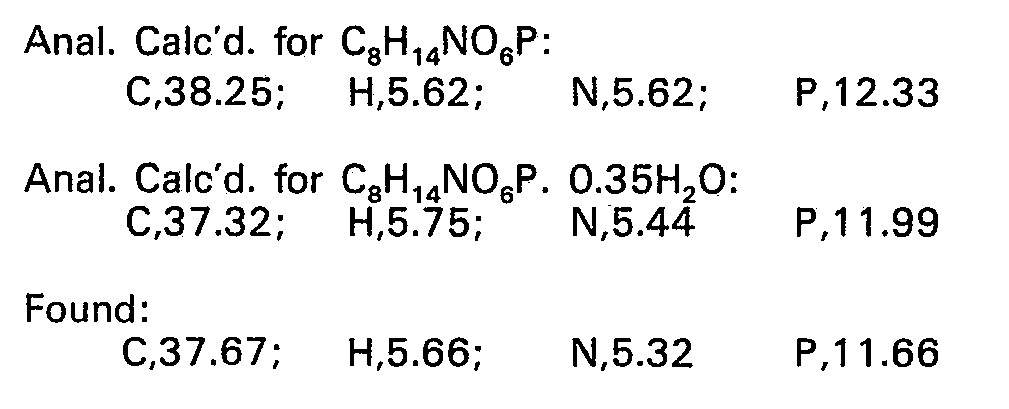
- A solution of 1-(1-oxo-2-phosphonopropyl)-L-proline in double-distilled water (pH=1.6) is treated dropwise with a 1 M lithium hydroxide solution until the pH reaches 9.2. The solution is then filtered through a millipore filter and lyophilized to yield 640 mg of 1-(1-oxo-2-phosphonopropyt)-L-pro)ine, trilithium salt, m.p. <330°.

- Methyl(dimethoxyphosphinyl)acetate (36.4 gm., 0.2 mol) is treated with phosphorus pentachloride (83.2 gm, 0.4 mol). An exothermic reaction raises the temperature of the mixture to 80°. The reaction mixture is maintained at 80° for one hour, then distilled in vacuo to obtain 13.5 gm. of (dichlorophosphinyl)acetic acid, methyl ester, b.p. 95-100° /1.5 mm.
- (Dichlorophosphinyl)acetic acid, methyl ester (7.2 g., 0.038 mol) is stirred in 100 ml of dichloromethane at 0° while 2-phenylethanol (4.6 gm., 0.038 mol) and triethylamine (5.2 ml., 0.038 mol) in 50 ml. of dichloromethane are added over 45 minutes. After stirring 2 hours, 4-nitrobenzyl alcohol (5.8 gm., 0.038 mol) and triethylamine in 50 mi. of dichloromethane are added and stirred overnight. The mixture is washed with water, saturated sodium bicarbonate and brine, and the organic layer is dried (MgS04) and evaporated to 10 gm. of brown oil. Chromatography on silica gel (1000 ml.) with dichloromethane-ethyl acetate yields 4.8 gm. of product [4-nitrobenzyloxy[2-phenylethyloxy]phosphinyl]acetic acid, methyl ester, as a viscous glass.
- The phosphinyl acetic acid ester obtained in part b (4.48 gm., 0.011 mol) is stirred with 1 N sodium hydroxide (12 ml.) overnight. The mixture is extracted with ether and the aqueous layer acidified, then extracted with dichloromethane. The dichloromethane extracts are dried (Na2SO4) and evaporated to 3.6 gm. of viscous oil. Chromatography on 300 ml. silica gel with acetic acid/benzene (1:10) yields 3.0 gm. of product, [4-nitrobenzyloxy[2-phenylethyloxy]phosphinyl]-acetic acid as a viscous glass.
- The phosphinyl acetic acid obtained in part c (2.65 gm., 0.007 mol) and 1,1'-carbonyldiimidazole (1.14 gm., 0.007 mol) are combined in 125 ml. of acetonitrile at 6° and stirred for 1 hour. L-proline benzyl ester (1.44 gm., 0.007 mol) is added and the mixture is stirred overnight at room temperature. The reaction mixture is concentrated in vacuo and partitioned between ethyl acetate and water. The ethyl acetate layer is washed with 5% potassium bisulfate and saturated sodium bicarbonate, then dried (Na2SO4) and evaporated to an oil. Chromatography on 300 ml silica gel with acetic acid/benzene (1:11) yields 3.1 gm. of the desired product, 1-[[4-nitrobenzyloxy[2-phenylethloxy]phosphinyl]acetyl]-L-proline, benzyl ester, as a viscous glass.
- The proline ester from part d is substituted for the 1-[[ethoxy[benzyloxy]phosphinyl]acetyl]-L-proline benzyl ester in the procedure of part e, Example 4, to obtain 1-[[hydroxy[2-phenylethyloxy]phosphinyl]acetyl]-L-proline.
- 0.1 N sodium hydroxide is substituted for the 0.1 N lithium hydroxide in the procedure of Example 2 to obtain 1-(phosphonoacetyl)-L-proline, sodium salt.
Claims (13)

Applications Claiming Priority (2)
| Application Number | Priority Date | Filing Date | Title |
|---|---|---|---|
| US82381877A | 1977-08-11 | 1977-08-11 | |
| US823818 | 1977-08-11 |
Publications (2)
| Publication Number | Publication Date |
|---|---|
| EP0000833A1 EP0000833A1 (en) | 1979-02-21 |
| EP0000833B1 true EP0000833B1 (en) | 1981-09-02 |
Family
ID=25239818
Family Applications (1)
| Application Number | Title | Priority Date | Filing Date |
|---|---|---|---|
| EP78300245A Expired EP0000833B1 (en) | 1977-08-11 | 1978-08-03 | Derivatives of phosphonoacyl prolines and their pharmaceutical use |
Country Status (11)
| Country | Link |
|---|---|
| US (1) | US4151172A (en) |
| EP (1) | EP0000833B1 (en) |
| JP (1) | JPS5430158A (en) |
| AU (1) | AU523323B2 (en) |
| CA (1) | CA1109476A (en) |
| DE (1) | DE2860019D1 (en) |
| DK (1) | DK147422C (en) |
| HU (1) | HU176712B (en) |
| IE (1) | IE47170B1 (en) |
| IT (1) | IT1098006B (en) |
| NO (1) | NO149923C (en) |
Families Citing this family (60)
| Publication number | Priority date | Publication date | Assignee | Title |
|---|---|---|---|---|
| US4316896A (en) * | 1978-09-07 | 1982-02-23 | Merck & Co., Inc. | Aminoacid derivatives as antihypertensives |
| ZA794723B (en) * | 1978-09-11 | 1980-08-27 | Univ Miami | Anti-hypertensive agents |
| US4690940A (en) * | 1979-08-14 | 1987-09-01 | University Of Miami | Anti-hypertensive agents |
| US4690938A (en) * | 1979-08-14 | 1987-09-01 | University Of Miami | Anti-hypertensive agents |
| US4690937A (en) * | 1979-08-14 | 1987-09-01 | University Of Miami | Anti-hypertensive agents |
| US4690939A (en) * | 1979-08-14 | 1987-09-01 | University Of Miami | Anti-hypertensive agents |
| US4698356A (en) * | 1979-08-14 | 1987-10-06 | University Of Miami | Anti-hypertensive agents |
| US4695577A (en) * | 1979-08-14 | 1987-09-22 | University Of Miami | Anti-hypertensive agents |
| US4698355A (en) * | 1979-08-14 | 1987-10-06 | University Of Miami | Anti-hypertensive agents |
| US4168267A (en) * | 1978-10-23 | 1979-09-18 | E. R. Squibb & Sons, Inc. | Phosphinylalkanoyl prolines |
| US4690936A (en) * | 1980-03-05 | 1987-09-01 | University Of Miami | Anti-hypertensive agents |
| US4734420A (en) * | 1980-03-05 | 1988-03-29 | University Of Miami | Anti-hypertensive agents |
| US4337201A (en) * | 1980-12-04 | 1982-06-29 | E. R. Squibb & Sons, Inc. | Phosphinylalkanoyl substituted prolines |
| US4379146A (en) * | 1981-02-17 | 1983-04-05 | Merck & Co., Inc. | Substituted phosphonamides as antihypertensives |
| US4416831A (en) * | 1981-04-27 | 1983-11-22 | E. R. Squibb & Sons, Inc. | Amino and substituted amino phosphinylalkanoyl compounds |
| US4374131A (en) * | 1981-04-27 | 1983-02-15 | E. R. Squibb & Sons, Inc. | Amino and substituted amino phosphinyl-alkanoyl compounds |
| US4416833A (en) * | 1981-05-04 | 1983-11-22 | E. R. Squibb & Sons, Inc. | Substituted carbonyl phosphinyl-alkanoyl compounds |
| US4381297A (en) * | 1981-05-04 | 1983-04-26 | E. R. Squibb & Sons, Inc. | Substituted carbonyl phosphinyl-alkanoyl compounds |
| EP0070131A1 (en) * | 1981-07-09 | 1983-01-19 | Analytical Research Pharmaceuticals Pty. Ltd. | Phosphonoalkanoylamino acids |
| US4432971A (en) * | 1981-08-03 | 1984-02-21 | E. R. Squibb & Sons, Inc. | Phosphonamidate compounds |
| US4371526A (en) * | 1981-08-21 | 1983-02-01 | E. R. Squibb & Sons, Inc. | Phosphinylalkanoyl substituted 4,5-dihydropyrazole-5-carboxylic acid derivatives and hypotensive method and composition |
| US4555506A (en) * | 1981-12-24 | 1985-11-26 | E. R. Squibb & Sons, Inc. | Phosphorus containing compounds and use as hypotensives |
| US4452791A (en) * | 1982-03-15 | 1984-06-05 | E. R. Squibb & Sons, Inc. | Aminoalkyl and related substituted phosphinic acid angiotensin converting enzyme inhibitors |
| US4560680A (en) * | 1982-03-15 | 1985-12-24 | E. R. Squibb & Sons, Inc. | Aminoalkyl and related substituted phosphinic acid angiotensin converting enzyme inhibitors |
| EP0091525A3 (en) * | 1982-04-08 | 1984-02-29 | Analytical Research Pharmaceuticals Pty. Ltd. | Phosphonoalkanoylamino acids |
| US4560681A (en) * | 1982-04-22 | 1985-12-24 | E. R. Squibb & Sons, Inc. | Phosphinylmethylaminocarbonyl imino acid compounds useful for treating hypertension |
| US4448772A (en) * | 1982-04-22 | 1984-05-15 | E. R. Squibb & Sons, Inc. | Phosphinylmethylaminocarbonyl imino acid compounds useful for treating hypertension |
| CA1258853A (en) * | 1982-04-30 | 1989-08-29 | Rudiger D. Haugwitz | Substituted 4-phenoxy prolines |
| US4616005A (en) * | 1982-06-23 | 1986-10-07 | E. R. Squibb & Sons, Inc. | Phosphonyl hydroxyacyl amino acid derivatives as antihypertensives |
| US4703043A (en) * | 1982-06-23 | 1987-10-27 | E. R. Squibb & Sons, Inc. | Phosphonyl hydroxyacyl amino acid derivatives as antihypertensive |
| US4452790A (en) * | 1982-06-23 | 1984-06-05 | E. R. Squibb & Sons, Inc. | Phosphonyl hydroxyacyl amino acid derivatives as antihypertensives |
| US4567166A (en) * | 1982-07-14 | 1986-01-28 | E. R. Squibb & Sons, Inc. | Amino and substituted amino phosphinylalkanoyl compounds useful for treating hypertension |
| US4552889A (en) * | 1983-06-09 | 1985-11-12 | Eli Lilly And Company | 3-Mercaptomethyl-2-oxo-1-pyrrolidine acetic acids and use for hypertension |
| JPH0624706B2 (en) * | 1985-10-01 | 1994-04-06 | ミネソタ マイニング アンド マニユフアクチユアリング コンパニ− | Polishing pad |
| CA2021409A1 (en) * | 1989-08-21 | 1991-02-22 | Donald S. Karanewsky | Phosphonate substituted amino or imino acids useful as antihypertensives |
| DE3939142A1 (en) * | 1989-11-27 | 1991-05-29 | Hoechst Ag | METHOD FOR THE OXIDATION OF 2-HYDROXY-AETHYLPHOSPHONESEUREDIALKYLESTERS |
| US6011021A (en) * | 1996-06-17 | 2000-01-04 | Guilford Pharmaceuticals Inc. | Methods of cancer treatment using naaladase inhibitors |
| US5795877A (en) * | 1996-12-31 | 1998-08-18 | Guilford Pharmaceuticals Inc. | Inhibitors of NAALADase enzyme activity |
| US5863536A (en) * | 1996-12-31 | 1999-01-26 | Guilford Pharmaceuticals Inc. | Phosphoramidate derivatives |
| US6384022B1 (en) | 1996-06-17 | 2002-05-07 | Guilford Pharmaceuticals Inc. | Prodrugs of NAALAdase inhibitors |
| US5672592A (en) * | 1996-06-17 | 1997-09-30 | Guilford Pharmaceuticals Inc. | Certain phosphonomethyl-pentanedioic acid derivatives thereof |
| US6025345A (en) * | 1996-06-17 | 2000-02-15 | Guilford Pharmaceuticals Inc. | Inhibitors of NAALADase enzyme activity |
| US5902817A (en) * | 1997-04-09 | 1999-05-11 | Guilford Pharmaceuticals Inc. | Certain sulfoxide and sulfone derivatives |
| US5977090A (en) * | 1996-09-27 | 1999-11-02 | Guilford Pharmaceuticals Inc. | Pharmaceutical compositions and methods of treating compulsive disorders using NAALADase inhibitors |
| US6046180A (en) * | 1996-06-17 | 2000-04-04 | Guilford Pharmaceuticals Inc. | NAALADase inhibitors |
| TR199802638T2 (en) | 1996-06-17 | 1999-03-22 | Guilford Pharmaceuticals, Inc. | Use of naaladase inhibitors in cancer treatment. |
| US6054444A (en) | 1997-04-24 | 2000-04-25 | Guilford Pharmaceuticals Inc. | Phosphonic acid derivatives |
| US6025344A (en) | 1996-06-17 | 2000-02-15 | Guilford Pharmaceuticals Inc. | Certain dioic acid derivatives useful as NAALADase inhibitors |
| US6071965A (en) * | 1996-06-17 | 2000-06-06 | Guilford Pharmaceuticals Inc. | Phosphinic alkanoic acid derivatives |
| US5962521A (en) * | 1997-04-04 | 1999-10-05 | Guilford Pharmaceuticals Inc. | Hydroxamic acid derivatives |
| US5981209A (en) * | 1997-12-04 | 1999-11-09 | Guilford Pharmaceuticals Inc. | Use of NAALADase activity to identify prostate cancer and benign prostatic hyperplasia |
| US6028216A (en) * | 1997-12-31 | 2000-02-22 | Guilford Pharmaceuticals Inc. | Asymmetric syntheses and intermediates for preparing enantiomer-enriched hydroxyphosphinyl derivatives |
| US6121252A (en) * | 1998-03-30 | 2000-09-19 | Guilford Pharmaceuticals Inc. | Phosphinic acid derivatives |
| US6395718B1 (en) | 1998-07-06 | 2002-05-28 | Guilford Pharmaceuticals Inc. | Pharmaceutical compositions and methods of inhibiting angiogenesis using naaladase inhibitors |
| TR200100025T2 (en) | 1998-07-06 | 2001-12-21 | Guilford Pharmaceuticals Inc. | Naaladase inhibitors useful as pharmaceutical compounds and compositions. |
| US6265609B1 (en) | 1998-07-06 | 2001-07-24 | Guilford Pharmaceuticals Inc. | Thio-substituted pentanedioic acid derivatives |
| US6313159B1 (en) | 1999-08-20 | 2001-11-06 | Guilford Pharmaceuticals Inc. | Metabotropic glutamate receptor ligand derivatives as naaladase inhibitors |
| ITMI20010395A1 (en) | 2001-02-27 | 2002-08-27 | Dompe Spa | OMEGA-AMINO ALKYLAMIDS OF R-2-ARYL-PROPIONIC ACIDS AS INHIBITORS OF CHEMOTAXIS OF POLYMORPHONUCLEATED AND MONONUCLEATE CELLS |
| US20060247297A1 (en) | 2002-12-10 | 2006-11-02 | Marcello Allegretti | Chiral arylketones in the treatment of neutrophil-dependent inflammatory diseases |
| WO2011080736A1 (en) * | 2009-12-29 | 2011-07-07 | Mapi Pharma Hk Limited | Intermediate compounds and processes for the preparation of tapentadol and related compounds |
Family Cites Families (3)
| Publication number | Priority date | Publication date | Assignee | Title |
|---|---|---|---|---|
| US4048156A (en) * | 1968-05-24 | 1977-09-13 | E. I Du Pont De Nemours And Company | Carbamoylphosphonates |
| US4025332A (en) * | 1974-10-01 | 1977-05-24 | Monsanto Company | Increasing sucrose content of sugarcane plants with N-phosphonomethylglycinamides |
| US4046889A (en) * | 1976-02-13 | 1977-09-06 | E. R. Squibb & Sons, Inc. | Azetidine-2-carboxylic acid derivatives |
-
1978
- 1978-07-20 US US05/926,177 patent/US4151172A/en not_active Expired - Lifetime
- 1978-07-21 CA CA307,853A patent/CA1109476A/en not_active Expired
- 1978-07-28 AU AU38436/78A patent/AU523323B2/en not_active Expired
- 1978-08-03 EP EP78300245A patent/EP0000833B1/en not_active Expired
- 1978-08-04 DE DE7878300245T patent/DE2860019D1/en not_active Expired
- 1978-08-07 IT IT26549/78A patent/IT1098006B/en active
- 1978-08-09 IE IE1619/78A patent/IE47170B1/en unknown
- 1978-08-09 HU HU78SU985A patent/HU176712B/en unknown
- 1978-08-10 NO NO782724A patent/NO149923C/en unknown
- 1978-08-10 DK DK353378A patent/DK147422C/en not_active IP Right Cessation
- 1978-08-11 JP JP9862478A patent/JPS5430158A/en active Pending
Also Published As
| Publication number | Publication date |
|---|---|
| IE47170B1 (en) | 1984-01-11 |
| AU3843678A (en) | 1980-01-31 |
| AU523323B2 (en) | 1982-07-22 |
| JPS5430158A (en) | 1979-03-06 |
| DK353378A (en) | 1979-02-12 |
| DE2860019D1 (en) | 1981-04-23 |
| US4151172A (en) | 1979-04-24 |
| HU176712B (en) | 1981-04-28 |
| DK147422C (en) | 1985-02-11 |
| IT1098006B (en) | 1985-08-31 |
| EP0000833A1 (en) | 1979-02-21 |
| NO782724L (en) | 1979-02-13 |
| NO149923B (en) | 1984-04-09 |
| IE781619L (en) | 1979-02-11 |
| NO149923C (en) | 1984-07-18 |
| CA1109476A (en) | 1981-09-22 |
| IT7826549A0 (en) | 1978-08-07 |
| DK147422B (en) | 1984-07-30 |
Similar Documents
| Publication | Publication Date | Title |
|---|---|---|
| US4151172A (en) | Phosphonoacyl prolines and related compounds | |
| US4168267A (en) | Phosphinylalkanoyl prolines | |
| US4337201A (en) | Phosphinylalkanoyl substituted prolines | |
| EP0063896B1 (en) | Amino and substituted amino phosphinyl-alkanoyl compositions | |
| CN112513025B (en) | Chemical method for preparing phenylpiperidinyl indole derivatives | |
| JPS58210097A (en) | Phosphinylalkanoyl substituted imino acids | |
| JPH07507046A (en) | Novel phosphonosuccinic acid derivatives, their production methods and pharmaceuticals containing these compounds | |
| TW201751B (en) | ||
| JPH0363294A (en) | Novel compound, its preparation and pharmaceutical composition containing same | |
| US4384123A (en) | Phosphinylalkanoyl substituted prolines | |
| Liu et al. | Asymmetric synthesis of N‐protected chiral 1‐aminoalkylphosphonic acids and synthesis of side chain–functionalized depsiphosphonopeptides | |
| US4186268A (en) | Mercaptoacylpyrrolidine phosphonic acids and related compounds | |
| HU204278B (en) | Processs for producingalkyl-phospho- and -phosphono-serine derivatives and pharmaceutical compositions containing them | |
| US4396772A (en) | Phosphinylalkanoyl amino acids | |
| US4206122A (en) | Derivatives of pyrrolidinecarboxaldehyde and piperidinecarboxaldehyde and intermediates therefor | |
| KR100297180B1 (en) | Phospholipid derivatives and preparation methods thereof | |
| US6391866B1 (en) | (α-aminophosphino) peptides derivative and compositions containing same | |
| US5583123A (en) | Certain tetrazole derivatives | |
| EP0070131A1 (en) | Phosphonoalkanoylamino acids | |
| CA2271814A1 (en) | New phosphonates, process for preparing the same and medicaments | |
| EP0091525A2 (en) | Phosphonoalkanoylamino acids |
Legal Events
| Date | Code | Title | Description |
|---|---|---|---|
| PUAI | Public reference made under article 153(3) epc to a published international application that has entered the european phase |
Free format text: ORIGINAL CODE: 0009012 |
|
| AK | Designated contracting states |
Designated state(s): BE CH DE FR GB LU NL SE |
|
| 17P | Request for examination filed | ||
| XX | Miscellaneous (additional remarks) |
Free format text: IN HEFT 42 V.16.10.80 S.546,SP.1 IST DIE VEROEFF.NR.IN 0000883 ZU BERICHTIGEN |
|
| GRAA | (expected) grant |
Free format text: ORIGINAL CODE: 0009210 |
|
| AK | Designated contracting states |
Designated state(s): BE CH DE FR GB LU NL SE |
|
| REF | Corresponds to: |
Ref document number: 2861012 Country of ref document: DE Date of ref document: 19811126 |
|
| PG25 | Lapsed in a contracting state [announced via postgrant information from national office to epo] |
Ref country code: LU Free format text: LAPSE BECAUSE OF NON-PAYMENT OF DUE FEES Effective date: 19820831 |
|
| PGFP | Annual fee paid to national office [announced via postgrant information from national office to epo] |
Ref country code: LU Payment date: 19830517 Year of fee payment: 6 |
|
| PGFP | Annual fee paid to national office [announced via postgrant information from national office to epo] |
Ref country code: FR Payment date: 19840625 Year of fee payment: 7 |
|
| PGFP | Annual fee paid to national office [announced via postgrant information from national office to epo] |
Ref country code: CH Payment date: 19840809 Year of fee payment: 7 |
|
| PGFP | Annual fee paid to national office [announced via postgrant information from national office to epo] |
Ref country code: SE Payment date: 19840930 Year of fee payment: 7 Ref country code: BE Payment date: 19840930 Year of fee payment: 7 |
|
| PGFP | Annual fee paid to national office [announced via postgrant information from national office to epo] |
Ref country code: DE Payment date: 19841031 Year of fee payment: 7 |
|
| PGFP | Annual fee paid to national office [announced via postgrant information from national office to epo] |
Ref country code: NL Payment date: 19850831 Year of fee payment: 8 |
|
| PG25 | Lapsed in a contracting state [announced via postgrant information from national office to epo] |
Ref country code: SE Effective date: 19860804 |
|
| PG25 | Lapsed in a contracting state [announced via postgrant information from national office to epo] |
Ref country code: CH Effective date: 19860831 |
|
| BERE | Be: lapsed |
Owner name: E.R. SQUIBB & SONS INC. Effective date: 19860831 |
|
| PG25 | Lapsed in a contracting state [announced via postgrant information from national office to epo] |
Ref country code: NL Effective date: 19870301 |
|
| NLV4 | Nl: lapsed or anulled due to non-payment of the annual fee | ||
| GBPC | Gb: european patent ceased through non-payment of renewal fee | ||
| PG25 | Lapsed in a contracting state [announced via postgrant information from national office to epo] |
Ref country code: FR Free format text: LAPSE BECAUSE OF NON-PAYMENT OF DUE FEES Effective date: 19870430 |
|
| REG | Reference to a national code |
Ref country code: CH Ref legal event code: PL |
|
| PG25 | Lapsed in a contracting state [announced via postgrant information from national office to epo] |
Ref country code: DE Effective date: 19870501 |
|
| REG | Reference to a national code |
Ref country code: FR Ref legal event code: ST |
|
| PG25 | Lapsed in a contracting state [announced via postgrant information from national office to epo] |
Ref country code: GB Effective date: 19881117 |
|
| PG25 | Lapsed in a contracting state [announced via postgrant information from national office to epo] |
Ref country code: BE Effective date: 19890831 |
|
| EUG | Se: european patent has lapsed |
Ref document number: 78300245.4 Effective date: 19870812 |
|
| PLBE | No opposition filed within time limit |
Free format text: ORIGINAL CODE: 0009261 |
|
| STAA | Information on the status of an ep patent application or granted ep patent |
Free format text: STATUS: NO OPPOSITION FILED WITHIN TIME LIMIT |