EP0000828B1 - Synthetic beta-lactam compounds, a process for their preparation and compositions containing them - Google Patents
Synthetic beta-lactam compounds, a process for their preparation and compositions containing them Download PDFInfo
- Publication number
- EP0000828B1 EP0000828B1 EP78300231A EP78300231A EP0000828B1 EP 0000828 B1 EP0000828 B1 EP 0000828B1 EP 78300231 A EP78300231 A EP 78300231A EP 78300231 A EP78300231 A EP 78300231A EP 0000828 B1 EP0000828 B1 EP 0000828B1
- Authority
- EP
- European Patent Office
- Prior art keywords
- hept
- ene
- oxo
- azabicyclo
- compound
- Prior art date
- Legal status (The legal status is an assumption and is not a legal conclusion. Google has not performed a legal analysis and makes no representation as to the accuracy of the status listed.)
- Expired
Links
- 238000002360 preparation method Methods 0.000 title claims description 42
- -1 beta-lactam compounds Chemical class 0.000 title claims description 36
- 239000000203 mixture Substances 0.000 title claims description 35
- 238000000034 method Methods 0.000 title claims description 17
- 150000001875 compounds Chemical class 0.000 claims description 69
- 239000002253 acid Substances 0.000 claims description 26
- 150000003839 salts Chemical group 0.000 claims description 24
- 150000002148 esters Chemical group 0.000 claims description 23
- 125000001997 phenyl group Chemical group [H]C1=C([H])C([H])=C(*)C([H])=C1[H] 0.000 claims description 19
- 125000001797 benzyl group Chemical group [H]C1=C([H])C([H])=C(C([H])=C1[H])C([H])([H])* 0.000 claims description 16
- 239000011734 sodium Substances 0.000 claims description 11
- 229910052708 sodium Inorganic materials 0.000 claims description 11
- DGAQECJNVWCQMB-PUAWFVPOSA-M Ilexoside XXIX Chemical compound C[C@@H]1CC[C@@]2(CC[C@@]3(C(=CC[C@H]4[C@]3(CC[C@@H]5[C@@]4(CC[C@@H](C5(C)C)OS(=O)(=O)[O-])C)C)[C@@H]2[C@]1(C)O)C)C(=O)O[C@H]6[C@@H]([C@H]([C@@H]([C@H](O6)CO)O)O)O.[Na+] DGAQECJNVWCQMB-PUAWFVPOSA-M 0.000 claims description 10
- 125000000217 alkyl group Chemical group 0.000 claims description 9
- 125000005633 phthalidyl group Chemical group 0.000 claims description 8
- WKBOTKDWSSQWDR-UHFFFAOYSA-N Bromine atom Chemical compound [Br] WKBOTKDWSSQWDR-UHFFFAOYSA-N 0.000 claims description 7
- ZAMOUSCENKQFHK-UHFFFAOYSA-N Chlorine atom Chemical compound [Cl] ZAMOUSCENKQFHK-UHFFFAOYSA-N 0.000 claims description 7
- PXGOKWXKJXAPGV-UHFFFAOYSA-N Fluorine Chemical compound FF PXGOKWXKJXAPGV-UHFFFAOYSA-N 0.000 claims description 7
- GDTBXPJZTBHREO-UHFFFAOYSA-N bromine Substances BrBr GDTBXPJZTBHREO-UHFFFAOYSA-N 0.000 claims description 7
- 229910052794 bromium Inorganic materials 0.000 claims description 7
- 239000000460 chlorine Substances 0.000 claims description 7
- 229910052801 chlorine Inorganic materials 0.000 claims description 7
- 125000004185 ester group Chemical group 0.000 claims description 7
- 229910052731 fluorine Inorganic materials 0.000 claims description 7
- 239000011737 fluorine Substances 0.000 claims description 7
- 238000011282 treatment Methods 0.000 claims description 7
- 150000001734 carboxylic acid salts Chemical class 0.000 claims description 6
- 125000000999 tert-butyl group Chemical group [H]C([H])([H])C(*)(C([H])([H])[H])C([H])([H])[H] 0.000 claims description 5
- ZLMJMSJWJFRBEC-UHFFFAOYSA-N Potassium Chemical compound [K] ZLMJMSJWJFRBEC-UHFFFAOYSA-N 0.000 claims description 4
- SWTVPHKYKAKNEJ-UHFFFAOYSA-N benzyl 3-(4-aminophenyl)sulfanyl-7-oxo-1-azabicyclo[3.2.0]hept-2-ene-2-carboxylate Chemical compound C1=CC(N)=CC=C1SC1=C(C(=O)OCC=2C=CC=CC=2)N2C(=O)CC2C1 SWTVPHKYKAKNEJ-UHFFFAOYSA-N 0.000 claims description 4
- 150000001732 carboxylic acid derivatives Chemical class 0.000 claims description 4
- 229910052700 potassium Inorganic materials 0.000 claims description 4
- 239000011591 potassium Substances 0.000 claims description 4
- LPCNCFWQKRMRGZ-UHFFFAOYSA-N (4-nitrophenyl)methyl 7-oxo-3-phenylsulfanyl-1-azabicyclo[3.2.0]hept-2-ene-2-carboxylate Chemical compound C1=CC([N+](=O)[O-])=CC=C1COC(=O)C1=C(SC=2C=CC=CC=2)CC2N1C(=O)C2 LPCNCFWQKRMRGZ-UHFFFAOYSA-N 0.000 claims description 3
- BUUDWHIBUGYSBJ-UHFFFAOYSA-N 2,2-dimethylpropanoyloxymethyl 7-oxo-3-phenylsulfanyl-1-azabicyclo[3.2.0]hept-2-ene-2-carboxylate Chemical compound C1C2CC(=O)N2C(C(=O)OCOC(=O)C(C)(C)C)=C1SC1=CC=CC=C1 BUUDWHIBUGYSBJ-UHFFFAOYSA-N 0.000 claims description 3
- 208000035143 Bacterial infection Diseases 0.000 claims description 3
- 229930182555 Penicillin Natural products 0.000 claims description 3
- 208000022362 bacterial infectious disease Diseases 0.000 claims description 3
- MBWMHGALCITXCZ-UHFFFAOYSA-N benzyl 3-(4-acetamidophenyl)sulfanyl-7-oxo-1-azabicyclo[3.2.0]hept-2-ene-2-carboxylate Chemical compound C1=CC(NC(=O)C)=CC=C1SC1=C(C(=O)OCC=2C=CC=CC=2)N2C(=O)CC2C1 MBWMHGALCITXCZ-UHFFFAOYSA-N 0.000 claims description 3
- YFVCJUUZVZGMPJ-UHFFFAOYSA-N benzyl 7-oxo-3-phenylsulfanyl-1-azabicyclo[3.2.0]hept-2-ene-2-carboxylate Chemical compound C=1C=CC=CC=1SC=1CC2CC(=O)N2C=1C(=O)OCC1=CC=CC=C1 YFVCJUUZVZGMPJ-UHFFFAOYSA-N 0.000 claims description 3
- 125000002843 carboxylic acid group Chemical group 0.000 claims description 3
- UKJLNMAFNRKWGR-UHFFFAOYSA-N cyclohexatrienamine Chemical group NC1=CC=C=C[CH]1 UKJLNMAFNRKWGR-UHFFFAOYSA-N 0.000 claims description 3
- 230000008030 elimination Effects 0.000 claims description 3
- 238000003379 elimination reaction Methods 0.000 claims description 3
- WKCVZNDNNMOAQT-UHFFFAOYSA-N methyl 7-oxo-3-phenylsulfanyl-1-azabicyclo[3.2.0]hept-2-ene-2-carboxylate Chemical compound C1C2CC(=O)N2C(C(=O)OC)=C1SC1=CC=CC=C1 WKCVZNDNNMOAQT-UHFFFAOYSA-N 0.000 claims description 3
- 125000006502 nitrobenzyl group Chemical group 0.000 claims description 3
- 125000006503 p-nitrobenzyl group Chemical group [H]C1=C([H])C(=C([H])C([H])=C1[N+]([O-])=O)C([H])([H])* 0.000 claims description 3
- 125000000636 p-nitrophenyl group Chemical group [H]C1=C([H])C(=C([H])C([H])=C1*)[N+]([O-])=O 0.000 claims description 3
- 229930186147 Cephalosporin Natural products 0.000 claims description 2
- JGSARLDLIJGVTE-MBNYWOFBSA-N Penicillin G Chemical compound N([C@H]1[C@H]2SC([C@@H](N2C1=O)C(O)=O)(C)C)C(=O)CC1=CC=CC=C1 JGSARLDLIJGVTE-MBNYWOFBSA-N 0.000 claims description 2
- 125000006278 bromobenzyl group Chemical group 0.000 claims description 2
- 125000003178 carboxy group Chemical group [H]OC(*)=O 0.000 claims description 2
- 229940124587 cephalosporin Drugs 0.000 claims description 2
- 150000001780 cephalosporins Chemical class 0.000 claims description 2
- 125000004803 chlorobenzyl group Chemical group 0.000 claims description 2
- 239000003937 drug carrier Substances 0.000 claims description 2
- 125000004175 fluorobenzyl group Chemical group 0.000 claims description 2
- 229940049954 penicillin Drugs 0.000 claims description 2
- 239000008194 pharmaceutical composition Substances 0.000 claims description 2
- XGDJBVMCOWHQIZ-UHFFFAOYSA-M sodium;7-oxo-3-phenylsulfanyl-1-azabicyclo[3.2.0]hept-2-ene-2-carboxylate Chemical compound [Na+].C1C2CC(=O)N2C(C(=O)[O-])=C1SC1=CC=CC=C1 XGDJBVMCOWHQIZ-UHFFFAOYSA-M 0.000 claims description 2
- 125000004178 (C1-C4) alkyl group Chemical group 0.000 claims 4
- NEQGRZCWHVYPKT-UHFFFAOYSA-N tert-butyl 3-(4-nitrophenyl)sulfanyl-7-oxo-1-azabicyclo[3.2.0]hept-2-ene-2-carboxylate Chemical compound C1C2CC(=O)N2C(C(=O)OC(C)(C)C)=C1SC1=CC=C([N+]([O-])=O)C=C1 NEQGRZCWHVYPKT-UHFFFAOYSA-N 0.000 claims 1
- XEKOWRVHYACXOJ-UHFFFAOYSA-N Ethyl acetate Chemical compound CCOC(C)=O XEKOWRVHYACXOJ-UHFFFAOYSA-N 0.000 description 151
- WYURNTSHIVDZCO-UHFFFAOYSA-N Tetrahydrofuran Chemical compound C1CCOC1 WYURNTSHIVDZCO-UHFFFAOYSA-N 0.000 description 82
- RTZKZFJDLAIYFH-UHFFFAOYSA-N Diethyl ether Chemical compound CCOCC RTZKZFJDLAIYFH-UHFFFAOYSA-N 0.000 description 77
- YXFVVABEGXRONW-UHFFFAOYSA-N Toluene Chemical compound CC1=CC=CC=C1 YXFVVABEGXRONW-UHFFFAOYSA-N 0.000 description 72
- XKRFYHLGVUSROY-UHFFFAOYSA-N Argon Chemical compound [Ar] XKRFYHLGVUSROY-UHFFFAOYSA-N 0.000 description 62
- 239000000243 solution Substances 0.000 description 62
- XYFCBTPGUUZFHI-UHFFFAOYSA-N Phosphine Chemical compound P XYFCBTPGUUZFHI-UHFFFAOYSA-N 0.000 description 61
- YMWUJEATGCHHMB-UHFFFAOYSA-N Dichloromethane Chemical compound ClCCl YMWUJEATGCHHMB-UHFFFAOYSA-N 0.000 description 46
- LFQSCWFLJHTTHZ-UHFFFAOYSA-N Ethanol Chemical compound CCO LFQSCWFLJHTTHZ-UHFFFAOYSA-N 0.000 description 40
- 229910052786 argon Inorganic materials 0.000 description 32
- MNFORVFSTILPAW-UHFFFAOYSA-N azetidin-2-one Chemical compound O=C1CCN1 MNFORVFSTILPAW-UHFFFAOYSA-N 0.000 description 31
- 239000007787 solid Substances 0.000 description 30
- ZMANZCXQSJIPKH-UHFFFAOYSA-N Triethylamine Chemical group CCN(CC)CC ZMANZCXQSJIPKH-UHFFFAOYSA-N 0.000 description 29
- 239000002904 solvent Substances 0.000 description 29
- YLQBMQCUIZJEEH-UHFFFAOYSA-N tetrahydrofuran Natural products C=1C=COC=1 YLQBMQCUIZJEEH-UHFFFAOYSA-N 0.000 description 25
- 238000006243 chemical reaction Methods 0.000 description 23
- OISVCGZHLKNMSJ-UHFFFAOYSA-N 2,6-dimethylpyridine Chemical compound CC1=CC=CC(C)=N1 OISVCGZHLKNMSJ-UHFFFAOYSA-N 0.000 description 22
- HEDRZPFGACZZDS-MICDWDOJSA-N Trichloro(2H)methane Chemical compound [2H]C(Cl)(Cl)Cl HEDRZPFGACZZDS-MICDWDOJSA-N 0.000 description 20
- 239000000047 product Substances 0.000 description 20
- UHOVQNZJYSORNB-UHFFFAOYSA-N Benzene Chemical compound C1=CC=CC=C1 UHOVQNZJYSORNB-UHFFFAOYSA-N 0.000 description 18
- VYPSYNLAJGMNEJ-UHFFFAOYSA-N Silicium dioxide Chemical compound O=[Si]=O VYPSYNLAJGMNEJ-UHFFFAOYSA-N 0.000 description 18
- DTQVDTLACAAQTR-UHFFFAOYSA-N Trifluoroacetic acid Chemical compound OC(=O)C(F)(F)F DTQVDTLACAAQTR-UHFFFAOYSA-N 0.000 description 17
- ZMXDDKWLCZADIW-UHFFFAOYSA-N N,N-Dimethylformamide Chemical compound CN(C)C=O ZMXDDKWLCZADIW-UHFFFAOYSA-N 0.000 description 14
- 238000004587 chromatography analysis Methods 0.000 description 14
- FYSNRJHAOHDILO-UHFFFAOYSA-N thionyl chloride Chemical compound ClS(Cl)=O FYSNRJHAOHDILO-UHFFFAOYSA-N 0.000 description 14
- XLYOFNOQVPJJNP-UHFFFAOYSA-N water Substances O XLYOFNOQVPJJNP-UHFFFAOYSA-N 0.000 description 14
- 239000000706 filtrate Substances 0.000 description 13
- 239000003208 petroleum Substances 0.000 description 13
- 238000003756 stirring Methods 0.000 description 13
- HEDRZPFGACZZDS-UHFFFAOYSA-N Chloroform Chemical compound ClC(Cl)Cl HEDRZPFGACZZDS-UHFFFAOYSA-N 0.000 description 12
- 239000013078 crystal Substances 0.000 description 12
- LGTLXDJOAJDFLR-UHFFFAOYSA-N diethyl chlorophosphate Chemical group CCOP(Cl)(=O)OCC LGTLXDJOAJDFLR-UHFFFAOYSA-N 0.000 description 11
- RIOQSEWOXXDEQQ-UHFFFAOYSA-N triphenylphosphine Chemical compound C1=CC=CC=C1P(C=1C=CC=CC=1)C1=CC=CC=C1 RIOQSEWOXXDEQQ-UHFFFAOYSA-N 0.000 description 11
- CSNNHWWHGAXBCP-UHFFFAOYSA-L Magnesium sulfate Chemical compound [Mg+2].[O-][S+2]([O-])([O-])[O-] CSNNHWWHGAXBCP-UHFFFAOYSA-L 0.000 description 10
- 238000010828 elution Methods 0.000 description 10
- 239000006260 foam Substances 0.000 description 10
- 238000010992 reflux Methods 0.000 description 10
- RYHBNJHYFVUHQT-UHFFFAOYSA-N 1,4-Dioxane Chemical compound C1COCCO1 RYHBNJHYFVUHQT-UHFFFAOYSA-N 0.000 description 9
- 238000001704 evaporation Methods 0.000 description 9
- CBENFWSGALASAD-UHFFFAOYSA-N Ozone Chemical compound [O-][O+]=O CBENFWSGALASAD-UHFFFAOYSA-N 0.000 description 8
- 230000008020 evaporation Effects 0.000 description 8
- BWHMMNNQKKPAPP-UHFFFAOYSA-L potassium carbonate Chemical compound [K+].[K+].[O-]C([O-])=O BWHMMNNQKKPAPP-UHFFFAOYSA-L 0.000 description 8
- 239000011541 reaction mixture Substances 0.000 description 8
- 238000001665 trituration Methods 0.000 description 8
- 0 *C(N(C(CC=C)C1)C1=I)=* Chemical compound *C(N(C(CC=C)C1)C1=I)=* 0.000 description 7
- 239000002585 base Substances 0.000 description 7
- 125000001424 substituent group Chemical group 0.000 description 7
- ZLUSCZLCHQSJRU-UHFFFAOYSA-N thallium(1+) Chemical group [Tl+] ZLUSCZLCHQSJRU-UHFFFAOYSA-N 0.000 description 7
- NHQDETIJWKXCTC-UHFFFAOYSA-N 3-chloroperbenzoic acid Chemical compound OOC(=O)C1=CC=CC(Cl)=C1 NHQDETIJWKXCTC-UHFFFAOYSA-N 0.000 description 6
- KWYUFKZDYYNOTN-UHFFFAOYSA-M Potassium hydroxide Chemical compound [OH-].[K+] KWYUFKZDYYNOTN-UHFFFAOYSA-M 0.000 description 6
- UIIMBOGNXHQVGW-UHFFFAOYSA-M Sodium bicarbonate Chemical compound [Na+].OC([O-])=O UIIMBOGNXHQVGW-UHFFFAOYSA-M 0.000 description 6
- HEMHJVSKTPXQMS-UHFFFAOYSA-M Sodium hydroxide Chemical compound [OH-].[Na+] HEMHJVSKTPXQMS-UHFFFAOYSA-M 0.000 description 6
- 239000012267 brine Substances 0.000 description 6
- 229910052739 hydrogen Inorganic materials 0.000 description 6
- HPALAKNZSZLMCH-UHFFFAOYSA-M sodium;chloride;hydrate Chemical compound O.[Na+].[Cl-] HPALAKNZSZLMCH-UHFFFAOYSA-M 0.000 description 6
- KDLHZDBZIXYQEI-UHFFFAOYSA-N Palladium Chemical compound [Pd] KDLHZDBZIXYQEI-UHFFFAOYSA-N 0.000 description 5
- PNEYBMLMFCGWSK-UHFFFAOYSA-N aluminium oxide Inorganic materials [O-2].[O-2].[O-2].[Al+3].[Al+3] PNEYBMLMFCGWSK-UHFFFAOYSA-N 0.000 description 5
- HPYNZHMRTTWQTB-UHFFFAOYSA-N dimethylpyridine Natural products CC1=CC=CN=C1C HPYNZHMRTTWQTB-UHFFFAOYSA-N 0.000 description 5
- 238000005984 hydrogenation reaction Methods 0.000 description 5
- 238000007327 hydrogenolysis reaction Methods 0.000 description 5
- 238000001727 in vivo Methods 0.000 description 5
- 229910052943 magnesium sulfate Inorganic materials 0.000 description 5
- 159000000000 sodium salts Chemical class 0.000 description 5
- 150000007970 thio esters Chemical class 0.000 description 5
- HIXDQWDOVZUNNA-UHFFFAOYSA-N 2-(3,4-dimethoxyphenyl)-5-hydroxy-7-methoxychromen-4-one Chemical compound C=1C(OC)=CC(O)=C(C(C=2)=O)C=1OC=2C1=CC=C(OC)C(OC)=C1 HIXDQWDOVZUNNA-UHFFFAOYSA-N 0.000 description 4
- XWKFPIODWVPXLX-UHFFFAOYSA-N 2-methyl-5-methylpyridine Natural products CC1=CC=C(C)N=C1 XWKFPIODWVPXLX-UHFFFAOYSA-N 0.000 description 4
- QGZKDVFQNNGYKY-UHFFFAOYSA-O Ammonium Chemical compound [NH4+] QGZKDVFQNNGYKY-UHFFFAOYSA-O 0.000 description 4
- VEXZGXHMUGYJMC-UHFFFAOYSA-N Hydrochloric acid Chemical compound Cl VEXZGXHMUGYJMC-UHFFFAOYSA-N 0.000 description 4
- OKKJLVBELUTLKV-UHFFFAOYSA-N Methanol Chemical compound OC OKKJLVBELUTLKV-UHFFFAOYSA-N 0.000 description 4
- PMZURENOXWZQFD-UHFFFAOYSA-L Sodium Sulfate Chemical compound [Na+].[Na+].[O-]S([O-])(=O)=O PMZURENOXWZQFD-UHFFFAOYSA-L 0.000 description 4
- CSCPPACGZOOCGX-WFGJKAKNSA-N acetone d6 Chemical compound [2H]C([2H])([2H])C(=O)C([2H])([2H])[2H] CSCPPACGZOOCGX-WFGJKAKNSA-N 0.000 description 4
- 125000003545 alkoxy group Chemical group 0.000 description 4
- 125000004432 carbon atom Chemical group C* 0.000 description 4
- 239000003054 catalyst Substances 0.000 description 4
- 125000001495 ethyl group Chemical group [H]C([H])([H])C([H])([H])* 0.000 description 4
- 235000019341 magnesium sulphate Nutrition 0.000 description 4
- 125000000449 nitro group Chemical group [O-][N+](*)=O 0.000 description 4
- 229910000027 potassium carbonate Inorganic materials 0.000 description 4
- 238000001953 recrystallisation Methods 0.000 description 4
- 239000012258 stirred mixture Substances 0.000 description 4
- 239000000725 suspension Substances 0.000 description 4
- 238000005406 washing Methods 0.000 description 4
- VEXZGXHMUGYJMC-UHFFFAOYSA-M Chloride anion Chemical compound [Cl-] VEXZGXHMUGYJMC-UHFFFAOYSA-M 0.000 description 3
- KEAYESYHFKHZAL-UHFFFAOYSA-N Sodium Chemical compound [Na] KEAYESYHFKHZAL-UHFFFAOYSA-N 0.000 description 3
- 125000003277 amino group Chemical group 0.000 description 3
- AKTMKWAUPOWVDV-UHFFFAOYSA-N benzyl 3-(4-nitrophenyl)sulfanyl-7-oxo-1-azabicyclo[3.2.0]hept-2-ene-2-carboxylate Chemical compound C1=CC([N+](=O)[O-])=CC=C1SC1=C(C(=O)OCC=2C=CC=CC=2)N2C(=O)CC2C1 AKTMKWAUPOWVDV-UHFFFAOYSA-N 0.000 description 3
- 239000012043 crude product Substances 0.000 description 3
- 239000012442 inert solvent Substances 0.000 description 3
- 239000000463 material Substances 0.000 description 3
- 125000002496 methyl group Chemical group [H]C([H])([H])* 0.000 description 3
- 239000012074 organic phase Substances 0.000 description 3
- 150000002960 penicillins Chemical class 0.000 description 3
- 239000000741 silica gel Substances 0.000 description 3
- 229910002027 silica gel Inorganic materials 0.000 description 3
- 229910000030 sodium bicarbonate Inorganic materials 0.000 description 3
- 239000012312 sodium hydride Substances 0.000 description 3
- 229910000104 sodium hydride Inorganic materials 0.000 description 3
- 239000007858 starting material Substances 0.000 description 3
- FKHIFSZMMVMEQY-UHFFFAOYSA-N talc Chemical compound [Mg+2].[O-][Si]([O-])=O FKHIFSZMMVMEQY-UHFFFAOYSA-N 0.000 description 3
- 238000004809 thin layer chromatography Methods 0.000 description 3
- RMVRSNDYEFQCLF-UHFFFAOYSA-N thiophenol Chemical compound SC1=CC=CC=C1 RMVRSNDYEFQCLF-UHFFFAOYSA-N 0.000 description 3
- PKRHOIOVOBITKL-UHFFFAOYSA-N 2,3-dimethylpyridine;hydrochloride Chemical compound Cl.CC1=CC=CN=C1C PKRHOIOVOBITKL-UHFFFAOYSA-N 0.000 description 2
- CLMSHAWYULIVFQ-UHFFFAOYSA-N 3-bromo-3h-2-benzofuran-1-one Chemical compound C1=CC=C2C(Br)OC(=O)C2=C1 CLMSHAWYULIVFQ-UHFFFAOYSA-N 0.000 description 2
- LULAYUGMBFYYEX-UHFFFAOYSA-N 3-chlorobenzoic acid Chemical compound OC(=O)C1=CC=CC(Cl)=C1 LULAYUGMBFYYEX-UHFFFAOYSA-N 0.000 description 2
- RNKLLZTVWHLOJG-UHFFFAOYSA-N 4-prop-2-enylazetidin-2-one Chemical compound C=CCC1CC(=O)N1 RNKLLZTVWHLOJG-UHFFFAOYSA-N 0.000 description 2
- UFHFLCQGNIYNRP-UHFFFAOYSA-N Hydrogen Chemical compound [H][H] UFHFLCQGNIYNRP-UHFFFAOYSA-N 0.000 description 2
- WMFOQBRAJBCJND-UHFFFAOYSA-M Lithium hydroxide Chemical compound [Li+].[OH-] WMFOQBRAJBCJND-UHFFFAOYSA-M 0.000 description 2
- 241001465754 Metazoa Species 0.000 description 2
- CDBYLPFSWZWCQE-UHFFFAOYSA-L Sodium Carbonate Chemical compound [Na+].[Na+].[O-]C([O-])=O CDBYLPFSWZWCQE-UHFFFAOYSA-L 0.000 description 2
- 150000007513 acids Chemical class 0.000 description 2
- LSQZJLSUYDQPKJ-NJBDSQKTSA-N amoxicillin Chemical compound C1([C@@H](N)C(=O)N[C@H]2[C@H]3SC([C@@H](N3C2=O)C(O)=O)(C)C)=CC=C(O)C=C1 LSQZJLSUYDQPKJ-NJBDSQKTSA-N 0.000 description 2
- 239000003242 anti bacterial agent Substances 0.000 description 2
- AGEZXYOZHKGVCM-UHFFFAOYSA-N benzyl bromide Chemical compound BrCC1=CC=CC=C1 AGEZXYOZHKGVCM-UHFFFAOYSA-N 0.000 description 2
- 229910052799 carbon Inorganic materials 0.000 description 2
- WRJWRGBVPUUDLA-UHFFFAOYSA-N chlorosulfonyl isocyanate Chemical compound ClS(=O)(=O)N=C=O WRJWRGBVPUUDLA-UHFFFAOYSA-N 0.000 description 2
- 239000006071 cream Substances 0.000 description 2
- 230000000994 depressogenic effect Effects 0.000 description 2
- GNOIPBMMFNIUFM-UHFFFAOYSA-N hexamethylphosphoric triamide Chemical compound CN(C)P(=O)(N(C)C)N(C)C GNOIPBMMFNIUFM-UHFFFAOYSA-N 0.000 description 2
- 239000001257 hydrogen Substances 0.000 description 2
- 230000007062 hydrolysis Effects 0.000 description 2
- 238000006460 hydrolysis reaction Methods 0.000 description 2
- 239000011261 inert gas Substances 0.000 description 2
- 239000000543 intermediate Substances 0.000 description 2
- LQNUZADURLCDLV-UHFFFAOYSA-N nitrobenzene Chemical compound [O-][N+](=O)C1=CC=CC=C1 LQNUZADURLCDLV-UHFFFAOYSA-N 0.000 description 2
- 239000003960 organic solvent Substances 0.000 description 2
- 239000000377 silicon dioxide Substances 0.000 description 2
- 229910052938 sodium sulfate Inorganic materials 0.000 description 2
- GEHJYWRUCIMESM-UHFFFAOYSA-L sodium sulfite Chemical compound [Na+].[Na+].[O-]S([O-])=O GEHJYWRUCIMESM-UHFFFAOYSA-L 0.000 description 2
- 235000011152 sodium sulphate Nutrition 0.000 description 2
- 239000006188 syrup Substances 0.000 description 2
- 235000020357 syrup Nutrition 0.000 description 2
- 229910052716 thallium Inorganic materials 0.000 description 2
- BKVIYDNLLOSFOA-UHFFFAOYSA-N thallium Chemical compound [Tl] BKVIYDNLLOSFOA-UHFFFAOYSA-N 0.000 description 2
- 229910052723 transition metal Inorganic materials 0.000 description 2
- 150000003624 transition metals Chemical class 0.000 description 2
- FIQMHBFVRAXMOP-UHFFFAOYSA-N triphenylphosphane oxide Chemical compound C=1C=CC=CC=1P(C=1C=CC=CC=1)(=O)C1=CC=CC=C1 FIQMHBFVRAXMOP-UHFFFAOYSA-N 0.000 description 2
- 238000010626 work up procedure Methods 0.000 description 2
- SFIBCACOCIDDSC-UHFFFAOYSA-N (4-nitrophenyl)methyl 2-[2-(benzenecarbonothioyl)-4-oxoazetidin-1-yl]-2-(triphenyl-lambda5-phosphanylidene)acetate Chemical compound C1=CC([N+](=O)[O-])=CC=C1COC(=O)C(N1C(CC1C(=S)C=1C=CC=CC=1)=O)=P(C=1C=CC=CC=1)(C=1C=CC=CC=1)C1=CC=CC=C1 SFIBCACOCIDDSC-UHFFFAOYSA-N 0.000 description 1
- OIHLWKOVIJPVHC-UHFFFAOYSA-N (4-nitrophenyl)methyl 2-oxoacetate;hydrate Chemical compound O.[O-][N+](=O)C1=CC=C(COC(=O)C=O)C=C1 OIHLWKOVIJPVHC-UHFFFAOYSA-N 0.000 description 1
- MHSGOABISYIYKP-UHFFFAOYSA-N (4-nitrophenyl)methyl carbonochloridate Chemical compound [O-][N+](=O)C1=CC=C(COC(Cl)=O)C=C1 MHSGOABISYIYKP-UHFFFAOYSA-N 0.000 description 1
- UUFQTNFCRMXOAE-UHFFFAOYSA-N 1-methylmethylene Chemical compound C[CH] UUFQTNFCRMXOAE-UHFFFAOYSA-N 0.000 description 1
- PRTLSSKMDKIFLF-UHFFFAOYSA-N 2-[1-[2-(2,2-dimethylpropanoyloxy)-2-oxo-1-(triphenyl-$l^{5}-phosphanylidene)ethyl]-4-oxoazetidin-2-yl]acetic acid Chemical compound C=1C=CC=CC=1P(C=1C=CC=CC=1)(C=1C=CC=CC=1)=C(C(=O)OC(=O)C(C)(C)C)N1C(CC(O)=O)CC1=O PRTLSSKMDKIFLF-UHFFFAOYSA-N 0.000 description 1
- LBFDLWSTZODQIH-UHFFFAOYSA-N 2-[1-[2-[(2-methylpropan-2-yl)oxy]-2-oxo-1-(triphenyl-$l^{5}-phosphanylidene)ethyl]-4-oxoazetidin-2-yl]acetic acid Chemical compound C=1C=CC=CC=1P(C=1C=CC=CC=1)(C=1C=CC=CC=1)=C(C(=O)OC(C)(C)C)N1C(CC(O)=O)CC1=O LBFDLWSTZODQIH-UHFFFAOYSA-N 0.000 description 1
- BWSQKOKULIALEW-UHFFFAOYSA-N 2-[2-[4-fluoro-3-(trifluoromethyl)phenyl]-3-[2-(piperidin-3-ylamino)pyrimidin-4-yl]imidazol-4-yl]acetonitrile Chemical compound FC1=C(C=C(C=C1)C=1N(C(=CN=1)CC#N)C1=NC(=NC=C1)NC1CNCCC1)C(F)(F)F BWSQKOKULIALEW-UHFFFAOYSA-N 0.000 description 1
- GEINDGWTKRFBQZ-UHFFFAOYSA-N 2-[4-oxo-1-[2-oxo-2-phenylmethoxy-1-(triphenyl-$l^{5}-phosphanylidene)ethyl]azetidin-2-yl]acetic acid Chemical compound OC(=O)CC1CC(=O)N1C(C(=O)OCC=1C=CC=CC=1)=P(C=1C=CC=CC=1)(C=1C=CC=CC=1)C1=CC=CC=C1 GEINDGWTKRFBQZ-UHFFFAOYSA-N 0.000 description 1
- 125000004200 2-methoxyethyl group Chemical group [H]C([H])([H])OC([H])([H])C([H])([H])* 0.000 description 1
- 125000004179 3-chlorophenyl group Chemical group [H]C1=C([H])C(*)=C([H])C(Cl)=C1[H] 0.000 description 1
- WCDSVWRUXWCYFN-UHFFFAOYSA-N 4-aminobenzenethiol Chemical compound NC1=CC=C(S)C=C1 WCDSVWRUXWCYFN-UHFFFAOYSA-N 0.000 description 1
- 125000001255 4-fluorophenyl group Chemical group [H]C1=C([H])C(*)=C([H])C([H])=C1F 0.000 description 1
- 125000004172 4-methoxyphenyl group Chemical group [H]C1=C([H])C(OC([H])([H])[H])=C([H])C([H])=C1* 0.000 description 1
- 125000000590 4-methylphenyl group Chemical group [H]C1=C([H])C(=C([H])C([H])=C1*)C([H])([H])[H] 0.000 description 1
- AXBVSRMHOPMXBA-UHFFFAOYSA-N 4-nitrothiophenol Chemical compound [O-][N+](=O)C1=CC=C(S)C=C1 AXBVSRMHOPMXBA-UHFFFAOYSA-N 0.000 description 1
- SPSUZXBBWFXTHD-UHFFFAOYSA-N C(C)(C)(C)OC(=O)C(=P(C1=CC=CC=C1)(C1=CC=CC=C1)C1=CC=CC=C1)N1C(CC1CC(=S)C1=CC=C(C=C1)[N+](=O)[O-])=O Chemical compound C(C)(C)(C)OC(=O)C(=P(C1=CC=CC=C1)(C1=CC=CC=C1)C1=CC=CC=C1)N1C(CC1CC(=S)C1=CC=C(C=C1)[N+](=O)[O-])=O SPSUZXBBWFXTHD-UHFFFAOYSA-N 0.000 description 1
- MXFPYOKVZXPESU-UHFFFAOYSA-N C(C1=CC=CC=C1)OC(=O)C(=P(C1=CC=CC=C1)(C1=CC=CC=C1)C1=CC=CC=C1)N1C(CC1C(C(=S)C1=CC=C(C=C1)[N+](=O)[O-])NC(=O)OCC1=CC=CC=C1)=O Chemical compound C(C1=CC=CC=C1)OC(=O)C(=P(C1=CC=CC=C1)(C1=CC=CC=C1)C1=CC=CC=C1)N1C(CC1C(C(=S)C1=CC=C(C=C1)[N+](=O)[O-])NC(=O)OCC1=CC=CC=C1)=O MXFPYOKVZXPESU-UHFFFAOYSA-N 0.000 description 1
- 229910014033 C-OH Inorganic materials 0.000 description 1
- PKZNKDUMWADENF-UHFFFAOYSA-N CC(C)CC(C1)NC1=O Chemical compound CC(C)CC(C1)NC1=O PKZNKDUMWADENF-UHFFFAOYSA-N 0.000 description 1
- QPJCYJIZFCJYIR-UHFFFAOYSA-N CCCC(C1)NC1=O Chemical compound CCCC(C1)NC1=O QPJCYJIZFCJYIR-UHFFFAOYSA-N 0.000 description 1
- WUCDBOGABCMVIV-UHFFFAOYSA-N COC(C1=[P](c2ccccc2)(c2ccccc2)(c2ccccc2)=CCC(C2)N1C2=O)=O Chemical compound COC(C1=[P](c2ccccc2)(c2ccccc2)(c2ccccc2)=CCC(C2)N1C2=O)=O WUCDBOGABCMVIV-UHFFFAOYSA-N 0.000 description 1
- OYPRJOBELJOOCE-UHFFFAOYSA-N Calcium Chemical compound [Ca] OYPRJOBELJOOCE-UHFFFAOYSA-N 0.000 description 1
- 229910014570 C—OH Inorganic materials 0.000 description 1
- HHLFWLYXYJOTON-UHFFFAOYSA-N Glyoxylic acid Natural products OC(=O)C=O HHLFWLYXYJOTON-UHFFFAOYSA-N 0.000 description 1
- 241000282412 Homo Species 0.000 description 1
- 241000282414 Homo sapiens Species 0.000 description 1
- 229910003202 NH4 Inorganic materials 0.000 description 1
- UIIMBOGNXHQVGW-DEQYMQKBSA-M Sodium bicarbonate-14C Chemical compound [Na+].O[14C]([O-])=O UIIMBOGNXHQVGW-DEQYMQKBSA-M 0.000 description 1
- FKNQFGJONOIPTF-UHFFFAOYSA-N Sodium cation Chemical compound [Na+] FKNQFGJONOIPTF-UHFFFAOYSA-N 0.000 description 1
- 241000218589 Streptomyces olivaceus Species 0.000 description 1
- 238000010521 absorption reaction Methods 0.000 description 1
- WETWJCDKMRHUPV-UHFFFAOYSA-N acetyl chloride Chemical compound CC(Cl)=O WETWJCDKMRHUPV-UHFFFAOYSA-N 0.000 description 1
- 239000012346 acetyl chloride Substances 0.000 description 1
- 150000001266 acyl halides Chemical class 0.000 description 1
- 125000004423 acyloxy group Chemical group 0.000 description 1
- 229910052783 alkali metal Inorganic materials 0.000 description 1
- 150000001340 alkali metals Chemical class 0.000 description 1
- 229910052784 alkaline earth metal Inorganic materials 0.000 description 1
- 125000003342 alkenyl group Chemical group 0.000 description 1
- 125000000304 alkynyl group Chemical group 0.000 description 1
- RMRFFCXPLWYOOY-UHFFFAOYSA-N allyl radical Chemical compound [CH2]C=C RMRFFCXPLWYOOY-UHFFFAOYSA-N 0.000 description 1
- 125000003368 amide group Chemical group 0.000 description 1
- 150000001412 amines Chemical class 0.000 description 1
- 150000003863 ammonium salts Chemical class 0.000 description 1
- 229960003022 amoxicillin Drugs 0.000 description 1
- 238000004458 analytical method Methods 0.000 description 1
- 239000008346 aqueous phase Substances 0.000 description 1
- 239000007864 aqueous solution Substances 0.000 description 1
- 125000003118 aryl group Chemical group 0.000 description 1
- RQPZNWPYLFFXCP-UHFFFAOYSA-L barium dihydroxide Chemical compound [OH-].[OH-].[Ba+2] RQPZNWPYLFFXCP-UHFFFAOYSA-L 0.000 description 1
- RUXWWXHBFXKFBW-UHFFFAOYSA-N benzyl 2-[2-[2-(4-nitrophenyl)-2-sulfanylideneethyl]-4-oxoazetidin-1-yl]-2-(triphenyl-lambda5-phosphanylidene)acetate Chemical compound C(C1=CC=CC=C1)OC(=O)C(=P(C1=CC=CC=C1)(C1=CC=CC=C1)C1=CC=CC=C1)N1C(CC1CC(=S)C1=CC=C(C=C1)[N+](=O)[O-])=O RUXWWXHBFXKFBW-UHFFFAOYSA-N 0.000 description 1
- WLOCMJQMRCPVRH-UHFFFAOYSA-N benzyl 2-oxoacetate;hydrate Chemical compound O.O=CC(=O)OCC1=CC=CC=C1 WLOCMJQMRCPVRH-UHFFFAOYSA-N 0.000 description 1
- 125000003460 beta-lactamyl group Chemical group 0.000 description 1
- 125000002619 bicyclic group Chemical group 0.000 description 1
- 239000011230 binding agent Substances 0.000 description 1
- 230000015572 biosynthetic process Effects 0.000 description 1
- ACBDNFPUXYGKPT-UHFFFAOYSA-N bromomethyl 2,2-dimethylpropanoate Chemical compound CC(C)(C)C(=O)OCBr ACBDNFPUXYGKPT-UHFFFAOYSA-N 0.000 description 1
- NADCWBQPDRZFOQ-UHFFFAOYSA-N butyl 7-oxo-3-phenylsulfanyl-1-azabicyclo[3.2.0]hept-2-ene-2-carboxylate Chemical compound C1C2CC(=O)N2C(C(=O)OCCCC)=C1SC1=CC=CC=C1 NADCWBQPDRZFOQ-UHFFFAOYSA-N 0.000 description 1
- 239000011575 calcium Substances 0.000 description 1
- 229910052791 calcium Inorganic materials 0.000 description 1
- 229910000019 calcium carbonate Inorganic materials 0.000 description 1
- AXCZMVOFGPJBDE-UHFFFAOYSA-L calcium dihydroxide Chemical compound [OH-].[OH-].[Ca+2] AXCZMVOFGPJBDE-UHFFFAOYSA-L 0.000 description 1
- 239000000920 calcium hydroxide Substances 0.000 description 1
- 229910001861 calcium hydroxide Inorganic materials 0.000 description 1
- 239000002775 capsule Substances 0.000 description 1
- 229940041011 carbapenems Drugs 0.000 description 1
- 150000001768 cations Chemical class 0.000 description 1
- 239000003610 charcoal Substances 0.000 description 1
- 125000001309 chloro group Chemical group Cl* 0.000 description 1
- 239000003086 colorant Substances 0.000 description 1
- 238000004440 column chromatography Methods 0.000 description 1
- 238000007796 conventional method Methods 0.000 description 1
- 238000002425 crystallisation Methods 0.000 description 1
- 230000003226 decolorizating effect Effects 0.000 description 1
- 238000000354 decomposition reaction Methods 0.000 description 1
- IJKVHSBPTUYDLN-UHFFFAOYSA-N dihydroxy(oxo)silane Chemical compound O[Si](O)=O IJKVHSBPTUYDLN-UHFFFAOYSA-N 0.000 description 1
- 239000003085 diluting agent Substances 0.000 description 1
- 239000007884 disintegrant Substances 0.000 description 1
- 238000004821 distillation Methods 0.000 description 1
- 238000005886 esterification reaction Methods 0.000 description 1
- 239000000284 extract Substances 0.000 description 1
- 238000000855 fermentation Methods 0.000 description 1
- 230000004151 fermentation Effects 0.000 description 1
- 238000001914 filtration Methods 0.000 description 1
- 239000000796 flavoring agent Substances 0.000 description 1
- 235000019634 flavors Nutrition 0.000 description 1
- 238000011010 flushing procedure Methods 0.000 description 1
- 238000001640 fractional crystallisation Methods 0.000 description 1
- 239000000499 gel Substances 0.000 description 1
- 150000004820 halides Chemical class 0.000 description 1
- 229910052736 halogen Inorganic materials 0.000 description 1
- 125000005843 halogen group Chemical group 0.000 description 1
- 150000002367 halogens Chemical class 0.000 description 1
- 238000010438 heat treatment Methods 0.000 description 1
- 238000011065 in-situ storage Methods 0.000 description 1
- 238000001802 infusion Methods 0.000 description 1
- 238000002347 injection Methods 0.000 description 1
- 239000007924 injection Substances 0.000 description 1
- 229910000032 lithium hydrogen carbonate Inorganic materials 0.000 description 1
- 229910000021 magnesium carbonate Inorganic materials 0.000 description 1
- 159000000003 magnesium salts Chemical class 0.000 description 1
- 238000004519 manufacturing process Methods 0.000 description 1
- 125000004184 methoxymethyl group Chemical group [H]C([H])([H])OC([H])([H])* 0.000 description 1
- YCYZHZKXVZOANE-UHFFFAOYSA-N methyl 2-oxoacetate;hydrate Chemical compound O.COC(=O)C=O YCYZHZKXVZOANE-UHFFFAOYSA-N 0.000 description 1
- 239000002808 molecular sieve Substances 0.000 description 1
- 150000007530 organic bases Chemical class 0.000 description 1
- 125000000962 organic group Chemical group 0.000 description 1
- MOOYVEVEDVVKGD-UHFFFAOYSA-N oxaldehydic acid;hydrate Chemical compound O.OC(=O)C=O MOOYVEVEDVVKGD-UHFFFAOYSA-N 0.000 description 1
- 125000006237 oxymethylenoxy group Chemical group [H]C([H])([*:1])[*:2] 0.000 description 1
- 238000005949 ozonolysis reaction Methods 0.000 description 1
- LSQZJLSUYDQPKJ-UHFFFAOYSA-N p-Hydroxyampicillin Natural products O=C1N2C(C(O)=O)C(C)(C)SC2C1NC(=O)C(N)C1=CC=C(O)C=C1 LSQZJLSUYDQPKJ-UHFFFAOYSA-N 0.000 description 1
- 125000003854 p-chlorophenyl group Chemical group [H]C1=C([H])C(*)=C([H])C([H])=C1Cl 0.000 description 1
- QYZLKGVUSQXAMU-UHFFFAOYSA-N penta-1,4-diene Chemical compound C=CCC=C QYZLKGVUSQXAMU-UHFFFAOYSA-N 0.000 description 1
- 150000004965 peroxy acids Chemical class 0.000 description 1
- 229910000073 phosphorus hydride Inorganic materials 0.000 description 1
- 239000011736 potassium bicarbonate Substances 0.000 description 1
- 229910000028 potassium bicarbonate Inorganic materials 0.000 description 1
- TYJJADVDDVDEDZ-UHFFFAOYSA-M potassium hydrogencarbonate Chemical compound [K+].OC([O-])=O TYJJADVDDVDEDZ-UHFFFAOYSA-M 0.000 description 1
- 239000000843 powder Substances 0.000 description 1
- 239000003755 preservative agent Substances 0.000 description 1
- 238000011321 prophylaxis Methods 0.000 description 1
- 238000000746 purification Methods 0.000 description 1
- 125000001422 pyrrolinyl group Chemical group 0.000 description 1
- 238000006798 ring closing metathesis reaction Methods 0.000 description 1
- 229920006395 saturated elastomer Polymers 0.000 description 1
- URGAHOPLAPQHLN-UHFFFAOYSA-N sodium aluminosilicate Chemical compound [Na+].[Al+3].[O-][Si]([O-])=O.[O-][Si]([O-])=O URGAHOPLAPQHLN-UHFFFAOYSA-N 0.000 description 1
- 229910000029 sodium carbonate Inorganic materials 0.000 description 1
- 235000010265 sodium sulphite Nutrition 0.000 description 1
- 238000010561 standard procedure Methods 0.000 description 1
- 238000003786 synthesis reaction Methods 0.000 description 1
- 239000003826 tablet Substances 0.000 description 1
- PYKYQLRSHLIABH-UHFFFAOYSA-N tert-butyl 2-oxoacetate;hydrate Chemical compound O.CC(C)(C)OC(=O)C=O PYKYQLRSHLIABH-UHFFFAOYSA-N 0.000 description 1
- IPAZULNDVWNOCR-UHFFFAOYSA-N tert-butyl 7-oxo-3-phenylsulfanyl-1-azabicyclo[3.2.0]hept-2-ene-2-carboxylate Chemical compound C1C2CC(=O)N2C(C(=O)OC(C)(C)C)=C1SC1=CC=CC=C1 IPAZULNDVWNOCR-UHFFFAOYSA-N 0.000 description 1
- YBRBMKDOPFTVDT-UHFFFAOYSA-N tert-butylamine Chemical class CC(C)(C)N YBRBMKDOPFTVDT-UHFFFAOYSA-N 0.000 description 1
- 150000003512 tertiary amines Chemical class 0.000 description 1
- 230000000699 topical effect Effects 0.000 description 1
- ZMANZCXQSJIPKH-UHFFFAOYSA-O triethylammonium ion Chemical compound CC[NH+](CC)CC ZMANZCXQSJIPKH-UHFFFAOYSA-O 0.000 description 1
- 229940124586 β-lactam antibiotics Drugs 0.000 description 1
Classifications
-
- C—CHEMISTRY; METALLURGY
- C07—ORGANIC CHEMISTRY
- C07D—HETEROCYCLIC COMPOUNDS
- C07D477/00—Heterocyclic compounds containing 1-azabicyclo [3.2.0] heptane ring systems, i.e. compounds containing a ring system of the formula:, e.g. carbapenicillins, thienamycins; Such ring systems being further condensed, e.g. 2,3-condensed with an oxygen-, nitrogen- or sulphur-containing hetero ring
- C07D477/10—Heterocyclic compounds containing 1-azabicyclo [3.2.0] heptane ring systems, i.e. compounds containing a ring system of the formula:, e.g. carbapenicillins, thienamycins; Such ring systems being further condensed, e.g. 2,3-condensed with an oxygen-, nitrogen- or sulphur-containing hetero ring with hydrogen atoms, hydrocarbon or substituted hydrocarbon radicals, directly attached in position 4, and with a carbon atom having three bonds to hetero atoms with at the most one bond to halogen, e.g. an ester or nitrile radical, directly attached in position 2
- C07D477/12—Heterocyclic compounds containing 1-azabicyclo [3.2.0] heptane ring systems, i.e. compounds containing a ring system of the formula:, e.g. carbapenicillins, thienamycins; Such ring systems being further condensed, e.g. 2,3-condensed with an oxygen-, nitrogen- or sulphur-containing hetero ring with hydrogen atoms, hydrocarbon or substituted hydrocarbon radicals, directly attached in position 4, and with a carbon atom having three bonds to hetero atoms with at the most one bond to halogen, e.g. an ester or nitrile radical, directly attached in position 2 with hydrogen atoms, hydrocarbon or substituted hydrocarbon radicals, attached in position 6
- C07D477/16—Heterocyclic compounds containing 1-azabicyclo [3.2.0] heptane ring systems, i.e. compounds containing a ring system of the formula:, e.g. carbapenicillins, thienamycins; Such ring systems being further condensed, e.g. 2,3-condensed with an oxygen-, nitrogen- or sulphur-containing hetero ring with hydrogen atoms, hydrocarbon or substituted hydrocarbon radicals, directly attached in position 4, and with a carbon atom having three bonds to hetero atoms with at the most one bond to halogen, e.g. an ester or nitrile radical, directly attached in position 2 with hydrogen atoms, hydrocarbon or substituted hydrocarbon radicals, attached in position 6 with hetero atoms or carbon atoms having three bonds to hetero atoms with at the most one bond to halogen, e.g. an ester or nitrile radical, directly attached in position 3
- C07D477/20—Sulfur atoms
-
- A—HUMAN NECESSITIES
- A61—MEDICAL OR VETERINARY SCIENCE; HYGIENE
- A61P—SPECIFIC THERAPEUTIC ACTIVITY OF CHEMICAL COMPOUNDS OR MEDICINAL PREPARATIONS
- A61P31/00—Antiinfectives, i.e. antibiotics, antiseptics, chemotherapeutics
- A61P31/04—Antibacterial agents
-
- C—CHEMISTRY; METALLURGY
- C07—ORGANIC CHEMISTRY
- C07D—HETEROCYCLIC COMPOUNDS
- C07D205/00—Heterocyclic compounds containing four-membered rings with one nitrogen atom as the only ring hetero atom
- C07D205/02—Heterocyclic compounds containing four-membered rings with one nitrogen atom as the only ring hetero atom not condensed with other rings
- C07D205/06—Heterocyclic compounds containing four-membered rings with one nitrogen atom as the only ring hetero atom not condensed with other rings having one double bond between ring members or between a ring member and a non-ring member
- C07D205/08—Heterocyclic compounds containing four-membered rings with one nitrogen atom as the only ring hetero atom not condensed with other rings having one double bond between ring members or between a ring member and a non-ring member with one oxygen atom directly attached in position 2, e.g. beta-lactams
-
- C—CHEMISTRY; METALLURGY
- C07—ORGANIC CHEMISTRY
- C07F—ACYCLIC, CARBOCYCLIC OR HETEROCYCLIC COMPOUNDS CONTAINING ELEMENTS OTHER THAN CARBON, HYDROGEN, HALOGEN, OXYGEN, NITROGEN, SULFUR, SELENIUM OR TELLURIUM
- C07F9/00—Compounds containing elements of Groups 5 or 15 of the Periodic Table
- C07F9/02—Phosphorus compounds
- C07F9/547—Heterocyclic compounds, e.g. containing phosphorus as a ring hetero atom
- C07F9/553—Heterocyclic compounds, e.g. containing phosphorus as a ring hetero atom having one nitrogen atom as the only ring hetero atom
- C07F9/568—Four-membered rings
Definitions
- the present invention relates to ⁇ -lactam antibacterials, to a process for their preparation and to compositions containing them.
- French Patent Application 2371449 discloses a wide range of carbapenems obtained by synthesis, which have a carbon-bonded substituent at the C-3 position.
- British Patent No. 1483142 and J. Chem. Soc., Chem. Comm., 1977, 523 disclose that the compound of the formula (I). and its salts may be obtained by fermentation of strains of Streptomyces olivaceus.
- a distinct class of synthetic antibacterial agents which contain a ⁇ -lactam ring fused to a pyrroline ring may be prepared.
- An apt group of compounds within formula (II) includes those wherein:
- a further apt group of compounds within formula (II) includes those wherein:
- Suitable esterifying groups R 1 include alkyl groups of up to 12 carbon atoms, alkenyl groups of up to 12 carbon atoms, alkynyl groups of up to 12 carbon atoms, phenyl or benzyl groups or any of the aforesaid inertly substituted by lower alkoxyl, lower acyloxyl, halogen, or nitro group. Used herein 'inertly substituted' means that the resulting group is stable and will not undergo rapid decomposition.
- Particularly suitable esterifying groups R 1 include lower alkyl groups optionally substituted by lower alkoxyl, the benzyl group optionally substituted by lower alkoxyl, nitro, or chloro and those groups which are known to give rise to rapid in-vivo hydrolysis in penicillin esters.
- Certain preferred esterifying groups R 1 inciude methyl, ethyl, methoxymethyl, 2-methoxyethyl, benzyl, methoxybenzyl and nitrobenzyl.
- esterifying groups R 1 include those which give rise to in-vivo hydrolysable esters such as acetoxymethyl, pivaloyloxymethyl, a-ethoxycarbonyloxyethyl and phthalidyl.
- a preferred group R 1 of those giving rise to in-vivo hydrolysable esters is the phthalidyl group.
- Preferred groups R 1 are those such that CO 2 R 1 is a carboxylic acid salt.
- the group CO 2 R 10 may also be a carboxylic acid salt.
- CO 2 R 1 is a carboxylic acid salt in compounds of the formula (II) also containing the group CO 2 R 10
- CO 2 R 10 is usually also a carboxylic acid salt, and normally R 1 and R 10 are like cations.
- salts of compounds of formula (II) are conventional pharmaceutically acceptable salts such as the alkali metal and alkaline earth metal salts, in particular the sodium, potassium, calcium and magnesium salts; ammonium and substituted ammonium salts, for example the t-butylamine salt.
- Particularly suitable salts are the potassium and sodium salts, especially the sodium salts.
- R 2 is a phenyl group, optionally mono-substituted.
- Suitable groups R 2 include the phenyl, p-chlorophenyl, m-chlorophenyl, p-nitrophenyl, m-nitrophenyl, p-ethoxycarbonylphenyl, p-fluorophenyl, p-methylphenyl, p-aminophenyl, p-acetamidophenyl, p-(4'-nitrobenzyloxycarbonylamino)phenyl and p-methoxyphenyl.
- a preferred sub-group of compounds within formula (II) is of formula (IV): wherein:
- R 1 1 include acetoxymethyl, pivaloyioxymethyl, a-ethoxycarbonyloxyethyl anc phthalidyl.
- R 1 1 is preferably phthalidyl.
- Suitable groups R 2 are as so described under formula (II).
- a second preferred sub-group of compounds within formula (II) is of formula (V): wherein:
- Particularly suitable salts are the potassium and sodium salts, especially the sodium salts.
- Suitable groups R 2 are as so described under formula (II).
- a sub-group of compounds within formula (ll) of interest is of formula (Vl): wherein:
- a suitable group R 3 is tert-butyl.
- Another suitable group R 3 1 is methyl.
- An additional suitable group R 3 1 is benzyl.
- a suitable group R 3 1 is p-nitrobenzyl.
- One more suitable group R 3 1 is phthalidyl.
- a further suitable group R 3 1 is pivaloyloxymethyl.
- R 3 1 is sodium.
- p-Nitrobenzyl is a preferred group R 3 1 .
- Phthalidyl is also a preferred group R 3 1 .
- Sodium is another preferred group R 3 1 .
- a suitable group R 1 2 is p-acetamidophenyl.
- R 1 2 is phenyl
- a suitable group R 1 2 is p-nitrophenyl.
- One more suitable group R 1 2 is p-aminophenyl.
- a further suitable group R 1 2 is p-(4'-nitrobenzyloxycarbonylamino)phenyl.
- a reaction sequence leading to the compounds of this invention is as follows:
- R 4 , R 5 and R 6 are each phenyl groups.
- the ring closure is normally brought about by heating the compound of the formula (VII) in an inert solvent; for example temperatures of 90-120°C and more suitably 100-110°C may be employed in a solvent such as toluene or the like.
- the reaction is best carried out under dry conditions under an inert gas.
- the ester of the compound (11) produced may be isolated by any standard method such as fractional crystallisation or chromatography. We have found that is is most convenient to separate the desired product by column chromatography.
- the ester employed is preferably one which is readily converted to the parent acid or its salt by mild methods of hydrogenolysis.
- the invention includes a process for preparing a salt or free acid of a compound (II) which process comprises de-esterifying an ester of a compound of formula (11).
- Particularly suitable esters for use in this process include benzyl esters, optionally substituted in the para position by a lower alkoxy, or nitro group or a halogen atom.
- a preferred ester for use in this process is the p-nitrobenzyl ester.
- Esters of compounds (II) may be de-esterified by conventional methods of hydrogenolysis.
- Suitable methods include hydrogenation in the presence of a transition metal catalyst.
- the pressure of hydrogen used in the reaction may be low, medium or high but in general an approximately atmospheric or slightly superatmospheric pressure of hydrogen is preferred.
- the transition metal catalyst employed is preferably palladium on charcoal or on calcium carbonate.
- the hydrogenation may be effected in a suitable solvent in which the ester is soluble such as aqueous dioxan. If this hydrogenation is carried out in the presence of a base then a salt of compounds (II) is produced.
- Suitable bases for inclusion include NaHCO 3 , KHCO 3 , Na 2 CO 3 , K 2 CO 3 , CaC0 3 , MgC0 3 , LiHCO 3 , NH 4 0COCH 3 and the like.
- Suitable bases which may be used to neutralise acids within formula (II) include LiOH, NaOH, NaHCO 3 , KOH, Ca(OH) 2 and Ba(OH) 2 .
- the salts of acids (II) may be converted to esters in conventional manner, for example by reaction with a reactive halide such as bromophthalide in .soiution in dimethylformamide.
- a reactive halide such as bromophthalide in .soiution in dimethylformamide.
- the substituent group or groups within the group R 2 in the compounds of formula (II) may be varied by conventional reactions.
- a substituent when a substituent is a nitro group it may be reduced in a conventional manner to an amino group, for example by catalysed hydrogenation.
- an amino group may be acylated to give a substituted amido group, for example by treatment with an acyl halide in the presence of an organic base.
- Substituents NHCO 2 R 3 where R 3 is a benzyl group substituted as hereinbefore described may be converted to amino groups, for example by hydrogenolysis.
- the compound of the formula (VII) may be prepared by the reaction of a corresponding compound of the formula (VIII): wherein R 4 , R 5 and R 6 are as defined in relation to formula (VII) with a diloweralkylphosphorochloridate and a triloweralkylamine followed by reaction with a derivative of the formula (IX): where L ⁇ is a sodium or thallium (I) cation or an ammonium ion substituted by-up to three organic groups, and R 2 is as defined in relation to formula (11).
- L ⁇ is a substituted ammonium ion
- it is preferably a tertiary ammonium ion, such as the triethylammonium ion. It is conveniently generated in situ by the reaction of a compound of the formula HSR 2 with an amine, preferably a tertiary amine.
- Favourably L ⁇ is a thallium (I) cation.
- Favourably L ⁇ is a sodium cation.
- a particularly suitable diloweralkylphosphorochloridate is diethylphosphorochloridate.
- a particularly suitable triloweralkylamine is triethylamine.
- the reaction is generally carried out in an inert organic solvent such as tetrahydrofuran at a non- extreme temperature such as 0 to 40°C, for example 15-25°C.
- an inert organic solvent such as tetrahydrofuran at a non- extreme temperature such as 0 to 40°C, for example 15-25°C.
- the compound of the formula (VIII) may be prepared by the reaction of the compound of the formula (X): wherein R 4 1 , R 4 , R 5 and R 6 are as defined in relation to formula (VIII) with ozone in the presence of trifluoroacetic acid followed by m-chloroperbenzoic acid.
- the ozonolysis is generally performed at a depressed temperature such as -40 to -80°C, for example about -70°C and in solution in an inert solvent such as methylene chloride. Excess ozone is removed by flushing with an inert gas and thereafter a solution of the peracid is added to the reaction mixture.
- the compound of the formula (X) may be prepared from the corresponding compound of the formula (XI): wherein R 4 1 is as defined in relation to formula (X) with a phosphine of the formula (XIl): where R 4 , R 5 and R 6 are as defined in relation to formula (X).
- This reaction is normally effected in the presence of at least one equivalent of a base of relatively low nucleophilicity such as 2,6-Iutidine at an ambient temperature in a dry solvent such as dioxan, or tetrahydrofuran.
- a base of relatively low nucleophilicity such as 2,6-Iutidine
- the compound of the formula (XI) may be prepared from the corresponding carbinol of the formula (XIII): wherein R 4 1 is as defined in relation to formula (XI) by reaction with thionyl chloride.
- This reaction is also normally effected in the presence of at least one equivalent of a base of relatively low nucleophilicity in a dry solvent such as dioxan or tetrahydrofuran but in this instance the reaction is performed at a depressed temperature, for example -30 to -10°C.
- the preceding carbinol may be prepared by the reaction of a compound of the formula (XIV): with a glyoxylic acid ester of the formula (XV): wherein R 4 , is as defined in relation to formula (VII).
- this reaction is carried out in an inert solvent at an elevated temperature, for example in dry benzene under reflux.
- the compound of the formula (XIV) may be prepared as described in Description 1 hereinafter.
- the present invention provides the compounds of the formulae (Vil) and (VIII), as useful intermediates.
- the process for the preparation of these compounds also forms part of this invention.
- the present invention also provides a pharmaceutical composition which comprises a compound of the formula (II) as hereinbefore defined and a pharmaceutically acceptable carrier.
- composition of the invention includes those in a form adapted for oral, topical or parenteral use and may be used for the treatment of bacterial infection in domestic animals or humans.
- compositions of this invention include. tablets, capsules, creams, syrups, suspensions, solutions, reconstitutable powders and sterile forms suitable for injection or infusion.
- Such compositions may contain conventional pharmaceutically acceptable materials such as diluents, binders, colours, flavours, preservatives and disintegrants in accordance with conventional pharmaceutical practice in the manner well understood by those skilled in the art of formulating antibacterial agents.
- the compound of the formula (II) present in such compositions will be in-vivo hydrolysable to the parent acid or its salt.
- composition of this invention may beneficially also comprise a penicillin or cephalosporin.
- penicillins for use in these compositions include amoxycillin trihydrate and sodium amoxycillin.
- the present invention also provides a method of treatment and/or prophylaxis of bacterial infections in human beings or domestic animals, which method comprises the administration to the sufferer of an effective amount of a compound of the formula (II).
- 1,4 Pentadiene(d1) (30g) and chlorosulphonyl isocyanate (d2) (35.4 ml) were mixed and allowed to stand at room temperature for 3 days, in a pressure bottle.
- the thick, dark syrup obtained was diluted with methylene chloride (500mi) and added dropwise to a stirred solution of sodium sulphite (66g) in water (240mi).
- the pH was maintained between 6.5 and 7.5 by the addition of 10% aqueous potassium hydroxide (600ml in total).
- the lower organic phase was separated and the aqueous phase extracted (x 2) with ethyl acetate.
- the crude ester (d 13) (4.7 g) was dissolved in dry tetrahydrofuran (80 ml) and stirred at -20° under argon. It was treated with 2,6-lutidine (3.7 ml) followed over a period of 5 minutes by a solution of thionyl chloride (2.3 ml) in tetrahydrofuran (20 ml). The reaction was allowed to warm to ambient temperature over a period of hour and then filtered. The solid was washed with dry toluene and the combined filtrates concentrated under reduced pressure. The vestigial thionyl chloride was removed by two further evaporations from toluene to give the chloride (d14) as a brown oil.
- the chloride (d 14) was dissolved in dry dioxane (80 ml) and treated with triphenylphosphine (8.2 g) and 2,6-lutidine (3.7 mi). The reaction mixture was stirred overnight and then filtered; the filtrate concentrated and re-dissolved in ethyl acetate (100 mi). This solution was washed free of base with N/10 hydrochloric acid (ca 100 ml) and then washed with brine and dried over sodium sulphate. The solution was concentrated and then chromatographed on silica gel 60 ( ⁇ 230 mesh) 63 ⁇ m eluting with ethyl acetate/60-80° petroleum ether 7:3 to give a foam.
- the acid (2a) was further characterised by treatment with benzyl bromide and potassium carbonate in dimethylformamide to give the benzyl ester (2b), obtained as white crystals (ex ether) m.p. 176.5-178°C. ⁇ max (CHCl 3 ) 1735, 1640, 1610cm -1 . (Found: C, 72.20; H, 6.59; N, 2.28; C 36 H 38 NO 5 P requires C, 72.83; H, 6.11; N, 2,36%).
- the acid (2a) (754mg; 1.5 mmol) was dissolved in dry THF (15ml) containing Et 5 N (167mg; 1.6 mmol) and stirred at RT.
- a solution of diethylphosphorochloridate (272mg; 1.6 mmol) in THF (5ml) was added dropwise to the solution under argon. Stirring was continued for 3h.
- the solution was filtered, and to the solution was added thallium (1) phenylthiolate (500mg; 1.6 mmol). Stirring was continued overnight.
- the acid (8a) was characterised by treatment with benzyl bromide and potassium carbonate in dimethylformamide to give the benzyl ester (8b), as white crystals (ex ethyl acetate/petroleum ether), mp 146-8°C, ⁇ max (CHCl 3 ) 1740, 9 620cm -1 (Found: C, 71.71; H, 5.67; N, 2.44. C 33 H 30 NO 5 P requires C, 71.87; H, 5.44; N, 2.54%.
- the acid (8a) (461 mg; 1 mmol) was dissolved in dry THF containing Et 3 N (110mg; 1.1 mmol) and stirred at RT whilst a solution of diethylphosphorochloridate (152mg; 1.1 mmol) in THF (5mi) was added dropwise at RT under argon. The solution was filtered, and thallium (1) phenylthiolate (345 mg; 1.1 mmol) was added to the filtrate. Stirring was continued overnight, the solution filtered, the solvent evaporated and the residue chromatographed to yield the phosphorane (9) as an oil (400mg).
- Trituration with ether yielded the phosphorane as a microcrystalline solid mp 172-3°C, ⁇ max 1740, 1700, 1620cm -1 (Found: C, 68.84; H, 5.24; N, 2.33. C 32 H 28 NO 4 SP requires C, 69.43; H, 5.06; N, 2.53%).
- the phosphorane (13) (150mg) was refluxed in dry toluene (100ml) under argon for nine hours. The solvent was evaporated and the product chromatographed on Merck Kieselgel 60 using ethyl acetate/petrof as eluant to yield the title compound (14) as the major product (25 mg; 30%), ⁇ max (CHCl 3 ) 1790, 1705 cm- 1 .
- the phosphorane (2.82g) in dry methylene chloride (125ml) was treated with trifluoroacetic acid (4ml) at 0°. The solution was cooled to -70° and treated with ozone until blue. Argon was passed through to remove excess ozone, and m-chloroperbenzoic acid (0.9g) in methylene chloride (20ml) was added, and the mixture was stirred at RT overnight. The solvent was evaporated, and the resulting white solid was dissolved in ethyl acetate and chromatographed on silica gel. Elution with 10% ethanol/ethyl acetate gave the product as the trifluoroacetic acid salt.
- the phosphorane (17) (550mg) was refluxed in dry toluene (500ml) for 24 hours with removal of water (Dean-Stark) under argon. The solvent was evaporated and the product chromatographed on florisil (200-300 U.S. mesh) using ethyl acetate/petrol (60-80°) as eluant to yield the title compound (52mg; 18%) as a crystalline solid from benzene/petrol (60-80°C) mp 112-4°C. v max (CHC1 3 ) 1790, 1705 cm -1 .
- This thioester (19) was also prepared substituting the sodium thiolate mixture by solid thallium (I)p-acetamidophenylthiolate. A comparable yield was obtained.
- the phosphorane (19) (136mg) was suspended in dry toluene (10ml) and the mixture was evaporated to dryness. The residue was suspended in dry toluene (60ml), and the mixture was degassed and heated, under argon, under reflux with a Dean-Stark head. After 5 hours the pale yellow solution was cooled to room temperature, and the solvent was evaporated. The residue was taken up in ethyl acetate (12ml), and left overnight at 5°, when buff coloured crystals were obtained. These were collected (97.5mg) and shown by thin layer chromatography to be recovered starting material.
- the phosphorane (21) (0.461g) was taken up in dry toluene, and the mixture was evaporated to dryness.
- the residue was suspended in dry toluene (250ml), and the mixture was degassed and heated to reflux. A pale yellow solution was obtained. After refluxing for 6.5 hours the solution was left in the refrigerator overnight.
- the toluene solution was decanted from some gummy material and evaporated to dryness. Trituration of the residue with dry diethyl ether gave recovered (21) as a solid (414mg).
- the phosphorane (23) (850mg) was suspended in dry toluene (500mi) and heated under an atmosphere of argon under reflux using a Dean-Stark apparatus to remove water. A clear, pale yellow solution was obtained. After refluxing for 6.5 hours the slightly darker solution was cooled and reduced by evaporation to about 150ml. On storing overnight at 5°, recovered starting material (551 mg) was precipitated. The solution was evaporated, and the residue was chromatographed on florisil (200-300 U.S. mesh).
- the p-nitrobenzyl ester (18) (70mg) was dissolved in 30% aqueous dioxan containing 5% Pd/C (90mg) [prehydrogenated for twenty minutes].
- the solution was hydrogenated at ambient temperature and pressure for one hour. Examination of the solution by u.v. showed a shift of chromophoric absorption of 316 nm and 266 nm for the p-nitrobenzyl ester to 314 nm and 251 nm respectively for the product.
- the solution was treated with one equivalent of NaHCO 3 (14.7mg) in water (2ml) and filtered through keiselguhr.
- the phosphorane (d15, prepared as in Description 5) (258mg) was dissolved in dry methylene chloride (15ml) containing trifluoroacetic acid (0.8ml) and stirred at RT. for ten minutes. The solution was cooled to -70° and ozonised for 15 minutes until a blue colour persisted. Argon was passed through the solution to remove excess ozone and m-chloroperbenzoic acid (90mg) in methylene chloride (5ml) was added. The mixture was allowed to warm up to RT. and stirred overnight.
- the phosphorane (30) (218mg) was refluxed in dry toluene (250ml) under argon for 18 hours.
- the solvent was evaporated and the residue chromatographed on florisil (200-300 U.S. mesh) using slight pressure and ethyl acetate/petrol (60-80) as eluant.
- the title compound (31 ) was collected as a colourless oil (6mg; 5%) v max (CHCl 3 ) 1780, 1750, 1725cm -1 .
Landscapes
- Chemical & Material Sciences (AREA)
- Organic Chemistry (AREA)
- Health & Medical Sciences (AREA)
- Life Sciences & Earth Sciences (AREA)
- General Health & Medical Sciences (AREA)
- Oncology (AREA)
- Communicable Diseases (AREA)
- Medicinal Chemistry (AREA)
- Nuclear Medicine, Radiotherapy & Molecular Imaging (AREA)
- Pharmacology & Pharmacy (AREA)
- Chemical Kinetics & Catalysis (AREA)
- Animal Behavior & Ethology (AREA)
- General Chemical & Material Sciences (AREA)
- Public Health (AREA)
- Veterinary Medicine (AREA)
- Biochemistry (AREA)
- Molecular Biology (AREA)
- Pharmaceuticals Containing Other Organic And Inorganic Compounds (AREA)
- Nitrogen Condensed Heterocyclic Rings (AREA)
Description
- The present invention relates to β-lactam antibacterials, to a process for their preparation and to compositions containing them. French Patent Application 2371449 discloses a wide range of carbapenems obtained by synthesis, which have a carbon-bonded substituent at the C-3 position. British Patent No. 1483142 and J. Chem. Soc., Chem. Comm., 1977, 523 disclose that the compound of the formula (I).

- Accordingly, the present invention provides the compounds of the formula (II):

- R1 is a group such that CO2R1 is a carboxylic acid group or a salt or ester thereof; and
- R2 is a phenyl group or a phenyl group substituted by one to four groups selected from lower alkyl, fluorine, chlorine, bromine, CN, N02, COR3, OR3, SR3, NH2, NHCOR3, NHCO2R3, CO2R3 or CO2R10 where
- R3 is lower alkyl, benzyl, fluorobenzyl, chlorobenzyl, bromobenzyl or nitrobenzyl and CO2R10 is carboxyl or a salt thereof, not more than three such groups being selected from fluorine, chlorine, bromine, CN, NO2, NH2, COR3 or C02R3 and not more than two such groups being selected from CN, N02 or NH2.
- An apt group of compounds within formula (II) includes those wherein:
- R1 is a group such that CO2R1 is a carboxylic acid group or a salt or ester thereof; and
- R2 is a phenyl group or a phenyl group substituted by one or two groups selected from lower alkyl, fluorine, chlorine, bromine, CN, N02, COR3, OR3, NHCOR3, NHCO2R3, or C02R3 where R3 is a lower alkyl or benzyl group.
- When used herein the term "lower" means that the group so described contains 1-4 carbon atoms.
- A further apt group of compounds within formula (II) includes those wherein:
- R, is a group such that CO2R1 is an ester group; and
- R2 is a phenyl group or a phenyl group substituted by one or two groups selected from fluorine, chlorine, bromine, CN, NO2, COR3, OR3, NHCOR3, NHCO2R3 or C02R3 where R3 is a lower alkyl or benzyl group.
- Suitable esterifying groups R1 include alkyl groups of up to 12 carbon atoms, alkenyl groups of up to 12 carbon atoms, alkynyl groups of up to 12 carbon atoms, phenyl or benzyl groups or any of the aforesaid inertly substituted by lower alkoxyl, lower acyloxyl, halogen, or nitro group. Used herein 'inertly substituted' means that the resulting group is stable and will not undergo rapid decomposition.
- Particularly suitable esterifying groups R1 include lower alkyl groups optionally substituted by lower alkoxyl, the benzyl group optionally substituted by lower alkoxyl, nitro, or chloro and those groups which are known to give rise to rapid in-vivo hydrolysis in penicillin esters.
- Certain preferred esterifying groups R1 inciude methyl, ethyl, methoxymethyl, 2-methoxyethyl, benzyl, methoxybenzyl and nitrobenzyl.
- Other particularly preferred esterifying groups R1 include those which give rise to in-vivo hydrolysable esters such as acetoxymethyl, pivaloyloxymethyl, a-ethoxycarbonyloxyethyl and phthalidyl. A preferred group R1 of those giving rise to in-vivo hydrolysable esters is the phthalidyl group.
- Preferred groups R1 are those such that CO2R1 is a carboxylic acid salt.
- The group CO2R10 may also be a carboxylic acid salt.
- When CO2R1 is a carboxylic acid salt in compounds of the formula (II) also containing the group CO2R10, then CO2R10 is usually also a carboxylic acid salt, and normally R1 and R10 are like cations.
- Typical of salts of compounds of formula (II) are conventional pharmaceutically acceptable salts such as the alkali metal and alkaline earth metal salts, in particular the sodium, potassium, calcium and magnesium salts; ammonium and substituted ammonium salts, for example the t-butylamine salt.
- Particularly suitable salts are the potassium and sodium salts, especially the sodium salts.
- Suitably R2 is a phenyl group, optionally mono-substituted.
- Suitable groups R2 include the phenyl, p-chlorophenyl, m-chlorophenyl, p-nitrophenyl, m-nitrophenyl, p-ethoxycarbonylphenyl, p-fluorophenyl, p-methylphenyl, p-aminophenyl, p-acetamidophenyl, p-(4'-nitrobenzyloxycarbonylamino)phenyl and p-methoxyphenyl.
- The compounds of the formula (II) are most easily provided as mixtures of those having the R- and S- configuration at C-5 i.e. the 5R and 5S forms (For example formula (III):

- A preferred sub-group of compounds within formula (II) is of formula (IV):

- R1 1 is a group such that CO2R1 1 is an ester group of the type which is known to undergo rapid in vivo hydrolysis in penicillin esters; and
- Fi2is as defined in formula (II).
- Suitable groups R1 1 include acetoxymethyl, pivaloyioxymethyl, a-ethoxycarbonyloxyethyl anc phthalidyl. R1 1 is preferably phthalidyl.
- Suitable groups R2 are as so described under formula (II).
- A second preferred sub-group of compounds within formula (II) is of formula (V):

- R2 1 is a group such that the compound of formula (V) is a carboxylic acid salt; and
- R2 is as defined in formula (II).
- Particularly suitable salts are the potassium and sodium salts, especially the sodium salts. Suitable groups R2 are as so described under formula (II).
- A sub-group of compounds within formula (ll) of interest is of formula (Vl):

- R3, and R1 2 are as in the Examples hereinafter.
- A suitable group R3, is tert-butyl.
- Another suitable group R3 1 is methyl.
- An additional suitable group R3 1 is benzyl.
- Similarly, a suitable group R3 1 is p-nitrobenzyl.
- One more suitable group R3 1 is phthalidyl.
- A further suitable group R3 1 is pivaloyloxymethyl.
- Yet a further suitable group R3 1 is sodium.
- p-Nitrobenzyl is a preferred group R3 1.
- Phthalidyl is also a preferred group R3 1.
- Sodium is another preferred group R3 1.
- A suitable group R1 2 is p-acetamidophenyl.
- An additional suitable group R1 2 is phenyl.
- Similarly, a suitable group R1 2 is p-nitrophenyl.
- One more suitable group R1 2 is p-aminophenyl.
- A further suitable group R1 2 is p-(4'-nitrobenzyloxycarbonylamino)phenyl.
- A reaction sequence leading to the compounds of this invention is as follows:

- The process provided by this invention for the preparation of the compounds of the formula (II) comprises
-
- a) the ring closing elimination of the elements of O=PR4R5R6 from a compound of the formula (VII):

- b) thereafter isolating the ester of the formula (II) so formed,
- c) where desired de-esterifying the ester to form a free acid or its salt,
- d) and thereafter optionally salifying or esterifying the free carboxylic acid so formed, or
- e) thereafter optionally converting the salts so formed into a free carboxylic acid, an ester or another salt.
- Most suitably R4, R5 and R6 are each phenyl groups.
- The ring closure is normally brought about by heating the compound of the formula (VII) in an inert solvent; for example temperatures of 90-120°C and more suitably 100-110°C may be employed in a solvent such as toluene or the like. The reaction is best carried out under dry conditions under an inert gas.
- The ester of the compound (11) produced may be isolated by any standard method such as fractional crystallisation or chromatography. We have found that is is most convenient to separate the desired product by column chromatography.
- Any convenient ester may be used in the process of this invention. Since it is frequently desirable to form a salt of compounds (II), the ester employed is preferably one which is readily converted to the parent acid or its salt by mild methods of hydrogenolysis. In a further aspect therefore the invention includes a process for preparing a salt or free acid of a compound (II) which process comprises de-esterifying an ester of a compound of formula (11). Particularly suitable esters for use in this process include benzyl esters, optionally substituted in the para position by a lower alkoxy, or nitro group or a halogen atom.
- A preferred ester for use in this process is the p-nitrobenzyl ester.
- Esters of compounds (II) may be de-esterified by conventional methods of hydrogenolysis.
- Suitable methods include hydrogenation in the presence of a transition metal catalyst. The pressure of hydrogen used in the reaction may be low, medium or high but in general an approximately atmospheric or slightly superatmospheric pressure of hydrogen is preferred. The transition metal catalyst employed is preferably palladium on charcoal or on calcium carbonate. The hydrogenation may be effected in a suitable solvent in which the ester is soluble such as aqueous dioxan. If this hydrogenation is carried out in the presence of a base then a salt of compounds (II) is produced. Suitable bases for inclusion include NaHCO3, KHCO3, Na2CO3, K2CO3, CaC03, MgC03, LiHCO3, NH40COCH3 and the like. If no base is present then hydrogenation leads to the preparation of an acid within formula (II) which may then be neutralised if desired to yield a salt. Suitable bases which may be used to neutralise acids within formula (II) include LiOH, NaOH, NaHCO3, KOH, Ca(OH)2 and Ba(OH)2.
- The salts of acids (II) may be converted to esters in conventional manner, for example by reaction with a reactive halide such as bromophthalide in .soiution in dimethylformamide.
- The substituent group or groups within the group R2 in the compounds of formula (II) may be varied by conventional reactions. Thus for example when a substituent is a nitro group it may be reduced in a conventional manner to an amino group, for example by catalysed hydrogenation. Similarly an amino group may be acylated to give a substituted amido group, for example by treatment with an acyl halide in the presence of an organic base. Substituents NHCO2R3 where R3 is a benzyl group substituted as hereinbefore described may be converted to amino groups, for example by hydrogenolysis.
- Compounds of the formula (II) wherein the group R2 contains one or more substituents CO2R10 as hereinbefore defined are preferably prepared from corresponding compounds of the formula (VII) wherein R2 contains corresponding substituents CO2R3 1 where CO2R3 1 is a group readily convertible to a group CO2R10 by hydrogenolysis. Suitable and preferred hydrogenolysis methods and esters therefor are those so described hereinbefore for the de-esterification of CO2R1 ester groups.
- The compound of the formula (VII) may be prepared by the reaction of a corresponding compound of the formula (VIII):


- When L⊕ is a substituted ammonium ion, it is preferably a tertiary ammonium ion, such as the triethylammonium ion. It is conveniently generated in situ by the reaction of a compound of the formula HSR2 with an amine, preferably a tertiary amine.
- Favourably L⊕ is a thallium (I) cation. Favourably L⊕ is a sodium cation.
- A particularly suitable diloweralkylphosphorochloridate is diethylphosphorochloridate.
- A particularly suitable triloweralkylamine is triethylamine.
- The reaction is generally carried out in an inert organic solvent such as tetrahydrofuran at a non- extreme temperature such as 0 to 40°C, for example 15-25°C.
- The compound of the formula (VIII) may be prepared by the reaction of the compound of the formula (X):
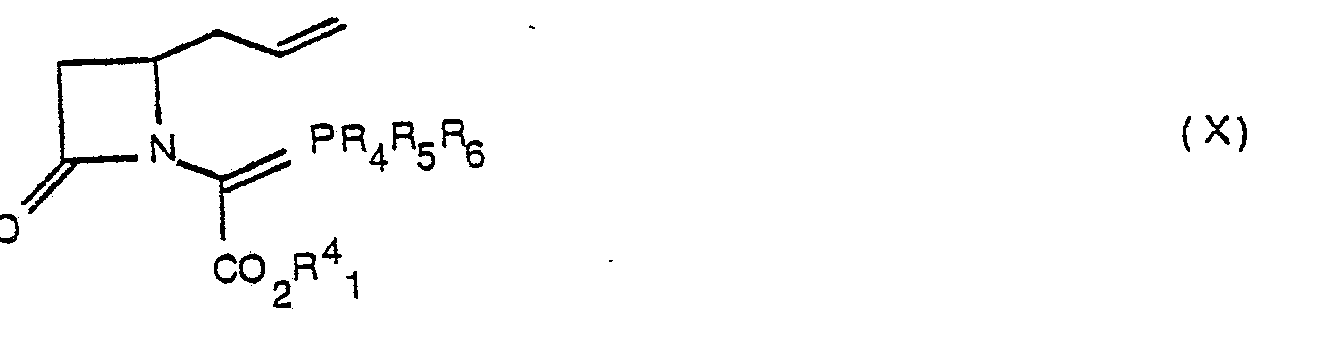
- The ozonolysis is generally performed at a depressed temperature such as -40 to -80°C, for example about -70°C and in solution in an inert solvent such as methylene chloride. Excess ozone is removed by flushing with an inert gas and thereafter a solution of the peracid is added to the reaction mixture.
- The compound of the formula (X) may be prepared from the corresponding compound of the formula (XI):


- This reaction is normally effected in the presence of at least one equivalent of a base of relatively low nucleophilicity such as 2,6-Iutidine at an ambient temperature in a dry solvent such as dioxan, or tetrahydrofuran.
- The compound of the formula (XI) may be prepared from the corresponding carbinol of the formula (XIII):

- This reaction is also normally effected in the presence of at least one equivalent of a base of relatively low nucleophilicity in a dry solvent such as dioxan or tetrahydrofuran but in this instance the reaction is performed at a depressed temperature, for example -30 to -10°C.
- The preceding carbinol may be prepared by the reaction of a compound of the formula (XIV):


- Normally this reaction is carried out in an inert solvent at an elevated temperature, for example in dry benzene under reflux.
- The compound of the formula (XIV) may be prepared as described in Description 1 hereinafter.
- The present invention provides the compounds of the formulae (Vil) and (VIII), as useful intermediates. The process for the preparation of these compounds also forms part of this invention.
- The present invention also provides a pharmaceutical composition which comprises a compound of the formula (II) as hereinbefore defined and a pharmaceutically acceptable carrier.
- The composition of the invention includes those in a form adapted for oral, topical or parenteral use and may be used for the treatment of bacterial infection in domestic animals or humans.
- Suitable forms of the compositions of this invention include. tablets, capsules, creams, syrups, suspensions, solutions, reconstitutable powders and sterile forms suitable for injection or infusion. Such compositions may contain conventional pharmaceutically acceptable materials such as diluents, binders, colours, flavours, preservatives and disintegrants in accordance with conventional pharmaceutical practice in the manner well understood by those skilled in the art of formulating antibacterial agents.
- Preferably the compound of the formula (II) present in such compositions will be in-vivo hydrolysable to the parent acid or its salt..
- The composition of this invention may beneficially also comprise a penicillin or cephalosporin. Certain particularly suitable penicillins for use in these compositions include amoxycillin trihydrate and sodium amoxycillin. - The present invention also provides a method of treatment and/or prophylaxis of bacterial infections in human beings or domestic animals, which method comprises the administration to the sufferer of an effective amount of a compound of the formula (II).
- The following Examples illustrate this invention. The following Descriptions relate to the preparation of useful intermediates. All temperatures provided in the Examples and Descriptions are in °C.
-

- 1,4 Pentadiene(d1) (30g) and chlorosulphonyl isocyanate (d2) (35.4 ml) were mixed and allowed to stand at room temperature for 3 days, in a pressure bottle. The thick, dark syrup obtained was diluted with methylene chloride (500mi) and added dropwise to a stirred solution of sodium sulphite (66g) in water (240mi). The pH was maintained between 6.5 and 7.5 by the addition of 10% aqueous potassium hydroxide (600ml in total). The lower organic phase was separated and the aqueous phase extracted (x 2) with ethyl acetate. The combined organic extracts were dried over magnesium sulphate, filtered, and evaporated to give the crude azetidinone (d3) as a red oil (16.05g). This was sufficiently pure for use in subsequent reactions e.g. Description 1 (ii), but could be further purified by distillation b.p. 76-80°/0.2 mm Hg. νmax (CHC13) 3490, 1770 (strong), 1650 (weak)cm-1. δppm (CDCl3) 2.39 (2H, t, J 6Hz, CH2), 2.61 (1 H, ddd, J 14 Hz, 2Hz, 1.5Hz, collapsing with D20 to dd, J 14Hz, 2Hz, C3-H), 3.10 (1H, ddd, J 14Hz, 5Hz, 2Hz, collapsing with D20 to dd, J 14Hz, 5Hz, C3-H), 3.55-3.91 (1 H, m, C4-H), 4.98-6.21 (3H, complex pattern, CH=CH2), 6.67 (1 H, broad s, exch. D2O) (Found: M, 111.0683. C6H9NO requires M, 111.0684).
-

-

- A stirred solution of the alcohol (d4) (4.2g) in dry tetrahydrofuran (120ml) under argon, was cooled to -20°, and treated with lutidine (4.03ml) in tetrahydrofuran (15ml). Thionyl chloride (2.54ml) in tetrahydrofuran (15ml) was added dropwise. After allowing to reach 0° over 30 minutes, the solution was filtered, the lutidine hydrochloride being washed with toluene.
- The combined filtrate and washings were evaporated to dryness. The residue was taken up in dry dioxan (100ml) and treated with lutidine (4.03mi) and triphenylphosphine (9.1 g). After stirring at room temperature overnight, the phosphorane (d5) was isolated as in Description 3 (ii) and obtained as white crystals (4.62g) from ether mp. 188-9°, νmax (CHCl3) 1730, 1638, 1610cm-1 (Found: C, 74.1; H, 6.8; N, 3.0, P, 6.2% C30H32NO3P requires C, 74.2, H, 6.6, N. 2.9, P, 6.4%).
-

- Methyl glyoxylate hydrate (9.75g) in benzene (500mi) was refluxed for 1 hour in a Dean-Stark apparatus to remove the water. The azetidinone (d3) (2.68g) was then added and the reaction mixture refluxed for 2 hours. A further portion of the azetidinone (1.34g) (d3) was then introduced, and refluxing continued for 3 hours. Chromatography of the crude product as in description 3 (i) gave the alcohol (d6) as a pale yellow oil (5.33g). νmax (CHCI3) 3500, 3350 (broad), 1760-1740 (strong), 1640 (weak)cm-1. δppm (CDCl3) 2.24-2.90 (3H, m, including [1 H, dd, J 3Hz, 14.5 Hz at δ 2.63]), 3.11 (1 H, dd, J 4.5Hz, 14.5Hz), 3.72-4.42 (5H, including [3H, s, at δ 3.90], 1 H, exch. D2O), 5.00-6.29 (4H, m including [1 H, s, at δ 5.48]).
-

- A stirred solution of the alcohol (d6) (5.23g) in dry tetrahydrofuran (150ml) under argon, was cooled to -20°, and treated with iutidine (6.06 ml) in tetrahydrofuran (20mi). Thionyl chloride (3.83mi) in tetrahydrofuran (20ml) was added dropwise. After allowing to reach 0° over 20 minutes, the solution was filtered, the lutidine hydrochloride being washed with toluene.
- The combined filtrate and washings were evaporated to dryness. The residue was taken up in dry dioxan (150mi) and treated with lutidine (6.06mi) and triphenylphosphine (13.7g). After stirring at room temperature, overnight, the phosphorane (d7) was isolated as in Description 3 (ii) and obtained as white crystals (7.3g) from ether m.p. 208-212°. νmax (CHCI3) 1738, 1640, 1620 cm-1 (Found; C, 72.6; H, 5.9; N, 3.0%. C27H26NO3P requires C, 73.1; H, 5.9; N, 3.2%).
-

- Benzyl glyoxylate hydrate (6g) in benzene (120ml) was refluxed for 0.5 hours in a Dean-Stark apparatus to remove the water. The azetidinone (d3) (2.13g) was added and the reaction mixture refluxed for 4 hours. The solution was cooled, evaporated, and chromatographed on silica gel, eluting with ethyl acetate-petroleum ether mixtures to give a colourless oil (5.6g) consisting mainly of the isomers of (d8) and sufficiently pure for use in subsequent reactions. Rechromatography of a small portion of this oil, eluting with chloroform gave (d8) as an oil. νmax (CHCI,) 3420, 1750 (strong), 1640 (weak)cm-1. 3 ppm (CDCl3) 1.90-3.05 [4H, m, including δ 2.53 (1 H, dd, J 15Hz, 2Hz, C3-H), 2.92 (1 H, dd, J, 15Hz, 5Hz, C3-H), obscuring 2H, CH2], 4.52 (1 H, broad s, exch. D20, -OH), 4.85-5.90 [6H, m, including 8 5.40 (1 H, broad, collapsing with D2O to singlet, H-C-OH) + complex pattern for CHZPh and CH=CH2], 7.29 (5H, s).
-

- A stirred solution of the alcohol (d8) (6.6g) in dry tetrahydrofuran (200ml), under argon, was cooled to -20°, and treated with lutidine (5.13g) in tetrahydrofuran (10ml). Thionyl chloride (5.70g) in tetrahydrofuran (20ml) was added dropwise. After allowing to reach 0°C over 20 minutes, the precipitated solid was filtered off, washing with dry toluene.
- The combined filtrate and washings were evaporated to dryness and the residue taken up in dry toluene, filtered and evaporated. The gum obtained was taken up in dioxan (200ml) and treated with triphenylphosphine (12.6g) and lutidine (5.53ml). After stirring under argon at room temperature for 3 hours and standing overnight, the precipitated solid was filtered off. The filtrate was evaporated to dryness. Chromatography on silica gel eluting with ethyl acetate-petroleum ether mixtures, gave the required phosphorane, initially as a foam, which crystallized from ether (5.7g) m.p. 150-6°C. νmax (CHCl3) 1730, 1638, 1610 cm-'.
-

-

- A stirred solution of the alcohol (d10) (1.6g) in dry THF (100ml) was treated with 2,6-lutidine (1.07g) and thionyl chloride (1.19g) in THF (20ml) at-20°, and stirring was continued for 20 minutes. The mixture was filtered, the solvent was evaporated, and the residue was azeotroped twice with toluene. It was dissolved in dioxan (100ml), and 2,6-lutidine (1.07g) and triphenylphosphine (2.62g) were added. The reaction was stirred overnight at RT and filtered. The solvent was evaporated, and the residue was chromatographed. After decolourising with charcoal (ethanol/ethyl acetate) and trituration of the residue from the evaporated solution with ether, (d11) was obtained as a yellow solid (1.5g; 53%) m.p. 182-3° νmax (CHCl3) 1740, 1620, 1525, 1355cm-1. (Found: C, 70.26; H, 5.33; N, 4.80. C33H29N2O5P requires C, 70.21; H, 5.14; N, 4.96%).
-

- 4-Allylazetidin-2-one(d3) (2.0 g) and glyoxylic acid monohydrate (1.75 g) were stirred together in dry dimethylformamide (10 ml) for 6 hours in the presence of 4A molecular sieves. The mixture was then cooled in an ice bath and powdered potassium carbonate (1.31 g) was added. It was allowed to warm to room temperature and stirred for 5 minutes prior to adding pivaloyloxymethyl bromide (5.3 g). The reaction was stirred overnight and then poured into a mixture of N/10 hydrochloric acid (80 ml) and ethyl acetate (80 ml). The organic phase was separated and the aqueous solution washed with further ethyl acetate (50 mi). The ethyl acetate solutions were combined, washed with saturated aqueous sodium bicarbonate, then brine and dried over sodium sulphate. It was concentrated in vacuo to give the crude ester (d 13) as a yellow oil (4.7 g).
- The crude ester (d 13) (4.7 g) was dissolved in dry tetrahydrofuran (80 ml) and stirred at -20° under argon. It was treated with 2,6-lutidine (3.7 ml) followed over a period of 5 minutes by a solution of thionyl chloride (2.3 ml) in tetrahydrofuran (20 ml). The reaction was allowed to warm to ambient temperature over a period ofhour and then filtered. The solid was washed with dry toluene and the combined filtrates concentrated under reduced pressure. The vestigial thionyl chloride was removed by two further evaporations from toluene to give the chloride (d14) as a brown oil.

- The chloride (d 14) was dissolved in dry dioxane (80 ml) and treated with triphenylphosphine (8.2 g) and 2,6-lutidine (3.7 mi). The reaction mixture was stirred overnight and then filtered; the filtrate concentrated and re-dissolved in ethyl acetate (100 mi). This solution was washed free of base with N/10 hydrochloric acid (ca 100 ml) and then washed with brine and dried over sodium sulphate. The solution was concentrated and then chromatographed on silica gel 60 (<230 mesh) 63µm eluting with ethyl acetate/60-80° petroleum ether 7:3 to give a foam. This was dissolved in diethyl ether (20 ml) and a white solid rapidly crystallised out. This was 4-allyl-1-(1'-pivaloyloxymethoxycarbonyl-1'-tri- phenylphosphoranylidenemethyl)azetidine-2-one (d 15) which was obtained in a yield of 3.06 g; m.p. 140-142° (ethyl acetate/60-80° petroleum ether; νmax (CHCl3) 2980, 1740 and 1635 cm-1.
-

- The phosphorane (1) (Prepared as Description 1)
- (2g) was dissolved in dry methylene chloride (100ml) and treated with trifluoroacetic acid (3.2ml). The solution was cooled to -70°C and ozonised until the solution turned blue. Excess ozone was removed by passing through argon and m-chloroperbenzoic acid (720 mg) in methylene chloride (20ml) was added. The mixture was allowed to reach RT and stirred overnight. The solvent was evaporated and the residue chromatographed on Merck Kieselgel 60 (<230 mesh) 63 µm. Elution with 50% ethanol/ethyl acetate gave the phosphorane-acid (2a) as a colourless foam which crystallised from ethyl acetate/ether (1.6g) as a mixture of zwitterion and trifluoroacetic acid salt, vmax 1770, 1750, 1670, 1590cm-1.
- The product (1.6g) was taken up in CHCl3 (50ml) and stirred with basic alumina (4g) overnight. The solution was filtered, the solvent evaporated and the residue triturated with ether to yield the phosphorane-acid (2a) as a white solid (0.9g) mp 141-3°C, vmax (CHCI2) 1750, 1595, 1590cm-1.
- The acid (2a) was further characterised by treatment with benzyl bromide and potassium carbonate in dimethylformamide to give the benzyl ester (2b), obtained as white crystals (ex ether) m.p. 176.5-178°C. νmax (CHCl3) 1735, 1640, 1610cm-1. (Found: C, 72.20; H, 6.59; N, 2.28; C36H38NO5P requires C, 72.83; H, 6.11; N, 2,36%).
-

- The acid-(2a) (1.06g; 2mmol) and Et3N (222mg; 2.2mmole) were stirred in dry THF (20ml) at RT. A solution of diethyl phosphorochloridate (363 mg; 2.2 mmol) in THF (5ml) was added dropwise under argon at RT and the mixture stirred for 3h. The solution was filtered and to the filtrate was added (787mg; 2,2 mmol) of thallium (I) p-nitrophenylthiolate. The mixture was stirred overnight, filtered and the filtrate evaporated. Chromatography on Merck Kieselgel 60 (<230 mesh) 63 µm using ethyl acetate - petrol yielded the product (3) as an oil which crystallised from ethyl acetate/petrol as a light yellow crystalline solid (570 mg; 56% mp 115-6°C, νmex (CHCI3) 1740, 1720 (sh), 1640cm-1 (Found: C, 65.82; H, 5.40; N, 4.32. C35H33N2C8SP requires C, 65.62; H, 5.16; N, 4.38%).
-

- The phosphorane (3) (128mg) was heated in refluxing toluene (50ml) for 15 min. The solvent was evaporated and the residue chromatographed on Merck Kieselgel 60 (<230 mesh) to yield. 15 mg of crude product. Re-chromatography yielded the title product (4) as a light yellow crystalline solid from ethyl acetate/petrol mp 148-50°C. νmax (CHCl3) 1790, 1710, 1695, 1525, 1345cm-1. δ ppm (CDCI3) 1.57 (9H, s, CO2C(CH3)3), 2.70 (2H, d, J 9.5Hz, C4-CH2), 2.83 (1 H, dd, J 17, 3Hz, C6-H trans), 3.43 (1H, dd, J 17, 5Hz, C6-H, cis), 4.12 (1H, m, C5-H), 7.62 and 8.17 (4H, ABq, J 9Hz aromatic protons), λmax (EtOH) 265 nm (ε = 14,300) 309 nm (ε = 17,300), 346 nm (sh) (ε = 13,700).
-

- The acid (2a) (754mg; 1.5 mmol) was dissolved in dry THF (15ml) containing Et5N (167mg; 1.6 mmol) and stirred at RT. A solution of diethylphosphorochloridate (272mg; 1.6 mmol) in THF (5ml) was added dropwise to the solution under argon. Stirring was continued for 3h. The solution was filtered, and to the solution was added thallium (1) phenylthiolate (500mg; 1.6 mmol). Stirring was continued overnight. The solution was filtered, the solvent evaporated and the residue chromatographed on Merck Kieselgel 60 using ethyl acetate-petrol to yield the phosphorane (5) (700mg) as an oil. Trituration with ether gave the phosphorane as a microcrystalline solid (55mg) mp 152-5°C. νmax 1740, 1700, 1640cm-1 (Found: C, 70.74; H, 5.76; N, 2.43. C35H34NO4SP requires C, 70.59; H, 5.71; N, 2.35%).
-

- The phosphorane (5) (120mg) was refluxed in dry toluene (10ml) under argon for six hours. The solvent was evaporated and the product chromatographed on Merck Kieselgel 60 to yield the title product (6) as the second compound eluted from the column (25mg; 39%). νmax (CHCl3) 1785, 1700cm-1. δ ppm (CDCI3) 1.56 (9H, s, CO2C(CH3)3), 2.57 (2H, d, J 9Hz; C4-CH2), 2.74 (1 H, dd, J 17, 3Hz, C6-H, trans), 3.32 (1 H, dd, J 17, 5Hz, C6-H, cis), 3.97 (1 H, m. C5-H), 7.39 (5H, m, Ph). νmax (EtOH) 313 nm (ε = 9,510) (Found: M, 317.1105, C17H19NO3S requires 317.1085).
-

- The phosphorane (7) (Prepared as in Description 2)
- (4.47g) in dry methylene chloride (250mi), was treated with trifluoroacetic acid (7.7ml). The solution, cooled to -70°C, was ozonised until it became blue. After passing argon through to remove excess ozone, m-chloroperbenzoic acid (1.74g) in methylene chloride (50ml) was added. The stirred mixture was allowed to reach room temperature, and after stirring overnight, was evaporated to dryness. After re-evaporation from dry toluene the residue was chromatographed on Merck Kieselgel 60. Elution with ethyl acetate gave m-chlorobenzoic acid. Further elution with 10% ethanol acetate gave the phosphorane-acid (8a), partially as the trifluoroacetic acid salt, as a yellow foam (2.7g), νmax (CH2Cl2) 1770, 1755, 1738, 1705-1675 (several weak peaks), 1585cm-1.
- This foam was taken up in dry methylene chloride (70mi), and stirred with basic alumina (8g), for 2 hours.
- Evaporation of the filtered solution gave a foam (3g). Trituration with ether gave the zwitterionic form of the acid-phosphorane (8a), as a pale yellow solid, which was collected and dried in vacuo (2.35g) νmax (CH2Cl2) 1750, 1740, 1590cm-1.
- The acid (8a) was characterised by treatment with benzyl bromide and potassium carbonate in dimethylformamide to give the benzyl ester (8b), as white crystals (ex ethyl acetate/petroleum ether), mp 146-8°C, νmax (CHCl3) 1740, 9 620cm-1 (Found: C, 71.71; H, 5.67; N, 2.44. C33H30NO5P requires C, 71.87; H, 5.44; N, 2.54%.
-

- The acid (8a) (461 mg; 1 mmol) was dissolved in dry THF containing Et3N (110mg; 1.1 mmol) and stirred at RT whilst a solution of diethylphosphorochloridate (152mg; 1.1 mmol) in THF (5mi) was added dropwise at RT under argon. The solution was filtered, and thallium (1) phenylthiolate (345 mg; 1.1 mmol) was added to the filtrate. Stirring was continued overnight, the solution filtered, the solvent evaporated and the residue chromatographed to yield the phosphorane (9) as an oil (400mg). Trituration with ether yielded the phosphorane as a microcrystalline solid mp 172-3°C, νmax 1740, 1700, 1620cm-1 (Found: C, 68.84; H, 5.24; N, 2.33. C32H28NO4SP requires C, 69.43; H, 5.06; N, 2.53%).
-

- The phosphorane (9) (80mg) was heated under reflux in dry toluene (5ml) for five hours. The solvent was evaporated and the product chromatographed to yield the title compound (10) (9.8mg, 25%), νmax (CHCl3) 1790, 1705cm-1. 8 ppm (CDCl3) 2.57 (2H, d, J 9Hz; C4―CH2) 2.76 (1H, dd, J 17Hz. 3Hz, C6―H, trans), 3.34 (1 H, dd, J 17Hz, 5Hz, C6-H, cis), 3.82 (3H, s, CO2CH3), 4.00 (1 H, m, C5―H), 7.35 (5H, m, Ph), λmax (EtOH) 313 nm (E = 11,400). (Found: M, 275.0616, C14H13NO3S requires 275.0616).
-

- The phosphorane (11, prepared as in Description 3)
- (2.076g) in dry methylene chloride (120ml) was treated with trifluoroacetic acid (3.08ml). The solution, cooled to -70°C, was ozonised until it became blue. After passing argon through to remove excess ozone, m-chloroperbenzoic acid (0.69g) in methylene chloride (25ml) was added. The stirred mixture was allowed to reach room temperature. After stirring for 3 days, work up and chromatography as in Example 1, gave the phosphorane acid (12) partially as the trifluoroacetic acid salt as a yellow foam (1.215g), νmax (CHCl3) 1770 (shoulder) 1750, 1730, 1700, 1665, 1590, 1575cm-1.
- This foam was taken up in chloroform (20mi) and stirred with basic alumina (4g) for 4 hours. Evaporation of the filtered solution gave the zwitterionic form of the acid-phosphorane (12) as a foam (0.855g) νmax (CHCl3) 1735, 1590, 1585, 1575cm-1.
-

- The acid (12) (1.07g; 2 mmol) and Et3N (220mg; 2.2 mmol) in dry THF (30ml) were stirred at RT and a solution of diethyl phosphorochloridate (380mg; 2.2 mmol) in THF (5ml) was added dropwise under argon and stirred for three hours at RT. To the solution was added thallium (I) phenylthiolate (686mg; 2.2 Mmol) and the mixture stirred overnight. The solution was filtered and the solvent evaporated to yield an oil. Chromatography on Merck Kieselgel 60 using ethyl acetate/petrol by gradient elution gave the title product (13), which crystallized from ethyl acetate/ether as a microcrystalline solid mp 160-1 °C, νmax 1745, 1705, 1620cm-1 (Found: C, 72.12; H, 5.28,; N, 2.15. C38H32NO4SP requires C, 72.50; H, 5.09; N, 2.23%).
-

- The phosphorane (13) (150mg) was refluxed in dry toluene (100ml) under argon for nine hours. The solvent was evaporated and the product chromatographed on Merck Kieselgel 60 using ethyl acetate/petrof as eluant to yield the title compound (14) as the major product (25 mg; 30%), νmax (CHCl3) 1790, 1705 cm-1. δ ppm ((CD3)2CO) 2.72 (2H, s, C4―CH2), 2.87 (1 H, dd, J 17, 3Hz, C6-H, trans), 3.32 (1 H, dd, J 17, 5Hz, C6-H, cis), 4.05 (1 H, m, C5-H), 5.23 (2H, s, CO2CH2Ph), 7.20-7.70 (10H, m, SPh and CO2CH2Ph), λmax (EtOH) 317 nm (ε = 12,250). (Found: M, 351.0929, C20H17NO3S requires 351.0929).

-

- The phosphorane (15, prepared as in Description 4) (2.82g) in dry methylene chloride (125ml) was treated with trifluoroacetic acid (4ml) at 0°. The solution was cooled to -70° and treated with ozone until blue. Argon was passed through to remove excess ozone, and m-chloroperbenzoic acid (0.9g) in methylene chloride (20ml) was added, and the mixture was stirred at RT overnight. The solvent was evaporated, and the resulting white solid was dissolved in ethyl acetate and chromatographed on silica gel. Elution with 10% ethanol/ethyl acetate gave the product as the trifluoroacetic acid salt. The product was stirred in ethyl acetate with basic alumina (6g) for two hours. Evaporation of the solvent and trituration of the residue with diethyl ether gave the acid (16) as a light yellow hygroscopic solid (2g; 69%). A small portion crystallised from diethyl ether gave a microcrystalline solid m.p. 127-33°C. νmax (CHC13) 1745, 1600, 1355, 1115cm-1. (Found: C, 64.59; H, 4.82; N, 4.66. C32H27N2O7P.H2O requires C, 64.97; H, 4.73; N, 4.73).

-

- The acid (16) (1.16g) and Et3N (220mg) in dry THF (30ml) were stirred at RT, and a solution of diethyl phosphorochloridate (380mg) in THF (5ml) was added dropwise under argon and stirred at RT for three hours. To the solution was added thallium (I) phenylthiolate (686mg), and the mixture was stirred overnight. The solution was filtered, and the solvent was evaporated. Chromatography yielded the phosphorane thioester (17) as a light tan solid from diethyl ether/ethyl acetate (950mg; 70%). Recrystallisation from ethyl acetate gave a white solid m.p. 186-8°C. νmax (CHCl3) 1745, 1705, 1615, 1350, 1145cm-1. (Found: C, 67.40; H, 4.68; N, 4.02. C38H31N2O6PS requires C, 67.66; H, 4.60; N, 4.15%).
- The acid, (16, prepared as in (a) above) (2.90g) and Et3N (550mg) in dry THF (75ml) were stirred at RT and a solution of diethyl phosphorochloridate (950mg) in THF (1 Oml) was added dropwise under argon and stirred for three hours at RT. Thiophenol (550mg) was added to the solution followed by Et3N (550mg) and the mixture stirred at RT. for two hours. The solvent was evaporated and the residue chromatographed to yield the thioester-phosphorane as a light tan solid from ethyl acetate/ether. Recrystallisation from ethyl acetate gave a white solid, shown by m.p., i.r. and analysis to be identical with (17) as in b (i) above.
-

- The phosphorane (17) (550mg) was refluxed in dry toluene (500ml) for 24 hours with removal of water (Dean-Stark) under argon. The solvent was evaporated and the product chromatographed on florisil (200-300 U.S. mesh) using ethyl acetate/petrol (60-80°) as eluant to yield the title compound (52mg; 18%) as a crystalline solid from benzene/petrol (60-80°C) mp 112-4°C. v max (CHC13) 1790, 1705 cm-1. 8 ppm (CDCl3) 2.63 (2H, d, J 9Hz, C4―CH2), 2.81 (1 H, dd, J17, 3Hz, C6-H trans), 3.38 (1H, dd, J17, 5Hz, C6-H, cis), 4.04 (1H, m, C5-H), 5.26 and 5.49 (2H,ABq J14Hz, benzylic CH2), 7.36 (5H, m, SPh), 7.60 (d, 2H, J9Hz, PhNO2), 8.15 (d, 2H, J9Hz, PhNO2) λmax (EtOH) 266 nm (ε 10,200), 317 nm (E 8,900). (Found: C, 60.56; H, 3.93; N, 6.91% C20H16N2O5S requires C, 60.61; H, 4.04; N, 7.07%).

-

- The acid (12; prepared as in Example 4a) (268mg) in dry tetrahydrofuran (10ml) under argon was treated with triethylamine (76mg), followed by diethylphosphorochloridate (130mg), diluted with tetrahydrofuran (5ml). After stirring at room temperature for 3 hours, the solution was added to freshly prepared sodium p-acetamidophenylthiolate in tetrahydrofuran [prepared by treating p-acetamidophenylthiol (92mg) in dry tetrahydrofuran (5ml)/hexamethylphosphoramide (89mg), under argon, at 0°, with sodium hydride (26mg of a 50% suspension in oil)].
- The stirred mixture was allowed to warm up from 0° to room temperature over 30 minutes, and after a further hour was diluted with ethyl acetate (60ml), washed with water, then brine, dried over magnesium sulphate and filtered and the filtrate was evaporated. Chromatography on Merck Kieselgel 60 (10g), eluting with ethyl acetate, gave the required thioester (19) as white crystals (128mg). Recrystallisation from chloroform/ethyl acetate gave white needles m.p. 181-3°C, νmax (Nujol) 1730, 1700, (broad), 1620, 1590cm-1. νmax (KBr) 1730, 1695 (broad), 1620, 1595cm-1. (Found: C, 69.81 ; H, 5.32; N, 4.35. C40H35N2SO5P requires C, 70.00; H, 5.10; N, 4.08%).
- Note: This thioester (19) was also prepared substituting the sodium thiolate mixture by solid thallium (I)p-acetamidophenylthiolate. A comparable yield was obtained.
-

- The phosphorane (19) (136mg) was suspended in dry toluene (10ml) and the mixture was evaporated to dryness. The residue was suspended in dry toluene (60ml), and the mixture was degassed and heated, under argon, under reflux with a Dean-Stark head. After 5 hours the pale yellow solution was cooled to room temperature, and the solvent was evaporated. The residue was taken up in ethyl acetate (12ml), and left overnight at 5°, when buff coloured crystals were obtained. These were collected (97.5mg) and shown by thin layer chromatography to be recovered starting material. The solution was evaporated, and the residue was chromatographed on Merck Keiselgel 60, eluting with ethyl acetate/petrol mixtures to give the required compound (20), initially as a gum (7.5mg) contaminated with triphenylphosphine oxide. Trituration of this gum with diethyl ether qave (20). as a white solid (4.2mg), νmax (CHCl3) 1782, 1700 (shoulder), 1695, 1590cm-1. λmax (ethanol) 312nm and 245 nm. δ ppm (CDCl3) 2.12 (s, 3H, CH3); 2.57 (2H, d, J 8Hz, C4―CH2), 2.74 ( H, dd, J 16Hz, 3Hz, C6-H); 3.32 (1 H, dd, J 16Hz, 5Hz, C6―H); 4.00 (1H, m, C5-H); 5.27 (2H, s, CH2Ph); 7.12-7.62 (14H, Ar + Ph3P=O); 7.71 (1H, s, NH).
-

- The acid (12, prepared as in Example 4a) (1.675g) in dry tetrahydrofuran (80ml), under argon, was treated with triethylamine (0.472g) and'diethylphosphorochloridate (0.807g). After stirring at room temperature for 3 hours the reaction mixture was added to freshly prepared sodium p-amino- phenylthiolate in tetrahydrofuran [prepared by treating p-aminophenylthiol (0.428g) in dry tetrahydrofuran (30ml)/hexamethylphosphoramide (0.505g), under argon at 0°, with sodium hydride (0.165g of a 50% suspension in oil)].
- The stirred mixture as allowed to warm from 0° to room temperature. After a total of 1.5 hours, work-up as in Example 6, followed by chromatography on Merck Keisel gel.60 (60g), eluting with from 50% ethyl acetate in petroleum ether (60―80°C) to neat ethyl acetate gave the required thioester (21) as a cream coloured solid (0.9g). Recrystallisation of a portion from hot ethyl acetate/petroleum ether (60-80°) gave "spherical crystals" m.p. 114.5-118°, v max (CHCI3) 3330, 1738, 1685 (broad, weak), 1620, 1600 (shoulder)cm-1.
-

- The phosphorane (21) (0.461g) was taken up in dry toluene, and the mixture was evaporated to dryness. The residue was suspended in dry toluene (250ml), and the mixture was degassed and heated to reflux. A pale yellow solution was obtained. After refluxing for 6.5 hours the solution was left in the refrigerator overnight. The toluene solution was decanted from some gummy material and evaporated to dryness. Trituration of the residue with dry diethyl ether gave recovered (21) as a solid (414mg). The ethereal solution was evaporated to dryness and the residue was taken up in toluene and chromatographed on Merck Keiselgel 60 (4g), eluting with mixtures of ethyl acetate and petroleum ether (60-800C), to give the required bicyclic product (22) as a gum (3.5mg). v max (CHCl3) 3300 (weak), 1780 (strong), 1700, 1685, (weak), 1620, 1600cm-1. λ max (ethanol) at 314 nm and 261.5 nm.
- (Treatment of this p-aminophenylthio compound (22) with triethylamine/acetyl chloride gave the p-acetamidophenylthio compound (20) as shown by thin layer chromatography).
-

- A catalyst of 10% palladium on charcoal (Engelhard 4505, 50mg) suspended in 90% aqueous ethanol (10ml) was prehydrogenated for 20 minutes at room temperature/atmospheric pressure. Benzyl 7-oxo-3-p-nitrophenylthio-1-azabicyclo[3.2.0]hept-2-ene-2-carboxylate (50mg) partially dissolved in ethanol (10ml) was added, and the mixture was hydrogenated at room temperature and atmospheric pressure for 1.5 hours. The catalyst was removed by filtration through "High-Flo", and the colourless filtrate was evaporated to give an oil (35mg) identical by TLC, u.v. and I.R. to the product (22) obtained in Example 7.
-

- The phosphorane (21) (438mg) in dry tetrahydrofuran (60ml), under argon was treated with powdered sodium hydroxide (27.2mg) and p-nitrobenzylchloroformate (147 mg). After stirring at room temperature for 1.5 hours, the solvent was removed by evaporation, and the residue was taken up in chloroform, washed with brine, dried over magnesium sulphate and filtered, and the filtrate was evaporated. Chromatography on Merck Keiselgel 60, eluting with from 50% ethyl acetate in petroleum ether (60-80°) to neat ethyl acetate gave the required thioester (23) as a white solid (255mg), contaminated with a little starting material (22). Further elution with a mixture of chloroform/ethyl acetate gave a further (109mg) of the required product (23). A portion was recrystallised from chloroform/ether. The crystals were dried in vacuo at 100°C for a total of 11 hours, to give fine white crystals m.p. 205-7°C (dec.) νmax (nujol) 1742, 1738, 1700, 1680 (weak), 1605, 1590, 1518, 1345cm-1. (Found: C, 65.52; H, 4.46; N, 4.86. C48H38N3O8SP.N2O requires:- C, 65.50; H, 4.75; N, - 4.98%).
-

- The phosphorane (23) (850mg) was suspended in dry toluene (500mi) and heated under an atmosphere of argon under reflux using a Dean-Stark apparatus to remove water. A clear, pale yellow solution was obtained. After refluxing for 6.5 hours the slightly darker solution was cooled and reduced by evaporation to about 150ml. On storing overnight at 5°, recovered starting material (551 mg) was precipitated. The solution was evaporated, and the residue was chromatographed on florisil (200-300 U.S. mesh). Elution with 20-30% ethyl acetate in petroleum ether (60-80°C) gave the required bicyclic compound (24) contaminated with triphenylphosphine oxide and some non-bicyclic β-lactam containing material as a gum (37.5mg). Trituration of this gum with diethyl ether gave a white solid (14.8mg). This solid was recrystallised from ethyl acetate/petroleum ether (60-80°C) to give the bicyclic compound (24) as fine white crystals m.p. 130-8°C, v max (CHC13) 1780 (strong) 1738, 1700, 1685, 1510, 1345cm-1. λmax (ethanol) 251 nm (ε = 23,700) and 316 nm (E = 16,700). 8 ppm (CDCI3) 2.56 (2H, d, J 9 Hz, C4―H's) 2.74 (1H, dd, J 16Hz, 2.5 Hz, C6-H); 3.35 (1H, dd, J 16Hz, 5Hz, C6―H); 3.85 (1 H, centre of m, C5―H); 5.24 (2H, s, CH2Ar); 5.26 (2H, s, CH2Ar); 6.76 (1 H, s, NH); 7.15-7.55 (11 H, Ar); 8.0-8.25 (2H, Ar).
-

- The acid (12, prepared as in Example 4a) (4.39g) in dry tetrahydrofuran (150ml), under argon, was treated with triethylamine (1.78ml) and diethylphosphorochloridate (2.13g). After stirring at room temperature for 3 hours, the reaction mixture was added to freshly prepared sodium p-nitrophenylthiolate in tetrahydrofuran at 0° [prepared by treating dried p-nitrophenylthiol (1.4g) in dry tetrahydrofuran (75ml), under argon at 0° with sodium hydride (0.426g of a 50% suspension in oil)].
- The stirred red mixture was kept below 10° (internal temperature) for 1.5 hours. After reducing the volume by evaporation, ethyl acetate (500ml) was added, and the reaction mixture was washed with brine, dried over magnesium sulphate and filtered, and the filtrate was evaporated. Chromatography of the residue on silica 60 (<230 mesh) 63 µm (80g), eluting with ethyl acetate gave the required thioester (25) (2.6g). Crystallisation from ethyl acetate/ether gave yellow crystals m.p. 169-700C v max (CHCI3) 1745, 1720 (sh), 1630 cm-1. (Found: C, 67.53; H, 4.57; N, 3.93%. C38H31N2O6SP requires C, 67.66; H, 4.60; N, 4.15%.
-

- The phosphorane (25) (1.0g) in dry toluene (600ml) was heated under an atmosphere of argon under reflux using a Dean-Stark apparatus to remove water. After 1.5 hours the dark solution was rapidly cooled, evaporated almost to dryness, then chromatographed on 30g silica 60 (230-400 mesh). Elution with 30% ethyl acetate in petroleum ether (60°-80°C) gave the required product (26), (41mg) as yellow crystals from ethyl acetate m.p. 126―31°. νmax (CHCl3) 1795, 1710, 1525, 1345cm-1. δ ppm [(CD3)2CO] 3.00 (2H, d, J 10Hz, C4-CH2), 3.07 (1 H, dd, J 17, 4Hz, C6-H trans), 3.52 (1H, dd, J 17, 6Hz, C6-H cis), 4.21 (1 H, m, C5-H), 5.36 (2H, s, CH2), 7.47 (5H, m, Ph), 7.92 and 8.32 (4H, ABq, J 9Hz, SPhNO2). λmax (EtOH) 261 nm (E = 8,430), 312 nm (ε = 10,219) 343 nm (sh) (ε = 8,500).
-

- The p-nitrobenzyl ester (18) (70mg) was dissolved in 30% aqueous dioxan containing 5% Pd/C (90mg) [prehydrogenated for twenty minutes]. The solution was hydrogenated at ambient temperature and pressure for one hour. Examination of the solution by u.v. showed a shift of chromophoric absorption of 316 nm and 266 nm for the p-nitrobenzyl ester to 314 nm and 251 nm respectively for the product. The solution was treated with one equivalent of NaHCO3 (14.7mg) in water (2ml) and filtered through keiselguhr. The organic solvent was removed under reduced pressure until cloudiness occurred and extracted with ethyl acetate (3 x 10ml). The water was evaporated to low volume (approx. 2ml) and loaded onto a biogel P2 column. Elution with water and collection of 10ml fractions gave the sodium salt in fractions 11 and 12. The solvent was evaporated under high vacuum, and the solid obtained by evaporation of solvent twice from ethanol (2 x 10ml) and twice from toluene (2 x 15ml) to yield (27) as a light yellow solid (12mg). v max (KBr disc) 1755cm-1, νmax (EtOH) 302 nm.
-

- The sodium slat (14mg) was dissolved in DMF (2ml) and treated with bromophthalide (10mg). The solution was stirred at RT for 3 hours, the solvent was evaporated, and the residue was dissolved in ethyl acetate and washed with brine (2 x 5ml). The organic phase was dried (MgSO4) and evaporated to yield an oil which after chromatography gave (28) as an oil (3mg) νmax (CHCl3) 1795, 1730cm-1. δ ppm (CDCl3) 2.69 (2H, d, J9.5 Hz, C4―CH2), 2.81 (1 H, dd, J 16.5, 3.5Hz, C6-Ha), 3.38 (1 H, dd, J16.5, 5.5Hz, C6―Hb) 4.07 (1H, m, C5-H) 6.55 (H, s, CO2CH from one isomer) 7.20 to 8.00 (


-

- The phosphorane (d15, prepared as in Description 5) (258mg) was dissolved in dry methylene chloride (15ml) containing trifluoroacetic acid (0.8ml) and stirred at RT. for ten minutes. The solution was cooled to -70° and ozonised for 15 minutes until a blue colour persisted. Argon was passed through the solution to remove excess ozone and m-chloroperbenzoic acid (90mg) in methylene chloride (5ml) was added. The mixture was allowed to warm up to RT. and stirred overnight. The solvent was evaporated and the residue chromatographed (Kieselgel 60, <230 mesh 63 µm) to yield the phosphorane acid (29) as the trifluoroacetic acid salt. The salt was dissolved in methylene chloride and stirred with basic alumina (500mg) for one hour. The solution was filtered and evaporated to yield the phosphorane-acid (29) as a colouriess foam (198 mg) νmax (CHCl3) 1730, 1600cm-1.
-

- The acid (29) (187mg) was dissolved in dry THF containing Et3N (34mg) and a solution of diethylphosphorochloridate (61 mg) in dry THF (2ml) was added dropwise under argon. The reaction was stirred at RT. for three hours and thallium (I) phenylthiolate (1 05mg) was added. The reaction was stirred overnight, filtered and the solvent evaporated. The resulting oil was chromatographed on Merck Kieselgel 60 (<230 mesh 63µm) using ethyl acetate/petrol (60―80) as eluant to yield the title compound (30) as a colourless oil which crystallised from ether as a white solid m.p. 149-50° (120mg; 55%). νmax (CHCI3) 1735, 1700 (sh), 1630cm-1.
-

- The phosphorane (30) (218mg) was refluxed in dry toluene (250ml) under argon for 18 hours. The solvent was evaporated and the residue chromatographed on florisil (200-300 U.S. mesh) using slight pressure and ethyl acetate/petrol (60-80) as eluant. The title compound (31 ) was collected as a colourless oil (6mg; 5%) v max (CHCl3) 1780, 1750, 1725cm-1. 8 ppm (CDCl3), 1.22 (9H, s, C(CH3)3) 2.62 (2H, d, J 9.5Hz, C4―CH2) 2.78 (1H, dd, J 16Hz, 3Hz, C6-H,trans), 3.36 (1H, dd, J 16Hz, 5Hz, C6-H, cis) 4.00 (1 H, m, C5-H) 5.87 and 5.98 (2H, ABq, J 5.5Hz, OCH2O) 7.40 (5H, m, Ph), λmax (EtOH) 319 nm.
-

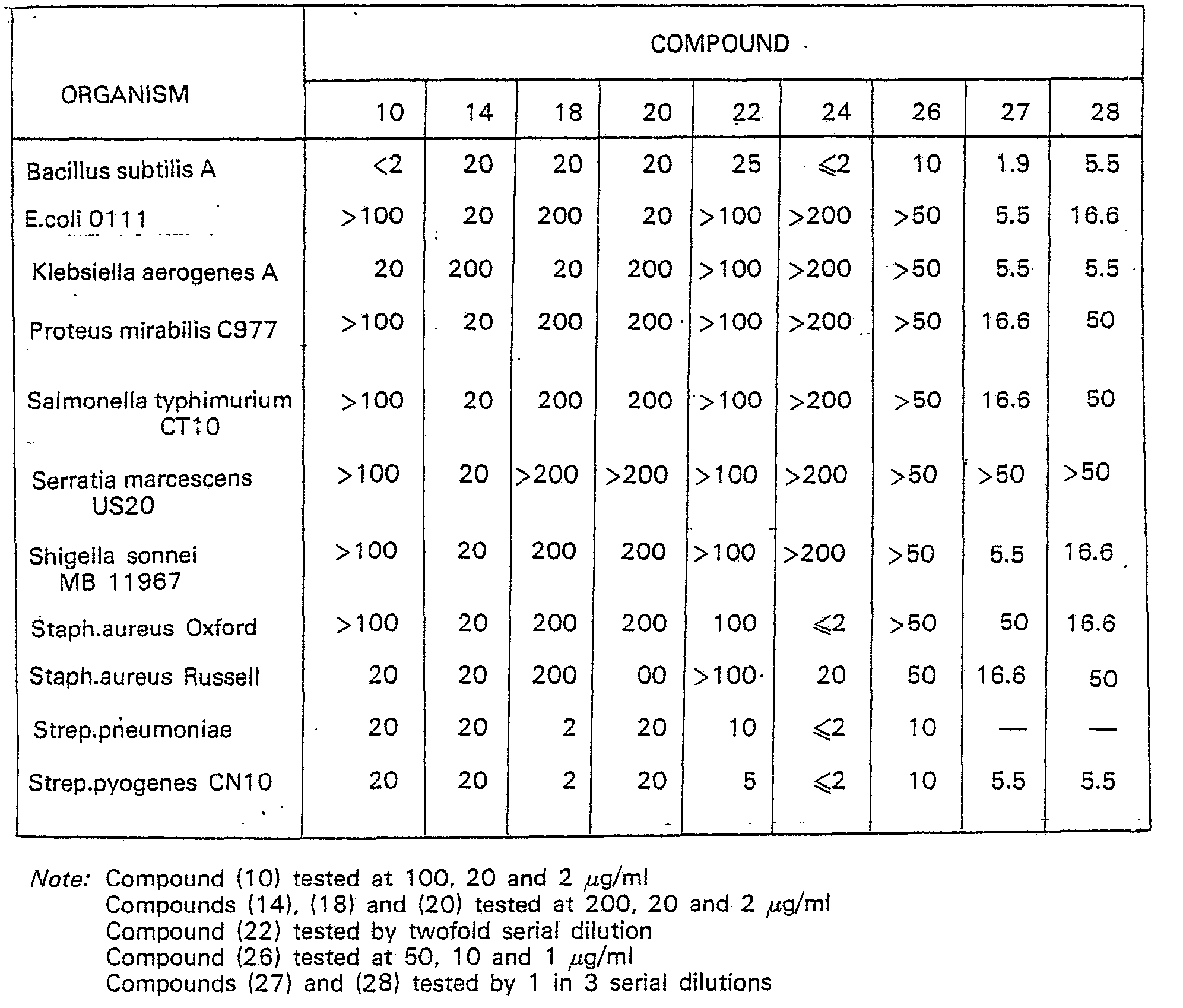
Claims (18)


Applications Claiming Priority (2)
| Application Number | Priority Date | Filing Date | Title |
|---|---|---|---|
| GB3303777 | 1977-08-06 | ||
| GB3303777 | 1977-08-06 |
Publications (2)
| Publication Number | Publication Date |
|---|---|
| EP0000828A1 EP0000828A1 (en) | 1979-02-21 |
| EP0000828B1 true EP0000828B1 (en) | 1983-03-09 |
Family
ID=10347670
Family Applications (1)
| Application Number | Title | Priority Date | Filing Date |
|---|---|---|---|
| EP78300231A Expired EP0000828B1 (en) | 1977-08-06 | 1978-08-02 | Synthetic beta-lactam compounds, a process for their preparation and compositions containing them |
Country Status (3)
| Country | Link |
|---|---|
| EP (1) | EP0000828B1 (en) |
| JP (1) | JPS5448786A (en) |
| DE (1) | DE2862198D1 (en) |
Families Citing this family (11)
| Publication number | Priority date | Publication date | Assignee | Title |
|---|---|---|---|---|
| DE2652606A1 (en) * | 1976-11-19 | 1978-05-24 | Bayer Ag | ISOTHIAZOLANTHRONE DYES |
| AU531084B2 (en) * | 1977-10-19 | 1983-08-11 | Merck & Co., Inc. | Azetidine derivatives |
| US4446146A (en) * | 1978-07-26 | 1984-05-01 | Beecham Group Limited | β-Lactam containing compounds, their preparation and use |
| IE52147B1 (en) * | 1980-03-27 | 1987-07-08 | Merck & Co Inc | 4-(3-carboxy-2-oxopropyl)-azetidin-2-ones and process for their preparation |
| JPS56142260A (en) * | 1980-04-09 | 1981-11-06 | Toyama Chem Co Ltd | 2-azetidinone and its preparation |
| JPS56145271A (en) * | 1980-04-11 | 1981-11-11 | Dai Ichi Seiyaku Co Ltd | 2-azetidinone derivative |
| JPS57103057A (en) * | 1980-12-19 | 1982-06-26 | Meito Sangyo Kk | Automatic measuring method for hdl-cholesterol and its precipitant |
| US4992542A (en) * | 1984-01-24 | 1991-02-12 | Merck & Co., Inc. | 2-substituted-6-carbadethiapen-2-em-3-carboxylic acids |
| GB9103034D0 (en) * | 1991-02-13 | 1991-03-27 | Fujisawa Pharmaceutical Co | Processes for preparing carbapenem derivatives |
| US5541317A (en) * | 1991-05-31 | 1996-07-30 | Sankyo Company, Limited | Azetidinone compounds useful in the preparation of carbapenem antibiotics and process for preparing carbapenem and penem compounds |
| CA2105746A1 (en) * | 1992-09-09 | 1994-03-10 | Akira Yoshida | Process for preparing carbapenem and penem compounds and new compounds involved in that process |
Family Cites Families (1)
| Publication number | Priority date | Publication date | Assignee | Title |
|---|---|---|---|---|
| GB1593524A (en) * | 1976-11-19 | 1981-07-15 | Merck & Co Inc | 1-carba-2-penem-3-carboxylic acids |
-
1978
- 1978-08-02 DE DE7878300231T patent/DE2862198D1/en not_active Expired
- 1978-08-02 EP EP78300231A patent/EP0000828B1/en not_active Expired
- 1978-08-07 JP JP9658978A patent/JPS5448786A/en active Pending
Also Published As
| Publication number | Publication date |
|---|---|
| EP0000828A1 (en) | 1979-02-21 |
| JPS5448786A (en) | 1979-04-17 |
| DE2862198D1 (en) | 1983-04-14 |
Similar Documents
| Publication | Publication Date | Title |
|---|---|---|
| US4282236A (en) | β-Lactam antibacterial agents, their use in pharmaceutical compositions, and intermediates | |
| US4223038A (en) | Bicyclic β-lactam antibiotics | |
| US4446146A (en) | β-Lactam containing compounds, their preparation and use | |
| US4153714A (en) | 3-Thio-5-methyl-7-oxo-1-azabicyclo[3,2,0]hept-2-ene-2-carboxylic acid esters, their production and use | |
| EP0000828A1 (en) | Synthetic beta-lactam compounds, a process for their preparation and compositions containing them | |
| US4210661A (en) | Synthetic β-lactam compounds, a process for their preparation and compositions containing them | |
| EP0008514B1 (en) | Beta-lactam anti-bacterials, compositions containing them and a process for their preparation | |
| GB2159818A (en) | Carbapenem intermediates | |
| US4244965A (en) | Azetidinoyl ethers | |
| EP0008888B1 (en) | Beta-lactam antibacterial compounds, their preparation and pharmaceutical compositions containing them | |
| FR2533568A1 (en) | NOVEL ANTIBIOTICS OF THE CARBAPENEMS CLASS AND THEIR PHARMACEUTICAL APPLICATION | |
| GB2037277A (en) | beta -Lactam antibacterial agents, their use in pharmaceutical compositions, processes for their preparation and intermediates for use in such processes | |
| US4258050A (en) | Antibacterial agents | |
| EP0034443B1 (en) | Beta-lactam antibacterial compounds, their preparation and pharmaceutical compositions containing them | |
| EP0003740B1 (en) | Beta-lactam antibiotics, a process for their preparation and pharmaceutical compositions containing them | |
| EP0005349A1 (en) | Alkylcarbapenems, their preparation, use in pharmaceutical compositions and intermediates | |
| US4263314A (en) | β-Lactam antibiotics, a process for their preparation and their use in pharmaceutical compositions | |
| US4255441A (en) | β-Lactam antibiotics, a process for their prepaeration and their use in pharmaceutical compositions | |
| EP0033209B1 (en) | Beta-lactam containing compounds, their preparation and use | |
| IE55225B1 (en) | Carbapenem antibiotics | |
| US4293501A (en) | β-Lactam antibiotics, a process for their preparation and their use in pharmaceutical compositions | |
| GB2105329A (en) | Penem-3-carboxylic acid derivatives their preparation and their use as antimicrobial agents | |
| JPS6187682A (en) | Carbapenem antibiotic | |
| US4169833A (en) | Novel phosphorane intermediates for use in preparing penem antibiotics | |
| US4192801A (en) | Novel phosphorane intermediates for use in preparing penem antibiotics |
Legal Events
| Date | Code | Title | Description |
|---|---|---|---|
| PUAI | Public reference made under article 153(3) epc to a published international application that has entered the european phase |
Free format text: ORIGINAL CODE: 0009012 |
|
| AK | Designated contracting states |
Designated state(s): CH DE FR GB NL |
|
| 17P | Request for examination filed | ||
| RAP1 | Party data changed (applicant data changed or rights of an application transferred) |
Owner name: BEECHAM GROUP PLC |
|
| GRAA | (expected) grant |
Free format text: ORIGINAL CODE: 0009210 |
|
| AK | Designated contracting states |
Designated state(s): CH DE FR GB NL |
|
| ET | Fr: translation filed | ||
| REF | Corresponds to: |
Ref document number: 2862198 Country of ref document: DE Date of ref document: 19830414 |
|
| PGFP | Annual fee paid to national office [announced via postgrant information from national office to epo] |
Ref country code: FR Payment date: 19830722 Year of fee payment: 6 |
|
| PGFP | Annual fee paid to national office [announced via postgrant information from national office to epo] |
Ref country code: CH Payment date: 19830819 Year of fee payment: 6 |
|
| PGFP | Annual fee paid to national office [announced via postgrant information from national office to epo] |
Ref country code: NL Payment date: 19830826 Year of fee payment: 6 |
|
| PGFP | Annual fee paid to national office [announced via postgrant information from national office to epo] |
Ref country code: DE Payment date: 19830901 Year of fee payment: 6 |
|
| PG25 | Lapsed in a contracting state [announced via postgrant information from national office to epo] |
Ref country code: CH Effective date: 19840831 |
|
| PG25 | Lapsed in a contracting state [announced via postgrant information from national office to epo] |
Ref country code: NL Effective date: 19850301 |
|
| NLV4 | Nl: lapsed or anulled due to non-payment of the annual fee | ||
| PG25 | Lapsed in a contracting state [announced via postgrant information from national office to epo] |
Ref country code: FR Free format text: LAPSE BECAUSE OF NON-PAYMENT OF DUE FEES Effective date: 19850430 |
|
| REG | Reference to a national code |
Ref country code: CH Ref legal event code: PL |
|
| PG25 | Lapsed in a contracting state [announced via postgrant information from national office to epo] |
Ref country code: DE Effective date: 19850501 |
|
| GBPC | Gb: european patent ceased through non-payment of renewal fee | ||
| REG | Reference to a national code |
Ref country code: FR Ref legal event code: ST |
|
| PG25 | Lapsed in a contracting state [announced via postgrant information from national office to epo] |
Ref country code: GB Effective date: 19881117 |
|
| PLBE | No opposition filed within time limit |
Free format text: ORIGINAL CODE: 0009261 |
|
| STAA | Information on the status of an ep patent application or granted ep patent |
Free format text: STATUS: NO OPPOSITION FILED WITHIN TIME LIMIT |