EP0000617B1 - Production of unsubstituted and substituted indene. - Google Patents
Production of unsubstituted and substituted indene. Download PDFInfo
- Publication number
- EP0000617B1 EP0000617B1 EP78300066A EP78300066A EP0000617B1 EP 0000617 B1 EP0000617 B1 EP 0000617B1 EP 78300066 A EP78300066 A EP 78300066A EP 78300066 A EP78300066 A EP 78300066A EP 0000617 B1 EP0000617 B1 EP 0000617B1
- Authority
- EP
- European Patent Office
- Prior art keywords
- indene
- precursor
- catalyst
- alkyl
- oxygen
- Prior art date
- Legal status (The legal status is an assumption and is not a legal conclusion. Google has not performed a legal analysis and makes no representation as to the accuracy of the status listed.)
- Expired
Links
- YBYIRNPNPLQARY-UHFFFAOYSA-N 1H-indene Natural products C1=CC=C2CC=CC2=C1 YBYIRNPNPLQARY-UHFFFAOYSA-N 0.000 title claims description 88
- 125000003454 indenyl group Chemical class C1(C=CC2=CC=CC=C12)* 0.000 title 1
- 239000003054 catalyst Substances 0.000 claims description 35
- 238000000034 method Methods 0.000 claims description 29
- 239000002243 precursor Substances 0.000 claims description 28
- 238000006243 chemical reaction Methods 0.000 claims description 25
- QVGXLLKOCUKJST-UHFFFAOYSA-N atomic oxygen Chemical compound [O] QVGXLLKOCUKJST-UHFFFAOYSA-N 0.000 claims description 23
- 229910052760 oxygen Inorganic materials 0.000 claims description 23
- 239000001301 oxygen Substances 0.000 claims description 23
- PQNFLJBBNBOBRQ-UHFFFAOYSA-N indane Chemical compound C1=CC=C2CCCC2=C1 PQNFLJBBNBOBRQ-UHFFFAOYSA-N 0.000 claims description 19
- 229910019142 PO4 Inorganic materials 0.000 claims description 14
- 150000002469 indenes Chemical class 0.000 claims description 14
- NBIIXXVUZAFLBC-UHFFFAOYSA-K phosphate Chemical compound [O-]P([O-])([O-])=O NBIIXXVUZAFLBC-UHFFFAOYSA-K 0.000 claims description 14
- 239000010452 phosphate Substances 0.000 claims description 12
- 125000000217 alkyl group Chemical group 0.000 claims description 10
- -1 alkyl indane Chemical compound 0.000 claims description 8
- UFERIGCCDYCZLN-UHFFFAOYSA-N 3a,4,7,7a-tetrahydro-1h-indene Chemical compound C1C=CCC2CC=CC21 UFERIGCCDYCZLN-UHFFFAOYSA-N 0.000 claims description 7
- 125000002619 bicyclic group Chemical group 0.000 claims description 7
- 125000004432 carbon atom Chemical group C* 0.000 claims description 7
- 229910052714 tellurium Inorganic materials 0.000 claims description 7
- INYHZQLKOKTDAI-UHFFFAOYSA-N 5-ethenylbicyclo[2.2.1]hept-2-ene Chemical compound C1C2C(C=C)CC1C=C2 INYHZQLKOKTDAI-UHFFFAOYSA-N 0.000 claims description 6
- 229910052787 antimony Inorganic materials 0.000 claims description 6
- 229910052788 barium Inorganic materials 0.000 claims description 6
- 229910052797 bismuth Inorganic materials 0.000 claims description 6
- 229910052791 calcium Inorganic materials 0.000 claims description 6
- 229910052804 chromium Inorganic materials 0.000 claims description 6
- 229910052742 iron Inorganic materials 0.000 claims description 6
- 229910052749 magnesium Inorganic materials 0.000 claims description 6
- 229910052759 nickel Inorganic materials 0.000 claims description 6
- 229910052712 strontium Inorganic materials 0.000 claims description 6
- 229920006395 saturated elastomer Polymers 0.000 claims description 5
- 229910052684 Cerium Inorganic materials 0.000 claims description 4
- 229910052776 Thorium Inorganic materials 0.000 claims description 4
- 125000003342 alkenyl group Chemical group 0.000 claims description 4
- 229910052785 arsenic Inorganic materials 0.000 claims description 4
- 229910052796 boron Inorganic materials 0.000 claims description 4
- 229910052802 copper Inorganic materials 0.000 claims description 4
- 229910052745 lead Inorganic materials 0.000 claims description 4
- 229910021645 metal ion Inorganic materials 0.000 claims description 4
- 229910052750 molybdenum Inorganic materials 0.000 claims description 4
- 125000001997 phenyl group Chemical group [H]C1=C([H])C([H])=C(*)C([H])=C1[H] 0.000 claims description 4
- 229910052707 ruthenium Inorganic materials 0.000 claims description 4
- 229910052721 tungsten Inorganic materials 0.000 claims description 4
- 229910052725 zinc Inorganic materials 0.000 claims description 4
- 229910052703 rhodium Inorganic materials 0.000 claims description 3
- AOIYTIDHFMNVOO-UHFFFAOYSA-N 2,3,3a,4,5,6-hexahydro-1h-indene Chemical compound C1CCC=C2CCCC21 AOIYTIDHFMNVOO-UHFFFAOYSA-N 0.000 claims description 2
- CWYNVVGOOAEACU-UHFFFAOYSA-N Fe2+ Chemical compound [Fe+2] CWYNVVGOOAEACU-UHFFFAOYSA-N 0.000 claims description 2
- VTLYFUHAOXGGBS-UHFFFAOYSA-N Fe3+ Chemical compound [Fe+3] VTLYFUHAOXGGBS-UHFFFAOYSA-N 0.000 claims description 2
- WAEMQWOKJMHJLA-UHFFFAOYSA-N Manganese(2+) Chemical compound [Mn+2] WAEMQWOKJMHJLA-UHFFFAOYSA-N 0.000 claims description 2
- 229910052782 aluminium Inorganic materials 0.000 claims description 2
- BNRNAKTVFSZAFA-UHFFFAOYSA-N hydrindane Chemical compound C1CCCC2CCCC21 BNRNAKTVFSZAFA-UHFFFAOYSA-N 0.000 claims description 2
- 229910052746 lanthanum Inorganic materials 0.000 claims description 2
- 229910052748 manganese Inorganic materials 0.000 claims description 2
- 230000000737 periodic effect Effects 0.000 claims description 2
- 229910052702 rhenium Inorganic materials 0.000 claims description 2
- 229910052718 tin Inorganic materials 0.000 claims description 2
- 235000021317 phosphate Nutrition 0.000 description 9
- 238000006356 dehydrogenation reaction Methods 0.000 description 8
- KAKZBPTYRLMSJV-UHFFFAOYSA-N Butadiene Chemical compound C=CC=C KAKZBPTYRLMSJV-UHFFFAOYSA-N 0.000 description 6
- 230000003197 catalytic effect Effects 0.000 description 6
- ZSWFCLXCOIISFI-UHFFFAOYSA-N cyclopentadiene Chemical compound C1C=CC=C1 ZSWFCLXCOIISFI-UHFFFAOYSA-N 0.000 description 6
- UFHFLCQGNIYNRP-UHFFFAOYSA-N Hydrogen Chemical compound [H][H] UFHFLCQGNIYNRP-UHFFFAOYSA-N 0.000 description 5
- 229910052739 hydrogen Inorganic materials 0.000 description 5
- 239000001257 hydrogen Substances 0.000 description 5
- 150000001768 cations Chemical class 0.000 description 4
- 239000003085 diluting agent Substances 0.000 description 4
- VNWKTOKETHGBQD-UHFFFAOYSA-N methane Chemical compound C VNWKTOKETHGBQD-UHFFFAOYSA-N 0.000 description 4
- 239000002245 particle Substances 0.000 description 4
- 239000000376 reactant Substances 0.000 description 4
- 239000007858 starting material Substances 0.000 description 4
- 239000004215 Carbon black (E152) Substances 0.000 description 3
- 229930195733 hydrocarbon Natural products 0.000 description 3
- 150000002430 hydrocarbons Chemical class 0.000 description 3
- 229910052751 metal Inorganic materials 0.000 description 3
- 239000002184 metal Substances 0.000 description 3
- 239000002244 precipitate Substances 0.000 description 3
- 239000000047 product Substances 0.000 description 3
- PNEYBMLMFCGWSK-UHFFFAOYSA-N Alumina Chemical compound [O-2].[O-2].[O-2].[Al+3].[Al+3] PNEYBMLMFCGWSK-UHFFFAOYSA-N 0.000 description 2
- 238000005698 Diels-Alder reaction Methods 0.000 description 2
- 229910002651 NO3 Inorganic materials 0.000 description 2
- NHNBFGGVMKEFGY-UHFFFAOYSA-N Nitrate Chemical compound [O-][N+]([O-])=O NHNBFGGVMKEFGY-UHFFFAOYSA-N 0.000 description 2
- VYPSYNLAJGMNEJ-UHFFFAOYSA-N Silicium dioxide Chemical compound O=[Si]=O VYPSYNLAJGMNEJ-UHFFFAOYSA-N 0.000 description 2
- GWEVSGVZZGPLCZ-UHFFFAOYSA-N Titan oxide Chemical compound O=[Ti]=O GWEVSGVZZGPLCZ-UHFFFAOYSA-N 0.000 description 2
- MCMNRKCIXSYSNV-UHFFFAOYSA-N Zirconium dioxide Chemical compound O=[Zr]=O MCMNRKCIXSYSNV-UHFFFAOYSA-N 0.000 description 2
- 239000006227 byproduct Substances 0.000 description 2
- 150000001875 compounds Chemical class 0.000 description 2
- 238000005336 cracking Methods 0.000 description 2
- 238000002474 experimental method Methods 0.000 description 2
- 238000004880 explosion Methods 0.000 description 2
- 239000007789 gas Substances 0.000 description 2
- 150000004820 halides Chemical class 0.000 description 2
- 239000003701 inert diluent Substances 0.000 description 2
- 239000007788 liquid Substances 0.000 description 2
- 239000000463 material Substances 0.000 description 2
- 150000002739 metals Chemical class 0.000 description 2
- 239000000203 mixture Substances 0.000 description 2
- 150000003013 phosphoric acid derivatives Chemical class 0.000 description 2
- 150000003016 phosphoric acids Chemical class 0.000 description 2
- 239000000243 solution Substances 0.000 description 2
- FIPKSKMDTAQBDJ-UHFFFAOYSA-N 1-methyl-2,3-dihydro-1h-indene Chemical class C1=CC=C2C(C)CCC2=C1 FIPKSKMDTAQBDJ-UHFFFAOYSA-N 0.000 description 1
- OTTZHAVKAVGASB-UHFFFAOYSA-N 2-heptene Natural products CCCCC=CC OTTZHAVKAVGASB-UHFFFAOYSA-N 0.000 description 1
- PGOIHFYFAIEZIE-UHFFFAOYSA-N 3a,4,7,7a-tetrahydro-1H-indene 2,3,3a,4-tetrahydro-1H-indene Chemical compound C12CC=CCC2C=CC1.C1CCC2CC=CC=C12 PGOIHFYFAIEZIE-UHFFFAOYSA-N 0.000 description 1
- OKTJSMMVPCPJKN-UHFFFAOYSA-N Carbon Chemical compound [C] OKTJSMMVPCPJKN-UHFFFAOYSA-N 0.000 description 1
- 229920000388 Polyphosphate Polymers 0.000 description 1
- BQCADISMDOOEFD-UHFFFAOYSA-N Silver Chemical compound [Ag] BQCADISMDOOEFD-UHFFFAOYSA-N 0.000 description 1
- 229910001310 TiP2O7 Inorganic materials 0.000 description 1
- 229910052770 Uranium Inorganic materials 0.000 description 1
- 229910052783 alkali metal Inorganic materials 0.000 description 1
- 150000001340 alkali metals Chemical class 0.000 description 1
- 150000001350 alkyl halides Chemical class 0.000 description 1
- LFVGISIMTYGQHF-UHFFFAOYSA-N ammonium dihydrogen phosphate Chemical compound [NH4+].OP(O)([O-])=O LFVGISIMTYGQHF-UHFFFAOYSA-N 0.000 description 1
- 239000007864 aqueous solution Substances 0.000 description 1
- 238000001354 calcination Methods 0.000 description 1
- 229910052799 carbon Inorganic materials 0.000 description 1
- 239000007795 chemical reaction product Substances 0.000 description 1
- 238000000975 co-precipitation Methods 0.000 description 1
- 239000011248 coating agent Substances 0.000 description 1
- 238000000576 coating method Methods 0.000 description 1
- 239000000567 combustion gas Substances 0.000 description 1
- 229920001577 copolymer Polymers 0.000 description 1
- XPPKVPWEQAFLFU-UHFFFAOYSA-J diphosphate(4-) Chemical compound [O-]P([O-])(=O)OP([O-])([O-])=O XPPKVPWEQAFLFU-UHFFFAOYSA-J 0.000 description 1
- 235000011180 diphosphates Nutrition 0.000 description 1
- 238000001035 drying Methods 0.000 description 1
- 230000002349 favourable effect Effects 0.000 description 1
- 229910052732 germanium Inorganic materials 0.000 description 1
- PCHJSUWPFVWCPO-UHFFFAOYSA-N gold Chemical compound [Au] PCHJSUWPFVWCPO-UHFFFAOYSA-N 0.000 description 1
- 229910052737 gold Inorganic materials 0.000 description 1
- 239000010931 gold Substances 0.000 description 1
- TVZISJTYELEYPI-UHFFFAOYSA-N hypodiphosphoric acid Chemical compound OP(O)(=O)P(O)(O)=O TVZISJTYELEYPI-UHFFFAOYSA-N 0.000 description 1
- 238000005470 impregnation Methods 0.000 description 1
- 150000002468 indanes Chemical class 0.000 description 1
- 150000002484 inorganic compounds Chemical class 0.000 description 1
- 229910010272 inorganic material Inorganic materials 0.000 description 1
- 238000006317 isomerization reaction Methods 0.000 description 1
- 125000005341 metaphosphate group Chemical group 0.000 description 1
- 238000002156 mixing Methods 0.000 description 1
- 239000000178 monomer Substances 0.000 description 1
- 229910000510 noble metal Inorganic materials 0.000 description 1
- 230000003647 oxidation Effects 0.000 description 1
- 238000007254 oxidation reaction Methods 0.000 description 1
- 235000011007 phosphoric acid Nutrition 0.000 description 1
- 125000004437 phosphorous atom Chemical group 0.000 description 1
- 229910052698 phosphorus Inorganic materials 0.000 description 1
- 239000001205 polyphosphate Substances 0.000 description 1
- 235000011176 polyphosphates Nutrition 0.000 description 1
- 239000000843 powder Substances 0.000 description 1
- 238000011084 recovery Methods 0.000 description 1
- 150000003839 salts Chemical class 0.000 description 1
- HBMJWWWQQXIZIP-UHFFFAOYSA-N silicon carbide Chemical compound [Si+]#[C-] HBMJWWWQQXIZIP-UHFFFAOYSA-N 0.000 description 1
- 229910010271 silicon carbide Inorganic materials 0.000 description 1
- 239000000377 silicon dioxide Substances 0.000 description 1
- 229910052709 silver Inorganic materials 0.000 description 1
- 239000004332 silver Substances 0.000 description 1
- 239000002002 slurry Substances 0.000 description 1
- 229910001220 stainless steel Inorganic materials 0.000 description 1
- 239000010935 stainless steel Substances 0.000 description 1
- PORWMNRCUJJQNO-UHFFFAOYSA-N tellurium atom Chemical compound [Te] PORWMNRCUJJQNO-UHFFFAOYSA-N 0.000 description 1
Classifications
-
- B—PERFORMING OPERATIONS; TRANSPORTING
- B01—PHYSICAL OR CHEMICAL PROCESSES OR APPARATUS IN GENERAL
- B01J—CHEMICAL OR PHYSICAL PROCESSES, e.g. CATALYSIS OR COLLOID CHEMISTRY; THEIR RELEVANT APPARATUS
- B01J27/00—Catalysts comprising the elements or compounds of halogens, sulfur, selenium, tellurium, phosphorus or nitrogen; Catalysts comprising carbon compounds
- B01J27/14—Phosphorus; Compounds thereof
- B01J27/16—Phosphorus; Compounds thereof containing oxygen, i.e. acids, anhydrides and their derivates with N, S, B or halogens without carriers or on carriers based on C, Si, Al or Zr; also salts of Si, Al and Zr
- B01J27/18—Phosphorus; Compounds thereof containing oxygen, i.e. acids, anhydrides and their derivates with N, S, B or halogens without carriers or on carriers based on C, Si, Al or Zr; also salts of Si, Al and Zr with metals other than Al or Zr
-
- C—CHEMISTRY; METALLURGY
- C07—ORGANIC CHEMISTRY
- C07C—ACYCLIC OR CARBOCYCLIC COMPOUNDS
- C07C5/00—Preparation of hydrocarbons from hydrocarbons containing the same number of carbon atoms
- C07C5/42—Preparation of hydrocarbons from hydrocarbons containing the same number of carbon atoms by dehydrogenation with a hydrogen acceptor
- C07C5/48—Preparation of hydrocarbons from hydrocarbons containing the same number of carbon atoms by dehydrogenation with a hydrogen acceptor with oxygen as an acceptor
Definitions
- the present invention relates to a novel catalytic technique for making unsubstituted and substituted indene.
- the invention is concerned with the problem of making unsubstituted or substituted indene in a simple economic and straightforward manner.
- suitable indene precursors may be converted to unsubstituted and substituted indene by a dehydrogenation process which involves contacting the indene precursors with a phosphate catalyst at elevated temperature in the presence of an oxygen donor.
- the invention therefore provides a process for producing unsubstituted or substituted indene by the oxydehydrogenation of an unsubstituted bicyclic indene precursor or a bicyclic indene precursor substituted with C 1 to C4 alkyl, C 1 to C 4 alkenyl or phenyl group, said precursor being more saturated than indene, characterised in that the indene precursor is contacted with a phosphate catalyst in the presence of an oxygen donor at a temperature of at least 100°C.
- the present invention is based on the observation that a wide variety of phosphate-containing inorganic compounds will catalyse the catalytic removal of hydrogen from indene precursors more saturated than indene in the presence of an oxygen donor so as to yield indene and substituted indene as a product.
- unsubstituted indene and substituted indenes are produced from bicyclic and substituted bicyclic indene precursors more saturated than indene.
- the substituted bicyclic compounds contain one or more alkyl or alkenyl groups having from 1 to 4 carbon atoms or phenyl groups attached to one or both rings.
- the substituted indenes produced from these precursors normally have the corresponding alkyl, alkenyl or phenyl groups attached, although thay may have fewer groups, or may have groups with fewer carbon atoms attached.
- precursors which may be converted into indene or substituted indenes in accordance with this invention include indane, alkyl indanes in which the alkyl groups have from 1 to 4 carbon atoms especially methyl indanes, tetrahydroindene (especially the bicyclo ⁇ 4.3.0 ⁇ nona-3,7-diene isomer), alkyl tetrahydroindenes in which the alkyl groups have from 1 to 4 carbon atoms, hexahydroindene, hexahydroindane and vinyl norbornene (5-vinyl bicyclo ⁇ 2.2.1 ⁇ -2-heptene).
- the indene precursor which is discussed above is contacted in the presence of an oxygen donor with a catalyst comprising a phosphate, i.e. a salt of one of the phosphoric acids.
- a catalyst comprising a phosphate, i.e. a salt of one of the phosphoric acids.
- a phosphate i.e. a salt of one of the phosphoric acids.
- Any type of phosphoric acid salt can be employed be it an orthophosphate, a hypophosphate, a metaphosphate, a pyrophosphate, or other polyphosphate.
- any cation can be employed, and in addition different types of cations can be employed in a single phosphate.
- an orthophosphate catalyst which can be used in accordance with the present invention can contain one, two or three different metals depending, of course, upon valence requirements, as well as hydrogen.
- the other types of phosphates can contain one or more different metal cations as well as hydrogen.
- Preferred catalysts for use in the process of the invention are those of the following formula: wherein M is one of more elements selected from Mg, Sr, Ca, Ba, La, Ce, other rare earths, Cr, Mn, Fe, Co, Ni, Cu, Zn, Sn, Pb, Bi, Te, B, Al, Rh, Sb, As, U, Th, Ge and Ru; and
- the catalysts employed in the inventive process are characterized by the following formula: wherein M is at least one of Bi, Fe, Ni, Co, Cr, La, Sn, Mg, Ca, Ce, U, Sb;
- M' is at least one element selected from Ge, Pb, Mo, W, Sr, Ba, Re, Th, As, Te, and elements selected from groups IA, IB, IIB, IIIA and VB of the Periodic Table;
- 0.1 ⁇ a ⁇ _ 16, 0 ⁇ b ⁇ 16, 0.5 ⁇ x ⁇ 16 and y is a number such that the valence requirements of the remaining elements for oxygen are satisfied.
- particularly preferred cations are Bi, Fe, Co, Cr, La, Sn, Mg, U, Sb, Mo, W and Te when used in combinations of two or more.
- Still another class of catalysts which has been found especially useful in accordance with the invention is characterized by the formula: wherein M is at least one element selected from Mg, Ca, Co, Ba, Sr, Fe(II), Mn(II); Ni, Cu, Zn and Pb;
- X is at least one of Fe(III), La, Cr, Ce, other rare earths, B, Al, Ru, and Rh;
- the catalysts used in the process of the present invention can be used either as on their own or the catalysts can be supported on suitable inert supports such as alpha alumina, Alundum (Registered Trade Mark), silica, silicon carbide, titania, zirconia and the like.
- suitable inert supports such as alpha alumina, Alundum (Registered Trade Mark), silica, silicon carbide, titania, zirconia and the like.
- phosphate support materials such as BP0 4 , TiP 2 O 7 , ZrP 2 0 7 , SbP ⁇ 4 and AIP0 4 can also be employed, wherein the catalyst support will exhibit some catalytic action of its own.
- the active catalytic component can be incorporated with the support by any known technique such as coprecipitation, impregnation or coating with a wet slurry, a partially dry powder or pelleting.
- the size of the catalyst particles is not critical and can vary between wide limits.
- the catalyst particle size may be extremely small (e.g. microspheroidal) so that the catalyst can be employed in a fluid-bed reactor or the catalyst can be significantly larger in particle size so that the catalyst can be employed in a fixed-bed reactor.
- the dehydrogenation reaction according to the invention is carried out in the presence of an oxygen donor.
- an oxygen donor elemental oxygen, O2 is normally employed.
- air is normally employed as a feed since it is cheapest and most convenient.
- Other compounds which will serve as oxygen donors in a dehydrogenation reaction can also be employed.
- SO 2 , COS and HOCI can also be employed.
- the amount of oxygen donor fed to the reaction vessel should at least be the stoichiometric amount necessary to react with all of the hydrogen to be withdrawn from the indene precursor feed. Of course, less than the stoichiometric amount can be fed to the reactor, but this will simply decrease the efficiency of the process.
- the amount of oxygen donor fed to the reaction vessel is at least twice, preferably 2 to 5 times, the stoichiometric amount necessary to react all of the hydrogen withdrawn from the indene precursor.
- a gaseous promoter known to increase oxidation rates can also be fed to the reaction vessel for improving the efficiency of the dehydrogenation reaction according to the invention.
- certain compounds such as halides (gaseous HCI, HBr, C1 2 , Br 2 , alkyl halides of the formula C x H Y X Z wherein X is halide and x is 1-5, y is 0-16, and z is 1-16 and so forth) serve to promote various types of dehydrogenation reactions.
- such gaseous promoters can also be fed to the reaction vessel normally together with the oxygen donor (which is normally in a gaseous state) for increasing the efficiency of the reaction according to the invention.
- the amount of gaseous promoter is less than 10%, in particular preferably less than 5%, of the oxygen donor fed to the reaction vessel in order that the hydrocarbon feed is not halogenated.
- the gaseous materials fed to the reaction vessel can also contain a gaseous diluent.
- a gaseous diluent Any gas inert to the reaction and catalyst can be employed as the gaseous diluent.
- Preferred gaseous diluents include N 2 , CO 2 , H 2 0, combustion gases and light hydrocarbon gases (e.g. methane). Methane is an especially preferred gaseous diluent since it suppresses explosions and hence allows more oxygen donor to be tolerated by the system without fear of explosion.
- the oxygen donor- is O2
- the amount of inert diluent should be in the range of 0 to 20 times the amount of O2 fed to the reaction vessel.
- a stoichiometrically corresponding amount of inert diluent can be employed.
- the reaction according to the invention can be carried out either in fixed-bed mode or fluid-bed mode.
- the liquid hourly space velocity of the indene precursor feed is from 0.01 to 10, preferably 0.05 to 1, optimally 0.25 hours-1.
- the contact time for the reactants in the inventive process is normally from 0.1 to 20 seconds, preferably 2 to 10 seconds.
- the reaction pressure is normally maintained at approximately atmospheric pressure, although a lower or higher pressure can be employed if desired. Indeed, any practicable pressure can be utilized.
- the reaction temperature must be at least 100°C and is normally maintained between 100°C and 650°C, preferably 250°C to 550°C.
- the preferred reaction temperature varies depending upon the indene precursor to be processed with a temperature range of 350°C to 600°C being preferred for indane dehydrogenation and 200° to 550°C being preferred for dehydrogenation of a more saturated precursor.
- each of these catalysts was prepared by mixing an appropriate amount of each of the metals in question in the form of an aqueous nitrate solution with an aqueous solution of NH 4 H 2 PO 4 to form a precipitate, drying the precipitate and calcining the dried precipitate at a temperature of from 500 to 600°C in air for a period of 120 to 1200 minutes.
- the particle size of each of the catalysts was between 0.833 mm and 0.417 mm mesh.
- Tetrahydroindene (bicyclo ⁇ 4.3.0 ⁇ nona-3,7 diene) was oxydehydrogenated to indene by the same procedure and under the same conditions as in Examples 1 to 11 except that the reaction temperature was 470°C and the catalysts used are those specified in Table II below. These catalysts were also prepared in the same way as the catalysts used in Examples 1 to 1 1. The results of Examples 12 to 17 are set forth in the following Table II.
- Examples 12 to 17 The procedure of Examples 12 to 17 was repeated using vinyl norbornene (5-vinyl-bicyclo ⁇ 2.2.1 - 2-heptene) as the feed and a catalyst comprising CO 7 La 1.5 Bi 2 P 12 0y as a catalyst.
- the per pass conversion to indene was 18% while the per pass conversion to indane was 5%.
- Isomerization also occurred to tetrahydroindene in an amount of 14% per pass conversion. 50% of the product was cracked predominantly to butadiene and cyclopentadiene, while approximately 10% of the reactant was combusted.
- Indene is produced with high yields in substantially all of the foregoing examples.
- substituted indene precursors especially alkyl substituted indene precursors of the foregoing type in which the alkyl groups have from 1 to 4 carbon atoms can also be employed.
- the hydrocarbon starting material can comprise a mixture of different indene precursors as well as a single indene precursor.
- the reaction product obtained by carrying out a Diels-Alder reaction on cyclopentadiene and butadiene, which normally contains both tetrahydroindene and vinyl norbornene could be directly processed in accordance with the present invention to form indene.
- indene precursor byproduct of the process of the invention it is also possible and may be preferable in accordance with the present invention to recycle indene precursor byproduct of the process of the invention in order to treat further these indene precursors to form indene.
- cyclopentadiene and butadiene are the predominant cracking products of the inventive reaction, it is also possible to subject these byproducts to a Diels-Alder reaction to form tetrahydroindene and vinyl norbornene which in turn can be used as a starting material in the process of the invention.
- the phosphate catalysts employed on the inventive process can be prepared in any conventional manner, such as by using a nitrate solution as discussed above or any other convenient technique.
Landscapes
- Chemical & Material Sciences (AREA)
- Organic Chemistry (AREA)
- Engineering & Computer Science (AREA)
- Materials Engineering (AREA)
- Chemical Kinetics & Catalysis (AREA)
- Organic Low-Molecular-Weight Compounds And Preparation Thereof (AREA)
- Low-Molecular Organic Synthesis Reactions Using Catalysts (AREA)
- Catalysts (AREA)
Description
- The present invention relates to a novel catalytic technique for making unsubstituted and substituted indene.
- Many patents directed to copolymers containing indene as an essential component have been published. Unfortunately, at the present time there is no simple straight forward and economical technique for producing indene monomer.
- The invention is concerned with the problem of making unsubstituted or substituted indene in a simple economic and straightforward manner.
- In United Kingdom Patent No. 761,625 there is described a non-catalytic process for the conversion of indanes and/or alkyl indanes to the corresponding indenes. In United Kingdom Patent No. 1218903 the conversion of indane or an alkyl indene to the corresponding indene by a two-stage oxydehydrogenation process utilizing a catalyst in the second stage is described.
- It has been found that suitable indene precursors may be converted to unsubstituted and substituted indene by a dehydrogenation process which involves contacting the indene precursors with a phosphate catalyst at elevated temperature in the presence of an oxygen donor.
- The invention therefore provides a process for producing unsubstituted or substituted indene by the oxydehydrogenation of an unsubstituted bicyclic indene precursor or a bicyclic indene precursor substituted with C1 to C4 alkyl, C1 to C4 alkenyl or phenyl group, said precursor being more saturated than indene, characterised in that the indene precursor is contacted with a phosphate catalyst in the presence of an oxygen donor at a temperature of at least 100°C.
- The present invention is based on the observation that a wide variety of phosphate-containing inorganic compounds will catalyse the catalytic removal of hydrogen from indene precursors more saturated than indene in the presence of an oxygen donor so as to yield indene and substituted indene as a product. Thus it is possible in accordance with the present invention to produce indene and substituted indene by a simple and straightforward catalytic dehydrogenation reaction.
- In accordance with the invention, unsubstituted indene and substituted indenes are produced from bicyclic and substituted bicyclic indene precursors more saturated than indene. The substituted bicyclic compounds contain one or more alkyl or alkenyl groups having from 1 to 4 carbon atoms or phenyl groups attached to one or both rings. The substituted indenes produced from these precursors normally have the corresponding alkyl, alkenyl or phenyl groups attached, although thay may have fewer groups, or may have groups with fewer carbon atoms attached.
- Examples of precursors which may be converted into indene or substituted indenes in accordance with this invention include indane, alkyl indanes in which the alkyl groups have from 1 to 4 carbon atoms especially methyl indanes, tetrahydroindene (especially the bicyclo{4.3.0}nona-3,7-diene isomer), alkyl tetrahydroindenes in which the alkyl groups have from 1 to 4 carbon atoms, hexahydroindene, hexahydroindane and vinyl norbornene (5-vinyl bicyclo{2.2.1 }-2-heptene).
- In carrying out the process of the invention the indene precursor which is discussed above is contacted in the presence of an oxygen donor with a catalyst comprising a phosphate, i.e. a salt of one of the phosphoric acids. Any type of phosphoric acid salt can be employed be it an orthophosphate, a hypophosphate, a metaphosphate, a pyrophosphate, or other polyphosphate. Moreover, in the foregoing types of phosphates, any cation can be employed, and in addition different types of cations can be employed in a single phosphate. For example, an orthophosphate catalyst which can be used in accordance with the present invention can contain one, two or three different metals depending, of course, upon valence requirements, as well as hydrogen. Similarly, the other types of phosphates can contain one or more different metal cations as well as hydrogen.
- Preferred catalysts for use in the process of the invention are those of the following formula:

- wherein 0.1 x < Σa < 10x, wherein Ea represents the sum of subscripts a of all of the metal ions and y is a number such that the valence requirements of the metal ions for oxygen is satisfied.
- In the foregoing catalysts, minor amounts (i.e. not more than 10% on a phosphorus atom basis) of alkali metals, noble metals, silver, gold and/or tellurium may be added.
- In a more specific embodiment, the catalysts employed in the inventive process are characterized by the following formula:

- wherein M' is at least one element selected from Ge, Pb, Mo, W, Sr, Ba, Re, Th, As, Te, and elements selected from groups IA, IB, IIB, IIIA and VB of the Periodic Table; and
- wherein 0.1 < a <_ 16, 0≤ b ≤ 16, 0.5 ≤ x≤ 16 and y is a number such that the valence requirements of the remaining elements for oxygen are satisfied.
- In this embodiment of the invention, particularly preferred cations are Bi, Fe, Co, Cr, La, Sn, Mg, U, Sb, Mo, W and Te when used in combinations of two or more.
- Still another class of catalysts which has been found especially useful in accordance with the invention is characterized by the formula:

- wherein X is at least one of Fe(III), La, Cr, Ce, other rare earths, B, Al, Ru, and Rh; and
- wherein 0 ≤ Ea + Eb ≤ 1 Ox and 0.5 ≤ x ≤ 100, wherein ∑a + ∑b represents the sum of all subscripts a + b and y is a number such that the valence requirements of all the other elements for oxygen is satisfied.
- Specific catalysts which have been found to be particularly useful in the process of the present invention include


- The catalysts used in the process of the present invention can be used either as on their own or the catalysts can be supported on suitable inert supports such as alpha alumina, Alundum (Registered Trade Mark), silica, silicon carbide, titania, zirconia and the like. In addition, phosphate support materials such as BP04, TiP2O7, ZrP207, SbPÚ4 and AIP04 can also be employed, wherein the catalyst support will exhibit some catalytic action of its own. The active catalytic component can be incorporated with the support by any known technique such as coprecipitation, impregnation or coating with a wet slurry, a partially dry powder or pelleting. The size of the catalyst particles is not critical and can vary between wide limits. For example, the catalyst particle size may be extremely small (e.g. microspheroidal) so that the catalyst can be employed in a fluid-bed reactor or the catalyst can be significantly larger in particle size so that the catalyst can be employed in a fixed-bed reactor.
- The dehydrogenation reaction according to the invention is carried out in the presence of an oxygen donor. As an oxygen donor, elemental oxygen, O2, is normally employed. In particular, air is normally employed as a feed since it is cheapest and most convenient. Other compounds which will serve as oxygen donors in a dehydrogenation reaction, however, can also be employed. For example, SO2, COS and HOCI can also be employed.
- The amount of oxygen donor fed to the reaction vessel should at least be the stoichiometric amount necessary to react with all of the hydrogen to be withdrawn from the indene precursor feed. Of course, less than the stoichiometric amount can be fed to the reactor, but this will simply decrease the efficiency of the process. Preferably, the amount of oxygen donor fed to the reaction vessel is at least twice, preferably 2 to 5 times, the stoichiometric amount necessary to react all of the hydrogen withdrawn from the indene precursor.
- In addition to the foregoing components, a gaseous promoter known to increase oxidation rates can also be fed to the reaction vessel for improving the efficiency of the dehydrogenation reaction according to the invention. In this regard, it is well known that certain compounds such as halides (gaseous HCI, HBr, C12, Br2, alkyl halides of the formula CxHYXZ wherein X is halide and x is 1-5, y is 0-16, and z is 1-16 and so forth) serve to promote various types of dehydrogenation reactions. In accordance with the present invention, such gaseous promoters can also be fed to the reaction vessel normally together with the oxygen donor (which is normally in a gaseous state) for increasing the efficiency of the reaction according to the invention. When a gaseous promoter is employed, it is preferable that the amount of gaseous promoter is less than 10%, in particular preferably less than 5%, of the oxygen donor fed to the reaction vessel in order that the hydrocarbon feed is not halogenated.
- The gaseous materials fed to the reaction vessel (i.e. the oxygen donor and optionally the gaseous promoter) can also contain a gaseous diluent. Any gas inert to the reaction and catalyst can be employed as the gaseous diluent. Preferred gaseous diluents include N2, CO2, H20, combustion gases and light hydrocarbon gases (e.g. methane). Methane is an especially preferred gaseous diluent since it suppresses explosions and hence allows more oxygen donor to be tolerated by the system without fear of explosion. When the oxygen donor-is O2, the amount of inert diluent should be in the range of 0 to 20 times the amount of O2 fed to the reaction vessel. When other oxygen donors are employed, a stoichiometrically corresponding amount of inert diluent can be employed.
- The reaction according to the invention can be carried out either in fixed-bed mode or fluid-bed mode. In fixed-bed mode, the liquid hourly space velocity of the indene precursor feed is from 0.01 to 10, preferably 0.05 to 1, optimally 0.25 hours-1. The contact time for the reactants in the inventive process is normally from 0.1 to 20 seconds, preferably 2 to 10 seconds. The reaction pressure is normally maintained at approximately atmospheric pressure, although a lower or higher pressure can be employed if desired. Indeed, any practicable pressure can be utilized.
- The reaction temperature must be at least 100°C and is normally maintained between 100°C and 650°C, preferably 250°C to 550°C. In this connection, it has been found that the preferred reaction temperature varies depending upon the indene precursor to be processed with a temperature range of 350°C to 600°C being preferred for indane dehydrogenation and 200° to 550°C being preferred for dehydrogenation of a more saturated precursor.
- The following examples illustrate the invention.
- 15 cc of the catalysts set forth in the following Table I were charged into a fixed-bed, 1.27 cm, outside diameter, stainless steel, tubular reactor. Each of these catalysts was prepared by mixing an appropriate amount of each of the metals in question in the form of an aqueous nitrate solution with an aqueous solution of NH4H2PO4 to form a precipitate, drying the precipitate and calcining the dried precipitate at a temperature of from 500 to 600°C in air for a period of 120 to 1200 minutes. The particle size of each of the catalysts was between 0.833 mm and 0.417 mm mesh.
- In each example, a mixture of indane, approximately five parts air and three parts N2 for each part indane vapour was fed to the reactor. The reactants were fed at a rate such that the liquid hourly space velocity of indane was 0.24 hr-1 and the contact time of the reactants was about three seconds. The reaction temperature was maintained at 550°C and the reaction pressure was one atmosphere. The following results were obtained:

- As will be noted, the single pass yields realized in the foregoing experiments were in excess of 65% and selectivities in excess of 80% were obtained. It will thus be appreciated that indane was dehydrogenated to indene with very favourable per pass conversions and selectivities in a very simple manner.
- Tetrahydroindene (bicyclo{4.3.0}nona-3,7 diene) was oxydehydrogenated to indene by the same procedure and under the same conditions as in Examples 1 to 11 except that the reaction temperature was 470°C and the catalysts used are those specified in Table II below. These catalysts were also prepared in the same way as the catalysts used in Examples 1 to 1 1. The results of Examples 12 to 17 are set forth in the following Table II.
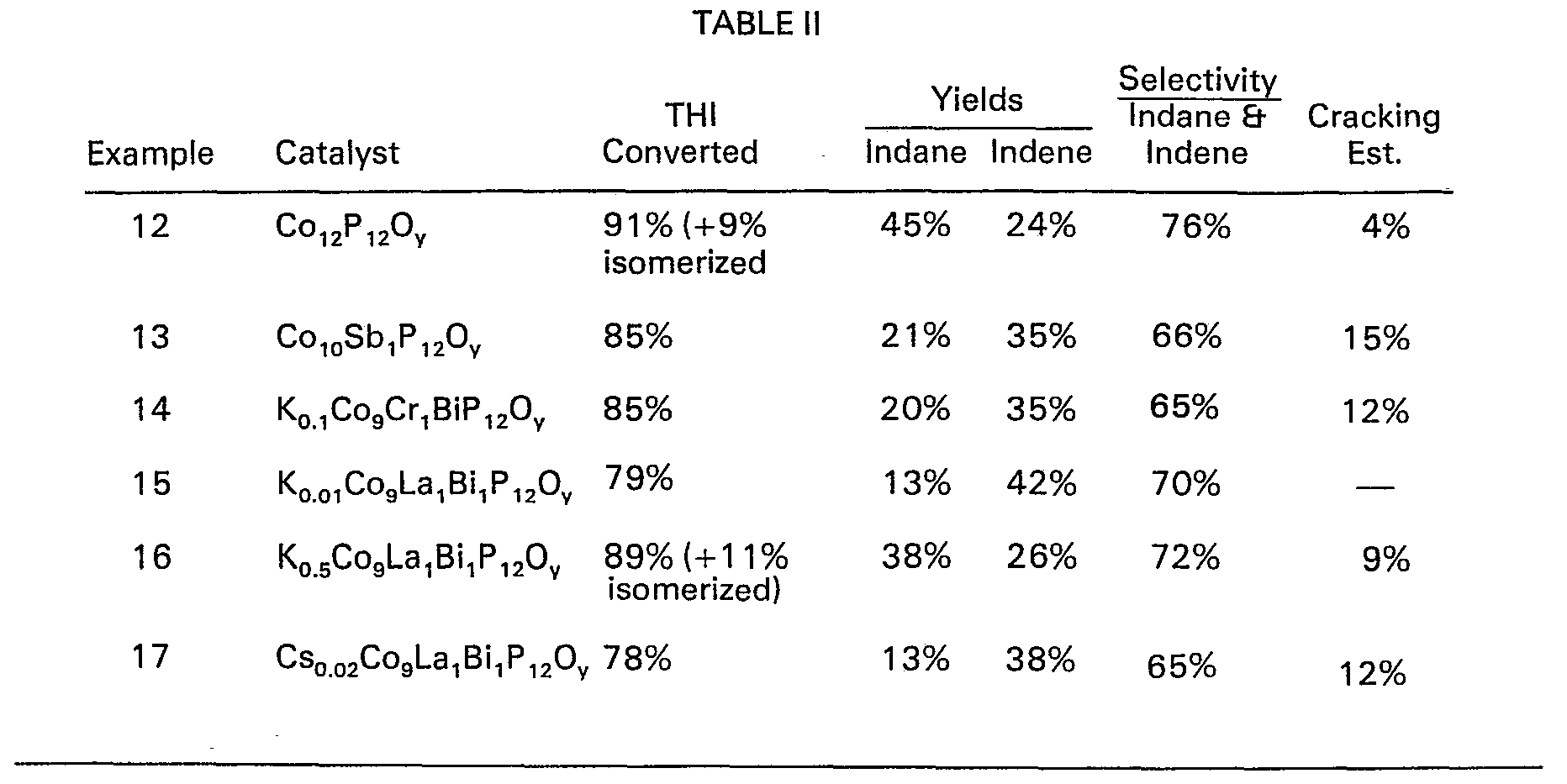
- As can be seen, total oxydehydrogenation selectivities in the foregoing examples were in excess of 60% and cracking of the starting material is quite small. Moreover, the recovery on a total carbon balance cases is quite high, 82-92%.
- The procedure of Examples 12 to 17 was repeated using vinyl norbornene (5-vinyl-bicyclo{2.2.1 - 2-heptene) as the feed and a catalyst comprising CO7La1.5Bi2P120y as a catalyst. The per pass conversion to indene was 18% while the per pass conversion to indane was 5%. Isomerization also occurred to tetrahydroindene in an amount of 14% per pass conversion. 50% of the product was cracked predominantly to butadiene and cyclopentadiene, while approximately 10% of the reactant was combusted.
- Additional experiments were conducted in which tetrahydroindene was oxydehydrogenated to indene in the presence of air in a fixed-bed reactor. The results of these tests are summarized in the Table III in which C.T. means contact time.


- Indene is produced with high yields in substantially all of the foregoing examples.
- In addition to the various indene precursors described above in the examples as starting materials, substituted indene precursors, especially alkyl substituted indene precursors of the foregoing type in which the alkyl groups have from 1 to 4 carbon atoms can also be employed. Furthermore, the hydrocarbon starting material can comprise a mixture of different indene precursors as well as a single indene precursor. In this regard the reaction product obtained by carrying out a Diels-Alder reaction on cyclopentadiene and butadiene, which normally contains both tetrahydroindene and vinyl norbornene, could be directly processed in accordance with the present invention to form indene. It is also possible and may be preferable in accordance with the present invention to recycle indene precursor byproduct of the process of the invention in order to treat further these indene precursors to form indene. In addition, since cyclopentadiene and butadiene are the predominant cracking products of the inventive reaction, it is also possible to subject these byproducts to a Diels-Alder reaction to form tetrahydroindene and vinyl norbornene which in turn can be used as a starting material in the process of the invention.
- The phosphate catalysts employed on the inventive process can be prepared in any conventional manner, such as by using a nitrate solution as discussed above or any other convenient technique.
Claims (9)


Applications Claiming Priority (2)
| Application Number | Priority Date | Filing Date | Title |
|---|---|---|---|
| US05/816,638 US4143082A (en) | 1977-07-18 | 1977-07-18 | Method for making indene |
| US816638 | 1977-07-18 |
Publications (2)
| Publication Number | Publication Date |
|---|---|
| EP0000617A1 EP0000617A1 (en) | 1979-02-07 |
| EP0000617B1 true EP0000617B1 (en) | 1981-08-12 |
Family
ID=25221218
Family Applications (1)
| Application Number | Title | Priority Date | Filing Date |
|---|---|---|---|
| EP78300066A Expired EP0000617B1 (en) | 1977-07-18 | 1978-06-22 | Production of unsubstituted and substituted indene. |
Country Status (10)
| Country | Link |
|---|---|
| US (1) | US4143082A (en) |
| EP (1) | EP0000617B1 (en) |
| JP (1) | JPS5439060A (en) |
| AT (1) | AT362779B (en) |
| AU (1) | AU519566B2 (en) |
| CA (1) | CA1092163A (en) |
| DE (1) | DE2860929D1 (en) |
| DK (1) | DK320978A (en) |
| IT (1) | IT1195255B (en) |
| ZA (1) | ZA783692B (en) |
Families Citing this family (15)
| Publication number | Priority date | Publication date | Assignee | Title |
|---|---|---|---|---|
| US4291181A (en) * | 1979-12-28 | 1981-09-22 | Standard Oil Company | Indenes from tetrahydroindenes |
| US4292456A (en) * | 1979-12-28 | 1981-09-29 | The Standard Oil Co. | Oxydehydrogenation process for preparing indenes |
| US4292455A (en) * | 1979-12-28 | 1981-09-29 | The Standard Oil Co. | Multi-stage dehydrogenation process for preparing indene |
| US4291180A (en) * | 1979-12-28 | 1981-09-22 | Standard Oil Company | Co-production of indene and styrene |
| CA1182803A (en) * | 1980-12-31 | 1985-02-19 | Svend E. Pedersen | Mixed metal phosphorus oxide catalyst for the oxidative dehydrogenation of carboxylic acids |
| US4366088A (en) * | 1981-01-26 | 1982-12-28 | Ashland Oil, Inc. | Support for a phosphate-containing catalyst |
| JPS6360840A (en) * | 1986-08-29 | 1988-03-16 | Canon Inc | Sheet handling device |
| US5001102A (en) * | 1989-01-11 | 1991-03-19 | Pq Corporation | Heterogeneous catalysts |
| EP1026137A4 (en) | 1998-08-18 | 2001-11-14 | Nippon Petrochemicals Co Ltd | Process for producing indene |
| JP2003081889A (en) * | 2001-09-11 | 2003-03-19 | Nippon Petrochemicals Co Ltd | Method for producing 1,4-methano-1,4,4a, 9a-tetrahydrofluorene |
| DE112008003858B4 (en) | 2008-05-09 | 2019-11-21 | Hewlett Packard Enterprise Development Lp | System and method for establishing an optical connection |
| DE102010032206A1 (en) * | 2010-07-26 | 2012-04-05 | Süd-Chemie AG | Gas phase coated lithium transition metal phosphate and process for its preparation |
| JP2013133293A (en) * | 2011-12-26 | 2013-07-08 | Waseda Univ | Method for producing indane and/or indene |
| JP2019156758A (en) * | 2018-03-13 | 2019-09-19 | Jxtgエネルギー株式会社 | Production method of indene |
| JP7029346B2 (en) | 2018-04-27 | 2022-03-03 | Eneos株式会社 | Indene manufacturing method |
Family Cites Families (8)
| Publication number | Priority date | Publication date | Assignee | Title |
|---|---|---|---|---|
| US3320329A (en) * | 1965-04-23 | 1967-05-16 | Phillips Petroleum Co | Oxidative dehydrogenation over stannic phosphate catalyst |
| DE1816697A1 (en) * | 1967-12-26 | 1969-08-28 | Phillips Petroleum Co | Oxidative transformation, which includes dehydration |
| US3716545A (en) * | 1970-01-16 | 1973-02-13 | Phillips Petroleum Co | Oxidative conversion including dehydrogenation |
| US4044066A (en) * | 1971-05-06 | 1977-08-23 | Phillips Petroleum Company | Nickel-phosphorus oxidative dehydrogenation catalyst |
| US3824195A (en) * | 1971-11-01 | 1974-07-16 | Phillips Petroleum Co | Oxidative dehydrogenation catalyst |
| US3845156A (en) * | 1972-04-05 | 1974-10-29 | Phillips Petroleum Co | Processes for dehydrogenation of organic compounds |
| US3975301A (en) * | 1973-10-26 | 1976-08-17 | Eastman Kodak Company | Dehydrogenation catalyst consisting of the calcined residue of ferric phosphate and lead phosphate |
| US4010114A (en) * | 1975-04-30 | 1977-03-01 | Phillips Petroleum Company | Oxidative dehydrogenation catalyst |
-
1977
- 1977-07-18 US US05/816,638 patent/US4143082A/en not_active Expired - Lifetime
-
1978
- 1978-06-20 AU AU37278/78A patent/AU519566B2/en not_active Expired
- 1978-06-22 EP EP78300066A patent/EP0000617B1/en not_active Expired
- 1978-06-22 DE DE7878300066T patent/DE2860929D1/en not_active Expired
- 1978-06-28 JP JP7849478A patent/JPS5439060A/en active Granted
- 1978-06-28 ZA ZA783692A patent/ZA783692B/en unknown
- 1978-06-30 IT IT25217/78A patent/IT1195255B/en active
- 1978-07-14 AT AT0512178A patent/AT362779B/en not_active IP Right Cessation
- 1978-07-17 CA CA307,521A patent/CA1092163A/en not_active Expired
- 1978-07-18 DK DK320978A patent/DK320978A/en not_active Application Discontinuation
Also Published As
| Publication number | Publication date |
|---|---|
| AT362779B (en) | 1981-06-10 |
| AU3727878A (en) | 1980-01-03 |
| DE2860929D1 (en) | 1981-11-12 |
| EP0000617A1 (en) | 1979-02-07 |
| IT1195255B (en) | 1988-10-12 |
| ATA512178A (en) | 1980-11-15 |
| ZA783692B (en) | 1980-01-30 |
| JPS5439060A (en) | 1979-03-24 |
| JPS6138176B2 (en) | 1986-08-28 |
| US4143082A (en) | 1979-03-06 |
| AU519566B2 (en) | 1981-12-10 |
| IT7825217A0 (en) | 1978-06-30 |
| CA1092163A (en) | 1980-12-23 |
| DK320978A (en) | 1979-01-19 |
Similar Documents
| Publication | Publication Date | Title |
|---|---|---|
| US4143082A (en) | Method for making indene | |
| EP0057918B1 (en) | Use of a catalytic composition for the preparation of acrylonitrile | |
| EP0050992B1 (en) | Production of tertiary olefins | |
| US4560804A (en) | Catalytic process for the manufacture of ketones | |
| JPH085820B2 (en) | Method for producing methacrylic acid and / or methacrolein | |
| US2991320A (en) | Catalytic dehydrogenation process | |
| US4377534A (en) | Production of unsaturated nitriles | |
| US3801670A (en) | Catalytic process for the production of diolefins | |
| US3621072A (en) | Process for producing isoprene | |
| US4139552A (en) | Production of unsaturated nitriles | |
| US4036901A (en) | Process for producing styrene | |
| CA1308744C (en) | Hydrocarbon dehydrogenation reactions | |
| US3926845A (en) | Catalysts compositions | |
| EP0013578B2 (en) | Process for producing methacrylic acid | |
| US2991322A (en) | Dehydrogenation in the presence of oxygen and bismuth tungstate | |
| US4148822A (en) | Process for the manufacture of methacrylic or acrylic acid | |
| US3036133A (en) | Process for the preparation of sulfur compounds | |
| US3313856A (en) | Preparation of acrolein or methacrolein | |
| US5220090A (en) | Method for preparing unsaturated compounds | |
| US4131631A (en) | Dehydrogenation of paraffins | |
| EP0557790B1 (en) | Process for producing isobutylene by oxidative dehydrogenation of isobutane | |
| US3067272A (en) | Catalytic dehydrogenation process | |
| RU2027693C1 (en) | Method of oxidative dehydrogenation of isoamylenes | |
| US4292455A (en) | Multi-stage dehydrogenation process for preparing indene | |
| US4950769A (en) | Process for the manufacture of maleic anhydride utilizing peroxides to improve catalytic activity |
Legal Events
| Date | Code | Title | Description |
|---|---|---|---|
| PUAI | Public reference made under article 153(3) epc to a published international application that has entered the european phase |
Free format text: ORIGINAL CODE: 0009012 |
|
| AK | Designated contracting states |
Designated state(s): BE DE FR GB NL SE |
|
| 17P | Request for examination filed | ||
| GRAA | (expected) grant |
Free format text: ORIGINAL CODE: 0009210 |
|
| AK | Designated contracting states |
Designated state(s): BE DE FR GB NL SE |
|
| REF | Corresponds to: |
Ref document number: 2860929 Country of ref document: DE Date of ref document: 19811112 |
|
| PGFP | Annual fee paid to national office [announced via postgrant information from national office to epo] |
Ref country code: FR Payment date: 19840629 Year of fee payment: 7 |
|
| PGFP | Annual fee paid to national office [announced via postgrant information from national office to epo] |
Ref country code: SE Payment date: 19840630 Year of fee payment: 7 |
|
| PGFP | Annual fee paid to national office [announced via postgrant information from national office to epo] |
Ref country code: DE Payment date: 19840731 Year of fee payment: 7 |
|
| PGFP | Annual fee paid to national office [announced via postgrant information from national office to epo] |
Ref country code: BE Payment date: 19840930 Year of fee payment: 7 |
|
| PGFP | Annual fee paid to national office [announced via postgrant information from national office to epo] |
Ref country code: NL Payment date: 19870630 Year of fee payment: 10 |
|
| PG25 | Lapsed in a contracting state [announced via postgrant information from national office to epo] |
Ref country code: GB Effective date: 19880622 |
|
| PG25 | Lapsed in a contracting state [announced via postgrant information from national office to epo] |
Ref country code: SE Effective date: 19880623 |
|
| BERE | Be: lapsed |
Owner name: THE STANDARD OIL CY Effective date: 19880630 |
|
| PG25 | Lapsed in a contracting state [announced via postgrant information from national office to epo] |
Ref country code: NL Effective date: 19890101 |
|
| NLV4 | Nl: lapsed or anulled due to non-payment of the annual fee | ||
| GBPC | Gb: european patent ceased through non-payment of renewal fee | ||
| PG25 | Lapsed in a contracting state [announced via postgrant information from national office to epo] |
Ref country code: FR Free format text: LAPSE BECAUSE OF NON-PAYMENT OF DUE FEES Effective date: 19890228 |
|
| PG25 | Lapsed in a contracting state [announced via postgrant information from national office to epo] |
Ref country code: DE Effective date: 19890301 |
|
| REG | Reference to a national code |
Ref country code: FR Ref legal event code: ST |
|
| PG25 | Lapsed in a contracting state [announced via postgrant information from national office to epo] |
Ref country code: BE Effective date: 19890630 |
|
| EUG | Se: european patent has lapsed |
Ref document number: 78300066.4 Effective date: 19890220 |
|
| PLBE | No opposition filed within time limit |
Free format text: ORIGINAL CODE: 0009261 |
|
| STAA | Information on the status of an ep patent application or granted ep patent |
Free format text: STATUS: NO OPPOSITION FILED WITHIN TIME LIMIT |