SUMMERY OF THE UTILITY MODEL
The utility model provides a rewinding machine with automatic tension control mechanism aims at solving the problem that traditional rewinding machine during operation control tension is permanent tension control.
The utility model discloses a realize like this, a rewinding machine with automatic tension control mechanism, including total base, the leftmost side of total base upper surface is provided with the scroll base, be provided with former scroll on the scroll base, just the below of scroll base is provided with the roller, the roller sets up on the roller base, the roller base sets up on the fixed station, the bottom of fixed station is connected with the wire rope that steerable compression roller goes up and down, the right side of scroll base, in the upper surface of total base is provided with the compression roller, the compression roller sets up on the compression roller base, the bottom of compression roller base with wire rope's the other end is connected.
Preferably, a tension sensor is arranged on the right side of the compression roller, the tension sensor is arranged on a tension sensor base, the tension sensor base is arranged on the upper surface of the main base, and a rewinding device is arranged on the rightmost side of the upper surface of the main base.
Preferably, a first groove is formed in the upper surface of the main base under the raw paper roll, the fixed table is arranged in the first groove, two first automatic telescopic rods are arranged in the first groove, the top ends of the first automatic telescopic rods are connected with the bottom of the fixed table, and first springs are sleeved on the two first automatic telescopic rods.
Preferably, a first rope groove is formed below the first groove, the length direction of the first rope groove is consistent with the height direction of the main base, a second rope groove is formed below the first rope groove, and the length direction of the second rope groove is consistent with the length direction of the main base.
Preferably, the leftmost side of second grooving is provided with first fixed pulley, just the second recess has been seted up to the intermediate position department of second grooving, the bottom of second recess is provided with electric telescopic handle, electric telescopic handle's bottom is connected with the movable pulley base, be provided with the movable pulley on the movable pulley base, electric telescopic handle's the left and right sides, in all be provided with the second fixed pulley in the second recess.
Preferably, a third fixed pulley is arranged on the rightmost side of the second rope groove, a third rope groove is formed in the upper portion of the third fixed pulley, the length direction of the third rope groove is consistent with the height direction of the main base, and a third groove is formed in the upper portion of the third rope groove.
Preferably, two second automatic telescopic rods are arranged in the third groove, a second spring is sleeved on each second automatic telescopic rod, and the top ends of the two second automatic telescopic rods are connected with the compression roller base.
Preferably, the first groove, the first rope groove, the second groove, the third groove and the third rope groove are communicated with each other, and the steel wire rope sequentially bypasses the first fixed pulley, the second fixed pulley, the movable pulley and the third fixed pulley.
Compared with the prior art, the beneficial effects of the utility model are that: the utility model discloses a rewinding machine with automatic tension control mechanism, the former scroll that does not begin to rewind is placed on the scroll base, through the thickness and the gravity of former scroll self with the compression roller drive compression roller base and fixed station extrude downwards, the first spring is compressed by the extrusion, first automatic telescopic link shrink, left wire rope moves downwards, and the wire rope on right side is because of the lax of left wire rope stretch out under the effect of second spring gradually, make the compression roller reach maximum height, the tension of paper is the biggest this moment; along with the work of the rewinding device, the thickness and the gravity of the original paper roll are reduced, the roll shaft gradually rises under the action of the first spring, the steel wire rope on the left side is pulled to move upwards, the steel wire rope on the right side pulls the compression roller to move downwards gradually, the tension of paper is reduced gradually, and the real-time control of the tension is realized;
when the tension needs to be manually adjusted, the electric telescopic rod is controlled to work, so that the fixed pulley moves up and down, the steel wire rope in the rope groove is tightened or loosened, and the pressing roller correspondingly moves down or up, so that the tension is manually controlled.
Detailed Description
In order to make the objects, technical solutions and advantages of the present invention more clearly understood, the present invention is further described in detail below with reference to the accompanying drawings and embodiments. It should be understood that the specific embodiments described herein are merely illustrative of the invention and are not intended to limit the invention.
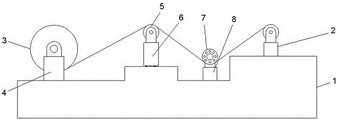
Referring to fig. 1-5, the present invention provides a technical solution: the utility model provides a rewinding machine with automatic tension control mechanism, including total base 1, the leftmost side of total base 1 upper surface is provided with scroll base 4, be provided with former scroll 3 on the scroll base 4, and the below of scroll base 4 is provided with roller 9, roller 9 sets up on roller base 10, roller base 10 sets up on fixed station 11, the bottom of fixed station 11 is connected with wire rope 16 that steerable compression roller 5 goes up and down, the right side of scroll base 4, be provided with compression roller 5 in total base 1's upper surface, compression roller 5 sets up on compression roller base 6, compression roller base 6's bottom is connected with wire rope 16's the other end.
The original paper roll 3 which is not rewound is placed on the paper roll base 4, under the action of the thickness and gravity of the original paper roll 3, the roller shaft 9 is pressed downwards to be extruded, the roller shaft 9 drives the roller shaft base 10 and the fixing platform 11 to move downwards, the first spring 12 and the first automatic telescopic rod 13 are extruded, the left steel wire rope 16 becomes loose, the right steel wire rope 16 moves upwards under the action of the second spring 24, the compression roller base 6 also drives the compression roller 5 to move upwards under the action of the second spring 24, the compression roller 5 reaches the maximum height at the moment, and the tension reaches the maximum value at the same time.
Further, a tension sensor 7 is arranged on the right side of the pressing roller 5, the tension sensor 7 is arranged on a tension sensor base 8, the tension sensor base 8 is arranged on the upper surface of the main base 1, and the rightmost side of the upper surface of the main base 1 is provided with the rewinding device 2.
The tension sensor 7 is used for detecting the real-time tension of paper in the device, and a worker determines whether the tension in the device is artificially interfered or not based on the real-time tension; the rewinding device 2 rewinds the base roll 3.
Specifically, under the raw paper roll 3, a first groove 14 is formed in the upper surface of the main base 1, the fixed table 11 is arranged in the first groove 14, two first automatic telescopic rods 13 are arranged in the first groove 14, the top ends of the first automatic telescopic rods 13 are connected with the bottom of the fixed table 11, and the two first automatic telescopic rods 13 are sleeved with first springs 12.
The arrangement of the first automatic telescopic rod 13 ensures that the position of the first spring 12 does not deviate in the telescopic process; the first spring 12 is arranged to support the roll shaft 9 and simultaneously control the steel wire rope 16 to be kept in a tight state by matching with the second spring 24 through the self elastic force.
Usually, a first rope groove 15 is formed below the first groove 14, the length direction of the first rope groove 15 is consistent with the height direction of the overall base 1, a second rope groove 18 is formed below the first rope groove 15, and the length direction of the second rope groove 18 is consistent with the length direction of the overall base 1.
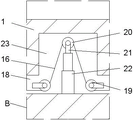
In addition, the leftmost side of the second rope groove 18 is provided with a first fixed pulley 17, a second groove 23 is formed in the middle position of the second rope groove 18, an electric telescopic rod 22 is arranged at the bottom of the second groove 23, the bottom end of the electric telescopic rod 22 is connected with a movable pulley base 21, a movable pulley 20 is arranged on the movable pulley base 21, and second fixed pulleys 19 are arranged in the second groove 23 on the left side and the right side of the electric telescopic rod 22.
The arrangement of the fixed pulley and the movable pulley 20 ensures the moving track of the steel wire rope 16 in the rope groove and the groove, reduces the friction force applied to the steel wire rope 16 in the moving process, protects the steel wire rope 16, and prevents the abrasion of the groove and the edge of the rope groove on the steel wire rope 16.
The electric telescopic rod 22 works to control the movable pulley 20 to move up and down, so that the tension is manually controlled.
In addition, a third fixed pulley 28 is arranged at the rightmost side of the second rope groove 18, a third rope groove 27 is formed above the third fixed pulley 28, the length direction of the third rope groove 27 is consistent with the height direction of the overall base 1, and a third groove 26 is formed above the third rope groove 27.
Further, two second automatic telescopic rods 25 are arranged in the third groove 26, a second spring 24 is sleeved on each second automatic telescopic rod 25, and the top ends of the two second automatic telescopic rods 25 are connected with the compression roller base 6.
The second spring 24 is arranged to be matched with the first spring 12, so that the steel wire rope 16 is controlled to be always kept in a tight state, and the up-and-down movement of the compression roller 5 is controlled; the elastic coefficient of the first spring 12 is greater than that of the second spring 24; the first spring 12 and the second spring 24 are not in a relaxed state at the same time.
Normally, the first groove 14, the first rope groove 15, the second rope groove 18, the second groove 23, the third groove 26 and the third rope groove 27 are all communicated with each other, and the steel wire rope 16 passes through the first fixed pulley 17, the two second fixed pulleys 19, the movable pulley 20 and the third fixed pulley 28 in sequence.
The utility model discloses a theory of operation and use flow: after the utility model is installed, the original paper roll 3 which is not rewound is placed on the paper roll base 4, the roller shaft 9 is pressed downwards to be extruded under the action of the thickness and gravity of the original paper roll 3, the roller shaft 9 drives the roller shaft base 10 and the fixed platform 11 to move downwards to extrude the first spring 12 and the first automatic telescopic rod 13, the left steel wire rope 16 becomes loose, the right steel wire rope 16 moves upwards under the action of the second spring 24, the steel wire rope 16 is tightened gradually, the compression roller base 6 drives the compression roller 5 to move upwards under the action of the second spring 24, the compression roller 5 reaches the maximum height at the moment, and the tension reaches the maximum value at the same time;
with the continuous work of the rewinding device 2, the thickness and gravity of the original paper roll 3 are reduced, the fixed table 11 drives the roller shaft base 10 and the roller shaft 9 to gradually rise under the action of the first spring 12, the steel wire rope 16 on the left side is pulled to move upwards, the steel wire rope 16 on the right side pulls the compression roller 5 and the compression roller base 6 to gradually move downwards and extrude the second spring 24, the tension of paper is reduced gradually, and the real-time control of the tension is realized;
a worker observes tension readings on the tension sensor 7 to determine whether tension is adjusted manually, and when the tension needs to be adjusted manually, the electric telescopic rod 22 is controlled to work, so that the movable pulley 20 moves up and down, the steel wire rope 16 in the second groove 23 is tightened or loosened, the compression roller 5 correspondingly moves down or up, and the tension is manually controlled.
The above description is only for the purpose of illustrating the preferred embodiments of the present invention and is not intended to limit the present invention, and any modifications, equivalents, improvements, etc. made within the spirit and principles of the present invention should be included within the scope of the present invention.