Background
In clinical practice, simple medical instruments are generally needed for auxiliary treatment, particularly in orthopedics department, when a patient is subjected to rehabilitation treatment, the body of the patient needs to be exercised by some traction equipment, and when the patient is bedridden for a long time or the limb movement is limited and cannot be subjected to functional exercise, complications such as limb stiffness, muscle atrophy and the like are easily caused.
At present, in order to prevent the occurrence of the conditions of stiffness and atrophy of the muscle of a patient in long-term bed rest, medical care personnel usually use a rehabilitation auxiliary instrument to perform proper muscle strength recovery training on the patient. The leg-lifting training is one of the classic items of lower limb muscle strength training, the inner side and outer side muscles of thighs of a patient can be strengthened by adopting a prone position, the training pertinence is very strong particularly to the biggest and most powerful muscle of the quadriceps femoris, the ilium and psoas muscle which helps the human body to keep balance is also trained, and the popliteus muscle can be trained by adjusting the training posture, so that the lower limbs of the patient are recovered comprehensively.
At present, a device for training the lower limbs of a patient mostly adopts treading type, the training difficulty is high for the patient with weak muscle strength, sitting posture training is adopted for a long time, the injury recovery effect of the patient with waist and back injury can be influenced, the prone lower limb rehabilitation training device based on straight leg lifting training can be suitable for most of patients, and the lower limb muscle group involved in straight leg lifting is large, the force is easy to apply, and the device is suitable for the patient with weak muscle strength. Therefore, the lower limb rehabilitation training device for orthopedic nursing, which can adopt prone position training and can be suitable for patients with weak muscle strength, has very important practical significance.
SUMMERY OF THE UTILITY MODEL
The utility model aims at providing a low limbs rehabilitation training device is used in orthopedics nursing carries out the rehabilitation training to its low limbs under the recovered condition in positions such as not influencing patient's back to applicable patient that is more weak in muscular strength.
The above technical purpose of the present invention can be achieved by the following technical solutions:
the lower limb rehabilitation training device for orthopedic nursing comprises a bed body, wherein a liftable portal is arranged above the bed body and slides in a reciprocating manner along the length direction of the bed body, the portal is fixed with the bed body through a first limiting assembly, the upper end of the portal is connected with an adjusting seat in a reciprocating manner from left to right, the adjusting seat is fixed with the portal through a second limiting assembly, and the bottom of the adjusting seat is in threaded connection with a spring damper;
the spring damper comprises a hollow shell with an opening at the lower end and a connecting portion arranged at the upper end of the shell, the connecting portion is in threaded connection with the adjusting seat, an elastic rope is arranged downwards at the top end in the shell, the lower end of the elastic rope is connected with a hook located below the shell, an elastic blocking piece is arranged at an opening of the hook, a training spring sleeved outside the elastic rope and connected with the upper end of the hook is arranged at the top end in the shell, and a leg lifting belt is hung on the hook.
By adopting the technical scheme, when a patient needs to carry out lower limb rehabilitation training, the portal frame is firstly slid to the tail end position of the bed body to bring convenience for the patient to go to bed, after the patient is in place in a prone position, the portal frame is slid to enable the leg hanging belt to be located at the proper position of the leg of the patient and fixed by the first limiting assembly, then the leg hanging belt is vertically moved to the proper position by adjusting the height of the portal frame according to the requirement of the rehabilitation training, the lower limb of the patient is placed into the leg hanging belt, the patient can pull down the leg hanging belt by downwards overcoming the resistance of the spring damper through the lower limb, and after the leg hanging belt is completely pulled down, the lower limb slowly enables the leg hanging belt to return by using force to overcome the tensile force of the spring damper so as to finish a complete leg lifting training, and the quadriceps and iliocostal muscles of the thigh are trained.
The posture of the patient is adjusted to enable the patient to lie on the side, the patient puts the lower limb into the leg-hanging belt after the position of the leg-hanging belt is adjusted, the leg-hanging belt is pulled down to carry out side-position leg lifting, and tensor fascia lata on the outer side of the thigh is trained.
The posture is adjusted to enable the patient to lie on the left lateral side of the leg, the position of the leg hanging belt is adjusted to enable the patient to bend the right leg, the right foot is stepped on a bed behind the popliteal fossa of the left leg to help support and keep the body stable, then the left leg is straightened, the left leg is lifted upwards and placed into the leg hanging belt, the inner side of the leg is lifted straight, and adductor muscles on the inner side of thighs and muscle fibers on the inner side of quadriceps femoris are trained.
The utility model discloses a further set up to: the left and right sides of the bed body all is provided with first slide rail along its length direction, and the equal vertical gliding sleeve of its length direction of edge that is provided with of each first slide rail, the both ends of portal insert in the sleeve that corresponds and rather than sliding fit, the third locating hole that a plurality of equidistant settings set up is seted up to the both sides of portal, each sleeve upper end all be provided with the spacing subassembly of third locating hole matched with third, the lower extreme of each first slide rail all is provided with rather than isometric limiting plate, and the first locating hole that a plurality of equidistant settings were all seted up to each limiting plate, each first spacing subassembly all set up in sleeve lower extreme and cooperate with the first locating hole that corresponds.
The utility model discloses a further set up to: the first limiting assembly and the third limiting assembly respectively comprise a hollow adjusting cap and an adjusting pin in sliding connection with the corresponding adjusting cap, the adjusting pin is respectively matched with the corresponding first positioning hole or the third positioning hole, each adjusting pin is provided with a retaining ring in the corresponding adjusting cap, and a reset spring sleeved on the corresponding adjusting pin is arranged between the bottom of each adjusting cap and the corresponding retaining ring.
The utility model discloses a further set up to: the upper end of the door frame is provided with a second slide rail, the adjusting seat is in sliding fit with the second slide rail, and a plurality of second positioning holes matched with the second limiting assembly are formed in the second slide rail at equal intervals.
The utility model discloses a further set up to: the second limiting assembly comprises a hollow pin boss and a pin cap, the pin boss is arranged at the upper end of the adjusting seat, the pin boss is connected with a fixing pin matched with the second positioning hole in a sliding mode, and the upper end of the fixing pin penetrates out of the pin boss and is connected with the pin cap.
The utility model discloses a further set up to: the elastic rope is made of soft rubber materials, and the length of the elastic rope is longer than the distance between the hook and the inner top of the shell in an unstressed state.
Through adopting above-mentioned technical scheme, the patient just begins with lower limbs pull-down leg sling time spring deformation but elasticity rope still relaxs, only need overcome the elasticity of spring this moment, need overcome the elasticity of elasticity rope and spring when certain distance is arrived in the lapse, improve the training effect.
The utility model discloses a further set up to: the spring damper is provided with different models which respectively have the training spring with different elastic coefficients and the elastic rope with different damping coefficients.
Through adopting above-mentioned technical scheme, select the spring damper model number of suitable patient's muscle power condition can avoid training too simply to lead to the unsatisfactory or too big influence patient's injury recovery of training effect.
The utility model discloses a further set up to: the upper end of the bed body is provided with two bilaterally symmetrical handles at the edge.
The utility model discloses a further set up to: the lifting leg belt is connected with the hook through a hanging rope.
Compared with the prior art, the utility model discloses following beneficial effect has:
firstly, the leg is lifted directly to be used as the main training purpose of the utility model, so that the adverse effect of the leg and waist strength exercise for a long time in sitting posture training on the recovery of the disease of the patient with waist and back injury is avoided, and the applicability to the patient is wider;
secondly, if the muscle strength of the lower limbs of the patient is insufficient, the stepping and pressing type sitting posture training is difficult, and the process that the leg hanging belt is pulled down by the prone position of the patient relates to most muscle groups of the legs and the core muscle group of the waist, so that the force exerting advantage is obvious, and the training is suitable for the patient with weak muscle strength;
thirdly, aiming training of quadriceps femoris, popliteal cord muscle, iliocortical muscle, triceps surae and the like on muscles required for standing and walking can be respectively exercised by adjusting different postures for training, and the training effect is good;
fourthly, the lower limb muscle strength of the patient can be trained in a stepped mode by using springs with different elastic coefficients and elastic ropes with different damping coefficients, and different muscle strength conditions of different patients can be used;
fifthly, moving the position of the adjusting seat to enable the leg hanging belt to open the lower limbs of the patient at a certain angle, and further stimulating specific muscle groups to exert force;
sixth, because the length of elasticity rope is slightly longer than the distance at the top in couple and the casing, the spring deformation but elasticity rope still lax when the patient just begins to pull down the shank strap with the lower limbs, only need overcome the elasticity of spring this moment, need overcome the elasticity of elasticity rope and spring when pulling down to a certain distance, improve the training effect.
Detailed Description
The present invention will be described in further detail with reference to the accompanying drawings.
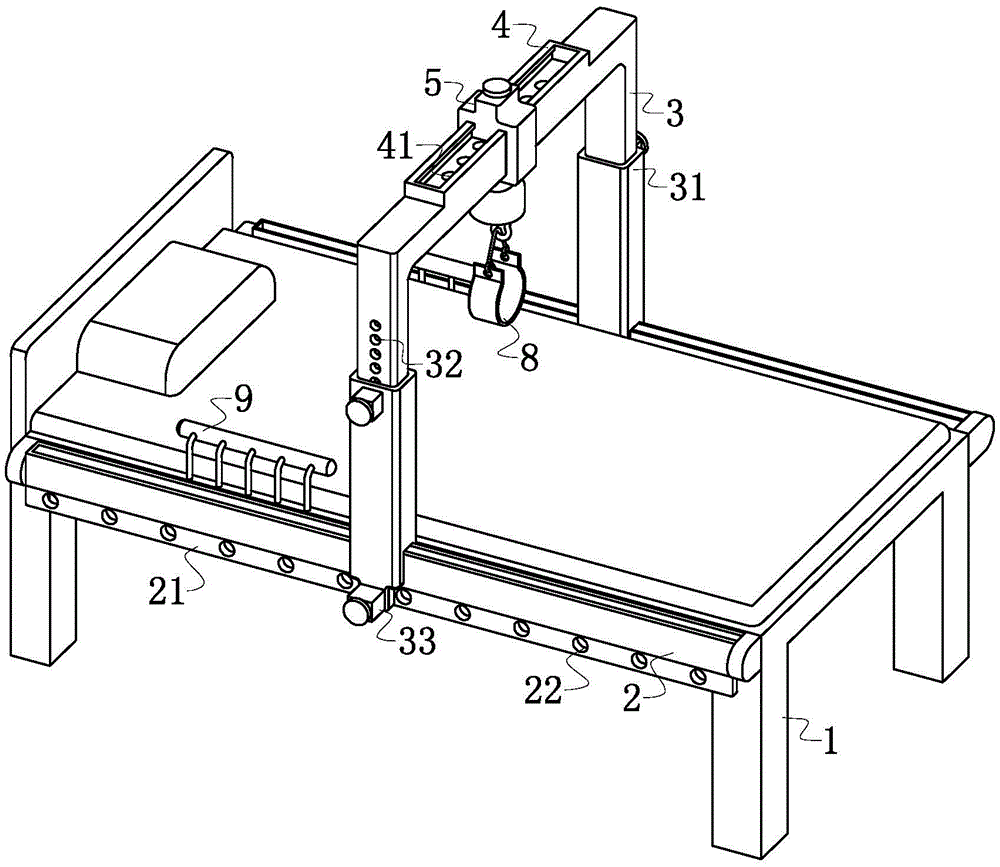
In the embodiment, referring to fig. 1-3, a lower limb rehabilitation training device for orthopedic nursing comprises a bed body 1, wherein two bilateral symmetrical handles 9 are arranged at the edge of the upper end of the bed body 1. The top of the bed body 1 is connected with a liftable portal 3 along the length direction in a reciprocating sliding manner, the two ends of the portal 3 are fixed with the bed body 1 through a first limiting component 36, the upper end of the portal 3 is connected with an adjusting seat 5 in a reciprocating sliding manner, the adjusting seat 5 is fixed with the portal 3 through a second limiting component 54, and the bottom of the adjusting seat 5 is connected with a spring damper 6 in a threaded manner.
The left and right sides of the bed body 1 all is provided with a first slide rail 2 along its length direction, the equal vertical gliding sleeve 31 of its length direction of edge that is provided with of each first slide rail 2, the both ends of portal 3 all insert in the sleeve 31 that corresponds and rather than sliding fit, a plurality of third locating holes 32 have been seted up to the impartial interval in the left and right sides of portal 3, the outside of each sleeve 31 all is provided with the spacing subassembly 37 of third locating hole 32 matched with third, the lower extreme of each first slide rail 2 all is provided with a limiting plate 21 rather than isometric, the impartial interval of each limiting plate 21 has seted up a plurality ofly and first locating hole 22 of first spacing subassembly 36 matched with.
The first limiting component 36 and the third limiting component 37 each include a hollow adjusting cap 33 and an adjusting pin 35 slidably connected to the corresponding adjusting cap 33, the adjusting pin 35 is respectively matched with the corresponding first positioning hole 22 or the third positioning hole 32, each adjusting pin 35 is provided with a stop ring 34 in the corresponding adjusting cap 33, and a return spring 38 sleeved on the corresponding adjusting pin 35 is provided between the bottom of each adjusting cap 33 and the corresponding stop ring 34.
The upper end of portal 3 is provided with second slide rail 4, adjusts seat 5 and second slide rail 4 sliding fit, and equidistant a plurality of and second spacing subassembly 54 matched with second locating hole 41 have been seted up to second slide rail 4.
The second limiting component 54 includes a hollow pin seat 51 and a pin cap 53, the pin seat 51 is disposed at the upper end of the adjusting seat 5, the pin seat 51 is slidably connected to a fixing pin 52 matched with the second positioning hole 41, and the upper end of the fixing pin 52 penetrates through the adjusting seat 5 and is connected to the pin cap 53.
The spring damper 6 comprises a hollow shell 61 with an opening at the lower end and a connecting portion 62 arranged at the upper end of the shell 61, the connecting portion 62 is in threaded connection with the adjusting seat 5, an elastic rope 63 is downwards arranged at the top end in the shell 61, the lower end of the elastic rope 63 is connected with a hook 65 positioned below the shell 61, an elastic blocking piece 66 is arranged at the opening of the hook 65, a training spring 64 which is sleeved on the elastic rope 63 and connected with the upper end of the hook 65 is arranged at the top end in the shell 61, and the hook 65 is connected with a leg hanging belt 8 through a hanging rope 7.
The elastic cord 63 is made of soft rubber material, and the length thereof is longer than the distance between the hook 65 and the inner top of the shell 61 in an unstressed state.
The working process is as follows:
when a patient needs lower limb rehabilitation training, the portal frame 3 is firstly slid to the tail end position of the bed body 1 to bring convenience for the patient to go to bed, after the patient is in place in a prone position, the portal frame 3 is slid to enable the leg hanging belt 8 to be located at a proper position of the leg of the patient and fixed by the first limiting assembly 36, then the leg hanging belt 8 is vertically moved to a proper position by adjusting the height of the portal frame 3 according to the requirement of the rehabilitation training, the lower limb of the patient is placed into the leg hanging belt 8, the patient can pull down the leg hanging belt 8 by overcoming the resistance of the spring damper 6 downwards by the lower limb, after the leg hanging belt 8 is completely pulled down, the lower limb slowly enables the leg hanging belt 8 to return by overcoming the tension of the spring damper 6 by force, and complete straight leg lifting training is completed, and the quadriceps and iliocostal muscles are trained.
The posture of the patient is adjusted to enable the patient to lie on the side, the position of the leg hanging belt 8 is adjusted, the patient puts the lower limb into the leg hanging belt 8, the leg hanging belt 8 is pulled down to carry out side position straight leg lifting, and the tensor fascia lata on the outer side of the thigh is trained. The posture is adjusted to enable the patient to lie on the left lateral side of the leg, the position of the leg hanging belt 8 is adjusted to enable the patient to bend the right leg, the right foot is stepped on a bed behind the popliteal fossa of the left leg to help support and keep the body stable, then the left leg is straightened, the left leg is lifted upwards and placed into the leg hanging belt 8, the inner side of the leg is lifted straight, and adductor muscles on the inner side of thighs and muscle fibers on the inner side of quadriceps femoris are trained.
Wherein, because the length of elastic rope 63 is slightly greater than the distance between couple 65 and the interior top of casing 61, the spring deformation but elastic rope 63 is still lax when the patient just begins to pull down shank strap 8 with the lower limbs, only need overcome the elasticity of spring this moment, need overcome the elasticity of elastic rope 63 and spring when pulling down to a certain distance, improve the training effect.
The present embodiment is only for explaining the present invention, and it is not limited to the present invention, and those skilled in the art can make modifications to the present embodiment without inventive contribution as required after reading the present specification, but all of them are protected by patent laws within the scope of the claims of the present invention.