Double-balloon extension type tracheal intubation catheter with side holes
Technical Field
The utility model relates to the field of medical auxiliary equipment, concretely relates to take two sacculus extension type trachea cannula pipes of side opening.
Background
At present, in critical rescue, the establishment of an artificial airway is very important, invasive mechanical ventilation can be performed through the establishment of the artificial airway, and the ventilation and air exchange functions of a patient are improved. In the aspect of life-threatening megahemoptysis, firstly, establishing an artificial airway which is a key step for successful megahemoptysis rescue, and establishing the artificial airway in emergency rescue, namely, a tracheal cannula is the first choice; in addition, when hemoptysis occurs, isolation of the bleeding side lung is also an important treatment measure, and in addition to inserting the tracheal intubation catheter into the healthy side lung for ventilation, another method is to use a guide wire guide balloon to isolate the bleeding side lung so as to ensure ventilation of the healthy side lung.
At present, the length of a conventional tracheal cannula is about 30cm, the conventional tracheal cannula is a single saccule and is suitable for being applied to conventional rescue, but the conventional tracheal cannula is not long enough when a hemoptysis patient needs to perform side-strengthening lung ventilation or side-affected lung isolation. To solve the above problems, the following types of endotracheal intubation catheters have emerged: (1) double-cavity trachea cannula catheter: the tracheal intubation catheter is inserted into a healthy lung to perform single lung ventilation under the condition of double bulbs, and is suitable for conventional lung surgery of thoracic surgery, and is mostly operated by an anesthesiologist; (2) single-cavity trachea cannula extension tube: at present, a single-cavity tracheal intubation extension tube is available, which can be inserted into a left main bronchus and a right main bronchus to ensure ventilation of healthy lateral lungs and isolate bleeding lateral lungs, but needs skillful technology or bronchoscope to guide the operation.
In view of the above, the present inventors have made extensive studies on the above-mentioned drawbacks of the prior art, and have made this invention.
SUMMERY OF THE UTILITY MODEL
The main object of the utility model is to provide a take two sacculus extension type trachea cannula pipe of side opening has the characteristics that make things convenient for the doctor to place trachea cannula in order to guarantee healthy side lung to ventilate to the patient of hemoptysis greatly.
In order to achieve the above purpose, the solution of the present invention is:
a double-balloon extension type tracheal intubation catheter with side holes comprises an intubation body, a first balloon, a second balloon and a guide wire; a main ventilation hole and a side hole which extend along the length direction of the cannula body are respectively formed in the cannula body; the first balloon is positioned on the front side of the cannula body, and the second balloon is positioned on the cannula body and positioned on the rear side of the first balloon; a first inflation connecting pipe and a second inflation connecting pipe which are respectively used for communicating the first balloon and the second balloon are formed on the cannula body; the main ventilation hole of the intubation tube body can be sleeved outside the guide wire.
Further, a first inflation and deflation channel and a second inflation and deflation channel which are respectively used for communicating the first balloon and the second balloon are formed in the intubation tube body; the first inflation and deflation channel is connected with the first inflation connecting pipe, and the second deflation channel is connected with the second inflation connecting pipe.
Further, the cross sections of the main vent hole and the side holes are both circular; the diameter of the main vent hole is larger than the diameter of the side hole.
Further, the section of the cannula body is oval; the first air charging and discharging channel and the second air charging and discharging channel are located between the main ventilation hole and the side hole.
Further, the diameter of the main vent hole is 6-8.5 mm; the diameter of the side hole is 2.8 mm.
Further, the distance between the first balloon and the front end of the tracheal cannula is 10mm, and the distance between the second balloon and the front end of the tracheal cannula is 70 mm.
Further, the length of the cannula body is 430 mm.
Further, the guide wire is 100cm in length and 4mm in diameter.
Furthermore, the upper part of the main ventilation hole is connected with a respirator joint.
Furthermore, a three-cavity two-sac tube is arranged in the side hole in a penetrating way.
After the structure is adopted, the utility model relates to a take two sacculus extension type trachea cannula pipes of side opening, it has following beneficial effect at least:
when the device is used, the guide wire is placed into a trachea of a patient through the guide wire in advance, the ventilation main hole of the elongated trachea cannula catheter can be sleeved on the guide wire, and the elongated trachea cannula catheter can be easily inserted into a left or right main trachea through the guiding effect of the guide wire to ventilate the lung on the healthy side.
The intubation tube body is provided with a first sacculus and a second sacculus, the first sacculus is located at the front end of the extension tube by 1cm, the length of the left main bronchus is 5-7cm, the rear sacculus is 8cm away from the front end of the extension tube, and for right-side pulmonary hemorrhage, the front sacculus can be located in the left main bronchus and the rear sacculus is located in the bronchus, so that the healthy-side pulmonary ventilation and the hemoptysis hemorrhage side blood can not overflow to the healthy side, the bronchus or even the oral cavity and other upper respiratory tracts.
Thirdly, through arranging the side hole, the pore canal of the side hole can be placed into a three-cavity two-balloon tube, for left-side pulmonary hemorrhage, right-side pulmonary ventilation is needed, but the right main bronchus is thick and short, and the cannula is inserted into the position and is easy to slip off, at the moment, the cannula body can be firstly inserted into the left side bronchus, the balloon of the three-cavity two-balloon tube is placed into the side hole, and is inflated, the bleeding left-side lung is isolated, then the cannula body can be retracted onto the carina, and at least one of the first balloon and the second balloon is inflated, so that a fixing effect is achieved; so, put into the sacculus in left bronchus through the side opening and keep apart bleeding side lung, can guarantee again that the right lung ventilates, avoid inserting the pipe into the bleeding slippage problem of right main bronchus.
Compared with the prior art, the utility model discloses a set up first sacculus and second sacculus to be used for putting into three chamber two bag pipes through the side opening, no matter be left side pulmonary hemorrhage or right side pulmonary hemorrhage, the homoenergetic can make things convenient for the doctor to carry out the shutoff to the side of bleeding, guarantees to be good for the side lung and ventilates.
Drawings
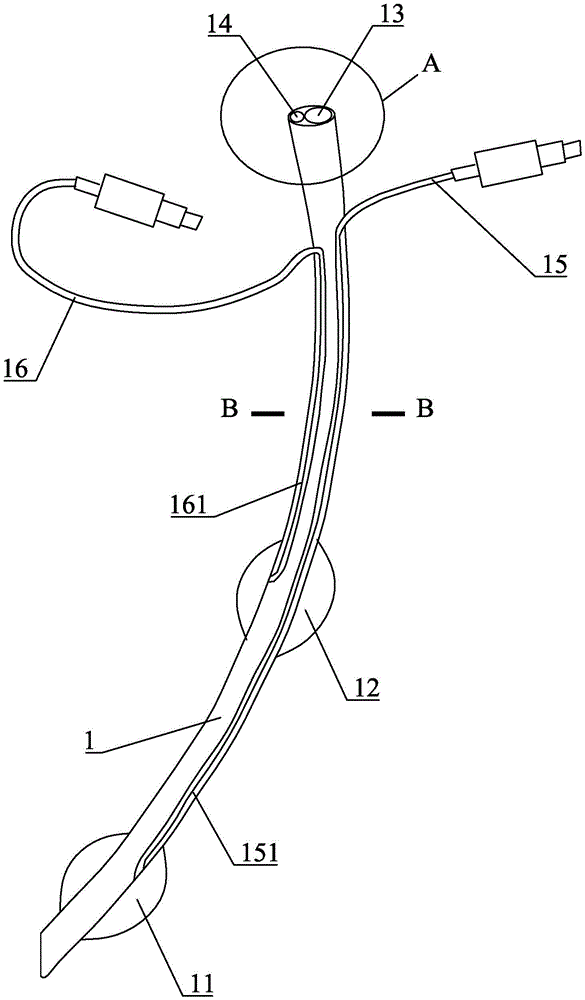
Fig. 1 is a schematic view of a three-dimensional structure of a double-balloon extended tracheal intubation catheter with a side hole.
Fig. 2 is an enlarged schematic view of a portion a in fig. 1.
Fig. 3 is an enlarged schematic cross-sectional view taken at B-B in fig. 1.
Fig. 4 is a partial schematic view of the present invention with a ventilator adapter.
In the figure:
an intubation tube body 1; a first balloon 11; a second balloon 12; a main vent hole 13; the side hole 14; a first pneumatic connection tube 15; a first inflation/deflation passage 151; a second pneumatic connecting tube 16; a second inflation/deflation channel 161;
a ventilator connector 2.
Detailed Description
In order to further explain the technical solution of the present invention, the present invention is explained in detail by the following embodiments.
As shown in fig. 1 to 4, the double-balloon extended endotracheal intubation catheter with side holes according to the present invention includes an intubation main body 1, a first balloon 11, a second balloon 12 and a guide wire; a main ventilation hole 13 and a side hole 14 which extend along the length direction of the cannula body 1 are respectively formed in the cannula body 1; the first balloon 11 is positioned at the front side of the cannula body 1, and the second balloon 12 is positioned on the cannula body 1 and positioned at the rear side of the first balloon 11; a first inflation connecting pipe 15 and a second inflation connecting pipe 16 which are respectively used for communicating the first balloon 11 and the second balloon 12 are formed on the cannula body 1; the main ventilation hole 13 of the intubation tube body 1 can be sleeved outside the guide wire. Preferably, the guide wire is 100cm long and 4mm in diameter.
When the trachea cannula is used, the guide wire is placed into a trachea of a patient through the advanced guide wire, the ventilation main hole 13 of the extension type trachea cannula catheter can be sleeved on the guide wire, the extension type trachea cannula catheter can be easily inserted into a left or right main bronchus under the guiding effect of the guide wire, the side-healthy lung ventilation is carried out, the cannula body 1 is provided with the first saccule 11 and the second saccule 12, the first saccule 11 is located at the front end 1cm of the extension tube, the rear saccule is 8cm away from the front end of the extension tube due to the fact that the length of the left main bronchus is 5-7cm, and for right side lung bleeding, the front saccule can be located in the left main bronchus, the rear saccule is located in the trachea, and the side-healthy lung ventilation is fully guaranteed while blood on the side with hemoptysis cannot overflow to upper respiratory tracts.
Through the arrangement of the side hole 14, a pore passage of the side hole 14 can be placed into the three-cavity two-balloon tube, for left-side pulmonary hemorrhage, right pulmonary ventilation is required, but the right main bronchus is thick and short, and the cannula is inserted into the position and is easy to slip off, at the moment, the cannula body 1 can be firstly inserted into the left side bronchus, the balloon of the three-cavity two-balloon tube is placed into the side hole 14, the left-side pulmonary hemorrhage is isolated by inflating, then the cannula body 1 can be retracted to the carina, and at least one of the first balloon 11 and the second balloon 12 is inflated to play a role in fixing; therefore, the side hole 14 is used for placing the saccule in the left bronchus to isolate the bleeding side lung, and the ventilation of the right lung can be ensured, thereby avoiding the problem of bleeding and slipping caused by inserting the catheter into the right main bronchus.
When a patient with fatal hemoptysis is sedated (midazolam or propofol), a guide wire with the diameter of 4mm and the length of 100cm is firstly introduced to a healthy side lung through a direct/indirect laryngoscope, or an intubation is guided by an endotracheal lens: (1) if bleeding is in the right lung: after the left main bronchus is intubated, the first saccule 11 and the second saccule 12 are inflated to maintain the ventilation of the left lung and isolate the right bleeding side lung; (2) if bleeding is in the left lung: similarly, the intubation tube is inserted into a main bronchus at the left side, a three-cavity two-balloon tube is arranged in the main bronchus through the side hole 14, and after the balloon is inflated, the intubation tube body 1 is retracted into the bronchus, so that the isolation of the left lung and the ventilation of the right lung are ensured.
Preferably, a first inflation/deflation channel 151 and a second inflation/deflation channel 161 for communicating the first balloon 11 and the second balloon 12 respectively are further formed in the cannula body 1; the first inflation/deflation channel 151 is connected with the first inflation connecting pipe 15, and the second deflation channel is connected with the first inflation connecting pipe 15.
Preferably, the main vent hole 13 and the side hole 14 are both circular in cross section; the main vent hole 13 has a diameter greater than that of the side hole 14. Furthermore, the diameter of the main vent hole 13 is 6-8.5 mm; the diameter of the side hole 14 is 2.8 mm. Thus, the side hole 14 can facilitate the three-lumen two-balloon tube to pass through.
Preferably, as shown in fig. 3, the section of the cannula body 1 is oval; the first and second inflation and deflation channels 151 and 161 are located between the main vent hole 13 and the side hole 14. In this way, the first inflation/deflation channel 151, the second inflation/deflation channel 161, the main ventilation hole 13 and the side hole 14 can be distributed in the cannula body 1 more reasonably, thereby ensuring the reasonable utilization of the internal space of the cannula body 1.
Preferably, the length of the cannula body 1 is 430mm, which is longer than that of a traditional trachea cannula, so that the operation of a doctor is convenient. Furthermore, the upper part of the main ventilation hole 13 is connected with a respirator connector 2, so that the respirator is conveniently connected; furthermore, the expiratory joint 2 is detachably connected with the main ventilation hole 13 of the cannula body 1.
Compared with the prior art, the utility model discloses a set up first sacculus 11 and second sacculus 12 to be used for putting into three chamber two bag pipes through side opening 14, no matter be left side pulmonary hemorrhage or right side pulmonary hemorrhage, the homoenergetic makes things convenient for the doctor to carry out the shutoff to the side of bleeding, guarantees to be good for the side lung and ventilates.
The above embodiments and drawings are not intended to limit the form and style of the present invention, and any suitable changes or modifications made by those skilled in the art should not be construed as departing from the scope of the present invention.