CN210706824U - Automotive Electrochromic Window Control System - Google Patents
Automotive Electrochromic Window Control System Download PDFInfo
- Publication number
- CN210706824U CN210706824U CN201921379365.4U CN201921379365U CN210706824U CN 210706824 U CN210706824 U CN 210706824U CN 201921379365 U CN201921379365 U CN 201921379365U CN 210706824 U CN210706824 U CN 210706824U
- Authority
- CN
- China
- Prior art keywords
- microprocessor
- resistor
- window
- transparency
- color
- Prior art date
- Legal status (The legal status is an assumption and is not a legal conclusion. Google has not performed a legal analysis and makes no representation as to the accuracy of the status listed.)
- Active
Links
Images

Landscapes
- Power-Operated Mechanisms For Wings (AREA)
Abstract
Description
技术领域technical field
本实用新型涉及汽车变色车窗领域,特别涉及一种汽车电致变色车窗控制系统。The utility model relates to the field of automobile color-changing windows, in particular to an automobile electrochromic window control system.
背景技术Background technique
随着我国经济的迅速发展以及人民生活水平的不断提高,我国普通家庭以及单位的车辆保有量不断上升。人们在享受汽车带来的便捷的同时,更多的考虑到车辆的舒适性、安全性及隐私性。在组成车身的众多零部件中,车窗便是重要的组成之一,在阳光强烈照射的情况下,变色车窗不仅可以降低太阳光线对车内用户的照射强度,还可以起到保护用户隐私的效果。With the rapid development of my country's economy and the continuous improvement of people's living standards, the number of vehicles owned by ordinary families and units in my country has continued to rise. While enjoying the convenience brought by the car, people also take into account the comfort, safety and privacy of the vehicle. Among the many parts that make up the car body, the car window is one of the important components. In the case of strong sunlight, the color-changing car window can not only reduce the intensity of the sun's rays to the users in the car, but also protect the user's privacy. Effect.
目前,汽车变色玻璃在汽车领域尚无应用实绩,但是已有汽车变色玻璃的专利申请,目前的变色玻璃控制方式主要有以下两种,一种是在变色玻璃系统中增加光传感器和温度传感器,当光照强度或车内温度达到一定值时,车窗自动变色用于阻挡外部光线进入车内,但是,如果车辆在短时间内从光线强的环境行驶到光线弱的环境,或者是短时间内从光线弱的环境行驶到光线强的环境,这种光线强度的突然改变容易导致驾驶员出现短时视盲和晕眩,使驾驶员视线受阻,影响安全驾驶;另一种是在变色玻璃系统中增加GPS信号,在这个情况下只有当车辆进入隧道或出隧道时车窗才会自动变色,以避免进入隧道或出隧道时外部光线的急剧变化,导致车辆驾驶员看不清物体发生意外,但是,这种变色方式只能用在进入隧道和出隧道的时候,不能在其它路段变色,应用环境太少,无法满足车辆在日常行驶中的光线需求。而且,以上两种控制方式均为汽车玻璃自动变色,驾驶员无法自主调节变色玻璃的透明度,车辆行驶过程中,如果车窗在非驾驶员意志的情况下改变了车窗透明度,很容易导致驾驶员视线受阻,发生意外。At present, car color-changing glass has no actual application in the automotive field, but there is a patent application for automobile color-changing glass. The current color-changing glass control methods mainly include the following two. One is to add light sensors and temperature sensors to the color-changing glass system. When the light intensity or the temperature inside the car reaches a certain value, the windows are automatically discolored to block external light from entering the car. When driving from a weak light environment to a strong light environment, the sudden change of the light intensity can easily lead to short-term blindness and dizziness of the driver, obstructing the driver's vision and affecting safe driving; the other is in the color-changing glass system In this case, the window will automatically change color only when the vehicle enters or exits the tunnel, so as to avoid the sudden change of external light when entering or exiting the tunnel, which may cause the driver of the vehicle to fail to see the object and cause an accident. However, this discoloration method can only be used when entering and exiting the tunnel, and cannot be discolored in other road sections, and the application environment is too small to meet the light requirements of vehicles in daily driving. Moreover, the above two control methods are the automatic discoloration of the car glass, and the driver cannot adjust the transparency of the discolored glass independently. During the driving process of the vehicle, if the window transparency is changed without the driver's will, it is easy to cause driving. The crew's vision was blocked and an accident occurred.
发明内容SUMMARY OF THE INVENTION
本实用新型的目的是针对现有技术的不足,提供一种汽车电致变色车窗控制系统,其能手动控制车窗变色膜的透明度,增加驾驶安全性。The purpose of the utility model is to aim at the deficiencies of the prior art, to provide an automotive electrochromic window control system, which can manually control the transparency of the window discoloration film and increase driving safety.
本实用新型的技术方案是:一种汽车电致变色车窗控制系统,包括电源、贴于车窗内侧的车窗变色膜、车窗控制单元,所述车窗控制单元的微处理器通过导线连接一变色膜开关电路,所述微处理器为集成有电压型PWM控制器的微处理器,所述微处理器的电压型PWM控制器与一变色膜控制电路电连接,所述变色膜控制电路通过导线与车窗变色膜连接,所述变色膜开关电路、变色膜控制电路的电源端均与电源连接,接地端均接地,形成通过微处理器改变电压型PWM控制器的占空比调节车窗变色膜透明度的车窗变色控制。The technical scheme of the utility model is: an electrochromic window control system for an automobile, comprising a power supply, a window discoloration film attached to the inner side of the window, and a window control unit, wherein the microprocessor of the window control unit passes through a wire A color-changing film switch circuit is connected, the microprocessor is a microprocessor integrated with a voltage-type PWM controller, and the voltage-type PWM controller of the microprocessor is electrically connected with a color-changing film control circuit, and the color-changing film controls The circuit is connected with the car window color-changing film through wires, the power terminals of the color-changing film switch circuit and the color-changing film control circuit are connected to the power supply, and the ground terminals are all grounded to form the duty cycle adjustment of the voltage-type PWM controller by changing the microprocessor. Window tinting control of the transparency of the window tinting film.
所述变色膜开关电路采用三挡数字开关电路,该三挡数字开关电路包括透明度增加挡开关、透明度降低挡开关,所述透明度增加挡开关一端连接第一二极管的负极,另一端接地,透明度增加挡开关一端与第一二极管的负极之间的结点连接第一电容的一端,所述第一二极管的正极经第二电阻连接微处理器,第一二级管的正极与第二电阻之间的结点经第一电阻连接5V电源,所述第二电阻与微处理器之间的结点连接第三电阻和第二电容的一端,所述透明度降低挡开关一端连接第二二极管的负极,另一端接地,透明度降低挡开关一端与第二二极管的负极之间的结点连接第三电容的一端,所述第二二极管的正极经第五电阻连接微处理器,第二二极管的正极与第五电阻之间的结点经第四电阻连接5V电源,所述第五电阻与微处理器之间的结点连接第六电阻和第四电容的一端,所述第一电容、第二电容、第三电阻、第三电容、第六电阻和第四电容的另一端均接地。The color-changing membrane switch circuit adopts a three-speed digital switch circuit, and the three-speed digital switch circuit includes a transparency increasing block switch and a transparency decreasing block switch. One end of the transparency increasing block switch is connected to the negative electrode of the first diode, and the other end is grounded. The node between one end of the transparency increasing block switch and the negative electrode of the first diode is connected to one end of the first capacitor. The positive electrode of the first diode is connected to the microprocessor through the second resistor, and the positive electrode of the first diode is connected to the microprocessor. The node between the second resistor and the second resistor is connected to the 5V power supply through the first resistor, the node between the second resistor and the microprocessor is connected to one end of the third resistor and the second capacitor, and one end of the transparency reducing switch is connected to The cathode of the second diode, the other end is grounded, the junction between one end of the transparency reducing switch and the cathode of the second diode is connected to one end of the third capacitor, and the anode of the second diode is connected through the fifth resistor Connect the microprocessor, the node between the anode of the second diode and the fifth resistor is connected to the 5V power supply through the fourth resistor, and the node between the fifth resistor and the microprocessor is connected to the sixth resistor and the fourth resistor One end of the capacitor, the other ends of the first capacitor, the second capacitor, the third resistor, the third capacitor, the sixth resistor and the fourth capacitor are all grounded.
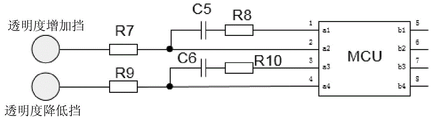
所述变色膜开关电路采用电容式开关电路,该电容式开关电路包括透明度增加挡和透明度降低挡,所述透明增加挡和透明降低挡均由金属片与触摸绝缘层构成,所述透明度增加挡的金属片经第七电阻连接微处理器的二号引脚,所述第七电阻与微处理器之间的结点经第五电容和第八电阻连接微处理器的一号引脚,所述透明度降低挡的金属片经第九电阻连接微处理器的四号引脚,所述第九电阻和微处理器之间的结点经第六电容和第十电阻连接微处理器的三号引脚。The color-changing membrane switch circuit adopts a capacitive switch circuit. The capacitive switch circuit includes a transparency increasing block and a transparency decreasing block. The transparency increasing block and the transparency decreasing block are both composed of metal sheets and a touch insulating layer. The transparency increasing block The metal sheet is connected to the No. 2 pin of the microprocessor through the seventh resistor, and the node between the seventh resistor and the microprocessor is connected to the No. 1 pin of the microprocessor through the fifth capacitor and the eighth resistor, so The metal sheet of the transparency reducing block is connected to the fourth pin of the microprocessor through the ninth resistor, and the node between the ninth resistor and the microprocessor is connected to the third pin of the microprocessor through the sixth capacitor and the tenth resistor. pin.
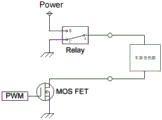
所述变色膜控制电路包括继电器、场效应管,所述场效应管的栅极连接微处理器的PWM控制器,漏极连接车窗变色膜的一端,源极接地,所述车窗变色膜的另一端连接继电器的A引脚,所述继电器的B引脚连接电源,C引脚接地。The color-changing film control circuit includes a relay and a field effect transistor. The gate of the field-effect transistor is connected to the PWM controller of the microprocessor, the drain is connected to one end of the window color changing film, and the source is grounded. The other end of the relay is connected to the A pin of the relay, the B pin of the relay is connected to the power supply, and the C pin is grounded.
所述场效应管采用N沟道场效应管。The field effect transistor adopts an N-channel field effect transistor.
所述车窗控制单元还包括电机驱动电路,该车窗控制单元的微处理器与一车窗控制开关电路导线连接,所述微处理器集成有第二电压型PWM控制器,该第二电压型PWM控制器与电机驱动电路电连接,所述电机驱动电路与车窗驱动电机导线连接,所述电机驱动电路、车窗控制开关电路的电源端均接电源,接地端均接地,所述微处理器接收车窗控制开关电路的指令,通过电机驱动电路控制车窗驱动电机正转或反转实现车窗玻璃的上升或下降。The window control unit also includes a motor drive circuit, the microprocessor of the window control unit is connected with a window control switch circuit wire, the microprocessor is integrated with a second voltage type PWM controller, the second voltage The PWM controller is electrically connected with the motor drive circuit, the motor drive circuit is connected with the window drive motor wire, the power supply terminals of the motor drive circuit and the window control switch circuit are all connected to the power supply, and the ground terminals are all grounded. The processor receives the instruction of the window control switch circuit, and controls the window driving motor to rotate forward or reversely through the motor drive circuit to realize the rise or fall of the window glass.
所述车窗驱动电机内设有一霍尔传感器,所述微处理器根据霍尔传感器的脉冲信号检测车窗的位置和运行方向。The window driving motor is provided with a hall sensor, and the microprocessor detects the position and running direction of the window according to the pulse signal of the hall sensor.
车窗控制单元还包括通信回路,所述通信回路可通过LIN 总线或CAN总线与一总线单元进行通信,所述车窗控制单元的微处理器通过LIN 总线或CAN总线获取车辆的状态信息。The window control unit further includes a communication loop, which can communicate with a bus unit through the LIN bus or the CAN bus, and the microprocessor of the window control unit obtains the status information of the vehicle through the LIN bus or the CAN bus.
采用上述技术方案:所述车窗控制单元的微处理器通过导线连接一变色膜开关电路,该变色膜开关电路为三挡数字开关电路或电容式开关电路,用户可以操作变色膜开关电路上的增加挡或降低挡开关,微处理器通过检测变色膜开关电路的电平高低,从而判断用户是否按下开关。所述微处理器为集成有电压型PWM控制器的微处理器,所述微处理器的电压型PWM控制器与一变色膜控制电路电连接,所述变色膜控制电路通过导线与车窗变色膜连接,所述变色膜开关电路、变色膜控制电路的电源端均与电源连接,接地端均接地,当微处理器检测到用户按下变色膜开关电路的开关后,微处理器将通过改变PWM控制器输出的占空比,使得变色膜控制电路改变施加于车窗变色膜两端的电压,从而调节车窗变色膜的透明度。在车辆行驶途中,用户可以根据外部光照强度的变化,手动控制车窗变色膜的透明度,使车窗变色膜的透明度适合驾驶,一方面可以提高车辆行驶的安全性,另一方面还可以提高驾驶员和乘坐人员的舒适性。The above technical solution is adopted: the microprocessor of the window control unit is connected to a color-changing membrane switch circuit through a wire, and the color-changing membrane switch circuit is a three-speed digital switch circuit or a capacitive switch circuit, and the user can operate the color-changing membrane switch circuit. To increase or decrease the gear switch, the microprocessor determines whether the user presses the switch by detecting the level of the color-changing membrane switch circuit. The microprocessor is a microprocessor integrated with a voltage-type PWM controller, and the voltage-type PWM controller of the microprocessor is electrically connected with a color-changing film control circuit, and the color-changing film control circuit is discolored with the car window through wires Membrane connection, the power terminals of the color-changing membrane switch circuit and the color-changing membrane control circuit are all connected to the power supply, and the ground terminals are all grounded. When the microprocessor detects that the user presses the switch of the color-changing membrane switch circuit, the microprocessor will change the The duty ratio output by the PWM controller makes the color-changing film control circuit change the voltage applied to both ends of the window color-changing film, thereby adjusting the transparency of the window color-changing film. During the driving of the vehicle, the user can manually control the transparency of the window color-changing film according to the change of the external light intensity, so that the transparency of the window color-changing film is suitable for driving. comfort for occupants and occupants.
所述变色膜开关电路采用三挡数字开关电路,所述三挡数字开关为机械式复位开关,该三挡数字电路包括透明度增加挡开关、透明度降低挡开关,若透明度增加挡开关和透明度降低挡开关均不按下,则处于空挡状态,该三挡数字开关电路的电路连接简单,按下开关后可自动复位,便于车辆驾驶员在驾驶途中操作。The color-changing membrane switch circuit adopts a three-gear digital switch circuit, and the third-gear digital switch is a mechanical reset switch. The three-gear digital circuit includes a transparency-increasing switch and a transparency-reducing switch. If the transparency increases the switch and the transparency reduces the switch If the switch is not pressed, it is in the neutral state. The circuit connection of the three-speed digital switch circuit is simple, and it can be automatically reset after pressing the switch, which is convenient for the vehicle driver to operate while driving.
所述变色膜开关电路采用电容式开关电路,该电容式开关电路包括透明度增加挡和透明度降低挡,所述透明增加挡和透明降低挡均由金属片与触摸绝缘层构成,在使用该电容式开关时,由于人体是导体,当人体触摸到透明度增加挡或透明度降低挡的触摸绝缘层时,人体与金属片会形成一个电容,形成的这个电容可以向电路中的并联电阻放电,因此微处理器通过周期性地检测放电时间,从而判断用户是否按下开关按键。The color-changing membrane switch circuit adopts a capacitive switch circuit. The capacitive switch circuit includes a transparency increasing block and a transparency decreasing block. The transparency increasing block and the transparency decreasing block are both composed of metal sheets and a touch insulating layer. When switching, because the human body is a conductor, when the human body touches the touch insulating layer with an increase in transparency or a decrease in transparency, the human body and the metal sheet will form a capacitor, and the formed capacitor can discharge to the parallel resistance in the circuit, so the micro-processing The device detects whether the user presses the switch button by periodically detecting the discharge time.
所述变色膜控制电路包括继电器、场效应管,所述场效应管的栅极连接微处理器的电压型PWM控制器,漏极连接车窗变色膜的一端,源极接地,所述车窗变色膜的另一端连接继电器的A引脚,所述继电器的B引脚连接电源,C引脚接地。微处理器通过改变电压型PWM控制器的占空比,来控制场效应管的通断时间,从而改变变色膜控制电路施加在车窗变色膜两端的平均电压,实现车窗变色膜透明度的调节。The color-changing film control circuit includes a relay and a field effect transistor. The grid of the field effect transistor is connected to the voltage-type PWM controller of the microprocessor, the drain is connected to one end of the color-changing film of the window, and the source is grounded. The other end of the color-changing film is connected to the A pin of the relay, the B pin of the relay is connected to the power supply, and the C pin is grounded. The microprocessor controls the on-off time of the FET by changing the duty ratio of the voltage-type PWM controller, thereby changing the average voltage applied by the color-changing film control circuit to the two ends of the color-changing film of the vehicle, and realizing the adjustment of the transparency of the color-changing film of the vehicle window. .
下面结合说明书附图和具体实施例对本实用新型作进一步说明。The present utility model will be further described below with reference to the accompanying drawings and specific embodiments of the description.
附图说明Description of drawings
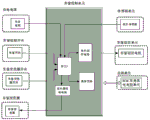
图1为本实用新型的架构框图;Fig. 1 is the structural block diagram of the present utility model;
图2为本实用新型的变色膜控制电路图;Fig. 2 is the color-changing film control circuit diagram of the utility model;
图3为本实用新型的三挡数字开关电路图;3 is a circuit diagram of a three-speed digital switch of the present utility model;
图4为本实用新型的电容式开关电路图;Fig. 4 is the capacitive switch circuit diagram of the utility model;
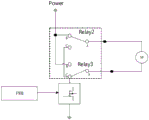
图5为本实用新型的电机驱动电路图。Fig. 5 is the motor drive circuit diagram of the utility model.
具体实施方式Detailed ways
参见图1至图5,一种汽车电致变色车窗控制系统,包括电源、贴于车窗内侧的车窗变色膜、车窗控制单元。所述车窗控制单元的微处理器MCU通过导线连接一变色膜开关电路,所述微处理器为集成有电压型PWM控制器的微处理器,该微处理器MCU采用八位以上处理器,如NXP 9S12ZVC、瑞萨R5F10DPE或功能等同的其它型号,所述变色膜开关电路可采用三挡数字开关电路或电容式开关电路。用户操作变色膜开关电路的透明度增加挡或透明度降低挡的开关按键,微处理器MCU通过检测变色膜开关电路的电平高低从而判断用户是否按下了变色膜开关电路的开关按键。所述微处理器的电压型PWM控制器与一变色膜控制电路电连接,该变色膜控制电路包括继电器relay、场效应管MOSFET,所述场效应管的栅极g连接微处理器中的电压型PWM控制器,漏极d连接车窗变色膜的一端,源极s接地,该场效应管MOSFET采用N沟道场效应管,所述车窗变色膜的另一端连接继电器relay的A引脚,所述继电器relay的B引脚连接电源,C引脚接地。所述变色膜控制电路通过导线与车窗变色膜连接,所述变色膜开关电路、变色膜控制电路的电源端均与电源连接,接地端均接地,使变色膜开关电路、变色膜控制电路分别形成回路。当微处理器MCU检测到变色膜开关电路的开关按键按下时,向变色膜控制电路中的继电器relay发出指令,使继电器relay通电,同时微处理器MCU通过电压型PWM控制器的输出占空比控制场效应管MOSFET的导通以及关断,从而改变变色膜控制电路施加于车窗变色膜两端的平均电压,从而调节车窗变色膜的透明度,实现手动对车窗变色的控制,若微处理器MCU检测到变色膜开关电路的开关按键没有按下,则继电器relay断电,车窗变色膜的透明度不发生改变。Referring to Figures 1 to 5, an automotive electrochromic window control system includes a power supply, a window color-changing film attached to the inner side of the window, and a window control unit. The microprocessor MCU of the window control unit is connected to a color-changing membrane switch circuit through a wire, the microprocessor is a microprocessor integrated with a voltage-type PWM controller, and the microprocessor MCU adopts an eight-bit or more processor. Such as NXP 9S12ZVC, Renesas R5F10DPE or other models with equivalent functions, the color-changing membrane switch circuit can adopt a three-speed digital switch circuit or a capacitive switch circuit. The user operates the switch button of the color-changing membrane switch circuit to increase the transparency or reduce the transparency, and the microprocessor MCU determines whether the user has pressed the switch button of the color-changing membrane switch circuit by detecting the level of the color-changing membrane switch circuit. The voltage-type PWM controller of the microprocessor is electrically connected with a color-changing film control circuit, the color-changing film control circuit includes a relay relay, a field effect transistor MOSFET, and the gate g of the field effect transistor is connected to the voltage in the microprocessor type PWM controller, the drain d is connected to one end of the window color-changing film, the source s is grounded, the field effect transistor MOSFET adopts an N-channel field effect transistor, and the other end of the window color-changing film is connected to the A pin of the relay relay, The B pin of the relay relay is connected to the power supply, and the C pin is grounded. The color-changing film control circuit is connected with the car window color-changing film through wires, the power terminals of the color-changing film switch circuit and the color-changing film control circuit are all connected to the power supply, and the ground terminals are all grounded, so that the color-changing film switch circuit and the color-changing film control circuit are respectively connected. form a loop. When the microprocessor MCU detects that the switch button of the color-changing film switch circuit is pressed, it sends an instruction to the relay relay in the color-changing film control circuit to energize the relay. At the same time, the microprocessor MCU is occupied by the output of the voltage-type PWM controller The ratio controls the turn-on and turn-off of the MOSFET, thereby changing the average voltage applied by the color-changing film control circuit to both ends of the window color-changing film, thereby adjusting the transparency of the window color-changing film, and realizing manual control of the color-changing of the vehicle window. When the processor MCU detects that the switch button of the color-changing film switch circuit is not pressed, the relay relay is powered off, and the transparency of the window color-changing film does not change.
所述变色膜开关电路采用三挡数字开关电路,该三挡数字开关为机械式复位开关,所述三挡数字开关电路包括透明度增加挡开关、透明度降低挡开关,所述透明度增加挡开关连接第一二极管D1的负极,另一端接地,透明度增加挡开关一端与第一二极管D1的负极之间的结点连接第一电容C1的一端,所述第一二极管D1的正极经第二电阻R2连接微处理器,第一二级管D1的正极与第二电阻R2之间的结点经第一电阻R1连接5V电源,所述第二电阻R2与微处理器MCU之间的结点连接第三电阻R3和第二电容C2的一端,当透明度增加挡开关未按下时,微处理器MCU检测到高电平,当透明度增加挡开关按下时,第一二极管D1导通起到防止产生反向电压的作用,此时微处理器MCU检测到低电平,即判断透明度增加挡开关被按下;所述透明度降低挡开关一端连接第二二极管D2的负极,另一端接地,透明度降低挡开关一端与第二二极管D2的负极之间的结点连接第三电容C3的一端,所述第二二极管D2的正极经第五电阻R5连接微处理器MCU,第二二极管D2的正极与第五电阻R5之间的结点经第四电阻R4连接5V电源,所述第五电阻R5与微处理器MCU之间的结点连接第六电阻R6和第四电容C4的一端,当透明度降低挡开关未按下时,微处理器MCU检测到高电平,当透明度降低挡开关被按下时,第二二极管D2导通起到防止产生反向电压的作用,此时微处理器MCU检测到低电平,即判断透明度降低挡开关被按下,所述透明度增加档开关、透明度降低挡开关、第一电容C1、第二电容C2、第三电阻R3、第三电容C3、第六电阻R6和第四电容C4的另一端均接地。若透明度增加挡开关和透明度降低挡开关均不按下,则为空挡。所述第一电容C1、第二电容C2、第三电容C3、第四电容C4均起到滤波的作用,第一电阻R1起到分压作用,防止第一二极管D1上的电压过大损坏第一二极管D1,所述第四电阻R4也起到分压作用,防止第二二极管D2上的电压过大损坏第二二极管D2,所述第二电阻R2、第五电阻R5起到限流作用,防止电流过大损坏微处理器MCU,所述第三电阻R3、第六电阻R6起到分压作用。该三挡数字开关电路的电路连接简单,按下开关后可自动复位,便于车辆驾驶员在驾驶图中操作。The color-changing membrane switch circuit adopts a three-gear digital switch circuit, which is a mechanical reset switch. The three-gear digital switch circuit includes a transparency increase switch and a transparency decrease switch, and the transparency increase switch is connected to the third gear. The cathode of a diode D1, the other end is grounded, the node between one end of the transparency increasing switch and the cathode of the first diode D1 is connected to one end of the first capacitor C1, and the anode of the first diode D1 is The second resistor R2 is connected to the microprocessor, the junction between the anode of the first diode D1 and the second resistor R2 is connected to the 5V power supply through the first resistor R1, and the connection between the second resistor R2 and the microprocessor MCU The node is connected to one end of the third resistor R3 and the second capacitor C2. When the transparency increase switch is not pressed, the microprocessor MCU detects a high level. When the transparency increase switch is pressed, the first diode D1 Conduction plays the role of preventing the generation of reverse voltage. At this time, the microprocessor MCU detects a low level, that is, it determines that the transparency increase switch is pressed; one end of the transparency decrease switch is connected to the negative electrode of the second diode D2 , the other end is grounded, the node between one end of the transparency reducing switch and the negative electrode of the second diode D2 is connected to one end of the third capacitor C3, and the positive electrode of the second diode D2 is connected to the microprocessor through the fifth resistor R5 MCU, the node between the anode of the second diode D2 and the fifth resistor R5 is connected to the 5V power supply through the fourth resistor R4, and the node between the fifth resistor R5 and the microprocessor MCU is connected to the sixth resistor One end of R6 and the fourth capacitor C4, when the transparency lowering switch is not pressed, the microprocessor MCU detects a high level, and when the transparency lowering switch is pressed, the second diode D2 conducts to prevent The effect of generating a reverse voltage, at this time, the microprocessor MCU detects a low level, that is, it determines that the transparency reduction gear switch is pressed, the transparency increase gear switch, the transparency reduction gear switch, the first capacitor C1, and the second capacitor C2. , the other ends of the third resistor R3, the third capacitor C3, the sixth resistor R6 and the fourth capacitor C4 are all grounded. If neither the transparency increase switch nor the transparency decrease switch is pressed, it is neutral. The first capacitor C1, the second capacitor C2, the third capacitor C3, and the fourth capacitor C4 all play the role of filtering, and the first resistor R1 plays the role of voltage divider to prevent the voltage on the first diode D1 from being too large If the first diode D1 is damaged, the fourth resistor R4 also acts as a voltage divider to prevent the voltage on the second diode D2 from being too large to damage the second diode D2. The second resistor R2, the fifth The resistor R5 plays a current limiting role to prevent the microprocessor MCU from being damaged by excessive current, and the third resistor R3 and the sixth resistor R6 play a voltage dividing role. The circuit connection of the three-speed digital switch circuit is simple, and the switch can be automatically reset after pressing the switch, which is convenient for the vehicle driver to operate in the driving chart.
所述变色膜开关电路采用电容式开关电路,该电容式开关电路包括透明度增加挡和透明度降低挡,所述透明增加挡和透明降低挡均由金属片与触摸绝缘层构成,所述透明度增加挡的金属片经第七电阻R7连接微处理器MCU的二号引脚,所述第七电阻R7与微处理器MCU之间的结点经第五电容C5和第八电阻R8连接微处理器MCU的一号引脚,所述透明度降低挡的金属片经第九电阻R9连接微处理器MCU的四号引脚,所述第九电阻R9和微处理器MCU之间的结点经第六电容C6和第十电阻R10连接微处理器MCU的三号引脚。由于人体是导体,当人体触摸到触摸绝缘层时,人体与开关按键中的金属片会形成一个电容,形成的这个电容与并联的第八电阻R8或第十电阻R10构成了RC电路。由于电容具有储存电量的特性,若微处理器MCU对开关按键输入高电平,则相当于对开关按键进行充电,人体与金属片形成的电容储存电量,当微处理器MCU停止对开关按键充电后,人体与金属片形成的电容将对并联的电阻持续放电一段时间。当人体未触摸到触摸绝缘层时,人体与开关按键之间则不会形成电容,微处理器MCU对开关按键停止充电后,开关按键不会对并联的电阻持续放电,因此微处理器MCU通过周期性检测第八电阻R8和第十电阻R10端的放电时间来判断人体是否触摸到开关按键,从而判定是否触发了透明度增加挡或透明度降低挡。电容式开关电路的电路连接非常简单,稳定性高,且便于在车辆行驶中操作。The color-changing membrane switch circuit adopts a capacitive switch circuit. The capacitive switch circuit includes a transparency increasing block and a transparency decreasing block. The transparency increasing block and the transparency decreasing block are both composed of metal sheets and a touch insulating layer. The transparency increasing block The metal sheet is connected to the second pin of the microprocessor MCU through the seventh resistor R7, and the node between the seventh resistor R7 and the microprocessor MCU is connected to the microprocessor MCU through the fifth capacitor C5 and the eighth resistor R8 The No. 1 pin of the said transparency reducing block is connected to the No. 4 pin of the microprocessor MCU through the ninth resistor R9, and the node between the ninth resistor R9 and the microprocessor MCU is connected by the sixth capacitor. C6 and the tenth resistor R10 are connected to the third pin of the microprocessor MCU. Since the human body is a conductor, when the human body touches the touch insulating layer, the human body and the metal sheet in the switch button will form a capacitor, and the formed capacitor and the parallel eighth resistor R8 or tenth resistor R10 form an RC circuit. Since the capacitor has the characteristic of storing electricity, if the microprocessor MCU inputs a high level to the switch button, it is equivalent to charging the switch button. The capacitor formed by the human body and the metal sheet stores the electricity. When the microprocessor MCU stops charging the switch button After that, the capacitance formed by the human body and the metal sheet will continue to discharge the parallel resistance for a period of time. When the human body does not touch the touch insulation layer, no capacitance will be formed between the human body and the switch button. After the microprocessor MCU stops charging the switch button, the switch button will not continue to discharge the parallel resistance. Therefore, the microprocessor MCU passes Periodically detect the discharge time of the eighth resistor R8 and the tenth resistor R10 to determine whether the human body touches the switch button, so as to determine whether the transparency increasing block or the transparency decreasing block is triggered. The circuit connection of the capacitive switch circuit is very simple, has high stability, and is easy to operate while the vehicle is running.
所述车窗控制单元还包括电机驱动电路,该车窗控制单元的微处理器与一车窗控制开关电路导线连接,所述车窗控制开关电路可采用三挡数字开关电路、五挡模拟开关电路或电容式开关电路。所述微处理器集成有第二电压型PWM控制器,该第二电压型PWM控制器与电机驱动电路电连接,所述电机驱动电路与车窗驱动电机导线连接,所述电机驱动电路、车窗控制开关电路的电源端均接电源,接地端均接地,所述电机驱动电路包括控制车窗驱动电机通电或断电的第二继电器Relay2、第三继电器Relay3,所述第二继电器Relay2的A引脚、第三继电器Relay3的A引脚均与车窗驱动电机通过导线连接,第二继电器Relay2的C引脚、第三继电器Relay3的C引脚分别与一场效应管的漏极连接,第二继电器Relay2的B引脚、第三继电器Relay3的B引脚分别与电源连接,所述场效应管的栅极与第二电压型PWM控制器连接,源极接地。所述微处理器MCU接收车窗控制开关电路的指令,通过电机驱动电路控制车窗驱动电机正转或反转实现车窗玻璃的上升或下降。当微处理器检测到车窗控制开关电路中的开关按键触发后,微处理器MCU向电机驱动电路发送指令,使第二继电器Relay2或第三继电器Relay3通电,从而控制车窗驱动电机正转或反转,实现车窗玻璃在车窗驱动电机的带动下上升或下降。并且,微处理器MCU通过改变第二电压型PWM控制器输出的占空比,可以控制场效应管导通和关断的时间,从而改变车窗驱动电机两端的平均电压,控制车窗驱动电机的运行速度。当车窗驱动电机两端的平均电压降低后,车窗驱动电机的转速减慢,使车窗缓慢关闭,降低因车窗关闭速度过快与车窗边框发生碰撞产生的撞击声。所述车窗驱动电机内设有一霍尔传感器,所述微处理器根据霍尔传感器的脉冲信号检测车窗的位置和运行方向,车窗驱动电机转动时霍尔传感器会感应出高低脉冲,微处理器MCU根据霍尔传感器的脉冲信号对车窗位置和车窗的运行方向进行检测,若车窗玻璃上升过程中,微处理器MCU根据霍尔传感器的脉冲宽度判断车窗是否遇到障碍物,若脉冲宽度超过设定的阈值时,微处理器MCU将控制车窗驱动电机反向转动从而使车窗玻璃下降,起到防夹的作用。此外,当微处理器MCU通过霍尔传感器发出的脉冲判断当前的车窗是否处于全开状态,若车窗处于全开状态,即使用户操作变色膜开关发出改变车窗变色膜透明度的指令,微处理器MCU也不会改变车窗变色膜的透明度。The window control unit also includes a motor drive circuit, the microprocessor of the window control unit is connected with a window control switch circuit wire, and the window control switch circuit can use a third-speed digital switch circuit, a fifth-speed analog switch circuit or capacitive switching circuit. The microprocessor is integrated with a second voltage type PWM controller, the second voltage type PWM controller is electrically connected with the motor drive circuit, the motor drive circuit is connected with the window drive motor wire, the motor drive circuit, the vehicle The power terminals of the window control switch circuit are all connected to the power supply, and the ground terminals are all grounded. The motor drive circuit includes a second relay Relay2 and a third relay Relay3 that control the power-on or power-off of the window drive motor. A of the second relay Relay2 The pin and the A pin of the third relay Relay3 are connected with the window drive motor through wires. The C pin of the second relay Relay2 and the C pin of the third relay Relay3 are respectively connected with the drain of the field effect transistor. The B pin of the second relay Relay2 and the B pin of the third relay Relay3 are respectively connected to the power supply, the gate of the field effect transistor is connected to the second voltage-type PWM controller, and the source is grounded. The microprocessor MCU receives the instruction of the window control switch circuit, and controls the window drive motor to rotate forward or reverse through the motor drive circuit to realize the rise or fall of the window glass. When the microprocessor detects that the switch button in the window control switch circuit is triggered, the microprocessor MCU sends an instruction to the motor drive circuit to energize the second relay Relay2 or the third relay Relay3, thereby controlling the window drive motor to rotate forward or Reversed, so that the window glass rises or falls under the drive of the window drive motor. In addition, the microprocessor MCU can control the turn-on and turn-off time of the FET by changing the duty cycle of the output of the second voltage-type PWM controller, thereby changing the average voltage across the window drive motor and controlling the window drive motor. running speed. When the average voltage at both ends of the window drive motor is reduced, the speed of the window drive motor is slowed down, so that the window is slowly closed, and the impact sound caused by the collision of the window frame with the window frame is reduced. The window driving motor is provided with a Hall sensor, and the microprocessor detects the position and running direction of the window according to the pulse signal of the Hall sensor. When the window driving motor rotates, the Hall sensor will sense high and low pulses, and the micro The processor MCU detects the position of the window and the running direction of the window according to the pulse signal of the Hall sensor. If the window glass is rising, the microprocessor MCU judges whether the window encounters an obstacle according to the pulse width of the Hall sensor. , if the pulse width exceeds the set threshold, the microprocessor MCU will control the window drive motor to rotate in the reverse direction, so that the window glass is lowered to prevent clipping. In addition, when the microprocessor MCU judges whether the current window is in the fully open state through the pulse sent by the Hall sensor, if the window is in the fully open state, even if the user operates the color-changing film switch to issue an instruction to change the transparency of the color-changing film of the window, the micro The processor MCU also does not change the transparency of the window film.
车窗控制单元还包括通信回路,所述通信回路可通过LIN 总线或CAN总线与一总线单元进行通信,所述车窗控制单元的微处理器通过LIN 总线或CAN总线获取车辆的状态信息。如果车辆配置了语音控制系统,微处理器MCU可以通过LIN总线或CAN总线获取车窗升降的语音控制指令或车窗变色膜透明度改变的语音控制指令,操作更简便,更智能。The window control unit further includes a communication loop, which can communicate with a bus unit through the LIN bus or the CAN bus, and the microprocessor of the window control unit obtains the status information of the vehicle through the LIN bus or the CAN bus. If the vehicle is equipped with a voice control system, the microprocessor MCU can obtain the voice control command for raising and lowering the window or the voice control command for changing the transparency of the window color-changing film through the LIN bus or the CAN bus, which is easier and smarter to operate.
本实用新型在使用时,车辆驾乘人员可以根据车辆所处的环境的光照强度随时地手动控制车窗变色膜的透明度,防止车窗在非驾乘人员意志的情况下改变车窗透明,能满足不同驾乘人员在车辆内对光照强度的不同需求,提高车辆的舒适性,防止驾驶员因光照强度的突然变化造成的短时视盲,操作起来简单方便,提高驾驶安全性。When the utility model is in use, the driver and passenger of the vehicle can manually control the transparency of the discoloration film of the vehicle window at any time according to the light intensity of the environment where the vehicle is located, so as to prevent the window from changing the transparency of the vehicle window without the will of the driver and passenger, and it can be It can meet the different needs of different drivers and passengers on the light intensity in the vehicle, improve the comfort of the vehicle, and prevent the driver from short-term blindness caused by sudden changes in the light intensity. The operation is simple and convenient, and the driving safety is improved.
Claims (8)
Priority Applications (1)
| Application Number | Priority Date | Filing Date | Title |
|---|---|---|---|
| CN201921379365.4U CN210706824U (en) | 2019-08-23 | 2019-08-23 | Automotive Electrochromic Window Control System |
Applications Claiming Priority (1)
| Application Number | Priority Date | Filing Date | Title |
|---|---|---|---|
| CN201921379365.4U CN210706824U (en) | 2019-08-23 | 2019-08-23 | Automotive Electrochromic Window Control System |
Publications (1)
| Publication Number | Publication Date |
|---|---|
| CN210706824U true CN210706824U (en) | 2020-06-09 |
Family
ID=70966710
Family Applications (1)
| Application Number | Title | Priority Date | Filing Date |
|---|---|---|---|
| CN201921379365.4U Active CN210706824U (en) | 2019-08-23 | 2019-08-23 | Automotive Electrochromic Window Control System |
Country Status (1)
| Country | Link |
|---|---|
| CN (1) | CN210706824U (en) |
Cited By (7)
| Publication number | Priority date | Publication date | Assignee | Title |
|---|---|---|---|---|
| CN111933091A (en) * | 2020-08-27 | 2020-11-13 | 努比亚技术有限公司 | Electrochromic film drive circuit |
| CN112099282A (en) * | 2020-09-28 | 2020-12-18 | 努比亚技术有限公司 | Electrochromic fan control circuit and mobile terminal |
| CN112223989A (en) * | 2020-11-04 | 2021-01-15 | 江西昌河汽车有限责任公司 | An intelligent control method for discoloring car windows by voice and light intensity |
| CN114355693A (en) * | 2021-12-20 | 2022-04-15 | 华南理工大学 | Charge compensation device for electrochromic device and control method |
| CN115397059A (en) * | 2022-08-24 | 2022-11-25 | 天津光电集团有限公司 | Control method for improving color-changing transition effect of RGB light-emitting diode |
| CN116256922A (en) * | 2023-03-13 | 2023-06-13 | 玮锦科技(深圳)有限公司 | An electronically controlled power supply based on SEC film |
| CN118269600A (en) * | 2023-06-20 | 2024-07-02 | 比亚迪股份有限公司 | Electronic sun visor system, control method, device, medium and vehicle |
-
2019
- 2019-08-23 CN CN201921379365.4U patent/CN210706824U/en active Active
Cited By (10)
| Publication number | Priority date | Publication date | Assignee | Title |
|---|---|---|---|---|
| CN111933091A (en) * | 2020-08-27 | 2020-11-13 | 努比亚技术有限公司 | Electrochromic film drive circuit |
| CN111933091B (en) * | 2020-08-27 | 2022-06-21 | 努比亚技术有限公司 | Electrochromic film drive circuit |
| CN112099282A (en) * | 2020-09-28 | 2020-12-18 | 努比亚技术有限公司 | Electrochromic fan control circuit and mobile terminal |
| CN112099282B (en) * | 2020-09-28 | 2023-03-10 | 东莞市擎宇电子科技有限公司 | Electrochromic fan control circuit and mobile terminal |
| CN112223989A (en) * | 2020-11-04 | 2021-01-15 | 江西昌河汽车有限责任公司 | An intelligent control method for discoloring car windows by voice and light intensity |
| CN114355693A (en) * | 2021-12-20 | 2022-04-15 | 华南理工大学 | Charge compensation device for electrochromic device and control method |
| CN114355693B (en) * | 2021-12-20 | 2023-07-18 | 华南理工大学 | A charge compensation device and control method for electrochromic devices |
| CN115397059A (en) * | 2022-08-24 | 2022-11-25 | 天津光电集团有限公司 | Control method for improving color-changing transition effect of RGB light-emitting diode |
| CN116256922A (en) * | 2023-03-13 | 2023-06-13 | 玮锦科技(深圳)有限公司 | An electronically controlled power supply based on SEC film |
| CN118269600A (en) * | 2023-06-20 | 2024-07-02 | 比亚迪股份有限公司 | Electronic sun visor system, control method, device, medium and vehicle |
Similar Documents
| Publication | Publication Date | Title |
|---|---|---|
| CN103556901B (en) | Automotive window intelligent regulating system and control method thereof | |
| CN104563734B (en) | Intelligent vehicle window control method and system | |
| CN205153820U (en) | Car door window prevent system of pressing from both sides | |
| CN213501798U (en) | Touch control type automobile window light adjusting glass | |
| CN203558023U (en) | Vehicular curtain automatic control device | |
| CN201635565U (en) | A car window control system | |
| CN204526751U (en) | The automotive sunshade panel of adjustable light transmitance | |
| CN108798351B (en) | Automobile window speed control circuit and method | |
| CN111942120B (en) | Vehicle skylight control method and system and automobile | |
| CN203713788U (en) | Escape device for vehicle falling into water | |
| CN105292037A (en) | In-car security system device | |
| CN211730996U (en) | Vehicle window glass color adjusting system | |
| CN204340785U (en) | Car seat heating system, automotive seat and automobile | |
| US20180304815A1 (en) | Intelligent light reflection adjusting device, adjusting method thereof and anti-dazzle rearview mirror | |
| CN212148341U (en) | Vehicle with a steering wheel | |
| CN202923350U (en) | Automatically adjust light transmittance windshield | |
| CN107364316B (en) | Intelligent electronic liquid crystal anti-dazzle sun-shading device and control method thereof | |
| CN207257312U (en) | The vehicle-mounted light adjusting system that rear viewing zone is separately controlled with non-rear viewing zone | |
| CN202450928U (en) | Anti-pinch control device of sensorless power window | |
| CN204969113U (en) | Mosquito repellent control system and car | |
| CN210101277U (en) | Vehicle front window glass shading device and vehicle | |
| CN209924739U (en) | A car window management device | |
| CN219056207U (en) | Intelligent automatic toughened glass breaking window device for car in distress | |
| CN216969305U (en) | Automobile skylight | |
| CN201105632Y (en) | Vehicle windscreen glass |
Legal Events
| Date | Code | Title | Description |
|---|---|---|---|
| GR01 | Patent grant | ||
| GR01 | Patent grant |