Hair cutter
Technical Field
The utility model belongs to the technical field of haircut articles for use technique and specifically relates to a haircut is with sharpener.
Background
With the improvement of living standard of people, people pay more and more attention to the requirement of hairstyle. The fashionable hairstyle not only enables people to become young, but also can effectively improve the self-confidence of people. A stylish hairstyle and the unique cutting of the stylist are indiscriminate. A good hairdresser not only creates the style of the hairstyle of the good hairdresser, but also designs the perfect hairstyle according to different people. When a hairdresser designs a hairstyle, the hairdresser needs to select to perform treatments such as trimming, thinning or perming and the like according to the actual situation of a customer, particularly thinning, and a perfect hairstyle can be formed only by repeatedly trimming and thinning the hairdresser. However, the hand of a hairdresser can be tired after the existing common cutter is held for a long time, so that the operation hand feeling is influenced; in addition, the blade used by the common shaver can cause the hair to be broken and frightened, and the final hairstyle effect can be influenced.
SUMMERY OF THE UTILITY MODEL
An object of the utility model is to provide a sharpener is used in haircut to solve the technical problem that the sharpener that exists among the prior art grips for a long time and causes the hand tired out easily.
In order to achieve the above purpose, the utility model provides a following technical scheme:
the utility model provides a hair cutter, which comprises a blade part, a handle part and a handle part, wherein the handle part is connected with one end part of the blade part, and the handle part is connected with the blade part through the handle part; the handle part is provided with a wave flow pattern towards one side of the blade part, and the handle part is provided with a holding member capable of being inserted with fingers.
Because the handle part is provided with the wavy veins and the handle part is provided with the holding member which can be inserted with fingers, the device can enable a hairdresser to hold the sharpener in a natural and relaxed posture without causing fatigue to the wrist and arm of the operator.
In the above technical solution, preferably, the blade portion includes:
a blade part, wherein the blade part is provided with a cutting edge for thinning hair,
and an adjustment member for adjusting a degree of thinning of hair, the plurality of adjustment members being disposed at intervals along the cutting edge and an edge of the adjustment member protruding with respect to the cutting edge so that hair is brought into contact with the blade section at the cutting edge between adjacent two of the adjustment members.
In the above technical solution, preferably, the blade portion further includes a fixing member for fixing the blade portion, the fixing member extends longitudinally in parallel with the blade edge and is in close contact with the hair to be shaved when in use, so that the blade edge and the fixing member are located on the same plane, an included angle between the blade portion and the plane is θ, and 0 degree < θ is less than or equal to 40 degrees.
In the above technical solution, preferably, the fixing member and the adjusting member are integrally provided.
In the above technical solution, preferably, the fixing member includes a bottom surface and a side surface connected through the bottom surface, and the other end of the side surface intersects at the position of the blade portion.
In the above technical solution, preferably, the side surface has a groove arranged longitudinally.
In the above technical solution, preferably, a width of the edge end is larger than a width of the adjustment member.
In the above technical solution, preferably, the cutting edge has an acute angle.
In the above technical solution, preferably, the wavy striations include a concave portion and a convex portion, wherein the concave portion and the convex portion are arranged at intervals, and the number of the concave portion and the number of the convex portion are not less than four.
In the above technical solution, preferably, the holding member is a hollow structure, and an inner side wall thereof is circular; or the holding component is of an arc-shaped structure, and the included angle of the arc is larger than 180 degrees.
Compared with the prior art, the utility model provides a haircut uses the sharpener, this sharpener includes blade part, handle of a knife part and handle part, wherein the blade part includes cutting part, adjusting member and is used for the fixed member of fixed cutting part, this fixed member passes through handle of a knife part and links to each other with handle part; in addition, the handle of a knife part is provided with the wave flow line that accords with ergonomic, and the handle part is provided with the gripping member that is convenient for hold this sharpener, can realize holding the effect of not tired hand for a long time, and in addition, the cutting part is the acute angle structure, can effectively guarantee that hair fracture department is bright and clean not frightened to the effect that makes final presentation is better.
Drawings
In order to more clearly illustrate the embodiments of the present invention or the technical solutions in the prior art, the drawings used in the description of the embodiments or the prior art will be briefly described below, it is obvious that the drawings in the following description are only some embodiments of the present invention, and for those skilled in the art, other drawings can be obtained according to these drawings without creative efforts.
FIG. 1 is a schematic view of a first embodiment of a hair cutting blade according to the present invention;
FIG. 2 is a partial schematic structural view of the blade portion of FIG. 1;
FIG. 3 is a schematic structural view of a second embodiment of a hair cutting blade in accordance with the present invention;
FIG. 4 is a schematic structural view of a third embodiment of a hair cutting blade in accordance with the present invention;
fig. 5 is a cross-sectional view of the hair cutting blade of the present invention in use.
In the figure: 1. a blade portion; 11. a blade part; 11a, a cutting edge; 12. an adjustment member; 13. a fixing member; 13a, a side surface; 13b, a bottom surface; 2. a shank portion; 21. wave flow lines; 3. a handle portion; 31. a gripping member; 4. a protective sleeve; sz: the index finger; zz: middle finger; mf: hair.
Detailed Description
In order to make the objects, technical solutions and advantages of the present invention clearer, the technical solutions of the present invention will be described in detail below. It is to be understood that the embodiments described are only some embodiments of the invention, and not all embodiments. Based on the embodiments of the present invention, all other embodiments obtained by a person skilled in the art without creative efforts belong to the protection scope of the present invention.
In the description of the present invention, it is to be understood that the terms "center", "longitudinal", "lateral", "length", "width", "thickness", "upper", "lower", "front", "rear", "left", "right", "vertical", "horizontal", "top", "bottom", "inner", "outer", "clockwise", "counterclockwise", etc. indicate orientations or positional relationships based on the orientations or positional relationships shown in fig. 1, and are only for convenience of description and to simplify the description, but do not indicate or imply that the device or element referred to must have a particular orientation, be constructed and operated in a particular orientation, and therefore should not be construed as limiting the present invention.
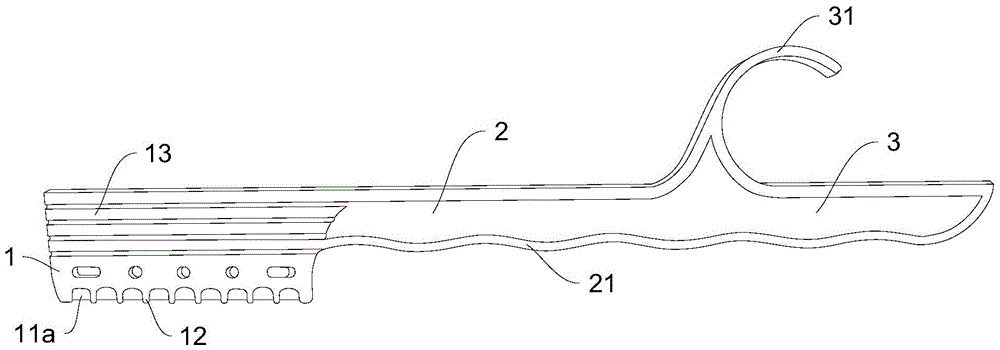
FIG. 1 is a schematic structural view of a first embodiment of a hair cutting blade according to the present invention; as can be seen from the figure, the blade part in the blade part is fixed under the action of the adjusting member and the fixing member, only the cutting edge is exposed, and the outer surface of the fixing member is provided with a strip-shaped groove which extends to the handle part through the handle part; the inner side of the handle part is provided with a curved wave flow pattern, and the back of the handle part is provided with an arc-shaped holding component.
FIG. 2 is a schematic view of a portion of the blade portion of FIG. 1; for the convenience of observation, the adjusting member is omitted in the figure, and it can be seen that the cross section of the fixing member is a triangular structure, and includes two side surfaces and a bottom surface, wherein the two side surfaces intersect with the blade portion, and in addition, as can be seen by comparing fig. 2A and fig. 2B, the cutting edges of the blade portion may be continuously distributed or may be distributed at intervals.
FIG. 3 is a schematic structural view of a second embodiment of a hair cutting blade in accordance with the present invention; as is evident from a comparison with fig. 1, the gripping member on the handle portion is now rounded.
FIG. 4 is a schematic structural view of a third embodiment of a hair cutting blade in accordance with the present invention; as is obvious from comparison with the figure 1, the outer side of the edge part is provided with a protective sleeve which can prevent the sharpener from being damaged and can protect a user.
FIG. 5 is a cross-sectional view of the hair cutting device of the present invention in use; the manner in which the sharpener operates in use can be clearly seen in the drawings.
Example 1:
as shown in fig. 1-2, the present invention provides a hair cutter comprising a blade portion 1, a handle portion 2 and a grip portion 3, wherein the handle portion 2 is connected to an end portion of the blade portion 1, and the grip portion 3 is connected to the blade portion 1 via the handle portion 2; the shank portion 2 is provided with wavy veins 21 on the side facing the blade portion 1, and the grip portion 3 is provided with a gripping member 31 into which fingers can be inserted.
Since the handle portion 2 is provided with the wavy veins 21 and the grip portion 3 is provided with the gripping member 31 into which fingers can be inserted, the device enables the hairdresser to hold the sharpener in a natural and relaxed posture without causing fatigue to the operator's wrist and arm.
In the actual production course of working, for the convenience, handle of a knife part 2 and handle part 3 can be fixed together through the mode of pasting, also can direct integral type machine-shaping, can also link to each other through swing joint's such as articulated mode.
As an alternative embodiment, the blade portion 1 includes: a blade 11, wherein the blade 11 is provided with a cutting edge 11a for thinning hair; and a plurality of setting members 12, the setting members 12 being for setting the degree of thinning of hair, the setting members 12 being disposed at intervals along the cutting edge 11a and edges of the setting members 12 protruding with respect to the cutting edge 11a so that the hair is brought into contact with the blade section 11 at the cutting edge 11a located between the adjacent two setting members 12.
Specifically, during machining, a low-carbon steel material is selected as the blade 11, thereby enhancing the wear resistance.
In order to make the shaver sharper and more convenient to use, the cutting edge 11a is arranged to be of an acute angle structure, and the angle is smaller than 45 degrees, thereby ensuring that the broken hair part is smooth and not frizzy.
Since the adjustment member 12 can adjust the degree of hair thinning, when the adjustment member 12 is too wide, it affects the thinning efficiency, and when it is too narrow, it affects the thinning effect, therefore, as an alternative embodiment, the width of the end portion of the cutting edge 11a is set to be larger than the width of the adjustment member 12, but the ratio thereof is not more than 3: 2.
in order to be able to fix the blade part 11 better, the blade part 1 is provided with a fixing member 13, the fixing member 13 extends longitudinally in parallel with the cutting edge 11a and is in close contact with the hair to be shaved when in use, so that the cutting edge 11a and the fixing member 13 are positioned on the same plane, the included angle between the blade part 11 and the plane is theta, and 0 degree < theta < 40 degrees.
As an alternative embodiment, the fixing member 13 includes a bottom surface 13b and a side surface 13a connected by the bottom surface 13b, and the other end of the side surface 13a intersects at the blade 11.
Specifically, the adjustment member 12 is connected to the side surface 13a of the fixing member 13.
It is not to be neglected that the adjusting member 12 and the fixing member 13 of the blade portion 1 may be integrally formed, or may be fixedly connected by means of subsequent adhesion.
Further, a fixing member 13 is connected to the shank portion 2.
As an alternative embodiment, the side 13a has a longitudinally arranged groove.
The recess may be a rinsing bath. In addition, the provision of the recess in the side surface 13a of the fixing member 13 also effectively prevents the hair from sticking to the hair cutter, particularly, the cut hair which has been cut off.
The handle portion is provided with wave flow line 21, and wave flow line 21 includes depressed part and bellying, and wherein depressed part and bellying interval set up and quantity between them is all not less than four. The wave flow lines 21 can better fit the structure of the hand of a human body, so that the comfort level of holding is improved.
In an alternative embodiment, the gripping member 31 is an arc-shaped structure, and the included angle of the arc is greater than 180 degrees. In use, the stylist can apply his or her fingers to the inner wall of the gripping member 31 to facilitate application of force.
Example 2:
as shown in fig. 3, the present embodiment 2 is different from embodiment 1 in that the grip member 31 has a hollow structure and a circular inner wall.
Example 3:
as shown in fig. 4, the present embodiment 3 is different from embodiment 1 in that: the blade portion 11 of the blade portion 1 is provided with a protective sheath 4, and the protective sheath 4 is fixed to the blade portion 11 by means of a snap fit and protects the cutting edge 11 a. When in use, the protective sleeve 4 can be taken down only by slightly breaking off the protective sleeve, so that the cutting knife can be used easily.
The razor is used by grasping the hair to be thinned with the index and middle fingers and then placing the razor on the hair in an inclined fashion, wherein the angle of inclination θ is less than 40 degrees, as shown in fig. 5.
In addition, in order to ensure the use sanitation, the sharpener is a disposable product, wherein the handle part 2 is processed by PP materials. Of course, the knife can be reused under the condition of ensuring sanitary safety and material durability.
The above description is only for the specific embodiments of the present invention, but the protection scope of the present invention is not limited thereto, and any person skilled in the art can easily think of the changes or substitutions within the technical scope of the present invention, and all should be covered within the protection scope of the present invention. Therefore, the protection scope of the present invention shall be subject to the protection scope of the claims.