Disclosure of Invention
The invention aims to provide a method and a system for deep denitrification of sewage and synergistic removal of emerging pollutants, aiming at the defects of large external carbon source dosage, easy hardening of a filler layer and the like in deep denitrification of a common biological denitrification process. The invention aims to realize biological deep denitrification of tail water of a sewage plant or effluent of a secondary sedimentation tank and remove micro new pollutants by using a modified high-specific surface area fluidized carrier in combination with a deep denitrification process and a double-medium filter tank system, reduce the generation amount of disinfection byproducts, meet the requirements of high-standard discharge, recycling and the like of municipal sewage or domestic sewage and industrial sewage, and also meet the requirements of deep treatment and standard discharge in the field of small-sized sewage treatment.
The purpose of the invention can be realized by the following technical scheme:
a sewage treatment system comprises a deep denitrification and residual external carbon source removing unit and a double-medium deep bed filtering unit which are arranged in series; wherein,
the deep denitrification and residual external carbon source removing unit comprises a denitrification area and an aeration area which are arranged in series, wherein the denitrification area and the aeration area are respectively filled with high-specific-surface-area suspended fillers, and the specific surface area of the suspended fillers is 800-3000 m 2 /m 3 To (c) to (d);
the double-medium deep bed filtering unit comprises an adsorption layer and a filtering layer which are sequentially stacked one above the other along the liquid flow direction.
Furthermore, the specific surface area of the high specific surface area suspended filler is 800-3000 m 2 /m 3 (ii) a In the denitrification zone, the filling amount of the high specific surface area suspended filler is 40-80%, and the sewage retention time is 1-3 h; in the aeration zone, the filling amount of the high specific surface area suspension filler is 20-50%, and the sewage retention time is 0.5-1 h.
Furthermore, the shape of the high specific surface area suspended filler is spherical, columnar, ratchet-shaped or sponge-shaped.
Furthermore, the denitrification area and the aeration area are separated by a fence or a separation net, a stirring device is arranged in the denitrification area, and an air diffuser is arranged in the aeration area.
Furthermore, the denitrification area and the aeration area are arranged in parallel or stacked one on another.
Furthermore, the adsorbing material used in the adsorption layer is activated carbon particles or biological carbon particles, the particle size is 1-2 mm, and the thickness of the adsorption layer is 1.6-2.2 m; the filtering material used in the filtering layer is quartz sand, ceramsite or volcanic rock, the grain diameter is 0.6-1.3 mm, and the thickness of the adsorption layer is 0.6-0.8 m.
Furthermore, a bearing layer is arranged below the filter layer, and bearing materials used in the bearing layer comprise pebbles or quartz sand, and the thickness of the bearing layer is 0.1-0.3 m;
the system also comprises an air diffusion pipe and a back-washing water distribution pipe which are arranged below the supporting layer.
A sewage treatment method based on the system comprises the following steps:
the sewage to be treated and an external carbon source are sent into a deep denitrification and residual external carbon source removing unit together, are sent into a denitrification area and an aeration area in sequence, and are sent into a double-medium deep bed filtering unit to obtain filtered recycled purified water.
Furthermore, the dissolved oxygen in the aeration zone is 4-7 mg/L.
Furthermore, in the double-medium deep-bed filtering unit, the filtering speed is 5-8m/h.
The invention not only can realize the high-efficiency synchronous removal of deep denitrification of sewage, new pollutants and the like, but also has simple treatment method, particularly, the filler for deep denitrification is in a fluidized state, the biomembrane is updated without a special back-washing facility, the addition amount of external carbon sources is small, and good total nitrogen concentration of effluent can be realized under the conditions of low temperature and the like in winter; the double-layer medium filtration can effectively remove trace organic pollutants and turbidity including emerging pollutants, and the purified reclaimed water has no chromaticity, so that various recycling requirements are met.
The invention has the characteristics of simple and easily maintained equipment, small using amount of the medicament and low operation cost, is suitable for the high-efficiency removal of pollutants with specific indexes for advanced treatment and reuse of urban sewage plants with different scales, and is also suitable for the advanced treatment and direct standard discharge of industrial wastewater.
Compared with the prior art, the invention has the following characteristics:
1) According to the invention, the modified high-specific surface area fluidized carrier is combined with a deep denitrification process and a double-medium filter tank system to treat tail water of a sewage plant or effluent of a secondary sedimentation tank, so that not only can total nitrogen and residual carbon sources be efficiently and stably removed, but also effective decoloration and turbidity removal are realized, trace emerging pollutants are removed, and the generation amount of disinfection byproducts is reduced;
2) According to the invention, sewage mixed external carbon source in the deep denitrification and residual external carbon source removing unit enters the device in a continuous water inlet mode, and is treated by the denitrification section and the aerobic carbon removal section in sequence, and biological denitrification and carbon removal are carried out by the added modified high-specific-surface-area fluidized carrier, so that the phenomenon of hardening or short flow of a filter material layer is avoided.
Detailed Description
The invention is described in detail below with reference to the figures and specific embodiments.
The invention relates to a method and a system for deep nitrogen removal of sewage and removal of emerging pollutants in a synergistic manner, and mainly solves the problems that deep nitrogen removal of the existing sewage treatment plant mostly adopts a denitrification filter tank process, hard particle fillers are used as main fillers, backwashing facilities are complex, short flow and sand leakage are easy to occur, consumption of external carbon sources in winter in low-temperature seasons is high, and the like; and the existing treatment facilities or recycling facilities of the municipal sewage treatment plant lack the removal capability or the removal efficiency of the micro new pollutants. The invention adopts the following method to realize the functions of efficient deep denitrification and the synergistic removal of trace organic matters such as emerging pollutants and the like: effluent of a secondary sedimentation tank of a sewage plant or effluent after conventional biochemical treatment firstly enters a deep denitrification and residual external carbon source removal unit, meanwhile, an external carbon source is added to a deep denitrification section, nitrate nitrogen in water is reduced into nitrogen by denitrifying bacteria attached and grown by suspended biological carriers with high specific surface area, the water after deep denitrification enters a residual external carbon source removal section of the unit, and the external carbon source which is not completely consumed and part of endogenous COD are removed by aerobic microorganisms on a filler through aeration oxygenation. The effluent rich in high dissolved oxygen enters a double-medium filtering unit, micro organic matters such as emerging pollutants and the like are firstly adsorbed and removed by porous materials and are oxidized and decomposed by microorganisms under the condition of oxygen enrichment, suspended matters in the water are intercepted and removed by filtering materials such as quartz sand and the like, and the regenerated water can be used as approaches for ecological water supplement, underground water supplement or landscape supplement, industry and miscellaneous use of residents and the like after advanced denitrification and micro organic matter removal and subsequent further disinfection.
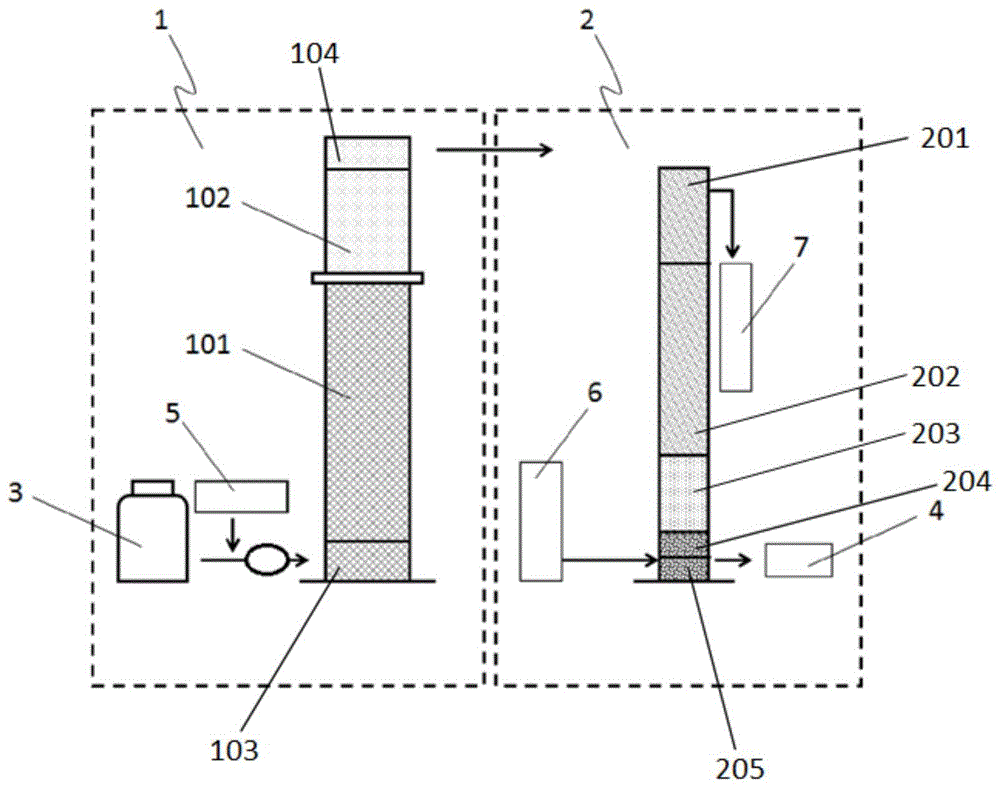
Specifically, the invention provides a sewage treatment system, which comprises a deep denitrification and residual external carbon source removing unit 1 and a double-medium deep bed filtering unit 2 which are arranged in series; wherein,
the deep denitrification and residual external carbon source removal unit 1 is characterized in that a modified high-specific surface area suspension carrier is added into a treatment unit, and the effluent or the discharged tail water of a secondary sedimentation tank of a sewage plant is further treated to remove total nitrogen and remove the residual amount of an external carbon source; the unit comprises a denitrification area 101 and an aeration area 102 for aerobic decarbonization, which are connected in series, wherein high-specific-surface-area suspension fillers are respectively filled in the denitrification area 101 and the aeration area 102, the materials are polyethylene, polypropylene or modified polyurethane materials, and the like, and the suspension fillers are spherical, columnar, ratchet-wheel-shaped or sponge-shaped; preferably a high specific surface area suspended filler.
The double-medium deep-bed filtering unit 2 adopts a filtering tank or tank form, and specifically, different types of porous adsorption and filtering materials are added into a filtering bed, so that various pollutants such as trace organic matters, chromaticity, turbidity and the like in the effluent of the deep denitrification and residual external carbon source removing unit 1 are removed under the conditions of certain flow rate, dissolved oxygen and the like, and thus, multi-target recycling or ecological water replenishing is realized; the unit comprises an adsorption layer and a filter layer which are sequentially stacked one above the other along the liquid flow direction.
Specifically, in the denitrification region 101, the filling amount of the high specific surface area suspended filler is 40-80%, and the retention time of the sewage is 1-3 h; in the aeration zone 102, the filling amount of the high specific surface area suspension filler is 20-50%, and the sewage retention time is 0.5-1 h. The shape of the high specific surface area suspension filler is spherical, columnar, ratchet-shaped or sponge-shaped.
The denitrification area 101 and the aeration area 102 are horizontally arranged in parallel or vertically combined, the denitrification area 101 is separated from the aeration area 102 through a fence or a separation net, and the sewage to be treated is in an upward flow or plug flow state in the denitrification area 101 and the aeration area 102 correspondingly.
In some preferred embodiments, the denitrification zone 101 is provided with an agitation device, and the aeration zone 102 is provided with an air diffuser.
The adsorbing material used in the adsorbing layer is active carbon particles, biological carbon particles or other porous materials with high adsorption performance, the particle size is 1-2 mm, and the thickness of the adsorbing layer is 1.6-2.2 m; the filtering material used in the filtering layer is quartz sand, ceramsite or volcanic rock, the grain diameter is 0.6-1.3 mm, and the thickness of the adsorption layer is 0.6-0.8 m.
A bearing layer is also arranged below the filter layer, and bearing materials used in the bearing layer comprise pebbles or quartz sand with the thickness of 0.1-0.3 m; the system also comprises an air diffusion pipe, a water collecting pipe and a back-washing water distribution pipe which are arranged below the supporting layer, so that aeration oxygenation or air-water combined back washing is realized.
A sewage treatment method based on the system comprises the following steps:
the sewage to be treated and an external carbon source are sent into a deep denitrification and residual external carbon source removing unit 1 together, are sent into a denitrification area 101 and an aeration area 102 in sequence, and are sent into a double-medium deep-bed filtering unit 2 to obtain filtered recycled purified water.
In some preferred embodiments, the effluent or the effluent of the secondary sedimentation tank of the sewage plant firstly enters a deep denitrification and residual external carbon source removal unit 1, an external carbon source is synchronously added into a water inlet pipeline through a metering pump, the sewage to be treated sequentially passes through a deep denitrification section and a residual external carbon source removal section, then flows into a double-medium deep-bed filtering unit 2 by gravity, and the filtered clear water is further sterilized and then is reused for urban miscellaneous use, landscape ecological water supplement or industrial production, circulating cooling water supplement and the like.
When the sewage flows through the deep denitrification section, the underwater stirrer pushes the high-specific-surface-area suspended filler to be in a fluidized or flowing state; the effluent after denitrification naturally enters an aerobic decarbonization section, and the dissolved oxygen in the area is controlled to be 4-7 mg/L through the aeration of an air diffusion pipe. The effluent after deep denitrification and external carbon source removal automatically flows or is lifted by a pump to enter a double-medium filtering unit, the filtering speed is controlled to be 5-8m/h, various trace organic matters in the water are adsorbed and biologically oxidized by a porous medium filter material, and suspended matters and turbidity are intercepted by a quartz sand cushion. The purified regenerated water can be sent to different water using purposes after being disinfected.
In some preferred embodiments, the external carbon source comprises sodium acetate, glucose, methanol or a complex carbon source, and the mass addition amount of the external carbon source is 3 to 6 times of the total nitrogen to be removed.
The invention not only can realize deep denitrification of sewage and high-efficiency synchronous removal of emerging pollutants, chromaticity, turbidity and the like, but also has small external carbon source dosage, can realize good total nitrogen concentration of effluent water under the conditions of low temperature and the like in winter, and avoids the phenomenon of material layer hardening or short flow; the double-layer medium filtration can effectively remove trace organic pollutants and turbidity including emerging pollutants, and the purified reclaimed water has no chromaticity, so that various recycling requirements are met.
The filler for deep denitrification is in a fluidized state, does not need a special back washing facility, has the characteristics of simple and easily maintained equipment, small medicament using amount and low operation cost, is suitable for high-efficiency removal of pollutants with specific indexes for deep treatment and recycling of municipal sewage plants with different scales, and is also suitable for deep treatment and direct standard discharge of industrial sewage.
The present embodiment is implemented on the premise of the technical solution of the present invention, and a detailed implementation manner and a specific operation process are given, but the scope of the present invention is not limited to the following embodiments.
In the following examples, the high specific surface area suspended fillers used were in the form of rectangular blocks of 20mm × 20mm × 5mm in size, and the number of fillers per liter under natural stacking conditions was 160; the filler is filled with powder particles with different densities, and the density is 1.04 to 1.10g/cm 3 (ii) a The porosity of the filler was 85%.
The sewage to be treated is taken from the effluent of a sedimentation tank of a certain water treatment plant.
Example 1:
the sewage treatment system shown in fig. 1 mainly comprises two reaction columns, namely a denitrification and residual carbon source oxidation column and a multi-medium filter column. Wherein, the bottom of the denitrification and residual carbon source oxidation column is a water inlet area 103, is not filled with filler or adsorption material, is communicated with the water inlet barrel 3 and the dosing barrel 5 for adding an external carbon source, and adopts an upward flow mode to prevent the filler from blocking the water inlet; the lower part is a denitrification area 101 which is separated from a water inlet area 103 by a filter screen and filled with 40-80% of high-specific-surface-area suspended filler, and the main function is deep denitrification; the upper part is an aeration zone 102 filled with 20-50% of high specific surface area suspended filler, and the main function is to remove redundant carbon sources. The multi-medium filter column is respectively provided with an active carbon layer and a quartz sand layer from top to bottom, and the active carbon layer and the quartz sand layer are mainly used for adsorbing, decoloring, removing trace organic matters, deeply purifying and removing granular components; the top is an ultrahigh area 104 without filling materials, and a filter screen is arranged between the ultrahigh area and the aeration area 102 to play a role in separation, so that the filler is prevented from blocking the water outlet of the deep denitrification and residual external carbon source removal unit 1.
The multi-medium filter column comprises a water drop zone 201, an activated carbon layer 202, a quartz sand layer 203, a supporting layer 204 and a water outlet zone 205 which are sequentially arranged from top to bottom along the liquid flow direction, wherein the water outlet zone 205 has a hollow structure, is communicated with the backwashing water inlet pipe 6 and the water outlet barrel 4, and is separated from the supporting zone through a filter screen so as to prevent the activated carbon and the quartz sand from flowing out; the water dropping area 201 has a hollow structure, and a back washing water outlet pipe 7 is arranged on the water dropping area.
In addition, the system also comprises a control unit for cooperatively controlling the water inlet purification and backwashing procedures.
The diameter of the column of the denitrification and residual carbon source oxidation column is 0.4m, the total height is 4.1m, and the volume of the denitrification area is about 314L. The diameter of the column body of the multi-medium filter column is 0.2m, the total height is 3.8m, and the multi-medium filter column is respectively provided with a water drop area, an activated carbon layer, a quartz sand layer, a bearing layer and a water outlet area from top to bottom.
A sewage treatment method based on the system comprises the following steps:
s1: under the condition that the temperature is 13 ℃, the flow rate of the effluent of the secondary sedimentation tank of the sewage plant is 125L/h, an additional carbon source is anhydrous sodium acetate, the anhydrous sodium acetate is dissolved in a dosing barrel 5 and is continuously input into a water inlet pipe, and the carbon-nitrogen ratio is set to be 5.9. The mixed sewage of the external carbon source enters a deep denitrification and residual external carbon source removing unit made of PP or PVC plastic materials, the flow state in the reactor is in an upward flow, the microorganisms on the high-specific-surface-area suspended filler are utilized to carry out denitrification and carbon removal reaction, and the hydraulic retention time of a denitrification section and the hydraulic retention time of an aeration carbon removal section are respectively 2.5h and 1.0h. Wherein, the dissolved oxygen in the aeration carbon removal section is controlled to be about 6 mg/L;
s2: the effluent treated in the step S1 flows into the double-medium filtering unit by gravity, the filtering speed is controlled to be about 6m/h, a trace amount of emerging pollutants in the sewage are adsorbed and biologically oxidized by the activated carbon filtering material, and suspended matters and turbidity are intercepted by the quartz sand cushion.
The double-medium filtering unit adopts three-section type washing, and the flow is as follows: flushing with gas alone (5 min, 20L/(m) 2 S)), air-water combined back washing (5 min, air impact strength 6-8L/(m) 2 S), water impact strength 4L/(m) 2 S)), last water rinse with water alone (5 min, 8L/(m) 2 S)), the backwash cycle is about 5d.
Example 2:
a sewage treatment method based on the system in the embodiment 1 comprises the following steps:
s1: under the condition of 25 ℃, the sewage inflow rate is 125L/h, the external carbon source is anhydrous sodium acetate, the anhydrous sodium acetate is dissolved in the dosing barrel 5 and is continuously input into the water inlet pipe, and the carbon-nitrogen ratio is set to be 3.7. The mixed sewage of the external carbon source enters a deep denitrification and residual external carbon source removing unit made of PP or PVC plastic materials, the flow state in the reactor is in an upward flow, the denitrification and carbon removal reaction is carried out by utilizing microorganisms on the modified high-specific-surface-area fluidized suspension filler, and the hydraulic retention time of a denitrification section and the hydraulic retention time of an aeration carbon removal section are respectively 2.5 hours and 1.0 hour. Wherein, the dissolved oxygen of the aeration carbon removal section is controlled to be about 6 mg/L.
S2: the effluent treated in the step S1 flows into the double-medium filtering unit by gravity, the filtering speed is controlled to be about 6m/h, a trace amount of emerging pollutants in the sewage are adsorbed and biologically oxidized by the activated carbon filtering material, and suspended matters and turbidity are intercepted by the quartz sand cushion.
The double-medium filtering unit adopts three-section type washing, and the process is as follows: flushing with gas alone (5 min, 20L/(m) 2 S)), air-water combined backwashing (5 min, air impact strength 8L/(m) 2 S), water impact strength 4L/(m) 2 S)), last water rinse with water alone (5 min, 8L/(m) 2 S)), the backwash cycle is about 5d.
In the embodiments 1-2 of the invention, water inlet of a denitrification section, water outlet of an aeration carbon removal unit and water outlet of a double-medium filtering unit are taken, and water quality conditions of COD, total Nitrogen (TN), chroma, turbidity and emerging pollutants (antibiotics) in a water sample under the conditions of different temperatures and carbon-nitrogen ratios are detected, and the results are shown in fig. 2, fig. 3 and fig. 4.
As can be seen from FIG. 2, in the embodiments 1-2 of the present invention, TN is significantly removed in the denitrification section, the removal rates are 89% and 40%, the aeration carbon removal unit can remove redundant carbon sources, the COD of the effluent of the unit is lower than 15mg/L, the reuse requirements of various reclaimed water are met, and the discharge standard of surface water is met. Comparing example 1 with example 2, it can be seen that in example 1, the average carbon-nitrogen ratio is 5.9, and deep denitrification can enable the total nitrogen of effluent to meet the quality standard of surface water under the low-temperature condition in winter, and the total nitrogen can be reused for industrial, agricultural and municipal applications; in example 2, the average carbon-nitrogen ratio is 3.7, and the removal rate of the denitrification section on the total nitrogen reaches 40%. The suspended biological carriers with high specific surface area added by the denitrification section and the aeration decarburization unit are in a fluidized state, a special back-washing facility is not needed for biomembrane updating, and the concentration of the total nitrogen of the effluent can reach the standard under the conditions of low temperature and the like in winter.
As can be seen from fig. 3, in examples 1 and 2 of the present invention, the effect of purifying the double medium filtration unit for chromaticity and turbidity was significant, and the removal rates for chromaticity and turbidity were 50% and 44%, respectively, and 45% and 34%, respectively, in comparison with the inlet and outlet water of the unit. Through the adsorption effect of the biological activated carbon of the double-medium filtering unit and the filtering effect of the quartz sand, the chroma and the turbidity of the purified regenerated water are obviously reduced, and various recycling requirements are met.
As can be seen from fig. 4, in example 1 of the present invention, the purification effect of the dual-media filtration unit on new pollutants is significant, especially the removal rate of macrolide antibiotics can reach 100%, and the purification effect on quinolone antibiotics and sulfonamide antibiotics can reach more than 80%. The treatment unit can further improve the quality of the effluent and expand the recycling approach of the reclaimed water.
The embodiments described above are intended to facilitate a person of ordinary skill in the art in understanding and using the invention. It will be readily apparent to those skilled in the art that various modifications to these embodiments may be made, and the generic principles described herein may be applied to other embodiments without the use of the inventive faculty. Therefore, the present invention is not limited to the above embodiments, and those skilled in the art should make improvements and modifications within the scope of the present invention based on the disclosure of the present invention.