Method for monitoring dynamic leakage flow and leakage rate of respirator in operation process
Technical Field
The invention relates to the technical field of respirator protection, in particular to a method for monitoring dynamic leakage flow and leakage rate of a respirator in an operation process.
Background
Respirators are the general names of self-suction filter type particulate matter prevention respirators, medical protective masks and other respiratory protection articles, are widely applied to the fields of dust protection in dust-related places of industrial and mining enterprises, virus and bacteria protection in medical environments, respiratory protection of outdoor atmospheric pollutants and the like, and for viruses taking droplet aerosols as main propagation paths, the respirators also become individual protection articles which need to be worn by people and are used for preventing virus infection;
the protection performance of the respirator can be represented by the total leakage rate, the lower the total leakage rate is, the better the protection performance of the respirator is, and the total leakage rate consists of a filter material penetration rate and a face part sealing leakage rate. At present, electret fiber filter materials are adopted in respirator products which are most widely applied in the market, the filter materials can effectively filter and purify air containing dust, germs and pollutant particles, the penetration rate of the filter materials can be controlled within 2%, the leakage of the face seal means that the particles leak into the face mask through the edge of the face mask and the face seal, the leakage rate of the particles is far greater than the penetration rate of an ultrafiltration material, and therefore the electret fiber filter materials play a decisive role in the protection performance of the respirator;
Current tests for respirator face seal performance are primarily by the following two methods:
firstly, a qualitative test is carried out, namely after a human body wears the respirator, irritant chemical reagents such as sweetening agents, bitter agents and the like are released outside the mask, the face tightness of the respirator is judged according to whether corresponding smell can be smelled subjectively, if the corresponding smell can be smelled, the tightness is poor, the respirator to be tested is not suitable for a test subject, and otherwise, the respirator and the face of the test subject are proved to be well sealed. The qualitative test method has the following defects that (1) the face seal leakage rate is difficult to quantitatively evaluate, and (2) the influence of the subjective olfaction threshold of a respirator wearer is large, the reliability is poor, and the method is not suitable for people with low olfaction sensitivity.
And secondly, carrying out quantitative test, namely after the respirator is worn by a human body, sampling holes are drilled on a face mask of the respirator, and sampling analysis is respectively carried out on the concentrations of the particles inside and outside the face mask by adopting a particle concentration detector so as to represent the total leakage rate of the respirator by the ratio of the concentrations of the particles inside and outside the face mask. This quantitative test method has the following three limitations for adhesion detection:
(1) the total leakage rate measured by the method simultaneously comprises the penetration rate of the filter material and the leakage rate of the face seal, and the individual investigation on the face seal leakage is difficult to realize; (2) along with the disturbance of the respiratory airflow of a human body, the concentration of particulate matters is unevenly distributed in the mask, the concentration of the particulate matters in the mask is usually detected through a single sampling hole arranged in the middle or on the left side and the right side of the mask, and the collected and detected concentration is difficult to represent the average concentration of the particulate matters in the mask; (3) the respirator's face seal leakage rate changes from moment to moment during the inspiration of each breathing cycle, and this method does not track and monitor the dynamic face seal leakage flow and face seal leakage rate that change from moment to moment.
Disclosure of Invention
The invention provides a method for monitoring the dynamic leakage flow and the leakage rate of a respirator in the operation process, which is convenient to operate, effectively realizes the quantification and the accurate monitoring of the leakage flow and the leakage rate of the respirator, ensures the dynamic measurement of real-time operation on the spot, and avoids the defects of poor reliability and narrow application range of the existing qualitative test of the tightness of the respirator, uneven sampling, low accuracy and the like in the quantitative test.
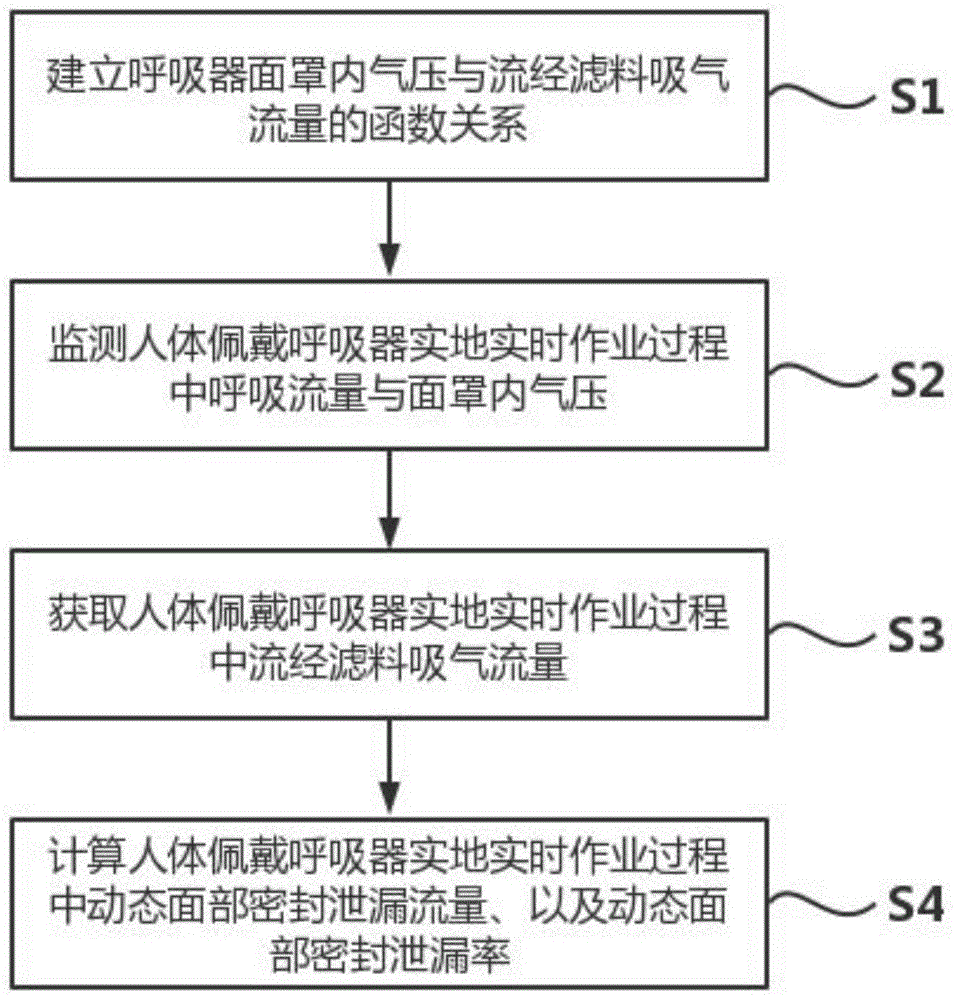
In order to achieve the purpose, the method for monitoring the dynamic leakage flow and the leakage rate of the respirator in the operation process specifically comprises the following steps:
s1, under the condition of complete sealing, establishing a functional relation between the air pressure in the respirator mask and the inspiration flow passing through the filter material;
s2, monitoring the respiratory flow and the air pressure in the mask in the real-time operation process of wearing the respirator on the human body;
s3, acquiring the inspiration flow passing through the filter material in the field real-time operation process of the respirator worn by the human body;
and S4, comparing the respiratory flow in the process of the real-time operation of the human body worn respirator in the step S2 with the inspiratory flow flowing through the filter material in the process of the real-time operation of the human body worn respirator in the step S3, and calculating to obtain the leakage flow and the leakage rate of the dynamic face seal in the process of the real-time operation of the human body worn respirator in the field.
Further, step S1 specifically includes the following steps:
(1) acquiring a simulation physical head model with a representative size;
(2) a connecting pipe with smooth inner wall is inserted from the hindbrain of the human head model to the position flush with the mouth-nose part, and the port of the connecting pipe at the hindbrain part is connected with a flowmeter and an adjustable flow air pump in series in a sealing way;
a sampling hole is formed in the middle of one side of a respirator mask to be detected, and the end head of the sampling hole is connected with a monitor for monitoring micro pressure and flow with high precision;
(3) wearing a respirator mask to be tested on the head model, so that the respirator mask to be tested is completely sealed with the edge of the head model; starting the air pump, and gradually increasing the air pumping flow of the air pump based on the reading of the flowmeter so as to simulate different air suction flow;
the monitor records the air pressure P in the lower cover under different pumping flows and the suction flow Q of the filter material flowing throughfilter(ii) a Establishing a self-variation of the pressure P in the maskFlow rate, suction flow rate Q of filter material flowing throughfilterIs a function of the dependent variable.
Further, in step S1, the function relationship between the air pressure in the respirator and the inspiratory flow through the filter material is
Qfilter=-2.0034P2+39.196P+0.1876。
Further, step S2 specifically includes the following steps:
(1) a sampling hole is formed in the same position of the mask of the same respirator, and the end of the sampling hole is connected with a monitor for monitoring micro-pressure and flow with high precision;
(2) The respirator is worn on a real human body, the monitor is started, the real respiration of the human body is monitored, and the respiratory flow Q under the real-time operation state on the spot is monitoredtotalMixing with the pressure P in the mask to obtain QtotalAnd P, respectively, versus breath time.
Further, in step S2, the time dynamic range is 8 breathing cycles of the actual human-body-worn respirator in the medium-intensity operating state within 19.2S, wherein each inhaling cycle has a duration of 1.2S.
Further, step S3 specifically includes the following steps:
substituting the dynamic variation curve of the air pressure P in the mask along with time in the step S2 into the air pressure P in the respirator mask and the inspiration flow Q flowing through the filter material in the step S1filterIn the functional relation, the flow Q of the inhaled air flowing through the filter material in the real-time field operation process of the respirator worn by the human body is calculatedfilter-ren。
Further, in step S4, the dynamic face seal leakage flow Q is measured during real-time operation of the human body-worn respirator in the fieldleakThe calculation formula of (c) is:
Qleak=Qtotal-Qfilter-ren
wherein: qtotalThe respiratory flow is the respiratory flow of the human body under the real respiration and real-time operation state;
Qfilter-renthe air suction flow flowing through the filter material in the real-time operation process of wearing the respirator on the spot for the human body.
Further, in step S4, the calculation formula of the dynamic face seal leakage rate IL during the real-time work of wearing the respirator on the human body in the field is as follows:
IL=Qleak/Qtotal。
Compared with the prior art, the method for monitoring the dynamic leakage flow and the leakage rate of the respirator in the operation process has the advantages that the function relation between the air pressure in the respirator mask and the air suction flow flowing through the filter material under the completely sealed condition is established, the relation between the respiratory flow and the air pressure in the respirator mask in the real-time operation process of wearing the respirator on the human body on the spot is monitored, so that the dynamic change of the air suction flow flowing through the filter material along with time in the real-time operation process of wearing the respirator on the spot is obtained, the respiratory flow and the air suction flow flowing through the filter material under the operation state are compared, and the corresponding dynamic face seal leakage flow and the dynamic face seal leakage rate are obtained through calculation Accurate monitoring, the dynamic measurement of the real-time operation on the spot of guarantee avoids the qualitative test reliability of current respirator adaptation poor, the narrow limitation of application scope, and the sample is uneven among the quantitative test, the precision is low grade defect, but wide application in the respirator adaptation test in many fields such as dust protection, medical environment virus bacterial protection, outdoor atmospheric pollutants respiratory protection of industrial and mining enterprises in dirt-related place.
Drawings
FIG. 1 is an overall flow diagram of the present invention;
FIG. 2 shows the pressure P in the respirator mask and the inspiration flow Q through the filter material under the complete sealing condition of the inventiontotalA functional relationship diagram of (a);
FIG. 3 shows the respiratory flow Q of the body worn respirator of the present invention during real-time operation in the fieldfilterIs plotted against the change of the air pressure P in the mask over time;
FIG. 4 shows the total inspiratory flow Q of a human body in accordance with the present inventiontotalAnd the suction flow Q of the filter material flowing throughfilter-renA graph of change over time;
FIG. 5 is a face seal leakage flow Q of the present inventionleakA graph of change over time;
fig. 6 is a graph of the face seal leakage rate IL over time in accordance with the present invention.
Detailed Description
The technical solutions in the embodiments of the present invention are clearly and completely described below with reference to the drawings in the embodiments of the present invention, and it is obvious that the described embodiments are only a part of the embodiments of the present invention, and not all embodiments. All other embodiments, which can be derived by a person skilled in the art from the embodiments given herein without making any creative effort, shall fall within the protection scope of the present invention.
As shown in fig. 1, the method for monitoring the dynamic leakage flow rate and the leakage rate of the respirator in the operation process specifically comprises the following steps:
S1, under the condition of complete sealing, establishing a functional relation between the air pressure in the respirator mask and the inspiration flow passing through the filter material;
s2, monitoring the respiratory flow and the air pressure in the mask in the real-time operation process of wearing the respirator on the human body;
s3, acquiring the flow of the air sucked by the filter material during the real-time operation of the respirator worn by the human body; preferably, the air pressure inside the mask in step S2 is acquired by changing dynamically with time during the real-time working on the spot in step S1;
and S4, comparing the breathing flow of the human body worn respirator in the step S2 in the real-time operation process with the breathing flow of the filter material flowing through the human body worn respirator in the step S3 in the real-time operation process, and calculating to obtain the dynamic face seal leakage flow and the dynamic face seal leakage rate of the human body worn respirator in the real-time operation process.
Examples
In step S1, a functional relation between the air pressure in the face mask and the air suction flow passing through the filter material is established under the condition that the respirator is completely sealed; the method specifically comprises the following steps:
the complete sealing condition is mainly to set up a set of simple human head model test system, and comprises the following steps:
firstly, acquiring a simulated physical human head model with a representative size based on human head and face three-dimensional scanning and 3D printing technologies, for example, the human head and face three-dimensional scanning can adopt infrared scanning, a scanning signal is connected with a computer, the human head three-dimensional model is established in the computer, the computer is connected with a 3D printing device, and the simulated physical human head model is established through the 3D printing device;
A connecting pipe with smooth inner wall is inserted from the back brain of the human head model to the position flush with the mouth and nose part so as to simulate the upper respiratory tract of a human body, and the connecting pipe can be a copper pipe; the end of the connecting pipe at the hindbrain is sequentially connected with the flowmeter and the flow-adjustable air pump in series in a sealing manner, and the air pump is intermittently started to simulate the breathing of a human body; a sampling hole is formed in the middle of one side of a respirator mask to be detected, and the end head of the sampling hole is connected with a monitor for monitoring micro pressure and flow with high precision;
wearing a respirator mask to be tested on the head model, so that the respirator mask to be tested is completely sealed with the edge of the head model; starting the air pump, gradually increasing the air pumping flow of the air pump based on the reading of the flowmeter, simulating different air suction flow, and recording the air pressure P in the lower cover and the air suction flow Q of the filter material flowing through the lower cover by the monitorfilter(ii) a Establishing the inspiration flow Q flowing through the filter material by taking the air pressure P in the mask as an independent variablefilterIs a function of the dependent variable.
As shown in FIG. 2, the pressure P in the mask and the suction flow Q passing through the filter materialfilterFitting is carried out, and the functional relation is as follows:
Qfilter=-2.0034P2+39.196P+0.1876。
in step S2, the flow of inhaled air flowing through the filter material is obtained during the real-time operation of wearing the respirator on the spot, specifically:
Step S1 is the same, namely, a sampling hole is arranged at the same position of the same respirator mask, and the end of the sampling hole is connected with a monitor for monitoring the micro pressure and the flow with high precision; the respirator is worn on a real human body, the respiratory flow Q is monitored by the monitor under the real-time operation state of the real respiration and the field of the human bodytotalAnd the pressure P in the mask to obtain QtotalAnd P, respectively, as a function of breathing time. As shown in fig. 3, the respiratory flow Q is mainly the respiratory flow during the wearing process of the respiratortotalThe dynamic change curve of the air pressure P in the mask along with the time respectively;
preferably, the curve intercepts 8 breathing cycles of a real body worn respirator in a medium intensity operating condition of 19.2s, i.e. 2.4s per breathing cycle, and 1.2s per inspiration cycle duration (including exhalation and inhalation);
in step S3, the flow of inhaled air flowing through the filter material is obtained during the real-time operation of wearing the respirator on the spot, specifically:
substituting the dynamic curve of the mask air pressure P with time in step S2 into step S1, i.e. the mask air pressure P and the inspiratory flow Q of the air passing through the filter material under the condition that the respirator is completely sealed and established in step S1filterFitting a functional relation, and calculating the flow Q of the air sucked by the filtering material in the real-time operation process of wearing the respirator on the human body on the spot filter-renObtaining Qfilter-renA dynamic variation curve over time; as shown in fig. 4, the respiratory flow Q is obtained in the real-time operation process of the respirator worn by the human bodytotalAnd the suction flow Q of the filter material flowing throughfilter-renA variation curve between;
in step S4, calculating the dynamic face seal leakage flow and the seal leakage rate during the real-time work of wearing the respirator on the human body, specifically:
respiratory flow Q monitored based on step S2totalDynamic change curve with time, and Q obtained in step S3filter-renDynamic change curve over time, as shown in FIG. 5, calculating dynamic face seal leakage flow Q during real-time operation of a human body-worn respirator in fieldleak=Qtotal-Qfilter-renObtaining QleakDynamic profile over time.
As shown in FIG. 6, the leakage rate IL Q of the dynamic face seal during the real-time operation of the respirator on the human body on the spot is calculatedleak/QtotalAnd acquiring a dynamic change curve of the IL along with time.
The method for monitoring the dynamic leakage flow and the leakage rate of the respirator in the operation process comprises the steps of establishing a functional relation between the air pressure in a respirator mask and the air suction flow flowing through a filter material under the condition of complete sealing, monitoring the relation between the respiratory flow and the air pressure in the mask in the process of real-time operation of wearing the respirator on the human body on the spot, obtaining the dynamic change of the air suction flow flowing through the filter material along with time in the process of real-time operation of wearing the respirator on the spot, comparing the respiratory flow and the air suction flow flowing through the filter material under the operation state, and calculating to obtain the corresponding dynamic face seal leakage flow and the dynamic face seal leakage rate, so that the whole method is simple, convenient to operate and high in detection precision, effectively realizes the quantification and the precise monitoring of the respiratory flow and the leakage rate of the respirator, the dynamic measurement of real-time operation on the spot is guaranteed, the limitations of poor reliability and narrow application range of the existing respirator tightness qualitative test are avoided, the defects of uneven sampling, low accuracy and the like in the quantitative test are overcome, and the device can be widely applied to the respirator tightness test in various fields of dust protection in dust-involved places of industrial and mining enterprises, virus and bacteria protection in medical environments, outdoor atmospheric pollutant breathing protection and the like.