Disclosure of Invention
The present invention is directed to solving at least one of the problems of the prior art. To this end, an object of the present invention is to propose a cooling and heating air conditioning system and a single cooling air conditioning system.
A cooling and heating air conditioning system according to a first embodiment of the present invention includes: main system and humidification system, main system includes: the air inlet and the air outlet of the compressor are respectively connected with a first interface and a second interface of the four-way valve, the indoor heat exchanger is connected with a third interface of the four-way valve, and the outdoor heat exchanger is connected with a fourth interface of the four-way valve. Wherein, humidification system and main system series connection, humidification system includes: an outdoor evaporator, a second expansion valve, a control valve set, the first expansion valve is connected between the outdoor heat exchanger and the outdoor evaporator, the second expansion valve is connected between the indoor heat exchanger and the outdoor evaporator, and the control valve set is constructed as follows: the refrigerant flow can be controlled to flow through at least one of the first expansion valve and the second expansion valve.
Therefore, the main system is connected with the humidifying system in series, and the control valve group can control the work of the main system through controlling the flow of the refrigerant of the humidifying system, so that the cold and hot air conditioning system is simplified, the humidifying quantity, the refrigerating quantity and the heating quantity of the cold and hot air conditioning system in the refrigerating and heating modes are improved, and the energy efficiency and the comfort are improved.
In some embodiments, the cooling and heating air conditioning system further includes a first solenoid valve and a second solenoid valve, the first expansion valve and the second expansion valve are respectively located on a first pipeline and a second pipeline, the first solenoid valve is located on a third pipeline, the second solenoid valve is located on a fourth pipeline, the third pipeline is connected in parallel to the first pipeline, and the fourth pipeline is connected in parallel to the second pipeline.
In some embodiments, when the humidification function is activated in the cooling mode, the first electromagnetic valve is closed, the second electromagnetic valve is opened, and the flow path of the refrigerant is as follows: the system comprises a compressor exhaust, a four-way valve, an outdoor heat exchanger, a first expansion valve, an outdoor evaporator, a second electromagnetic valve, an indoor heat exchanger, a four-way valve and a compressor.
In some embodiments, when the humidification function is not activated in the cooling mode or the defrosting mode is activated, the first electromagnetic valve and the second electromagnetic valve are closed, and the flow path of the refrigerant is as follows: the system comprises a compressor exhaust, a four-way valve, an outdoor heat exchanger, a fully-opened first expansion valve, an outdoor evaporator, a second expansion valve, an indoor heat exchanger, a four-way valve and a compressor. Or the first electromagnetic valve is opened, the second electromagnetic valve is closed, and the flow path of the refrigerant is as follows: the system comprises a compressor exhaust, a four-way valve, an outdoor heat exchanger, a first electromagnetic valve, an outdoor evaporator, a second expansion valve, an indoor heat exchanger, a four-way valve and a compressor.
In some embodiments, in the heating mode, the second solenoid valve is closed, the first solenoid valve is opened, and the flow path of the refrigerant is: the system comprises a compressor exhaust, a four-way valve, an indoor heat exchanger, a second expansion valve, an outdoor evaporator, a first electromagnetic valve, an outdoor heat exchanger, a four-way valve and a compressor.
In some embodiments, the main system is further provided with a first stop valve and a second stop valve, the first stop valve is located between the indoor heat exchanger and the four-way valve, and the second stop valve is located between the indoor heat exchanger and the second expansion valve.
In some embodiments, the humidification system is formed as a module disposed on top of an outdoor unit where the outdoor heat exchanger is located.
In some embodiments, the humidification system further comprises a water collecting device and a heating device, wherein the heating device is used for heating and vaporizing the condensed water collected by the water collecting device.
A single-cooling air conditioning system according to an embodiment of a second aspect of the present invention includes: the outdoor heat exchanger comprises a compressor, an outdoor heat exchanger, an indoor heat exchanger, a third electromagnetic valve, a first expansion valve and a second expansion valve, wherein the compressor, the indoor heat exchanger, the second expansion valve, the outdoor evaporator and the first expansion valve are sequentially connected end to end, and the third electromagnetic valve is connected in parallel on a pipeline where the second expansion valve is located.
In some embodiments, when the humidifying function is started in the refrigeration mode, the third electromagnetic valve and the first expansion valve are opened; when the humidifying function is not started in the refrigeration mode, the third electromagnetic valve is closed, and the first expansion valve is fully opened.
Additional aspects and advantages of the invention will be set forth in part in the description which follows and, in part, will be obvious from the description, or may be learned by practice of the invention.
Detailed Description
Embodiments of the present invention are described in detail below, the embodiments described with reference to the drawings are exemplary, and a cooling-heating air conditioning system 100 and a cooling-only air conditioning system 200 according to embodiments of the present invention are described below with reference to fig. 1 to 10.
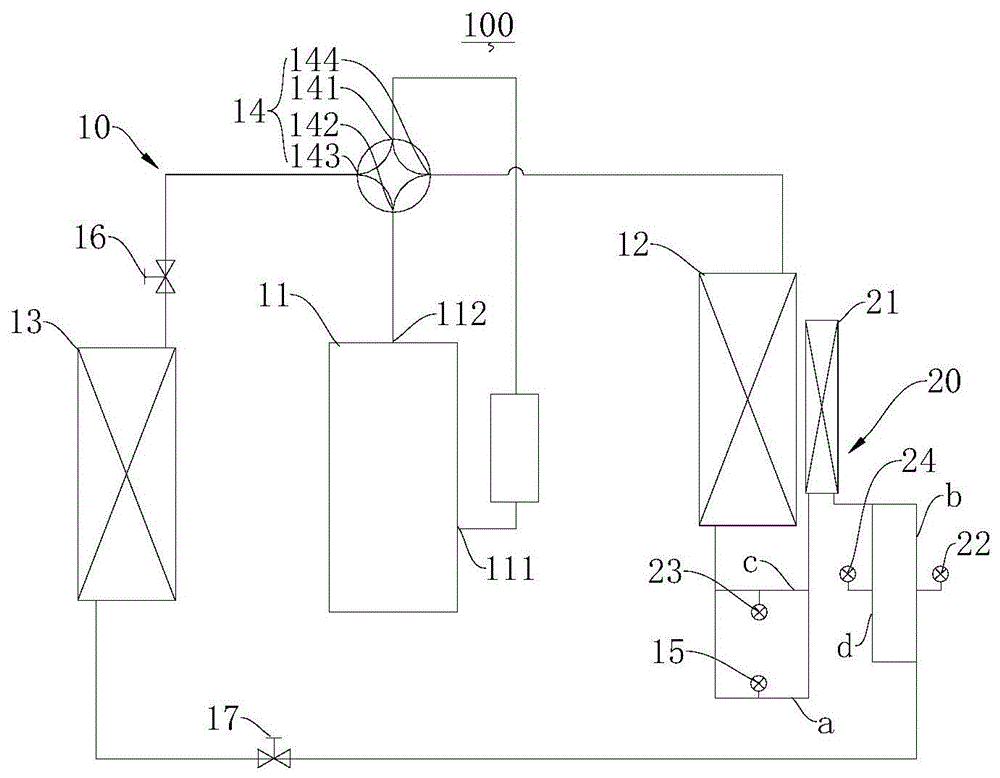
The cooling and heating air conditioning system 100 according to the first embodiment of the present invention includes: main system 10 and humidification system 20, main system 10 includes: the air conditioner comprises a compressor 11, an outdoor heat exchanger 12, an indoor heat exchanger 13, a four-way valve 14 and a first expansion valve 15, wherein an air inlet 111 and an air outlet 112 of the compressor 11 are respectively connected with a first interface 141 and a second interface 142 of the four-way valve 14, the indoor heat exchanger 13 is connected with a third interface 143 of the four-way valve 14, and the outdoor heat exchanger 12 is connected with a fourth interface 144 of the four-way valve 14.
As shown in fig. 1, in the main system 10, the air inlet 111 of the compressor 11 is communicated with the first port 141 of the four-way valve 14, the air outlet 112 is communicated with the second port 142, one end of the indoor heat exchanger 13 is connected with one end of the humidification system 20, the other end of the indoor heat exchanger 13 is connected with the third port 143, one end of the outdoor heat exchanger 12 is connected with the fourth port 144, and the other end is connected with the other end of the humidification system 20, thereby forming a closed loop.
Wherein, humidification system 20 and main system 10 series connection, humidification system 20 includes: an outdoor evaporator 21, a second expansion valve 22, a control valve group, the first expansion valve 15 being connected between the outdoor heat exchanger 12 and the outdoor evaporator 21, the second expansion valve 22 being connected between the indoor heat exchanger 13 and the outdoor evaporator 21, and the control valve group being configured to: the refrigerant flow through at least one of the first expansion valve 15 and the second expansion valve 22 can be controlled.
That is, the humidification system 20 is connected in series in the main system 10 to regulate the flow direction of the refrigerant through the control valve set in the humidification system 20, so that the refrigerant flows to the first expansion valve 15 and/or the second expansion valve 22, and the heat exchange capacities of the indoor heat exchanger 13, the outdoor heat exchanger 12, and the outdoor evaporator 21 are adjusted.
Therefore, the main system 10 and the humidification system 20 are connected in series, and the control valve group can control the work of the main system 10 by controlling the flow of the refrigerant of the humidification system 20, so as to simplify the cold and hot air conditioning system 100, improve the humidification quantity, the refrigeration quantity and the heating quantity of the cold and hot air conditioning system 100 in the refrigeration and heating modes, improve the energy efficiency and simultaneously improve the comfort.
Optionally, the air conditioning system 100 further includes a first solenoid valve 23 and a second solenoid valve 24, the first expansion valve 15 and the second expansion valve 22 are respectively located on the first pipeline a and the second pipeline b, the first solenoid valve 23 is disposed on the third pipeline c, the second solenoid valve 24 is disposed on the fourth pipeline d, the third pipeline c is connected in parallel to the first pipeline a, and the fourth pipeline d is connected in parallel to the second pipeline b.
As shown in fig. 1, two pipelines, namely a first pipeline a and a third pipeline c, are disposed between the outdoor heat exchanger 12 and the outdoor evaporator 21, the first pipeline a is connected in parallel with the third pipeline c, a second pipeline b and a fourth pipeline d are disposed between the indoor heat exchanger 13 and the outdoor evaporator 21, and the second pipeline b is connected in parallel with the fourth pipeline d. Specifically, the first solenoid valve 23 may operate during heating and humidifying, the second solenoid valve 24 may operate during cooling and humidifying, and the first solenoid valve 23 and the second solenoid valve 24 do not participate in operation when the cooling/heating air conditioning system 100 cools or heats without turning on the humidifying function. The first solenoid valve 23 may be a normally closed type solenoid valve or a bidirectional flow type.
Thus, by providing the first solenoid valve 23 and the second solenoid valve 24 in the air-conditioning system 100, the heating and cooling circuits in the air-conditioning system 100 are controlled so as to control the humidification function in the heating mode or the cooling mode alone, and the first solenoid valve 23 and the first expansion valve 15, the second solenoid valve 24 and the second expansion valve 22 are provided in parallel, so as to increase the variety of function adjustments of the air-conditioning system 100.
Specifically, when the humidification function is started in the cooling mode, the first electromagnetic valve 23 is closed, the second electromagnetic valve 24 is opened, and the flow path of the refrigerant is: the air conditioner comprises a compressor 11, a four-way valve 14, an outdoor heat exchanger 12, a first expansion valve 15, an outdoor evaporator 21, a second electromagnetic valve 24, an indoor heat exchanger 13, the four-way valve 14 and the compressor 11.
As shown in fig. 2, in the flow path and direction of the refrigerant when the humidification function is activated in the cooling mode, the first expansion valve 15 and the second solenoid valve 24 are opened, so that the refrigerant can flow to the outdoor evaporator 21 through the throttling function of the first expansion valve 15, condensed water is formed in the outdoor evaporator 21, and then the refrigerant enters the indoor heat exchanger 13 through the second solenoid valve 24 to be cooled.
Accordingly, the humidifying function is activated in the cooling mode, the second solenoid valve 24 connected in parallel to the second expansion valve 22 is opened to short-circuit the pressure drop of the second expansion valve 22, the heat exchange effect of the outdoor heat exchanger 12 is improved, and the amount of condensed water generated by the outdoor evaporator 21 is increased by throttling the first expansion valve 15.
In some embodiments, when the humidification function is not activated in the cooling mode or the defrosting mode is activated, the first electromagnetic valve 23 and the second electromagnetic valve 24 are closed, and the flow path of the refrigerant is as follows: a compressor 11 exhaust, a four-way valve 14, an outdoor heat exchanger 12, a fully open first expansion valve 15, an outdoor evaporator 21, a second expansion valve 22, an indoor heat exchanger 13, a four-way valve 14, and a compressor 11. Or the first electromagnetic valve 23 is opened, the second electromagnetic valve 24 is closed, and the flow path of the refrigerant is as follows: the air conditioner comprises a compressor 11, a four-way valve 14, an outdoor heat exchanger 12, a first electromagnetic valve 23, an outdoor evaporator 21, a second expansion valve 22, an indoor heat exchanger 13, the four-way valve 14 and the compressor 11.
As shown in fig. 3 and 4, in the cooling mode, the paths of the refrigerant flowing between the outdoor heat exchanger 12 and the outdoor evaporator 21 may be different, namely, the refrigerant flows from the outdoor heat exchanger 12 to the outdoor evaporator 21 through the first expansion valve 15, and the first expansion valve 15 is in a fully open state, so that the refrigerant can flow to the outdoor evaporator 21 as much as possible; the other is that the refrigerant flows from the outdoor heat exchanger 12 to the outdoor evaporator 21 through the first electromagnetic valve 23, and at this time, the first electromagnetic valve 23 is of a bidirectional flow type, because the bidirectional flow type electromagnetic valve is normally closed, when the electromagnetic valve is opened, the inlet pressure is greater than the outlet pressure, the refrigerant flows from the inlet to the outlet, and the electromagnetic valve can intercept the refrigerant after being powered off regardless of the pressures of the refrigerant at the inlet end and the outlet end.
Therefore, when the cold-hot air conditioning system 100 is in the cooling mode and the humidification and defrosting modes are not turned on, the opening and closing of the first electromagnetic valve 23 and the first expansion valve 15 are controlled to realize different refrigerant flow paths, so that the diversity of the refrigerant flow paths in the cooling mode is increased, and the throttling function of the second expansion valve 22 can improve the cooling capacity and the energy efficiency in the cooling mode.
In detail, in the heating mode, the second solenoid valve 24 is closed, the first solenoid valve 23 is opened, and the flow path of the refrigerant is: the air conditioner comprises a compressor 11, a four-way valve 14, an indoor heat exchanger 13, a second expansion valve 22, an outdoor evaporator 21, a first electromagnetic valve 23, an outdoor heat exchanger 12, the four-way valve 14 and the compressor 11.
As shown in fig. 5, in the process that the refrigerant passes through the humidification system 20, the second expansion valve 22 is opened, the refrigerant flows into the outdoor evaporator 21 through the first expansion valve 15, when the refrigerant flows to the outdoor evaporator 21, because the first electromagnetic valve 23 is in an open state, the first electromagnetic valve 23 is connected in parallel with the first expansion valve 15, the first expansion valve 15 is short-circuited by the first electromagnetic valve 23, the first expansion valve 15 does not have a throttling function in the heating mode, and the refrigerant flowing out of the outdoor evaporator 21 enters the outdoor heat exchanger 12 through the first electromagnetic valve 23.
Therefore, by opening the first electromagnetic valve 23 and closing the second electromagnetic valve 24 in the humidification system 20, the refrigerant can smoothly enter the outdoor heat exchanger 12 through the second expansion valve 22, the outdoor evaporator 21 and the first electromagnetic valve 23, so that the heating mode and the cooling mode of the cooling and heating air conditioning system 100 can be distinguished, the independent operation is realized, the mutual interference in the heating mode and the cooling mode is reduced, and the heating quantity and the cooling quantity are influenced.
In addition, the air conditioning system 100 can at least realize three modes of heating, heating and humidifying, and heating and humidifying defrosting in the heating mode, and the flow of the refrigerant in the heating mode in the above embodiment is the flow process of the refrigerant in the heating and humidifying mode: the air conditioner comprises a compressor 11, a four-way valve 14, an indoor heat exchanger 13, a second expansion valve 22, an outdoor evaporator 21, a first electromagnetic valve 23, an outdoor heat exchanger 12, the four-way valve 14 and the compressor 11. The refrigerant flow for heating is the same as the refrigerant flow in the heating and humidifying mode, except that the condensed water formed in the exterior evaporator 21 in the heating mode does not need to be heated.
As shown in fig. 6 and 7, in order to perform heating and defrosting mode, when the outdoor evaporator 21 frosts in a low temperature environment, the first solenoid valve 23 and the second solenoid valve 24 need to be closed to allow the refrigerant to flow through the first expansion valve 15 (fully opened) and the second expansion valve 22, or the first expansion valve 15 and the second solenoid valve 24 need to be closed to allow the refrigerant to flow through the first solenoid valve 23 and the second expansion valve 22, and at this time, the first solenoid valve 23 is in a two-way flow type. The two refrigerant flow paths are beneficial to relieving the frosting phenomenon of the outdoor evaporator 21, and the pressure drop of the cold and hot air conditioning system 100 is reduced by adjusting the first electromagnetic valve 23 and the second electromagnetic valve 24, so that the heat exchange capacity of the outdoor evaporator 21 is improved.
Optionally, the main system 10 is further provided with a first cut-off valve 16 and a second cut-off valve 17, the first cut-off valve 16 is located between the indoor heat exchanger 13 and the four-way valve 14, and the second cut-off valve 17 is located between the indoor heat exchanger 13 and the second expansion valve 22.
As shown in fig. 1 to 10, a first cut-off valve 16 and a second cut-off valve 17 are installed on the main system 10 at both ends of the indoor heat exchanger 13, respectively, wherein the second cut-off valve 17 is installed on the main system 10 between the humidification system 20 and the indoor heat exchanger 13.
Therefore, by providing the first stop valve 16 and the second stop valve 17 in the main system 10, the stop of the main system 10 and the flow rate adjustment are facilitated due to the short opening and closing stroke of the stop valves, so that the degree of intelligence of the cold and hot air conditioning system 100 is increased, and the communication between the indoor unit and the outdoor unit of the air conditioner is facilitated.
Further, the humidification system 20 is formed as a module provided on the top of the outdoor unit where the outdoor heat exchanger 12 is located.
Therefore, by arranging the humidification system 20 on the top of the outdoor unit so that the inlet and outlet of the outdoor evaporator 21 are connected with the relevant pipes of the outdoor heat exchanger 12, the humidification system 20 is independent of the control system of the air conditioner, and the control of the humidification system 20 is better realized.
In some embodiments, the humidification system 20 further includes a water collecting device for collecting the condensed water of the outdoor evaporator 21, and a heating device (not shown in the drawings) for heating and vaporizing the condensed water collected by the water collecting device.
That is, in the humidification system 20, the operation of the outdoor evaporator 21 brings a large amount of heat, and a heat dissipation fan is required to dissipate heat from the outdoor evaporator 21, condensed water generated by the outdoor evaporator 21 can flow to a water collection device disposed below the outdoor evaporator 21, a water collection material disposed in the water collection device can absorb water, the water collection material of the water collection device is heated and vaporized by a heating device to form water molecules, and the water molecules after being heated and vaporized are sent to the indoor side by the outdoor fan, so as to humidify the indoor.
From this, through setting up water-collecting device and heating device to make outdoor evaporimeter 21 can normally work, with the partial or whole heating of condensate water of collection, blow to indoor under outdoor fan's effect, increase indoor humidification volume, with provide a comparatively comfortable environment.
Optionally, the humidification system 20 further includes a heat dissipation fan and an outdoor fan (not shown in the figure), and since the outdoor evaporator 21 is easy to generate heat during operation, the heat dissipation fan can take away most of the heat of the outdoor evaporator 21, thereby improving the heat exchange capability of the outdoor evaporator 21. The condensed water generated after the outdoor evaporator 21 is operated flows to the water collecting device, and the condensed water is vaporized by the heating device to form water molecules, which can be delivered to the indoor side by the outdoor fan.
The single cooling air conditioning system 200 according to the embodiment of the second aspect of the present invention includes: the compressor 11, the outdoor heat exchanger 12, the indoor heat exchanger 13, the third electromagnetic valve 25, the first expansion valve 15 and the second expansion valve 22 are sequentially connected end to end, the compressor 11, the indoor heat exchanger 13, the second expansion valve 22, the outdoor evaporator 21 and the first expansion valve 15 are sequentially connected end to end, and the third electromagnetic valve 25 is connected in parallel on a pipeline where the second expansion valve 22 is located.
As shown in fig. 8, the first expansion valve 15 has one end connected to the outdoor heat exchanger 12 and the other end connected to the outdoor evaporator 21, the third solenoid valve 25 is connected to the second expansion valve 22 in parallel and has one end connected to the outdoor evaporator 21 and the other end connected to the indoor heat exchanger 13, thereby forming a closed circuit with the main system 10, and the first and second stop valves 16 and 17 are respectively disposed between the compressor 11 and the indoor heat exchanger 13 and between the indoor heat exchanger 13 and the second expansion valve 22.
Therefore, only the first expansion valve 15 is connected between the outdoor evaporator 21 and the outdoor heat exchanger 12 in the single-cooling air conditioner system, so that the throttling of the main system 10 can be realized through the first expansion valve 15, the quantity of the refrigerant entering the outdoor evaporator 21 is controlled, the main system 10 is opened and closed, and the single-cooling air conditioner system 200 can realize humidification and fresh air exchange and is beneficial to improving the energy efficiency of the air conditioner.
Specifically, when the humidification function is turned on in the refrigeration mode, the third electromagnetic valve 25 and the first expansion valve 15 are opened; when the humidification function is not turned on in the cooling mode, the third electromagnetic valve 25 is closed, and the first expansion valve 15 is fully opened.
As shown in fig. 9, when the humidification function is turned on in the cooling mode, the refrigerant flowing out of the outdoor heat exchanger 12 flows to the indoor heat exchanger 13 after passing through the first expansion valve 15, the outdoor evaporator 21, and the third solenoid valve 25 in this order, and at this time, the third solenoid valve 25 is opened to form a short circuit with respect to the second expansion valve 22.
As shown in fig. 10, when the humidification function is not turned on in the cooling mode, the third solenoid valve 25 is closed, and the refrigerant flowing out of the outdoor heat exchanger 12 flows through the fully open first expansion valve 15, the outdoor evaporator 21, and the second expansion valve 22 in this order to the indoor heat exchanger 13, and at this time, the outdoor evaporator 21 is used as a condenser.
Therefore, the humidifying function is started in the cooling mode, the flow paths of the refrigerants are different by controlling the opening and closing of the third electromagnetic valve 25, the heat exchange area of the outdoor evaporator 21 is enlarged, the cooling capacity of the single-cooling air conditioning system 200 is improved, the power of the single-cooling air conditioning system 200 is reduced, and the energy efficiency is improved.
In the description of the present invention, it is to be understood that the terms "central," "longitudinal," "lateral," "length," "width," "thickness," "upper," "lower," "front," "rear," "left," "right," "vertical," "horizontal," "top," "bottom," "inner," "outer," "clockwise," "counterclockwise," "axial," "radial," "circumferential," and the like are used in the orientations and positional relationships indicated in the drawings for convenience in describing the invention and to simplify the description, and are not intended to indicate or imply that the referenced device or element must have a particular orientation, be constructed and operated in a particular orientation, and are not to be considered limiting of the invention.
In the description of the present invention, "the first feature" and "the second feature" may include one or more of the features. In the description of the present invention, "a plurality" means two or more. In the description of the present invention, the first feature being "on" or "under" the second feature may include the first and second features being in direct contact, and may also include the first and second features being in contact with each other not directly but through another feature therebetween. In the description of the invention, "above", "over" and "above" a first feature in a second feature includes the first feature being directly above and obliquely above the second feature, or simply means that the first feature is higher in level than the second feature.
In the description herein, references to the description of the term "one embodiment," "some embodiments," "an illustrative embodiment," "an example," "a specific example," or "some examples" or the like mean that a particular feature, structure, material, or characteristic described in connection with the embodiment or example is included in at least one embodiment or example of the invention. In this specification, the schematic representations of the terms used above do not necessarily refer to the same embodiment or example.
While embodiments of the invention have been shown and described, it will be understood by those of ordinary skill in the art that: various changes, modifications, substitutions and alterations can be made to the embodiments without departing from the principles and spirit of the invention, the scope of which is defined by the claims and their equivalents.