Engineering measure for reducing supersaturation of dissolved gas in water under dam
Technical Field
The invention belongs to the technical field of influence of water body dissolved gas supersaturation on ecological environment, relates to an engineering measure for slowing down the supersaturation of water body dissolved gas, and particularly relates to an engineering method for slowing down the total dissolved gas supersaturation of a water body under a dam.
Background
With the construction and operation of more and more dams, the problem of supersaturation of total dissolved gas in a water body caused by water drainage is widely concerned. In the process of water drainage of a dam, a large amount of air is sucked into the bottom of a subdam digestion tank or a plunge pool, the air is dissolved in water under the action of high pressure, a state of total dissolved air supersaturation relative to the atmospheric pressure is generated, and the supersaturation total dissolved air can damage aquatic organisms, particularly fishes, so that the fishes suffer from gas diseases and even die, and the aquatic ecological environment is damaged.
Bubbly disease is a non-infectious, environmental disease of aquatic animals. The supersaturated water body of Total Dissolved Gas (TDG) is attached to the gill wire, dorsal fin, body surface or enters the blood vessel of fish, when the fish swims from a high-pressure area to a low-pressure area or from a place with lower water temperature to a place with higher water temperature, the saturated solubility of the gas is reduced under the influence of pressure and temperature change, so that the gas excessively dissolved in the water is separated out in the form of bubbles and is attached to the fish body surface, the fish fin and the gill wire or enters the blood vessel to form a gas embolism. Leading to the blockage of blood vessels and heart, and the damage or death of fish. Research shows that the pathogenic influence degree of the supersaturated total dissolved gas water body on the fishes is related to the total dissolved gas saturation degree. The higher the total dissolved gas saturation, the greater the probability of fish suffering from the disease and the more severe the disease. How to slow down the supersaturation degree of the total dissolved gas under the dam through engineering facilities so as to slow down and even avoid the adverse effect of the water drainage of the water outlet structure on the fishes is one of the technical problems to be solved in the field.
At present, foreign countries, the more common engineering facilities for slowing down the supersaturation degree of the total dissolved gas are that a bias flow device (Deflector) is arranged on a spillway, after the downward flow passes through the bias flow device, the vertical momentum of the flow is converted into horizontal jet flow, and the transportation of bubbles can be reduced to the deep part of a stilling pool, so that the exchange of a large amount of water and gas quality is avoided, and the effect of reducing the supersaturation total dissolved gas generation is achieved. The bias flow device is applied to foreign low-head power stations, but for high-head power stations, the high dam usually adopts an energy dissipation mode of energy-picking energy dissipation, and the energy dissipation facility with the energy-picking function does not have an overflow dam surface, but the bias flow device needs to be installed on the overflow dam surface, so that the mode of arranging the bias flow device is only suitable for the low-head power stations with the energy-picking function and cannot be applied to water discharge of the high dam with the energy-picking function.
Based on the technical current situation, if engineering measures capable of being applied to dams with different discharge energy dissipation modes for relieving the supersaturation degree of total dissolved gas can be designed, the method has particularly important practical significance and theoretical value for relieving the influence of the supersaturation total dissolved gas formed by dam water discharge on fishes and building ecological friendly hydraulic engineering.
Disclosure of Invention
The invention aims to overcome the defects of the prior art, provides an engineering measure for relieving total dissolved gas supersaturation of a water body under a dam, and aims to overcome the defect that the conventional mode of relieving total dissolved gas supersaturation under the dam by arranging a bias flow device cannot be applied to a high-water-head dam with trajectory-oriented energy dissipation, and expand the applicability of the method for relieving total dissolved gas supersaturation to dams with various modes for discharging energy dissipation, so that the adverse effect of supersaturated total dissolved gas formed by dam water discharge on fishes is relieved, and fish resources are better protected.
The invention is based on the discovery that in the research process of the inventor of the application, after a supersaturated total dissolved gas reducing pier is arranged in a certain area of a lower part of a stilling weir of a dam or a lower part of a second dam, a large amount of bubbles generated by turbulent aeration can be gathered near a free liquid level after passing through the supersaturated total dissolved gas reducing pier, the supersaturated total dissolved gas reducing pier can effectively promote the bubbles to move upwards so as to reduce the pressure bearing of the bubbles, and simultaneously, the detention time of the bubbles in a high pressure area is reduced, the detention time of the bubbles in a low pressure area is increased, so that the bubbles are reduced and mass transfer is caused, the generation of the total dissolved gas under the dam can be slowed down, and the effect of slowing down the supersaturation degree of the total dissolved gas of.
In order to achieve the purpose, the invention adopts the following technical scheme:
the engineering measure for slowing the supersaturation of the total dissolved gas of the water body under the dam is that a supersaturated total dissolved gas reducing pier is arranged at the downstream of a stilling weir or a secondary dam which is positioned at the downstream of the dam, the supersaturated total dissolved gas reducing pier is arranged at a bottom high-speed water flow area after water flows out of a stilling basin or a plunge pool, and bubbles positioned at the bottom high-speed water flow area are lifted to the surface layer of the water body through the supersaturated total dissolved gas reducing pier so as to slow down the supersaturation degree of the total dissolved gas of the water body under the dam.
In the technical scheme of the engineering measure for slowing down the supersaturation of the total dissolved gas in the water body under the dam, the size, the set number and the arrangement position of the total dissolved gas supersaturated reduction piers are related to the width of a river channel and the range of the bottom high-speed area of water flow. Typically, at least 2 supersaturated total dissolved gas abatement piers are provided. Further, the arrangement mode of the supersaturated total dissolved gas abatement piers is side-by-side arrangement or staggered arrangement. Furthermore, the distance between the adjacent supersaturated total dissolved gas reduction piers is 0.5-1.5 times of the width of the supersaturated total dissolved gas reduction pier.
In the technical scheme of the engineering measure for slowing down the supersaturation of the total dissolved gas in the water body under the dam, the total dissolved gas reduction pier is preferably in a cuboid or a cube shape, and the impact resistance of the total dissolved gas reduction pier in the two shapes is better.
In the technical scheme of the engineering measure for slowing down the supersaturation of the total dissolved gas of the water body under the dam, the height of the supersaturated total dissolved gas reduction pier arranged at the outlet of the stilling weir at the downstream of the dam is 0.1-1.0 times of the height of the stilling weir, and the height of the supersaturated total dissolved gas reduction pier arranged at the downstream of the secondary dam at the downstream of the dam is 0.1-1.0 times of the height of the secondary dam. Further, the ratio of the height to the width of the supersaturated total dissolved gas abatement pier is (0.5-1): 1.
In the technical scheme of the engineering measure for relieving the supersaturation of the total dissolved gas in the water body under the dam, the width of the total dissolved gas reduction pier refers to the size of the supersaturation total dissolved gas reduction pier in the direction perpendicular to the water flow direction, and the thickness of the supersaturation total dissolved gas reduction pier refers to the size of the supersaturation total dissolved gas reduction pier in the direction consistent with the water flow direction. When the supersaturated total dissolved gas abatement pier is arranged, the width direction of the supersaturated total dissolved gas abatement pier is perpendicular to the water flow direction.
According to the technical scheme of the engineering measure for slowing down the supersaturation of the total dissolved gas in the water body under the dam, on the basis that the height and the width of the supersaturation total dissolved gas reduction pier meet the requirements, the thickness of the supersaturation total dissolved gas reduction pier only needs to meet the strength requirement of the supersaturation total dissolved gas reduction pier generally, and other special requirements and limitations are not needed.
When the dam drains, a high-speed flow area is formed at the bottom of the stilling pool or the plunge pool due to the impact of the drained water flow in the stilling pool or the plunge pool, and the flow speed at the bottom of the water body is generally gradually reduced within a certain distance after the energy dissipation of a stilling ridge behind the stilling pool or a secondary dam behind the plunge pool. Therefore, in the above technical scheme of the engineering measure for slowing the supersaturation of the total dissolved gas in the water body under the dam, the bottom high-speed water flow area after the stilling pool or the plunge pool refers to an area where the bottom of the water body is still in a high-speed water flow state after energy dissipation of the stilling dam or the secondary dam.
In the above technical solution of the engineering measure for slowing down the total dissolved gas supersaturation in the water body under the dam, the position and range of the bottom high-speed water flow area can be generally determined by a numerical simulation means, that is, a flow field is first calculated by using numerical simulation software (e.g., OpenFoam, Fluent, etc.) commonly used in the art, and then the position and range of the high-speed water flow area are determined, and simulation conditions adopted during numerical simulation, such as the flow rate, the size of the energy dissipation facility of the drainage water, the size of the river channel, etc., are consistent with actual engineering.
Compared with the prior art, the technical scheme provided by the invention can produce the following beneficial technical effects:
1. the engineering measure (engineering method) for slowing the supersaturation of the total dissolved gas in the water body under the dam is characterized in that the supersaturated total dissolved gas reducing pier is arranged at the downstream of the stilling weir or the secondary dam and is positioned in the bottom high-speed water flow area after water flows out of the stilling pool or the plunge pool, and bubbles in the bottom high-speed water flow area are lifted to the surface layer of the water body through the supersaturated total dissolved gas reducing pier to slow down the supersaturation of the total dissolved gas in the water body under the dam. Compared with the existing mode of slowing down the supersaturation of the total dissolved gas under the dam by arranging the bias flow device, the method provided by the invention has the advantages of better universality and higher feasibility.
2. Experiments prove that after the supersaturated total dissolved gas reducing pier is arranged at the downstream of the secondary dam, bubbles float upwards after passing through the supersaturated total dissolved gas reducing pier when flowing downstream along with water flow, and are more concentrated at the position of a free liquid level compared with the condition that the supersaturated total dissolved gas reducing pier is not arranged.
Drawings
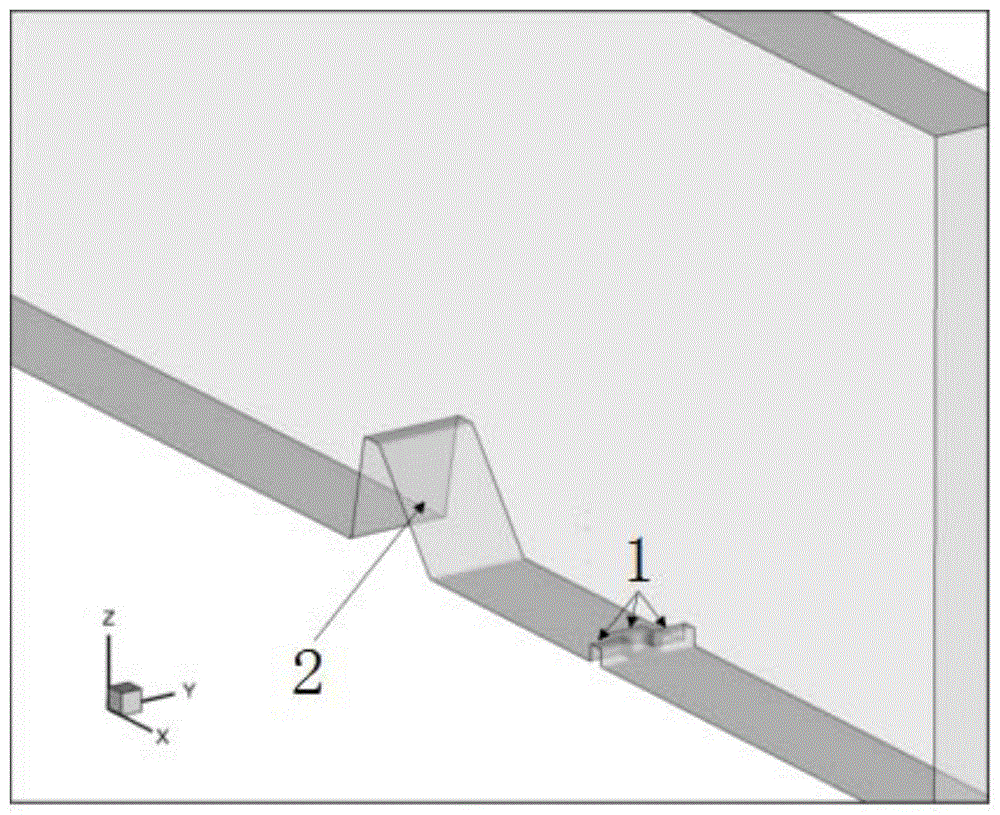
Fig. 1 is a schematic diagram of the arrangement of a supersaturated total dissolved gas abatement pier downstream of a secondary dam in example 1, in which 1-supersaturated total dissolved gas abatement pier, 2-secondary dam.
FIG. 2 is an aeration concentration profile of the body of water under the dam for example 1 and comparative example 1 with (A) graph and without (B) graph under supersaturated total dissolved gas trim pier conditions.
FIG. 3 is a graph of total dissolved gas supersaturation for dam water for both the set up ((A) diagram) and the set up ((B) diagram) without the supersaturated total dissolved gas abatement pier for example 1 and comparative example 1.
Detailed Description
The engineering measures for reducing the total dissolved gas supersaturation in the water body under the dam according to the present invention will be further described with reference to the accompanying drawings and embodiments, which are only a part of the embodiments of the present invention, but not all of them. Based on the summary and examples of the present invention, those skilled in the art can obtain other embodiments without creative efforts and still fall within the protection scope of the present invention.
Example 1
In the embodiment, a great river and great hillock power station is taken as an example to illustrate the method for slowing the supersaturation of the total dissolved gas in the water body under the dam, and the numerical simulation technology is used to illustrate the effect of the method for slowing the supersaturation of the total dissolved gas in the water body under the dam.
The large hillock hydropower station is located in midstream of a large river of Sichuan province, the upstream is connected with the hard beam-covered hydropower station, and the downstream is connected with the leading stone hydropower station. The engineering task is mainly power generation and flood control. The water retaining building adopts a concrete parabolic hyperbolic arch dam, the maximum dam height is 210.0m, and the total installed capacity of a power station is 2600MW (4 multiplied by 650 MW). The diversion power generation building is arranged on the left bank, and the plant is an underground plant. The water release building consists of 4 deep holes in the dam body and 1 open-type inlet non-pressure flood discharge hole in the right bank, the deep holes are 6m wide and 6.6m high, and the outlets adopt trajectory jet energy dissipation. A plunge pool and a secondary dam are arranged under the dam, the center line of the plunge pool is superposed with the center line of the arch dam, the secondary dam is arranged at the tail end of the plunge pool, the secondary dam is in a gravity dam type, the width of the dam crest is 7.0m, and the maximum dam height is 37.0 m.
In the embodiment, three supersaturated total dissolved gas abatement piers 1 are arranged at the downstream of a secondary dam 2, the three supersaturated total dissolved gas abatement piers are arranged in two rows in a staggered manner in a bottom high-speed water flow region, and the position range of the high-speed water flow region is determined by a numerical simulation means, namely, a numerical simulation software Openfoam or Fluent commonly used in the field is adopted to calculate a flow field first and then determine the position range of the high-speed water flow region, and simulation conditions such as flow, the size of a drainage energy dissipation facility, the size of a river channel and the like adopted in numerical simulation are consistent with actual engineering. The specific arrangement mode is as shown in fig. 1, the supersaturated total dissolved gas abatement piers are cuboid in shape, the sizes of the supersaturated total dissolved gas abatement piers are all 5m (height) × 2m (thickness) × 5m (width), the distance between the front row of the supersaturated total dissolved gas abatement piers and the rear row of the supersaturated total dissolved gas abatement piers is 2m, and the distance between the adjacent supersaturated total dissolved gas abatement piers in the second row is 2 m.
Comparative example 1
This comparative example differs from example 1 only in that no supersaturated total dissolved gas abatement piers are provided downstream of the secondary dams.
The distribution conditions of the aeration concentration of the water body under the dam under the working conditions of the example 1 and the comparative example 1 are simulated through a numerical simulation research means, the simulation conditions of the flow, the size of a drainage energy dissipation facility, the size of a river channel and the like adopted in the numerical simulation are consistent with the actual engineering, and the saturation of the total dissolved gas of the water body under the dam under the condition that the supersaturated total dissolved gas reduction pier is set and not set are compared.
The distribution of the aeration concentration of the under-dam body of water under the condition of the supersaturated total dissolved gas abatement pier with and without the supersaturated total dissolved gas abatement pier is shown in fig. 2 for example 1 and comparative example 1. As can be seen from fig. 2, in example 1, after the supersaturated total dissolved gas abatement pier is provided, bubbles float upward after passing through the supersaturated total dissolved gas abatement pier as they flow downstream following the water flow, and the bubbles under the dam are more concentrated at the free liquid surface in example 1 than in comparative example 1.
The undersea water supersaturated total dissolved gas profiles for example 1 and comparative example 1 with and without the supersaturated total dissolved gas abatement pier are shown in figure 3. As can be seen from fig. 3, after the supersaturated total dissolved gas abatement pier is arranged, since the bubbles float upward under the action of the supersaturated total dissolved gas abatement pier, and are influenced by pressure, the effective saturation solubility of the total dissolved gas at the free liquid level is smaller, so that the mass transfer of the bubbles is also smaller, which leads to the reduction of the total dissolved gas saturation under the dam, and in the downstream area of the two dams, the total dissolved gas saturation of example 1 is lower than that of comparative example 1. The total dissolved gas saturation for example 1 and comparative example 1 was 120.9% and 134.0% respectively at the calculated zone end section 500m below the dam, that is, the total dissolved gas saturation in the body of water was reduced by 13.1% within 500m below the dam, which is a very significant difference to the art, relative to comparative example 1, after example 1 had the total dissolved gas abatement pier located downstream of the two-way dam.
The numerical simulation calculation results show that the supersaturated total dissolved gas reduction pier arranged at the downstream of the secondary dam can effectively promote bubbles to move upwards so as to slow down the total dissolved gas over-saturation degree of the water body under the dam.