Family education game system and method based on VR technology
Technical Field
The invention belongs to the technical field of virtual reality, and particularly relates to a family education game system and method based on VR technology.
Background
At present: with the development of information technology, traditional education is developed from online to online, a plurality of courses can realize remote teaching through a network, and for parents who work busy and have no time to go out of class for children, the remote teaching not only saves traffic time and traffic cost, but also enables the children to learn extra knowledge at home. However, in the current remote teaching, a teacher still gives a lecture through a blackboard or gives a lecture interactively, the teacher is not moved to a network video from a classroom, the teaching quality of the remote teaching does not change essentially, students cannot be supervised and controlled at the learning moment, and whether the students are qualified or not cannot be resolved only by examination at the end of a period, and the like. The virtual reality shows an extremely real world, can convert the traditional plane and boring speaking education into virtual 3D education, and can enable children to learn knowledge in the game process, so that the children have more sense of participation.
Virtual reality technology (VR) mainly includes aspects of simulating environment, perception, natural skills, sensing equipment and the like. The main technology is a technology for providing immersion feeling in an interactive three-dimensional environment generated on a computer by comprehensively utilizing a computer graphic system and various interface devices such as reality and control. VR has been applied in a number of fields including the field of gaming, but current VR games suffer from a lack of tactile experience and a poor gaming experience. Moreover, the existing VR technology is not combined with family education, and the family education cannot be realized in a game mode.
Through the above analysis, the problems and defects of the prior art are as follows: at present, VR games are lack of touch experience, and the game experience is poor; the existing VR technology is not combined with family education, and the family education cannot be realized in a game mode.
Disclosure of Invention
Aiming at the problems in the prior art, the invention provides a family education game system based on VR technology.
The present invention is achieved in such a way that a family education game system based on VR technology includes:
the image acquisition module is connected with the central control module and is used for acquiring the game image through an acquisition program;
the image analysis module is connected with the central control module and is used for analyzing the acquired image through an analysis program;
the scene editing module is connected with the central control module and is used for editing the game scene through an editing program;
the central control module is connected with the image acquisition module, the image analysis module, the scene editing module, the logic block storage module, the scene selection module, the VR imaging module, the VR glasses module, the sensor module, the limb action acquisition module, the instruction determination module, the instruction output module and the display module, and is used for processing acquired information through the main control computer and controlling each module to normally operate through a processing result and preset parameters;
the logic block storage module is connected with the central control module and used for storing a logic graphic block of dynamic element motion in the VR virtual scene through the memory;
the scene selection module is connected with the central control module and is used for selecting game scenes through a selection program;
the VR imaging module is connected with the central control module and is used for performing VR imaging on the collected game images and the selected game scenes through an imaging program;
the VR glasses module is connected with the central control module and used for displaying the image data generated by the VR imaging module through VR glasses;
the sensor module is connected with the central control module and used for sensing the user movement information through the sensor;
the limb action acquisition module is connected with the central control module and is used for acquiring and identifying the limb action information of the user through the camera;
the instruction determining module is connected with the central control module and used for comparing the limb action information of the user with prestored instructions and determining control instructions corresponding to the limb action information;
the instruction output module is connected with the central control module and is used for adjusting and transforming the image picture displayed in the VR imaging module according to the control instruction corresponding to the limb action information;
and the display module is connected with the central control module and used for synchronously displaying the image data displayed by the VR glasses through the display.
Further, the scene editing module includes:
a base image obtaining unit for receiving a base image required for scene editing, the base image including a plurality of HR images and one enlarged LR image;
a basic image processing unit for dividing the amplified LR image into a plurality of query image blocks and projecting each of a plurality of HR images onto a space of a reconstructed HR panoramic image a plurality of times to generate a plurality of homographic projections;
the image matching unit is used for searching the best matching image block similar to the query image block in the amplified LR image in the homography projection in the HR image;
and the image reconstruction and combination unit selects a plurality of best matching image blocks for combination and reconstruction, and combines the combined and reconstructed image into the reconstructed HR panoramic image.
Further, the limb movement acquisition module comprises:
an image acquisition unit for acquiring a background image not including a human body image and a current image including a human body image;
the foreground obtaining unit is used for obtaining a human body image foreground image by adopting a frame difference method according to the background image and the current image;
the action recognition unit analyzes the acquired image and recognizes the action of the limbs according to the position of the human body in the scene;
and the characteristic extraction unit is used for extracting the characteristics of the identified limb action information to obtain the characteristic information corresponding to the limb action information.
Further, the sensor module includes:
the infrared induction unit tracks the moving process of the human body through an infrared inductor;
the contour image acquisition unit is used for shooting the tracked human body through the infrared camera device and acquiring a temperature distribution image of the human body, and acquiring a human body contour image according to the temperature distribution image of the human body;
and the mobile identification unit is used for matching the detected human body movement information with the corresponding control information to obtain a control scheme matched with the movement information.
Further, the instruction determination module comprises:
the instruction pre-storing unit is used for pre-storing the control instruction to construct an instruction data set;
the information association unit is used for associating and storing different limb action information and different control instructions;
and the characteristic matching unit is used for matching and retrieving the characteristic information extracted by the limb action acquisition module and the associated limb action information in the instruction data set to retrieve the control instruction corresponding to the characteristic information.
Another object of the present invention is to provide a method of a VR technology-based home education game system, the method of the VR technology-based home education game including:
acquiring a planar image of a game, analyzing acquired image information, and editing a game scene through an editing program;
step two, storing a logic graphic block of the dynamic element motion in the VR virtual scene through a memory;
selecting a game scene, and performing VR imaging of the scene through an imaging program and displaying;
step four, the user movement information is sensed through a sensor, and the user movement information is converted through a converter;
and step five, generating an image from the conversion information through an image generation program, performing VR imaging again, and displaying the game through a display.
Further, the method for analyzing the acquired image information comprises the following steps:
labeling a first type of image in the collected images to obtain a label of the first type of image, and generating an identification model according to the first type of image and the label of the first type of image;
and automatically labeling second images except the first images in the sample images through the identification model to obtain labels of the second images.
Further, the method for editing the game scene comprises the following steps:
receiving a plurality of HR images and a 360 degree low resolution LR image;
wherein the plurality of HR image pairs have a higher resolution for a photographic target and the 360 degree LR image pair have a lower resolution for a photographic target, wherein the photographic target is viewable by the one HR camera and the perpendicular camera;
magnifying the 360-degree LR image to a higher resolution space to produce a magnified LR image;
segmenting the enlarged LR image into a plurality of query image blocks;
projecting each of the plurality of HR images onto a space of one reconstructed HR panoramic image a plurality of times using a plurality of homography matrices to produce a plurality of homography projections;
searching a search window in each of a plurality of homographic projections generated from each HR image to find a best matching image block that is similar to a query image block in the enlarged LR image;
selecting among the best matching image blocks according to the similarity with the query image block to generate a selected image block;
synthesizing the selected image blocks to generate a reconstructed image block; and placing the reconstructed image blocks in the reconstructed HR panoramic image at the positions corresponding to the query image blocks in the amplified LR image so as to add the HR image details to the amplified LR image;
thus, the HR details of the plurality of HR images are placed on the enlarged LR image, which provides image block location information.
Further, the VR imaging method comprises:
emitting VR images by tilting the display upwards by 10-40 degrees;
the total reflection mirror respectively reflects the VR images to a Fresnel lens below for trapezoidal correction and first amplification;
the transparent curved mirror pasted with the holographic film respectively reflects the VR split-screen image and carries out secondary amplification, and images are formed in eyes of a user; meanwhile, the real scene in front of the user directly forms an image in the eyes of the user through the transparent curved mirror pasted with the holographic film, wherein the transparent curved mirror pasted with the holographic film is a concave curved mirror or a convex curved mirror.
Further, the method for the sensor to sense the user movement information comprises the following steps:
detecting human bodies around the action sensing device through the infrared sensor and adjusting the rotation angle of the infrared sensor to track the detected human bodies;
shooting the tracked human body through an infrared shooting unit, acquiring a temperature distribution image of the human body, and obtaining a human body outline image according to the temperature distribution image of the human body;
acquiring distance information between a human motion part and the motion sensing device through an infrared sensor;
comparing the acquired human body contour image with a stored human body contour image, determining a human body contour image matched with the acquired human body contour image from the stored human body contour image, and determining a two-dimensional action corresponding to the human body contour image according to the determined human body contour image; and determining a corresponding operation action according to the two-dimensional action and the acquired distance change information between the human motion part and the action sensing device, and determining an operation control signal according to the determined operation action so as to perform corresponding operation on the action sensing device.
By combining all the technical schemes, the invention has the advantages and positive effects that: the invention can preset and edit game scenes and pictures through the image acquisition module and the scene editing module, is convenient for pertinence setting according to the characteristics of different students, and can be suitable for family education of different children. The imaging is carried out through the VR imaging module, the game imaging is more real, a user can be brought into a game scene, the scene experience brought by a virtual technology is experienced, and the game experience is better. Moreover, the traditional plane and boring speaking education can be displayed in a dynamic sound, image and interaction mode, so that children can learn knowledge in the game process and have more participation sense; the learning operation process of the user can be checked through the display, and the learning content and the learning condition of the user can be checked through the APP client side of the mobile terminal.
Drawings
In order to more clearly illustrate the technical solutions of the embodiments of the present application, the drawings needed to be used in the embodiments of the present application will be briefly described below, and it is obvious that the drawings described below are only some embodiments of the present application, and it is obvious for those skilled in the art that other drawings can be obtained from the drawings without creative efforts.
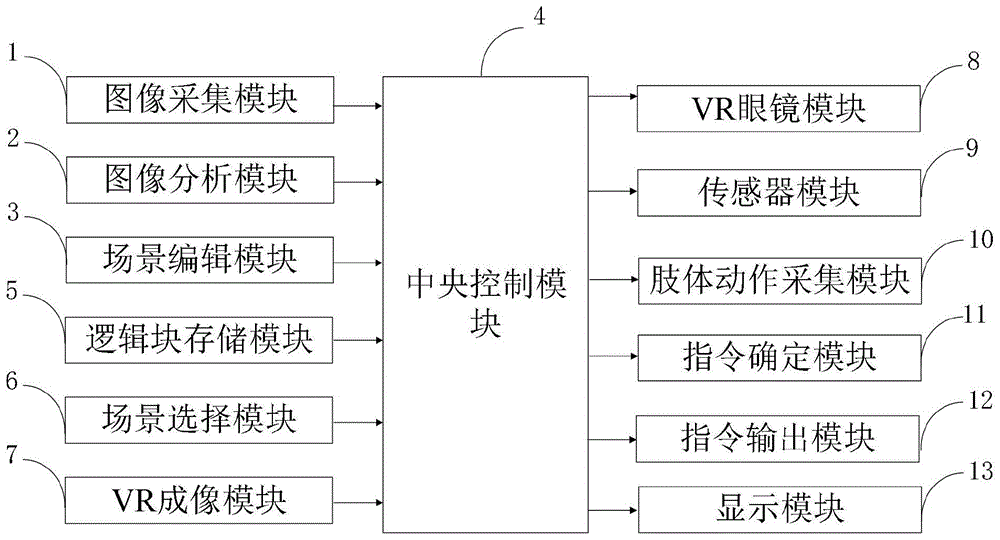
Fig. 1 is a block diagram of a home education game system based on VR technology provided in an embodiment of the present invention;
in the figure: 1. an image acquisition module; 2. an image analysis module; 3. a scene editing module; 4. a central control module; 5. a logical block storage module; 6. a scene selection module; 7. a VR imaging module; 8. a VR glasses module; 9. a sensor module; 10. a limb movement acquisition module; 11. an instruction determination module; 12. an instruction output module; 13. and a display module.
Fig. 2 is a flowchart of a home education game method based on VR technology according to an embodiment of the present invention.
Fig. 3 is a schematic diagram of a limb movement acquisition module according to an embodiment of the present invention.
Fig. 4 is a schematic diagram of a sensor module provided by an embodiment of the invention.
Fig. 5 is a schematic diagram of a method of a VR technology-based home education game applied to a VR technology-based home education game system according to an embodiment of the present invention.
Detailed Description
In order to make the objects, technical solutions and advantages of the present invention more apparent, the present invention is further described in detail with reference to the following embodiments. It should be understood that the specific embodiments described herein are merely illustrative of the invention and are not intended to limit the invention.
In view of the problems in the prior art, the present invention provides a family education game system and method based on VR technology, and the present invention will be described in detail with reference to the accompanying drawings.
As shown in fig. 1, a home education game system based on VR technology according to an embodiment of the present invention includes:
the image acquisition module 1 is connected with the central control module and is used for acquiring game images through an acquisition program;
the image analysis module 2 is connected with the central control module and is used for analyzing the acquired image through an analysis program;
the scene editing module 3 is connected with the central control module and is used for editing the game scene through an editing program;
the central control module 4 is connected with the image acquisition module, the image analysis module, the scene editing module, the logic block storage module, the scene selection module, the VR imaging module, the VR glasses module, the sensor module, the limb action acquisition module, the instruction determination module, the instruction output module and the display module, and is used for processing the acquired information through the main control computer and controlling each module to normally operate through the processing result and the preset parameters;
the logic block storage module 5 is connected with the central control module and is used for storing logic graphic blocks of dynamic element motion in the VR virtual scene through a memory;
the scene selection module 6 is connected with the central control module and is used for selecting game scenes through a selection program;
the VR imaging module 7 is connected with the central control module and is used for carrying out VR imaging on the collected game images and the selected game scenes through an imaging program;
the VR glasses module 8 is connected with the central control module and used for displaying the image data generated by the VR imaging module through VR glasses;
the sensor module 9 is connected with the central control module and used for sensing the user movement information through a sensor;
the limb action acquisition module 10 is connected with the central control module and is used for acquiring and identifying the limb action information of the user through a camera;
the instruction determining module 11 is connected with the central control module and is used for comparing the limb action information of the user with a prestored instruction and determining a control instruction corresponding to the limb action information;
the instruction output module 12 is connected with the central control module and is used for adjusting and converting the image frame displayed in the VR imaging module according to the control instruction corresponding to the limb action information;
and the display module 13 is connected with the central control module and is used for synchronously displaying the image data displayed by the VR glasses through the display.
As shown in fig. 2, the scene editing module 3 in the embodiment of the present invention includes:
a base image obtaining unit for receiving a base image required for scene editing, the base image including a plurality of HR images and one enlarged LR image;
a basic image processing unit for dividing the amplified LR image into a plurality of query image blocks and projecting each of a plurality of HR images onto a space of a reconstructed HR panoramic image a plurality of times to generate a plurality of homographic projections;
the image matching unit is used for searching the best matching image block similar to the query image block in the amplified LR image in the homography projection in the HR image;
and the image reconstruction and combination unit selects a plurality of best matching image blocks for combination and reconstruction, and combines the combined and reconstructed image into the reconstructed HR panoramic image.
As shown in fig. 3, the limb movement acquisition module 10 in the embodiment of the present invention includes:
an image acquisition unit for acquiring a background image not including a human body image and a current image including a human body image;
the foreground obtaining unit is used for obtaining a human body image foreground image by adopting a frame difference method according to the background image and the current image;
the action recognition unit analyzes the acquired image and recognizes the action of the limbs according to the position of the human body in the scene;
and the characteristic extraction unit is used for extracting the characteristics of the identified limb action information to obtain the characteristic information corresponding to the limb action information.
As shown in fig. 4, the sensor module 9 in the embodiment of the present invention includes:
the infrared induction unit tracks the moving process of the human body through an infrared inductor;
the contour image acquisition unit is used for shooting the tracked human body through the infrared camera device and acquiring a temperature distribution image of the human body, and acquiring a human body contour image according to the temperature distribution image of the human body;
and the mobile identification unit is used for matching the detected human body movement information with the corresponding control information to obtain a control scheme matched with the movement information.
The instruction determining module 11 in the embodiment of the present invention includes:
the instruction pre-storing unit is used for pre-storing the control instruction to construct an instruction data set;
the information association unit is used for associating and storing different limb action information and different control instructions;
and the characteristic matching unit is used for matching and retrieving the characteristic information extracted by the limb action acquisition module and the associated limb action information in the instruction data set to retrieve the control instruction corresponding to the characteristic information.
As shown in fig. 5, a method for a VR technology-based home education game applied to a VR technology-based home education game system according to an embodiment of the present invention includes:
s101, collecting a planar image of a game, analyzing the collected image information, and editing a game scene through an editing program;
s102, storing a logic graphic block of dynamic element motion in the VR virtual scene through a memory;
s103, selecting a game scene, and performing VR imaging of the scene through an imaging program and displaying;
s104, sensing user movement information through a sensor, and converting the user movement information through a converter;
and S105, generating an image by the conversion information through an image generation program, performing VR imaging again, and displaying the game through the display.
The method for analyzing the acquired image information provided by the embodiment of the invention comprises the following steps:
labeling a first type of image in the collected images to obtain a label of the first type of image, and generating an identification model according to the first type of image and the label of the first type of image;
and automatically labeling second images except the first images in the sample images through the identification model to obtain labels of the second images.
The method for editing the game scene provided by the embodiment of the invention comprises the following steps:
receiving a plurality of HR images and a 360 degree low resolution LR image;
wherein the plurality of HR image pairs have a higher resolution for a photographic target and the 360 degree LR image pair have a lower resolution for a photographic target, wherein the photographic target is viewable by the one HR camera and the perpendicular camera;
magnifying the 360-degree LR image to a higher resolution space to produce a magnified LR image;
segmenting the enlarged LR image into a plurality of query image blocks;
projecting each of the plurality of HR images onto a space of one reconstructed HR panoramic image a plurality of times using a plurality of homography matrices to produce a plurality of homography projections;
searching a search window in each of a plurality of homographic projections generated from each HR image to find a best matching image block that is similar to a query image block in the enlarged LR image;
selecting among the best matching image blocks according to the similarity with the query image block to generate a selected image block;
synthesizing the selected image blocks to generate a reconstructed image block; and placing the reconstructed image blocks in the reconstructed HR panoramic image at the positions corresponding to the query image blocks in the amplified LR image so as to add the HR image details to the amplified LR image;
thus, the HR details of the plurality of HR images are placed on the enlarged LR image, which provides image block location information.
The VR imaging method provided by the embodiment of the invention comprises the following steps:
emitting VR images by tilting the display upwards by 10-40 degrees;
the total reflection mirror respectively reflects the VR images to a Fresnel lens below for trapezoidal correction and first amplification;
the transparent curved mirror pasted with the holographic film respectively reflects the VR split-screen image and carries out secondary amplification, and images are formed in eyes of a user; meanwhile, the real scene in front of the user directly forms an image in the eyes of the user through the transparent curved mirror pasted with the holographic film, wherein the transparent curved mirror pasted with the holographic film is a concave curved mirror or a convex curved mirror.
The method for sensing the user movement information by the sensor provided by the embodiment of the invention comprises the following steps:
detecting human bodies around the action sensing device through the infrared sensor and adjusting the rotation angle of the infrared sensor to track the detected human bodies;
shooting the tracked human body through an infrared shooting unit, acquiring a temperature distribution image of the human body, and obtaining a human body outline image according to the temperature distribution image of the human body;
acquiring distance information between a human motion part and the motion sensing device through an infrared sensor;
comparing the acquired human body contour image with a stored human body contour image, determining a human body contour image matched with the acquired human body contour image from the stored human body contour image, and determining a two-dimensional action corresponding to the human body contour image according to the determined human body contour image; and
and determining a corresponding operation action according to the determined two-dimensional action and the acquired distance change information between the human motion part and the action sensing device, and determining an operation control signal according to the determined operation action so as to perform corresponding operation on the action sensing device.
The above description is only for the purpose of illustrating the preferred embodiments of the present invention, and the scope of the present invention is not limited thereto, and any modification, equivalent replacement, and improvement made by those skilled in the art within the technical scope of the present invention disclosed herein, which is within the spirit and principle of the present invention, should be covered by the present invention.