CN111857567A - Memory system and method of controlling its temperature - Google Patents
Memory system and method of controlling its temperature Download PDFInfo
- Publication number
- CN111857567A CN111857567A CN201911367376.5A CN201911367376A CN111857567A CN 111857567 A CN111857567 A CN 111857567A CN 201911367376 A CN201911367376 A CN 201911367376A CN 111857567 A CN111857567 A CN 111857567A
- Authority
- CN
- China
- Prior art keywords
- memory
- execution
- memory device
- temperature
- controller
- Prior art date
- Legal status (The legal status is an assumption and is not a legal conclusion. Google has not performed a legal analysis and makes no representation as to the accuracy of the status listed.)
- Withdrawn
Links
Images




Classifications
-
- G—PHYSICS
- G06—COMPUTING OR CALCULATING; COUNTING
- G06F—ELECTRIC DIGITAL DATA PROCESSING
- G06F3/00—Input arrangements for transferring data to be processed into a form capable of being handled by the computer; Output arrangements for transferring data from processing unit to output unit, e.g. interface arrangements
- G06F3/06—Digital input from, or digital output to, record carriers, e.g. RAID, emulated record carriers or networked record carriers
- G06F3/0601—Interfaces specially adapted for storage systems
- G06F3/0628—Interfaces specially adapted for storage systems making use of a particular technique
- G06F3/0655—Vertical data movement, i.e. input-output transfer; data movement between one or more hosts and one or more storage devices
- G06F3/0659—Command handling arrangements, e.g. command buffers, queues, command scheduling
-
- G—PHYSICS
- G06—COMPUTING OR CALCULATING; COUNTING
- G06F—ELECTRIC DIGITAL DATA PROCESSING
- G06F3/00—Input arrangements for transferring data to be processed into a form capable of being handled by the computer; Output arrangements for transferring data from processing unit to output unit, e.g. interface arrangements
- G06F3/06—Digital input from, or digital output to, record carriers, e.g. RAID, emulated record carriers or networked record carriers
- G06F3/0601—Interfaces specially adapted for storage systems
- G06F3/0602—Interfaces specially adapted for storage systems specifically adapted to achieve a particular effect
- G06F3/0614—Improving the reliability of storage systems
-
- G—PHYSICS
- G11—INFORMATION STORAGE
- G11C—STATIC STORES
- G11C16/00—Erasable programmable read-only memories
- G11C16/02—Erasable programmable read-only memories electrically programmable
- G11C16/04—Erasable programmable read-only memories electrically programmable using variable threshold transistors, e.g. FAMOS
- G11C16/0483—Erasable programmable read-only memories electrically programmable using variable threshold transistors, e.g. FAMOS comprising cells having several storage transistors connected in series
-
- G—PHYSICS
- G01—MEASURING; TESTING
- G01K—MEASURING TEMPERATURE; MEASURING QUANTITY OF HEAT; THERMALLY-SENSITIVE ELEMENTS NOT OTHERWISE PROVIDED FOR
- G01K13/00—Thermometers specially adapted for specific purposes
-
- G—PHYSICS
- G06—COMPUTING OR CALCULATING; COUNTING
- G06F—ELECTRIC DIGITAL DATA PROCESSING
- G06F3/00—Input arrangements for transferring data to be processed into a form capable of being handled by the computer; Output arrangements for transferring data from processing unit to output unit, e.g. interface arrangements
- G06F3/06—Digital input from, or digital output to, record carriers, e.g. RAID, emulated record carriers or networked record carriers
- G06F3/0601—Interfaces specially adapted for storage systems
- G06F3/0602—Interfaces specially adapted for storage systems specifically adapted to achieve a particular effect
- G06F3/0614—Improving the reliability of storage systems
- G06F3/0619—Improving the reliability of storage systems in relation to data integrity, e.g. data losses, bit errors
-
- G—PHYSICS
- G06—COMPUTING OR CALCULATING; COUNTING
- G06F—ELECTRIC DIGITAL DATA PROCESSING
- G06F3/00—Input arrangements for transferring data to be processed into a form capable of being handled by the computer; Output arrangements for transferring data from processing unit to output unit, e.g. interface arrangements
- G06F3/06—Digital input from, or digital output to, record carriers, e.g. RAID, emulated record carriers or networked record carriers
- G06F3/0601—Interfaces specially adapted for storage systems
- G06F3/0628—Interfaces specially adapted for storage systems making use of a particular technique
- G06F3/0629—Configuration or reconfiguration of storage systems
- G06F3/0634—Configuration or reconfiguration of storage systems by changing the state or mode of one or more devices
-
- G—PHYSICS
- G06—COMPUTING OR CALCULATING; COUNTING
- G06F—ELECTRIC DIGITAL DATA PROCESSING
- G06F3/00—Input arrangements for transferring data to be processed into a form capable of being handled by the computer; Output arrangements for transferring data from processing unit to output unit, e.g. interface arrangements
- G06F3/06—Digital input from, or digital output to, record carriers, e.g. RAID, emulated record carriers or networked record carriers
- G06F3/0601—Interfaces specially adapted for storage systems
- G06F3/0628—Interfaces specially adapted for storage systems making use of a particular technique
- G06F3/0638—Organizing or formatting or addressing of data
- G06F3/064—Management of blocks
-
- G—PHYSICS
- G06—COMPUTING OR CALCULATING; COUNTING
- G06F—ELECTRIC DIGITAL DATA PROCESSING
- G06F3/00—Input arrangements for transferring data to be processed into a form capable of being handled by the computer; Output arrangements for transferring data from processing unit to output unit, e.g. interface arrangements
- G06F3/06—Digital input from, or digital output to, record carriers, e.g. RAID, emulated record carriers or networked record carriers
- G06F3/0601—Interfaces specially adapted for storage systems
- G06F3/0628—Interfaces specially adapted for storage systems making use of a particular technique
- G06F3/0653—Monitoring storage devices or systems
-
- G—PHYSICS
- G06—COMPUTING OR CALCULATING; COUNTING
- G06F—ELECTRIC DIGITAL DATA PROCESSING
- G06F3/00—Input arrangements for transferring data to be processed into a form capable of being handled by the computer; Output arrangements for transferring data from processing unit to output unit, e.g. interface arrangements
- G06F3/06—Digital input from, or digital output to, record carriers, e.g. RAID, emulated record carriers or networked record carriers
- G06F3/0601—Interfaces specially adapted for storage systems
- G06F3/0628—Interfaces specially adapted for storage systems making use of a particular technique
- G06F3/0655—Vertical data movement, i.e. input-output transfer; data movement between one or more hosts and one or more storage devices
- G06F3/0658—Controller construction arrangements
-
- G—PHYSICS
- G06—COMPUTING OR CALCULATING; COUNTING
- G06F—ELECTRIC DIGITAL DATA PROCESSING
- G06F3/00—Input arrangements for transferring data to be processed into a form capable of being handled by the computer; Output arrangements for transferring data from processing unit to output unit, e.g. interface arrangements
- G06F3/06—Digital input from, or digital output to, record carriers, e.g. RAID, emulated record carriers or networked record carriers
- G06F3/0601—Interfaces specially adapted for storage systems
- G06F3/0668—Interfaces specially adapted for storage systems adopting a particular infrastructure
- G06F3/0671—In-line storage system
- G06F3/0673—Single storage device
-
- G—PHYSICS
- G11—INFORMATION STORAGE
- G11C—STATIC STORES
- G11C16/00—Erasable programmable read-only memories
- G11C16/02—Erasable programmable read-only memories electrically programmable
- G11C16/06—Auxiliary circuits, e.g. for writing into memory
- G11C16/34—Determination of programming status, e.g. threshold voltage, overprogramming or underprogramming, retention
- G11C16/349—Arrangements for evaluating degradation, retention or wearout, e.g. by counting erase cycles
- G11C16/3495—Circuits or methods to detect or delay wearout of nonvolatile EPROM or EEPROM memory devices, e.g. by counting numbers of erase or reprogram cycles, by using multiple memory areas serially or cyclically
-
- G—PHYSICS
- G11—INFORMATION STORAGE
- G11C—STATIC STORES
- G11C7/00—Arrangements for writing information into, or reading information out from, a digital store
- G11C7/04—Arrangements for writing information into, or reading information out from, a digital store with means for avoiding disturbances due to temperature effects
-
- G—PHYSICS
- G11—INFORMATION STORAGE
- G11C—STATIC STORES
- G11C16/00—Erasable programmable read-only memories
- G11C16/02—Erasable programmable read-only memories electrically programmable
- G11C16/06—Auxiliary circuits, e.g. for writing into memory
- G11C16/08—Address circuits; Decoders; Word-line control circuits
-
- G—PHYSICS
- G11—INFORMATION STORAGE
- G11C—STATIC STORES
- G11C16/00—Erasable programmable read-only memories
- G11C16/02—Erasable programmable read-only memories electrically programmable
- G11C16/06—Auxiliary circuits, e.g. for writing into memory
- G11C16/10—Programming or data input circuits
- G11C16/14—Circuits for erasing electrically, e.g. erase voltage switching circuits
- G11C16/16—Circuits for erasing electrically, e.g. erase voltage switching circuits for erasing blocks, e.g. arrays, words, groups
-
- G—PHYSICS
- G11—INFORMATION STORAGE
- G11C—STATIC STORES
- G11C16/00—Erasable programmable read-only memories
- G11C16/02—Erasable programmable read-only memories electrically programmable
- G11C16/06—Auxiliary circuits, e.g. for writing into memory
- G11C16/26—Sensing or reading circuits; Data output circuits
-
- G—PHYSICS
- G11—INFORMATION STORAGE
- G11C—STATIC STORES
- G11C16/00—Erasable programmable read-only memories
- G11C16/02—Erasable programmable read-only memories electrically programmable
- G11C16/06—Auxiliary circuits, e.g. for writing into memory
- G11C16/30—Power supply circuits
-
- G—PHYSICS
- G11—INFORMATION STORAGE
- G11C—STATIC STORES
- G11C16/00—Erasable programmable read-only memories
- G11C16/02—Erasable programmable read-only memories electrically programmable
- G11C16/06—Auxiliary circuits, e.g. for writing into memory
- G11C16/34—Determination of programming status, e.g. threshold voltage, overprogramming or underprogramming, retention
- G11C16/3436—Arrangements for verifying correct programming or erasure
- G11C16/3454—Arrangements for verifying correct programming or for detecting overprogrammed cells
- G11C16/3459—Circuits or methods to verify correct programming of nonvolatile memory cells
-
- G—PHYSICS
- G11—INFORMATION STORAGE
- G11C—STATIC STORES
- G11C2211/00—Indexing scheme relating to digital stores characterized by the use of particular electric or magnetic storage elements; Storage elements therefor
- G11C2211/56—Indexing scheme relating to G11C11/56 and sub-groups for features not covered by these groups
- G11C2211/564—Miscellaneous aspects
- G11C2211/5641—Multilevel memory having cells with different number of storage levels
-
- G—PHYSICS
- G11—INFORMATION STORAGE
- G11C—STATIC STORES
- G11C29/00—Checking stores for correct operation ; Subsequent repair; Testing stores during standby or offline operation
- G11C29/52—Protection of memory contents; Detection of errors in memory contents
Landscapes
- Engineering & Computer Science (AREA)
- Theoretical Computer Science (AREA)
- Physics & Mathematics (AREA)
- General Physics & Mathematics (AREA)
- Human Computer Interaction (AREA)
- General Engineering & Computer Science (AREA)
- Microelectronics & Electronic Packaging (AREA)
- Computer Security & Cryptography (AREA)
- Techniques For Improving Reliability Of Storages (AREA)
Abstract
Description
相关申请的交叉引用CROSS-REFERENCE TO RELATED APPLICATIONS
本专利申请要求于2019年4月30日提交的韩国专利申请第 10-2019-0050297号的优先权,其全部内容通过引用合并于此。This patent application claims priority from Korean Patent Application No. 10-2019-0050297 filed on April 30, 2019, the entire contents of which are incorporated herein by reference.
技术领域technical field
各种实施例涉及一种包括存储器设备和控制器的存储器系统,并且更具体地涉及一种存储器系统以及控制该存储器系统的温度的方法。Various embodiments relate to a memory system including a memory device and a controller, and more particularly to a memory system and method of controlling the temperature of the memory system.
背景技术Background technique
近来,用于计算环境的范例已经转移到无处不在的计算,这使得可以随时随地访问计算机系统。结果,诸如移动电话、数码相机、笔记本计算机等便携式电子设备的使用正在迅速增加。这种便携式电子设备通常使用或包括使用或嵌入至少一个存储器设备(即,数据存储设备)的存储器系统。数据存储设备可以用作便携式电子设备的主存储设备或辅助存储设备。Recently, the paradigm for computing environments has shifted to ubiquitous computing, which enables access to computer systems anytime, anywhere. As a result, the use of portable electronic devices such as mobile phones, digital cameras, notebook computers, and the like is rapidly increasing. Such portable electronic devices typically employ or include a memory system that employs or embeds at least one memory device (ie, a data storage device). The data storage device can be used as a primary storage device or a secondary storage device for the portable electronic device.
与硬盘不同,使用非易失性半导体存储器设备的数据存储设备的优点在于,由于其不具有机械驱动部分(例如,机械臂),具有高数据访问速度,并且具有低功耗,因此其具有优异的稳定性和耐用性。在具有这种优点的存储器系统的上下文中,示例性数据存储设备包括 USB(通用串行总线)存储器设备、具有各种接口的存储器卡、固态驱动器(SSD)等。Unlike a hard disk, a data storage device using a nonvolatile semiconductor memory device is advantageous in that it has an excellent stability and durability. In the context of a memory system with this advantage, exemplary data storage devices include USB (Universal Serial Bus) memory devices, memory cards with various interfaces, solid state drives (SSDs), and the like.
发明内容SUMMARY OF THE INVENTION
各个实施例涉及一种存储器系统及其驱动方法,其可以通过基于检测到的存储器设备的温度来不同地设定内部操作的执行条件、并且根据设定执行条件控制内部操作(包括对数据安全性影响较小的后台操作或伪操作)的执行来提高数据可靠性。Various embodiments relate to a memory system and a method for driving the same, which can variously set an execution condition of an internal operation based on a detected temperature of a memory device, and control an internal operation (including data security) according to the set execution condition. Background operations or pseudo-operations with less impact) are executed to improve data reliability.
各个实施例涉及提供一种装置或方法,其可以保持存储器系统的寿命或改善数据安全性或设备安全性,以使得存储器系统根据操作环境来确定是否执行内部操作。Various embodiments are directed to providing an apparatus or method that may preserve the lifespan of a memory system or improve data security or device security so that the memory system determines whether to perform internal operations depending on the operating environment.
根据本发明的实施例,一种存储器系统可以包括:可以包括多个存储器块的存储器设备;以及适合于控制存储器设备的操作的控制器,其中当存储器设备的温度在低温范围内时,控制器可以对没有用于存储数据的设定存储器块执行伪操作。伪操作可以包括编程操作、擦除操作或读取操作。存储器系统还可以包括适合于检测存储器设备的温度的温度传感器。设定存储器块可以包括坏块或备用存储器块。控制器可以基于存储器设备的温度,根据用于后台操作的执行条件来执行后台操作。后台操作可以包括垃圾收集、损耗均衡和读取回收中的至少一项。用于后台操作的执行条件可以包括执行时间、设定存储器块中的执行目标数和执行周期。当温度在常温范围内时,控制器可以根据第一执行条件来执行第一后台操作,当温度在低温范围内时,控制器可以根据第二执行条件来执行第二后台操作,并且当温度在高温范围内时,控制器可以根据第三执行条件来执行第三后台操作。第二执行条件可以具有比第一执行条件更多的执行目标和更短的执行周期。第三执行条件可以具有比第一执行条件更少的执行目标和更长的执行周期。According to an embodiment of the present invention, a memory system may include: a memory device that may include a plurality of memory blocks; and a controller adapted to control the operation of the memory device, wherein when the temperature of the memory device is in a low temperature range, the controller Pseudo operations can be performed on set memory blocks that are not used to store data. Dummy operations may include program operations, erase operations, or read operations. The memory system may also include a temperature sensor adapted to detect the temperature of the memory device. Provisioning memory blocks may include bad blocks or spare memory blocks. The controller may perform the background operation according to the execution condition for the background operation based on the temperature of the memory device. Background operations may include at least one of garbage collection, wear leveling, and read collection. Execution conditions for background operations may include execution time, the number of execution targets in the set memory block, and execution cycles. When the temperature is within the normal temperature range, the controller may execute the first background operation according to the first execution condition, and when the temperature is within the low temperature range, the controller may execute the second background operation according to the second execution condition, and when the temperature is within When within the high temperature range, the controller may execute a third background operation according to a third execution condition. The second execution condition may have more execution targets and a shorter execution period than the first execution condition. The third execution condition may have fewer execution targets and a longer execution period than the first execution condition.
根据本发明的实施例,一种通过存储器系统控制温度的方法,该存储器系统可以包括:包括多个存储器块的存储器设备和适合于控制存储器设备的控制器,该方法可以包括:检测存储器设备的温度;以及当检测到的存储器设备的温度在低温范围内时,对没有用于存储数据的设定存储器块执行伪操作。伪操作可以包括编程操作、擦除操作或读取操作。设定存储器块可以包括坏块或备用存储器块。该方法还可以包括基于检测到的温度,根据用于对存储器块执行的后台操作的执行条件来执行后台操作。后台操作的执行在伪操作的执行之前执行。后台操作的执行在伪操作的执行之后执行。后台操作可以包括垃圾收集、损耗均衡和读取回收中的至少一项。执行条件可以包括执行时间、设定存储器块中的执行目标数和执行周期。该方法还可以包括:当温度在常温范围内时,根据第一执行条件执行第一后台操作;当温度在低温范围内时,根据第二执行条件执行第二后台操作;以及当温度在高温范围内时,根据第三执行条件执行后台操作。第二执行条件可以具有比第一执行条件更多的执行目标和更长的执行时间,并且第三执行条件可以具有比第一执行条件更少的执行目标和更短的执行时间。According to an embodiment of the present invention, a method of controlling temperature by a memory system, the memory system may include: a memory device including a plurality of memory blocks and a controller adapted to control the memory device, the method may include: detecting the temperature of the memory device temperature; and when the detected temperature of the memory device is in the low temperature range, performing a dummy operation on a set memory block that is not used to store data. Dummy operations may include program operations, erase operations, or read operations. Provisioning memory blocks may include bad blocks or spare memory blocks. The method may further include performing a background operation according to an execution condition for the background operation performed on the memory block based on the detected temperature. The execution of the background operation is performed before the execution of the pseudo operation. The execution of the background operation is performed after the execution of the pseudo operation. Background operations may include at least one of garbage collection, wear leveling, and read collection. The execution conditions may include execution time, the number of execution targets in the set memory block, and execution cycles. The method may further include: when the temperature is within a normal temperature range, performing a first background operation according to a first execution condition; when the temperature is within a low temperature range, performing a second background operation according to a second execution condition; and when the temperature is within a high temperature range When inside, the background operation is performed according to the third execution condition. The second execution condition may have more execution targets and longer execution time than the first execution condition, and the third execution condition may have fewer execution targets and shorter execution time than the first execution condition.
根据本发明的实施例,一种控制存储器系统中的温度的方法,该存储器系统可以包括:包括存储器块的存储器设备和适合于控制存储器设备的控制器,该方法可以包括:检测存储器设备的温度;根据温度和执行条件对存储器块执行内部操作,其中执行条件基于温度而变化。用于内部操作的执行条件可以包括执行时间、存储器块中的执行目标数和执行周期中的至少一项。执行内部操作可以包括:当检测到的温度在常温范围内时,根据第一条件执行内部操作;当检测到的温度在低温范围内时,根据第二条件执行内部操作;以及当检测到的温度在高温范围内时,根据第三条件执行内部操作。根据第二条件执行内部操作的频率高于根据第一条件执行内部操作的频率,并且根据第二条件的执行时间比根据第一条件的执行时间更长。根据第三条件执行内部操作的频率低于根据第一条件执行内部操作的频率,并且根据第三条件的执行时间比根据第一条件的执行时间更短。在根据第二条件的内部操作中生成的热量大于在根据第一条件的内部操作中生成的热量。在根据第三条件的内部操作中生成的热量小于在根据第一条件的内部操作中生成的热量。内部操作是后台操作,可以包括垃圾收集、损耗均衡和读取回收中的至少一项。该方法还可以包括:当温度在低温范围内时,在根据第二条件执行内部操作之后,对没有用于存储数据的设定存储器块执行伪操作,其中伪操作可以包括编程操作、擦除操作和读取操作。执行内部操作可以包括:当检测到的温度不在低温范围内时,根据第一条件执行第一内部操作;或者当检测到的温度在低温范围内时,根据第二条件执行第二内部操作。第二内部操作可以包括对没有用于存储数据的设定存储器块执行的伪操作,该伪操作可以包括编程操作、读取操作或擦除操作,并且设定存储器块可以包括坏块或备用存储器块。According to an embodiment of the present invention, a method of controlling temperature in a memory system, the memory system may include: a memory device including a memory block and a controller adapted to control the memory device, the method may include: detecting a temperature of the memory device ;Performs internal operations on memory blocks based on temperature and execution conditions, where execution conditions vary based on temperature. The execution condition for the internal operation may include at least one of an execution time, the number of execution targets in the memory block, and an execution cycle. Performing the internal operation may include: when the detected temperature is within the normal temperature range, performing the internal operation according to the first condition; when the detected temperature is within the low temperature range, performing the internal operation according to the second condition; and when the detected temperature In the high temperature range, the internal operation is performed according to the third condition. The frequency of executing the internal operation according to the second condition is higher than the frequency of executing the internal operation according to the first condition, and the execution time according to the second condition is longer than the execution time according to the first condition. The frequency of executing the internal operation according to the third condition is lower than the frequency of executing the internal operation according to the first condition, and the execution time according to the third condition is shorter than the execution time according to the first condition. The heat generated in the internal operation according to the second condition is greater than the heat generated in the internal operation according to the first condition. The heat generated in the internal operation according to the third condition is smaller than the heat generated in the internal operation according to the first condition. Internal operations are background operations that can include at least one of garbage collection, wear leveling, and read collection. The method may further include: when the temperature is in the low temperature range, after performing the internal operation according to the second condition, performing a pseudo operation on the set memory block not used for storing data, wherein the pseudo operation may include a programming operation, an erasing operation and read operations. Performing the internal operation may include: when the detected temperature is not within the low temperature range, performing the first internal operation according to the first condition; or when the detected temperature is within the low temperature range, performing the second internal operation according to the second condition. The second internal operation may include a dummy operation performed on a set memory block not used to store data, the pseudo operation may include a program operation, a read operation, or an erase operation, and the set memory block may include a bad block or spare memory piece.
根据本发明的实施例,一种存储器系统可以包括:包括多个存储器块的存储器设备;适于检测存储器设备的温度的温度传感器;控制器,适合于根据温度和执行条件对多个存储器块中的存储器块执行内部操作,并且基于检测到的温度来改变内部操作的执行条件。内部操作可以包括后台操作,该后台操作包括垃圾收集、损耗均衡和读取回收中的至少一项。内部操作可以包括后台操作,该后台操作可以包括垃圾收集、损耗均衡和读取回收中的至少一项。用于内部操作的执行条件可以包括执行时间、执行目标数和执行周期中的至少一项。该控制器适合于:当温度在常温范围内时,根据第一条件执行第一内部操作;当温度在低温范围内时,根据第二条件执行第二内部操作;以及当温度在高温范围内时,根据第三条件执行内部操作。第一内部操作是当空闲存储器块数为N或更少时执行的垃圾收集,第二内部操作是当空闲存储器块数为K或更少(其中K小于N)时执行的垃圾收集,第三内部操作是当空闲存储器块数为B或更少(其中B大于N)时执行的垃圾收集。第一内部操作是对具有擦除计数为N或更多的存储器块执行的损耗均衡或读取回收,第二内部操作是对具有擦除计数为K 或更多(其中K小于N)的存储器块执行的损耗均衡或读取回收,第三内部操作是对具有擦除计数为B或更多(其中B大于N)的存储器块执行的损耗均衡或读取回收。控制器适合于进一步执行伪操作,该伪操作在温度在低温范围内时、根据第二条件执行第二内部操作之后对没有用于存储数据的设定存储器块执行,并且设定存储器块可以包括坏块或备用存储器块。According to an embodiment of the present invention, a memory system may include: a memory device including a plurality of memory blocks; a temperature sensor adapted to detect a temperature of the memory device; and a controller adapted to process the data among the plurality of memory blocks according to temperature and execution conditions The memory block performs internal operations, and the conditions under which the internal operations are performed are changed based on the detected temperature. Internal operations may include background operations including at least one of garbage collection, wear leveling, and read collection. Internal operations may include background operations that may include at least one of garbage collection, wear leveling, and read collection. The execution condition for the internal operation may include at least one of execution time, execution target number, and execution period. The controller is adapted to: perform a first internal operation according to a first condition when the temperature is within a normal temperature range; perform a second internal operation according to a second condition when the temperature is within a low temperature range; and when the temperature is within a high temperature range , which performs an internal action based on the third condition. The first inner operation is garbage collection performed when the number of free memory blocks is N or less, the second inner operation is garbage collection performed when the number of free memory blocks is K or less (where K is less than N), and the third inner operation is garbage collection performed when the number of free memory blocks is K or less (where K is less than N) The operation is a garbage collection performed when the number of free memory blocks is B or less (where B is greater than N). The first internal operation is wear leveling or read reclamation on memory blocks with erase counts of N or more, and the second internal operation is on memory with erase counts of K or more (where K is less than N) Wear leveling or read reclamation performed by blocks, and a third internal operation is wear leveling or read reclamation performed on memory blocks with erase counts of B or more (where B is greater than N). The controller is adapted to further perform a pseudo operation performed on a set memory block not used to store data when the temperature is in the low temperature range, after the second internal operation is performed according to the second condition, and the set memory block may include Bad block or spare memory block.
根据本发明的实施例,一种存储器系统可以包括:一种控制包括存储器设备的存储器系统中的温度的方法,该方法可以包括:检测存储器设备中的温度;当检测到的温度低于第一参考温度时,对存储器设备执行低温条件后台操作或伪操作;当检测到的温度大于或等于第一参考温度时,将检测到的温度与第二参考温度进行比较;当检测到的温度大于或等于第二参考温度(第二参考温度大于第一参考温度) 时,对存储器设备执行高温条件后台操作;当检测到的温度在第一参考温度与第二参考温度之间时,对存储器设备执行正常温度条件后台操作。该方法还可以包括:在执行低温条件后台操作或伪操作之后,再次检测存储器设备中的温度;以及在检测到的温度低于第一参考温度时对存储器设备执行先前未执行的低温条件后台操作或伪操作。According to an embodiment of the present invention, a memory system may include: a method of controlling a temperature in a memory system including a memory device, the method may include: detecting a temperature in the memory device; when the detected temperature is lower than a first When referring to the temperature, perform a low temperature condition background operation or pseudo operation on the memory device; when the detected temperature is greater than or equal to the first reference temperature, compare the detected temperature with the second reference temperature; when the detected temperature is greater than or equal to the first reference temperature When the second reference temperature is equal to the second reference temperature (the second reference temperature is greater than the first reference temperature), the high temperature condition background operation is performed on the memory device; when the detected temperature is between the first reference temperature and the second reference temperature, the memory device is performed. Normal temperature conditions background operation. The method may further include: after performing the low temperature condition background operation or the pseudo operation, detecting the temperature in the memory device again; and performing the previously unexecuted low temperature condition background operation on the memory device when the detected temperature is lower than the first reference temperature or pseudo-operation.
附图说明Description of drawings
图1示出了根据本公开的实施例的存储器系统执行内部操作的方法;FIG. 1 illustrates a method for a memory system to perform internal operations according to an embodiment of the present disclosure;
图2示出了根据本公开的实施例的包括存储器系统的数据处理系统的配置;2 illustrates a configuration of a data processing system including a memory system according to an embodiment of the present disclosure;
图3示出了图2所示的存储器设备的配置;Fig. 3 shows the configuration of the memory device shown in Fig. 2;
图4示出了图2所示的存储器设备中的存储器块的存储器单元阵列的配置;FIG. 4 shows a configuration of a memory cell array of a memory block in the memory device shown in FIG. 2;
图5示出了根据本公开的实施例的存储器系统的配置;5 illustrates a configuration of a memory system according to an embodiment of the present disclosure;
图6A和图6B示出了根据本公开的实施例的存储器系统指定坏块的方法;6A and 6B illustrate a method for specifying bad blocks in a memory system according to an embodiment of the present disclosure;
图7A至图7D示出了根据本公开的实施例的存储器系统执行后台操作的方法;7A-7D illustrate a method for a memory system to perform background operations according to an embodiment of the present disclosure;
图8是示出了根据本公开的实施例的存储器系统执行内部操作的方法的图;8 is a diagram illustrating a method by which a memory system performs internal operations according to an embodiment of the present disclosure;
图9是示出了根据本公开的另一实施例的存储器系统执行内部操作的方法的图;以及FIG. 9 is a diagram illustrating a method by which a memory system performs internal operations according to another embodiment of the present disclosure; and
图10A和10B示出了根据本公开的又一实施例的存储器系统执行内部操作的方法。10A and 10B illustrate a method by which a memory system performs internal operations according to yet another embodiment of the present disclosure.
具体实施方式Detailed ways
下面参考附图更详细地描述本公开的各种实施例。然而,本公开的元件和特征可以被不同地配置或布置以形成其他实施例,这些其他实施例可以是任何公开的实施例的变型。因此,本发明不限于本文中阐述的实施例。相反,提供所描述的实施例是为了使得本公开透彻和完整,并且将本公开的范围充分传达给本发明所属领域的技术人员。注意,对“一个实施例”、“另一实施例”等的引用不一定仅表示一个实施例,并且对任何这样的短语的不同引用不一定针对相同的(多个)实施例。Various embodiments of the present disclosure are described in greater detail below with reference to the accompanying drawings. However, the elements and features of the present disclosure may be configured or arranged differently to form other embodiments, which may be variations on any of the disclosed embodiments. Accordingly, the present invention is not limited to the embodiments set forth herein. Rather, the described embodiments are provided so that this disclosure will be thorough and complete, and will fully convey the scope of the disclosure to those skilled in the art to which the invention pertains. Note that references to "one embodiment," "another embodiment," etc. do not necessarily mean only one embodiment, and that different references to any such phrases are not necessarily to the same embodiment(s).
应当理解,尽管术语“第一”、“第二”、“第三”等在本文中可以用于标识各种元素,但是这些元素不受这些术语的限制。这些术语用于将一个元素与具有相同或相似名称的另一元素区分开。因此,一个实例中的第一元素在另一实例中也可以被称为第二元素或第三元素,而不暗示对基础元素的形式或功能的任何改变。It will be understood that, although the terms "first," "second," "third," etc. may be used herein to identify various elements, these elements are not limited by these terms. These terms are used to distinguish one element from another element with the same or similar name. Thus, a first element in one instance could also be termed a second element or a third element in another instance without implying any change in the form or function of the underlying element.
附图不一定按比例绘制,并且在某些情况下,可能已经放大了比例以便清楚地示出实施例的特征。当一个元件被称为连接或耦合到另一元件时,应当理解,前者可以直接连接或耦合到后者,或者可以经由其间的中间元件电连接或耦合到后者。另外,还应当理解,当元件被称为在两个元件“之间”时,该元件可以是两个元件之间的唯一元件,或者也可以存在一个或多个中间元件。The drawings are not necessarily to scale and, in some instances, the scale may have been exaggerated in order to clearly illustrate features of the embodiments. When an element is referred to as being connected or coupled to another element, it will be understood that the former can be directly connected or coupled to the latter or can be electrically connected or coupled to the latter via intervening elements therebetween. In addition, it will also be understood that when an element is referred to as being "between" two elements, it can be the only element between the two elements, or one or more intervening elements may also be present.
本文中使用的术语仅出于描述特定实施例的目的,而非旨在限制本发明。如本文中使用的,单数形式旨在包括复数形式,除非上下文另外明确指出。除非另外说明,或者从上下文可以清楚地理解为单数形式,否则在本申请和所附权利要求中使用的冠词“一个(a)”和“一个(an)”通常应当被解释为“一个或多个”。The terminology used herein is for the purpose of describing particular embodiments only and is not intended to limit the invention. As used herein, the singular is intended to include the plural unless the context clearly dictates otherwise. As used in this application and the appended claims, the articles "a (a)" and "an (an)" should generally be construed to mean "an or multiple".
应当进一步理解,当在本说明书中使用时,术语“包括 (comprises)”、“包括(comprising)”、“包括(includes)”和“包括(including)”指定所述元件的存在,并且不排除一个或多个其他元件的存在或增加。如本文中使用的,术语“和/或”包括一个或多个相关联的所列项目的任何和所有组合。It should be further understood that when used in this specification, the terms "comprises", "comprising", "includes" and "including" designate the presence of stated elements and do not exclude The presence or addition of one or more other elements. As used herein, the term "and/or" includes any and all combinations of one or more of the associated listed items.
除非另外定义,否则本文中使用的所有术语(包括技术术语和科学术语)具有与本发明所属领域的普通技术人员鉴于本公开而通常理解的相同含义。还应当理解,除非本文中明确定义,否则诸如在常用词典中定义的术语应当被解释为具有与其在本公开和相关技术的上下文中的含义相一致的含义,而不是在理想化或过于正式的意义上来解释。Unless otherwise defined, all terms (including technical and scientific terms) used herein have the same meaning as commonly understood by one of ordinary skill in the art to which this invention belongs in view of this disclosure. It should also be understood that unless explicitly defined herein, terms such as those defined in common dictionaries should be construed to have meanings consistent with their meanings in the context of the present disclosure and related art, rather than in idealized or overly formalized terms meaning to explain.
在下面的描述中,阐述了很多具体细节以便提供对本发明的透彻理解。可以在没有一些或所有这些具体细节的情况下实践本发明。在其他情况下,未详细描述公知的过程结构和/或过程,以免不必要地使本发明晦涩。In the following description, numerous specific details are set forth in order to provide a thorough understanding of the present invention. The present invention may be practiced without some or all of these specific details. In other instances, well-known process structures and/or procedures have not been described in detail so as not to unnecessarily obscure the present invention.
还应当注意,在某些情况下,如对相关领域的技术人员很清楚的,结合一个实施例描述的特征或元件可以单独使用或与另一实施例的其他特征或元件组合使用,除非另有明确说明。It should also be noted that, in some cases, features or elements described in connection with one embodiment may be used alone or in combination with other features or elements of another embodiment, unless otherwise apparent to those skilled in the relevant art. Explain clearly.
在下文中,下面参考附图更详细地描述各种实施例。Hereinafter, various embodiments are described in more detail below with reference to the accompanying drawings.
图1是示出了根据本公开的实施例的存储器系统执行内部操作的方法的图。FIG. 1 is a diagram illustrating a method by which a memory system performs internal operations according to an embodiment of the present disclosure.
根据本公开的实施例的存储器系统包括:包括多个存储器块的存储器设备和控制存储器设备的控制器。多个存储器块中的每个包括多个存储器单元。如果存储器单元的温度太低或太高,则可能发生数据损坏的可能性增加。因此,当存储器设备的温度变低或变高时,在存储器设备的操作中可能发生错误。A memory system according to an embodiment of the present disclosure includes a memory device including a plurality of memory blocks and a controller that controls the memory device. Each of the plurality of memory blocks includes a plurality of memory cells. If the temperature of the memory cells is too low or too high, there is an increased likelihood that data corruption may occur. Therefore, when the temperature of the memory device becomes low or high, errors may occur in the operation of the memory device.
为了防止这种问题,根据本公开的实施例的存储器设备可以包括用于检测存储器设备的当前温度的温度传感器。温度传感器可以定位在存储器设备内以便检测存储器设备的准确温度。然而,本发明不限于温度传感器的任何特定定位,只要它能够准确地检测存储器设备的温度。在一个实施例中,存储器设备可以从与存储器设备结合操作的外部电路接收温度信息。To prevent such a problem, a memory device according to an embodiment of the present disclosure may include a temperature sensor for detecting a current temperature of the memory device. A temperature sensor can be positioned within the memory device in order to detect the exact temperature of the memory device. However, the present invention is not limited to any particular positioning of the temperature sensor as long as it can accurately detect the temperature of the memory device. In one embodiment, the memory device may receive temperature information from an external circuit operating in conjunction with the memory device.
此外,根据本公开的实施例的控制器可以基于存储器设备的当前温度来不同地设定条件,在该条件下执行在存储器设备中执行的内部操作。执行内部操作的条件可以包括执行时间、可以包括目标存储器块数的执行目标数量、和执行周期。在这种情况下,内部操作可以包括可以由存储器系统自主执行的后台(BG)操作、或对数据安全性影响较小并且使用没有用于在存储器设备存储数据的坏块或备用存储器块的伪操作。例如,BG操作可以包括垃圾收集和损耗均衡。伪操作可以包括对坏块或备用存储器块中的伪数据进行编程、读取坏块或备用存储器块中存储的数据、或者擦除坏块或备用存储器块中存储的数据。即使对坏块或备用存储器块执行了诸如编程、读取或擦除等操作时,坏块或备用存储器块也可能对存储在存储器设备中的有效数据的安全性具有较小影响,因为它不包括有效数据。In addition, the controller according to an embodiment of the present disclosure may variously set a condition under which an internal operation performed in the memory device is performed based on the current temperature of the memory device. Conditions for performing internal operations may include execution time, the number of execution targets that may include the number of target memory blocks, and execution cycles. In this case, internal operations may include background (BG) operations that can be performed autonomously by the memory system, or pseudo-blocks that have less impact on data security and use no bad or spare memory blocks for storing data on the memory device operate. For example, BG operations may include garbage collection and wear leveling. Dummy operations may include programming dummy data in a bad or spare memory block, reading data stored in a bad or spare memory block, or erasing data stored in a bad or spare memory block. Even when operations such as programming, reading, or erasing are performed on a bad or spare memory block, a bad or spare memory block may have a minor impact on the security of valid data stored in the memory device because it does not Include valid data.
在下文中,参考图1描述根据本公开的实施例的存储器系统控制存储器设备的温度的方法。Hereinafter, a method of controlling the temperature of a memory device by a memory system according to an embodiment of the present disclosure is described with reference to FIG. 1 .
温度传感器检测存储器设备的当前温度C_TEMP(S10)。控制器确定检测到的当前温度所属的温度范围(S30)。如果当前温度在常温范围内,则控制器根据第一执行条件执行内部操作(S50a)。如果当前温度在低温范围内,则控制器根据第二执行条件执行内部操作(S50b)。如果当前温度在高温范围内,则控制器根据第三执行条件执行内部操作(S50c)。The temperature sensor detects the current temperature C_TEMP of the memory device (S10). The controller determines the temperature range to which the detected current temperature belongs (S30). If the current temperature is within the normal temperature range, the controller performs an internal operation according to the first execution condition (S50a). If the current temperature is within the low temperature range, the controller performs an internal operation according to the second execution condition (S50b). If the current temperature is within the high temperature range, the controller performs an internal operation according to the third execution condition (S50c).
可以设定根据第二执行条件的内部操作的执行时间,使得与根据第一执行条件的内部操作的执行时间相比,更频繁地执行根据第二执行条件的内部操作。因此,在低温范围内执行内部操作的频率可以高于在常温范围内执行内部操作的频率。此外,可以将根据第二执行条件的内部操作的执行目标数设定为大于根据第一执行条件的内部操作的执行目标数。因此,在低温范围内的内部操作的执行时间可以比在常温范围内的内部操作的执行时间更长。此外,可以将根据第二执行条件的内部操作的执行周期设定为比根据第一执行条件的内部操作的执行周期更短。因此,在高温范围内执行内部操作的频率可以高于在常温范围内执行内部操作的频率。总之,由于内部操作的执行时间和在低温范围内执行内部操作的频率,在低温范围内从存储器设备生成的热量可以大于在常温范围内从存储器设备生成的热量。因此,低温范围内的存储器设备的温度可以逐渐升高。The execution time of the internal operation according to the second execution condition may be set such that the internal operation according to the second execution condition is executed more frequently than the execution time of the internal operation according to the first execution condition. Therefore, the frequency of performing the internal operation in the low temperature range may be higher than the frequency of performing the internal operation in the normal temperature range. Furthermore, the number of execution targets of the internal operations according to the second execution condition may be set to be larger than the number of execution targets of the internal operations according to the first execution condition. Therefore, the execution time of the internal operation in the low temperature range can be longer than the execution time of the internal operation in the normal temperature range. Furthermore, the execution cycle of the internal operation according to the second execution condition may be set to be shorter than the execution cycle of the internal operation according to the first execution condition. Therefore, the frequency of performing the internal operation in the high temperature range may be higher than the frequency of performing the internal operation in the normal temperature range. In conclusion, the heat generated from the memory device in the low temperature range may be greater than the heat generated from the memory device in the normal temperature range due to the execution time of the internal operation and the frequency of performing the internal operation in the low temperature range. Therefore, the temperature of the memory device in the low temperature range can be gradually increased.
可以设定根据第三执行条件的内部操作的执行时间,使得与根据第一执行条件的内部操作的执行时间相比,更不频繁地执行根据第三执行条件的内部操作。因此,在高温范围内执行内部操作的频率可以低于在常温范围内执行内部操作的频率。此外,可以将根据第三执行条件的内部操作的执行目标数设定为小于根据第一执行条件的内部操作的执行目标数。因此,在低温范围内的内部操作的执行时间可以比在常温范围内的内部操作的执行时间更短。此外,可以将根据第三执行条件的内部操作的执行周期设定为比根据第一执行条件的内部操作的执行周期更长。因此,在高温范围内执行内部操作的频率可以低于在常温范围内执行内部操作的频率。总之,由于内部操作的执行时间和在高温范围内执行内部操作的频率,在高温范围内从存储器设备生成的热量可以小于在常温范围内从存储器设备生成的热量。因此,高温范围内的存储器设备的温度可以逐渐下降。The execution time of the internal operation according to the third execution condition may be set such that the internal operation according to the third execution condition is executed less frequently than the execution time of the internal operation according to the first execution condition. Therefore, the frequency of performing the internal operation in the high temperature range may be lower than the frequency of performing the internal operation in the normal temperature range. Furthermore, the number of execution targets of the internal operations according to the third execution condition may be set to be smaller than the number of execution targets of the internal operations according to the first execution condition. Therefore, the execution time of the internal operation in the low temperature range can be shorter than the execution time of the internal operation in the normal temperature range. Furthermore, the execution cycle of the internal operation according to the third execution condition may be set to be longer than the execution cycle of the internal operation according to the first execution condition. Therefore, the frequency of performing the internal operation in the high temperature range may be lower than the frequency of performing the internal operation in the normal temperature range. In conclusion, the heat generated from the memory device in the high temperature range may be smaller than the heat generated from the memory device in the normal temperature range due to the execution time of the internal operations and the frequency of performing the internal operations in the high temperature range. Therefore, the temperature of the memory device in the high temperature range may gradually decrease.
在图1的步骤S50a、S50b和S50c中根据第一执行条件至第三执行条件执行的内部操作可以包括:在没有主机请求的情况下,在控制器的控制下对存储器块执行的BG操作。The internal operations performed according to the first to third execution conditions in steps S50a, S50b and S50c of FIG. 1 may include: BG operations performed on the memory block under the control of the controller without a host request.
根据本公开的实施例的BG操作可以包括损耗均衡、读取回收、垃圾收集和/或结果映射数据管理。例如,当在存储器系统中需要或期望进行垃圾收集时,或者从最后一次执行垃圾收集的时间过去了设定时间时,存储器系统可以通过执行垃圾收集来引起存储器设备的温度升高。相反,存储器系统可以延迟垃圾收集的执行,以便避免在输入和输出性能未降低的范围内的温度升高。BG operations according to embodiments of the present disclosure may include wear leveling, read collection, garbage collection, and/or result map data management. For example, the memory system may cause the temperature of the memory device to increase by performing garbage collection when garbage collection is required or desired in the memory system, or when a set time has elapsed since the last time garbage collection was performed. Conversely, the memory system may delay the execution of garbage collection in order to avoid temperature increases in the range where input and output performance is not degraded.
损耗均衡包括:通过将存储在具有相对高擦除计数的存储器块中的数据复制到具有相对低擦除计数的存储器块来改变存储位置的操作。读取回收包括:通过将存储在具有相对高读取计数的存储器块中的数据复制到具有相对低读取计数的存储器块来改变存储位置的操作。垃圾收集包括:将存储在其中分散有有效数据的存储器块中的数据移动到空闲存储器块并且擦除对应存储器块的操作。映射数据管理包括:通过修改映射表从而将不是无效物理地址的改变后的物理地址映射到逻辑地址,来将映射表保持在最新状态的操作。Wear leveling involves the operation of changing storage locations by copying data stored in memory blocks with relatively high erase counts to memory blocks with relatively low erase counts. Read reclamation includes operations that change storage locations by copying data stored in memory blocks with relatively high read counts to memory blocks with relatively low read counts. Garbage collection includes operations of moving data stored in memory blocks in which valid data is scattered to free memory blocks and erasing the corresponding memory blocks. The mapping data management includes the operation of keeping the mapping table up-to-date by modifying the mapping table so that changed physical addresses that are not invalid physical addresses are mapped to logical addresses.
根据本公开的实施例的存储器系统可以通过对存储器设备执行损耗均衡和读取回收,来提高存储器设备的可靠性,使得数据不存储在坏块中而是存储在正常存储器块中。根据本公开的实施例的存储器系统可以通过对存储器设备执行垃圾收集以增加空闲块数,来提高存储器设备中的数据存储效率。根据本公开的实施例的存储器系统可以通过映射数据管理,通过使用具有最新状态的映射表对存储器设备执行存储操作来提高存储操作速度。参考图7A至7D详细描述BG操作。A memory system according to an embodiment of the present disclosure can improve reliability of a memory device by performing wear leveling and read reclamation on the memory device so that data is not stored in bad blocks but in normal memory blocks. A memory system according to an embodiment of the present disclosure can improve data storage efficiency in a memory device by performing garbage collection on the memory device to increase the number of free blocks. The memory system according to the embodiment of the present disclosure can improve the storage operation speed by performing the storage operation on the memory device using the mapping table with the latest state through mapping data management. The BG operation is described in detail with reference to FIGS. 7A to 7D .
此外,当存储器设备的当前温度分别处于设定的低温范围或高温范围内时,通过基于存储器设备的当前温度不同地设定BG操作的执行条件,根据本公开的实施例的存储器系统引起存储器设备的温度升高或降低。因此,根据本公开的实施例的存储器系统可以有效地减少存储器设备中的故障和/或数据错误的发生,并且可以提高存储器设备中的存储数据的可靠性。In addition, the memory system according to the embodiment of the present disclosure causes the memory device to be caused by differently setting the execution condition of the BG operation based on the current temperature of the memory device when the current temperature of the memory device is within the set low temperature range or high temperature range, respectively. temperature increases or decreases. Therefore, the memory system according to the embodiments of the present disclosure can effectively reduce the occurrence of failures and/or data errors in the memory device, and can improve the reliability of stored data in the memory device.
此外,当在步骤S10中检测到的当前温度在低温范围内时,在根据第二执行条件执行内部操作(例如,BG操作)(S50b)之后,控制器还可以对没有用于存储数据的选择存储器块执行伪操作,该选择存储器块可以是预定的。根据本公开的实施例的没有用于存储数据的选择存储器块可以包括备用存储器块或坏块。根据本公开的实施例的没有用于存储数据的存储器块可以包括坏块BB。坏块BB可以在制造半导体装置的过程中发生,或者可以在半导体装置的操作期间被发现或指定。In addition, when the current temperature detected in step S10 is within the low temperature range, after performing an internal operation (eg, a BG operation) according to the second execution condition (S50b), the controller may further select no option for storing data The memory block performs a pseudo operation, and the selection of the memory block may be predetermined. Selected memory blocks not used to store data according to embodiments of the present disclosure may include spare memory blocks or bad blocks. A memory block not used to store data according to an embodiment of the present disclosure may include a bad block BB. Bad blocks BB may occur during the manufacture of the semiconductor device, or may be discovered or specified during operation of the semiconductor device.
如果读出数据中包括的错误位数是设定的错误位数或更多,则可以将存储有读出数据的存储器块指定为坏块BB。此外,可以将其数据的编程和擦除计数等于或高于设定水平(例如,磨损水平WOL) 的存储器块指定为坏块BB。此外,可以将编程数据的保留时间短于设定时间的存储器块指定为坏块BB。此外,可以将其数据的读取计数等于或高于设定水平(例如,WOL)的存储器块指定为坏块BB。参考图6A和6B对此进行详细描述。If the number of error bits included in the read data is the set number of error bits or more, the memory block in which the read data is stored may be designated as a bad block BB. In addition, memory blocks whose program and erase counts of data are equal to or higher than a set level (eg, wear level WOL) may be designated as bad blocks BB. Also, a memory block in which the retention time of program data is shorter than a set time may be designated as a bad block BB. In addition, memory blocks whose read counts of data are equal to or higher than a set level (eg, WOL) may be designated as bad blocks BB. This is described in detail with reference to Figures 6A and 6B.
根据本公开的实施例的伪操作包括对存储器设备中包括的坏块 BB或备用存储器块执行的存储器操作。伪操作可以包括擦除操作、读取操作和/或编程操作。执行根据本公开的实施例的伪操作以将存储器设备的温度升高到低温范围以上。控制器不需要考虑伪操作的执行结果以及坏块BB或备用存储器块可以被劣化的可能性,因为这样的块不再用于存储数据。A pseudo operation according to an embodiment of the present disclosure includes a memory operation performed on a bad block BB or a spare memory block included in the memory device. Dummy operations may include erase operations, read operations, and/or program operations. A pseudo operation according to an embodiment of the present disclosure is performed to raise the temperature of the memory device above the low temperature range. The controller does not need to consider the execution result of the dummy operation and the possibility that the bad block BB or spare memory block may be degraded since such blocks are no longer used to store data.
如果坏块BB或备用存储器块没有顺序地出现,而是均匀地分散在存储管芯中,则可以使用存储器交错方法来执行伪操作。此外,可以在空闲状态下执行伪操作,在空闲状态下,存储器系统很可能处于低温状态。此外,即使在存储器系统不处于空闲状态时,即在存储器系统执行正常操作的正常状态下,当存储器系统的状态处于低温状态时,也可以执行伪操作。在这种情况下,可以在不妨碍存储器系统的正常操作的范围内执行块操作。If the bad blocks BB or spare memory blocks do not occur sequentially, but are evenly dispersed across the memory die, a memory interleaving method can be used to perform pseudo operations. Furthermore, pseudo operations can be performed in an idle state where the memory system is likely to be in a low temperature state. Furthermore, even when the memory system is not in an idle state, that is, in a normal state in which the memory system performs a normal operation, when the state of the memory system is in a low temperature state, a pseudo operation can be performed. In this case, the block operation can be performed within a range that does not interfere with the normal operation of the memory system.
根据本公开的实施例的参考图1描述的存储器系统的操作可以由图2至图5所示的存储器系统来执行。参考图6A至图10B更详细地描述执行内部操作的方法。The operations of the memory system described with reference to FIG. 1 according to an embodiment of the present disclosure may be performed by the memory systems shown in FIGS. 2 to 5 . The method of performing the internal operations is described in more detail with reference to FIGS. 6A-10B .
图2是示出了根据本发明的实施例的数据处理系统100的框图。FIG. 2 is a block diagram illustrating a
参考图2,数据处理系统100可以包括接合或可操作地耦合到存储器系统110的主机102。Referring to FIG. 2 ,
主机102可以包括例如诸如移动电话、MP3播放器和膝上型计算机等便携式电子设备、或者诸如台式计算机、游戏机、电视(TV)、投影仪等电子设备。Host 102 may include, for example, portable electronic devices such as mobile phones, MP3 players, and laptop computers, or electronic devices such as desktop computers, game consoles, televisions (TVs), projectors, and the like.
主机102还包括通常可以管理和控制在主机102中执行的功能和操作的至少一个操作系统(OS)。OS可以提供与存储器系统110接合的主机102与需要并且使用存储器系统110的用户之间的互操作性。OS可以支持与用户的请求相对应的功能和操作。作为示例而非限制,根据主机102的移动性,OS可以是通用操作系统或移动操作系统。根据系统要求或用户的环境,通用操作系统可以分为个人操作系统和企业操作系统。包括Windows和Chrome在内的个人操作系统可以出于一般目的服从支持服务。但是企业操作系统可以专门用于保护和支持高性能,包括Windows服务器、Linux、Unix等。此外,移动操作系统可以包括Android、iOS、Windows Mobile等。移动操作系统可以服从用于移动性的支持服务或功能(例如,省电功能)。主机102可以包括多个操作系统。主机102可以执行与用户请求相对应的多个操作系统。主机102可以向存储器系统110传输与用户请求相对应的多个命令,从而执行与存储器系统110内的命令相对应的操作。下面参考图4和图5描述在存储器系统110中处理多个命令。The
存储器系统110可以响应于来自主机102的请求而操作或执行特定功能或操作,并且具体地,可以存储要由主机102访问的数据。存储器系统110可以用作主机102的主存储器系统或辅助存储器系统。存储器系统110可以根据主机接口的协议用各种类型的存储器设备中的任何一种来实现,该存储器设备可以与主机102电耦合。合适的存储器设备的非限制性示例包括固态驱动器(SSD)、多媒体卡(MMC)、嵌入式MMC(eMMC)、尺寸减小的MMC(RS-MMC)、微型MMC、安全数字(SD卡)、微型SD卡、微型SD卡、通用串行总线(USB) 存储设备、通用闪存(UFS)设备、紧凑型闪存(CF)卡、智能媒体 (SM)卡、记忆棒等。The
用于存储器系统110的存储器设备可以用易失性存储器设备(例如,动态随机存取存储器(DRAM)和静态RAM(SRAM))和/或非易失性存储器设备(诸如只读存储器(ROM)、掩码ROM(MROM)、可编程ROM(PROM)、可擦除可编程ROM(EPROM)、电可擦除可编程ROM(EEPROM)、铁电RAM(FRAM)、相变RAM(PRAM)、磁阻RAM(MRAM)、电阻RAM(RRAM或ReRAM)和闪存)来实现。The memory devices used in
存储器系统110可以包括控制器130和存储器设备150。存储器设备150可以存储要由主机102访问的数据。控制器130可以控制数据在存储器设备150中的存储。
控制器130和存储器设备150可以被集成到单个半导体器件中,该单个半导体器件可以被包括在如上所述的各种类型的存储器系统中的任何一个中。The
作为示例而非限制,控制器130和存储器设备150可以集成到单个半导体器件中。控制器130和存储器设备150可以如此集成到SSD 中以提高操作速度。当存储器系统110用作SSD时,与用硬盘实现的主机102相比,可以提高连接到存储器系统110的主机102的操作速度。另外,控制器130和存储器设备150可以集成到一个半导体器件中以形成存储器卡,诸如PC卡(PCMCIA)、紧凑型闪存卡(CF)、诸如智能媒体卡(SM、SMC)等存储器卡、记忆棒、多媒体卡(MMC、 RS-MMC、MMCmicro)、SD卡(SD、miniSD、microSD、SDHC)、通用闪存等。By way of example and not limitation,
存储器设备150可以包括检测存储器设备150的当前温度的温度传感器335。温度传感器335可以设置在存储器设备150内以准确地测量存储器设备的温度,但是本发明不限于温度传感器335的任何具体放置,只要其能够准确地测量存储器设备150的温度。在本发明的一个实施例中,温度传感器335可以在控制器130的控制下测量当前温度。温度传感器335还可以将所测量的当前温度提供给控制器130。因此,控制器130将当前温度与参考温度进行比较,并且确定当前温度所属的温度范围。参考温度可以被预设并且存储在控制器130中。The
存储器系统110可以被配置为例如以下各项的一部分:计算机、超移动PC(UMPC)、工作站、上网本、个人数字助理(PDA)、便携式计算机、Web平板电脑、平板电脑、无线电话、移动电话、智能电话、电子书、便携式多媒体播放器(PMP)、便携式游戏机、导航系统、黑匣子、数码相机、数字多媒体广播(DMB)播放器、3维(3D) 电视、智能电视、数字录音机、数字音频播放器、数字图片记录器、数字图片播放器、数字视频记录器、数字视频播放器、配置数据中心的存储器、能够在无线环境下发射和接收信息的设备、配置家庭网络的各种电子设备之一、配置计算机网络的各种电子设备之一、配置远程信息处理网络的各种电子设备之一、射频识别(RFID)设备、或配置计算系统的各种组件之一。The
存储器设备150可以是即使当不提供电力时也保留所存储的数据的非易失性存储器设备。存储器设备150可以通过写入操作存储从主机102提供的数据,同时通过读取操作将存储在其中的数据提供给主机102。存储器设备150可以包括多个存储器块152、154、156,每个存储器块可以包括多个页面。多个页面中的每个页面可以包括多个存储器单元,多个字线(WL)电耦合到该多个存储器单元。存储器设备150还包括多个存储器管芯,每个存储器管芯包括多个平面,每个平面包括多个存储器块。另外,存储器设备150可以是非易失性存储器设备,例如闪存,其中闪存可以是三维堆栈结构。
控制器130可以控制存储器设备150的整体操作,诸如读取、写入、编程和擦除操作。例如,控制器130可以响应于来自主机102的请求而控制存储器设备150。控制器130可以将从存储器设备150读取的数据提供给主机102。控制器130可以将由主机102提供的数据存储到存储器设备150中。The
控制器130可以包括主机接口(I/F)132、处理器134、纠错码 (ECC)组件138、电源管理单元(PMU)140、存储器接口(I/F) 142和存储器144,这些全部经由内部总线可操作地耦合。
主机接口132可以处理从主机102提供的命令和数据,并且可以通过各种接口协议中的至少一种与主机102通信,诸如通用串行总线 (USB)、多媒体卡(MMC)、外围设备组件互连(PCI-e或PCIe)、小型计算机系统接口(SCSI)、串行连接的SCSI(SAS)、串行高级技术附件(SATA)、并行高级技术附件(PATA)、小型计算机系统接口(SCSI)、增强型小磁盘接口(ESDI)和/或集成驱动电子设备 (IDE)。根据一个实施例,主机接口132与主机102交换数据,这可以通过称为主机接口层(HIL)的固件来实现。The
ECC组件138可以校正要在存储器设备150中处理(例如,从其输出)的数据的错误位,ECC组件138可以包括ECC编码器和ECC 译码器。在此,ECC编码器可以对要在存储器设备150中编程的数据进行纠错编码以生成被添加了奇偶校验位的编码数据,并且将编码数据存储在存储器设备150中。当控制器130读取存储在存储器设备150 中的数据时,ECC译码器可以检测和校正从存储器设备150读取的数据中包含的错误。换言之,在对从存储器设备150读取的数据执行纠错译码之后,ECC组件138可以确定纠错译码是否成功并且输出指令信号(例如,纠正成功信号或纠正失败信号)。ECC组件138可以使用在ECC编码过程中生成的奇偶校验位来校正读取数据的错误位。当错误位数大于或等于可纠正错误位的阈值数目时,ECC组件138 可以不纠正错误位,而是可以输出指示纠正错误位失败的纠错失败信号。
ECC组件138可以基于诸如低密度奇偶校验(LDPC)码、 Bose-Chaudhuri-Hocquenghem(BCH)码、turbo码、Reed-Solomon (RS)码、卷积码、递归系统码(RSC)、网格编码调制(TCM)和 /或块编码调制(BCM)等编码调制来执行纠错操作。ECC组件138 可以包括用于基于上述代码中的至少一种来执行纠错操作的任何和所有电路、模块、系统或设备。
PMU 140可以管理、控制或提供在控制器130中提供的电力。
存储器接口142可以用作用于处理在控制器130与存储器设备 150之间传送的命令和数据的接口,以允许控制器130响应于从主机 102传递的请求来控制存储器设备150。在存储器设备150是闪存并且特别地存储器设备150是NAND闪存的情况下,存储器接口142可以生成用于存储器设备150的控制信号,并且可以在处理器134的控制下处理输入到存储器设备150中或从存储器设备150输出的数据。存储器接口142可以提供用于处理控制器130与存储器设备150 之间的命令和数据的接口,例如,NAND闪存接口的操作,特别是控制器130与存储器设备150之间的操作。根据一个实施例,存储器接口142可以通过称为闪存接口层(FIL)的固件来实现,作为用于与存储器设备150交换数据的组件。
存储器144可以支持由存储器系统110和控制器130执行的操作。存储器144可以存储用于存储器系统110和控制器130中的操作的临时或事务数据。控制器130可以响应于来自主机102的请求而控制存储器设备150。控制器130可以将从存储器设备150读取的数据传递到主机102。控制器130可以将通过主机102输入的数据存储在存储器设备150内。存储器144可以用于存储用于控制器130和存储器设备150执行诸如读取操作或编程/写入操作等操作的数据。
存储器144可以用易失性存储器来实现。存储器144可以用静态随机存取存储器(SRAM)、动态随机存取存储器(DRAM)或两者来实现。尽管图2例示了设置在控制器130内的第二存储器144,但是本发明不限于此。也就是说,存储器144可以位于控制器130内部或外部。例如,存储器144可以由外部易失性存储器来体现,该外部易失性存储器具有在存储器144与控制器130之间传输数据和/或信号的存储器接口。
存储器144可以存储用于执行操作(诸如由主机102所请求的数据写入和数据读取,和/或用于诸如上述垃圾收集和损耗均衡等后台操作的存储器设备150与控制器130之间的数据传送)的数据。根据一个实施例,为了支持存储器系统110中的操作,存储器144可以包括程序存储器、数据存储器、写缓冲器/高速缓存、读缓冲器/高速缓存、数据缓冲器/高速缓存、映射缓冲器/高速缓存等。
存储器144可以存储映射数据和状态信息。控制器映射数据包括 L2P映射数据,该L2P映射数据包括L2P段,该L2P段包括在主机 102中使用的逻辑地址和与该逻辑地址相对应的存储器设备150的物理地址。控制器映射数据还可以包括P2L映射数据,该P2L映射数据包括P2L段,该P2L段包括所使用的物理地址和与该物理地址相对应的逻辑地址。
根据一个实施例,当从主机102接收到具有第一逻辑地址的擦除请求E_REQ时,控制器130将来自主机102的第一逻辑地址关联到包括擦除物理地址EPA或擦除状态值EV的擦除信息E_INF。此时,控制器130可以通过使映射数据中映射到第一逻辑地址的物理地址无效来对第一逻辑地址执行解映射操作。然后,控制器130将第一逻辑地址对应于映射数据中的擦除的物理地址EPA或擦除的状态值EV。According to one embodiment, when an erase request E_REQ with a first logical address is received from the
另外,存储器144可以存储状态信息以及控制器映射数据。状态信息可以包括脏信息、无效地址信息、有效存储元件信息、空闲块号信息和擦除状态信息。存储器系统110可以使用脏信息或无效地址信息来确定利用擦除请求E_REQ从主机102接收到的物理地址和逻辑地址的有效性。在本公开的实施例中,当利用逻辑地址接收到擦除请求E_REQ时,控制器130将逻辑地址的擦除状态信息更新为具有擦除状态值EV。另外,存储器系统110可以使与擦除请求E_REQ的逻辑地址相对应的物理地址无效,然后改变与无效的物理地址相对应的存储器块的有效页面计数VPC。另外,存储器系统可以对具有有效页面数小于设定数目的存储器块执行垃圾收集。当空闲块数信息小于或等于设定数目时,存储器系统110可以执行垃圾收集。Additionally,
处理器134可以用微处理器和/或中央处理单元(CPU)来实现。存储器系统110可以包括一个或多个处理器134。处理器134可以控制存储器系统110的整体操作。作为示例而非限制,处理器134可以响应于从主机102输入的写入请求或读取请求而控制存储器设备150的编程操作或读取操作。根据一个实施例,处理器134可以使用或执行固件来控制存储器系统110的整体操作。在本文中,固件可以被称为闪存转换层(FTL)。FTL可以执行诸如主机102与存储器设备150 之间的接口等操作。主机102可以通过FTL向存储器设备150传输对写入和读取操作的请求。The
FTL可以管理地址映射、垃圾收集、损耗均衡等操作。具体地,FTL可以加载、生成、更新或存储映射数据。因此,控制器130可以通过映射数据将从主机102输入的逻辑地址与存储器设备150的物理地址进行映射。由于地址映射操作,存储器设备150可以像正常存储器设备一样执行读取或写入操作。而且,通过基于映射数据的地址映射操作,当控制器130试图更新存储在特定页面中的数据时,由于闪存设备的特性,控制器130可以在另一空页面上编程更新后的数据,并且可以使该特定页面的旧数据无效(例如,将来自先前的特定页面的、与更新后的数据的逻辑地址相对应的物理地址更新到另一新编程的页面)。此外,控制器130可以将新数据的映射数据存储到FTL 中。FTL can manage operations such as address mapping, garbage collection, wear leveling, etc. Specifically, FTL can load, generate, update or store mapping data. Therefore, the
例如,当执行从存储器设备150中的主机102请求的操作时,控制器130使用在微处理器或中央处理单元(CPU)等中实现的处理器 134。与存储器设备150接合的处理器134可以处理与从主机102输入的命令相对应的指令或命令。控制器130可以执行与从主机102输入的命令相对应的前台操作作为命令操作,诸如与写入命令相对应的编程操作、与读取命令相对应的读取操作、与擦除/丢弃命令相对应的擦除/丢弃操作、以及与设定参数命令或具有设定命令的设定特征命令相对应的参数设定操作。For example,
对于另一示例,控制器130可以通过处理器134对存储器设备150 执行后台操作。作为示例而非限制,用于存储器设备150的后台操作包括将存储器设备150中的存储器块152、154、156中的存储器块中存储的数据复制到另一存储器块,例如,垃圾收集(GC)操作。后台操作可以包括将存储器块152、154、156中至少一个存储器快中存储的数据移动或交换到存储器块152、154、156中的至少另一个存储器块中,例如,损耗均衡(WL)操作。在后台操作期间,控制器130 可以使用处理器134来将存控制器130中储的映射数据存储到存储器设备150中的存储器块152、154、156中的至少一个,例如,映射刷新操作。检查或搜索存储器块152、154、156中的坏块的坏块管理操作是由处理器134执行的后台操作的另一示例。For another example, the
在存储器系统110中,控制器130执行与从主机102输入的多个命令相对应的多个命令操作。例如,当顺序地、随机地或备选地执行与多个编程命令相对应的多个编程操作、与多个读取命令相对应的多个读取操作和与多个擦除命令相对应的多个擦除操作时,控制器130 可以确定用于将控制器130连接到存储器150中包括的多个存储管芯的多个通道(方式)中的哪个(哪些)通道或方式是适当的或适合于执行每个操作的。控制器130可以经由确定的用于执行每个操作的通道或方式发送或传输数据或指令。在每个操作完成之后,存储器150 中包括的多个存储管芯可以分别经由相同的通道或方式来传输操作结果。然后,控制器130可以向主机102传输响应或确认信号。在一个实施例中,控制器130可以检查每个通道或每种方式的状态。响应于从主机102输入的命令,控制器130可以基于每个通道或每种方式的状态来选择至少一个通道或方式,使得可以经由所选择的(多个) 通道或方式来传递具有数据的指令和/或操作结果。In the
作为示例而非限制,控制器130可以识别关于与存储器设备150 中包括的多个存储管芯相关联的多个通道(或方式)的状态。控制器 130可以将每个通道或每种方式的状态确定为繁忙状态、就绪状态、活动状态、空闲状态、正常状态和/或异常状态。控制器对传送指令(和 /或数据)的通道或方式的确定可以与物理块地址相关联,例如,指令 (和/或数据)被传递到哪个(哪些)管芯。控制器130可以参考从存储器设备150传递的描述符。描述符可以包括描述关于存储器设备 150的某些东西的参数的块或页面,其是具有特定格式或结构的数据。例如,描述符可以包括设备描述符、配置描述符、单元描述符等。控制器130可以参考或使用描述符来确定交换指令或数据的通道或方式。By way of example and not limitation,
管理单元(未示出)可以被包括在处理器134中。管理单元可以对存储器设备150执行坏块管理。管理单元可以在存储器设备150中找到处于进一步使用的不令人满意的条件的坏存储器块,以及对坏存储器块执行坏块管理。当存储器设备150是闪存(例如,NAND闪存) 时,由于NAND逻辑功能的特性,在写入操作期间(例如,在编程操作期间)可能发生编程故障。在坏块管理期间,可以将编程失败的存储器块或坏存储器块的数据编程到新的存储器块中。坏块可能会严重恶化具有3D堆栈结构的存储器设备150的利用率和存储器系统110的可靠性。因此,可靠的坏块管理可以增强或改善存储器系统110 的性能。A management unit (not shown) may be included in the
图3是示出在图2的存储器系统中采用的存储器设备的配置的示意图。FIG. 3 is a schematic diagram showing the configuration of a memory device employed in the memory system of FIG. 2 .
图4是示出存储器设备150中的存储器块的存储器单元阵列330 的配置的电路图。FIG. 4 is a circuit diagram showing the configuration of a
参考图3,存储器设备150可以包括多个存储器块BLOCK0至 BLOCKN-1,例如,BLOCK0(210)、BLOCK1(220)、BLOCK2 (230)和BLOCKN-1(240)。存储器块210、220、230和240中的每个可以包括多个页面,例如2M个页面,其数目可以根据电路设计而变化。例如,在一些应用中,每个存储器块可以包括M个页面。每个页面可以包括耦合到字线WL的多个存储器单元。3, the
此外,存储器设备150中的多个存储器块中的每个存储器块可以由单级单元(SLC)存储器块实现,其中每个存储器单元能够存储一位数据,或者每个存储器块可以由多级单元(MLC)存储器块实现,其中每个存储器单元可以存储两位或更多位数据。MLC存储器块的一些示例是双层单元存储器块(也称为MLC存储器块)、三级单元 (TLC)存储器块和四级单元(QLC)存储器块。Additionally, each of the plurality of memory blocks in
根据本发明的实施例,存储器设备150可以是非易失性存储器,诸如闪存,例如NAND闪存。然而,存储器设备150可以被实现为相变随机存取存储器(PCRAM)、电阻式随机存取存储器(RRAM 或ReRAM)、铁电随机存取存储器(FRAM)、自旋转移转矩磁性随机存取存储器(STT-RAM或STT-MRAM)等中的任何一种。According to an embodiment of the present invention, the
存储器块210、220、230、……、240可以通过编程操作存储从主机传输的数据,并且通过读取操作将存储在其中的数据传输到主机。The memory blocks 210, 220, 230, . . . , 240 may store data transferred from the host through a program operation, and transfer the data stored therein to the host through a read operation.
图4是示出存储器设备150中的存储器块330的电路图。FIG. 4 is a circuit diagram illustrating the
参考图4,存储器设备150可以包括:包括多个存储器单元阵列的存储器块330、行译码器315、读/写电路320、电压源310和控制逻辑325。存储器设备150可以包括检测存储器设备150的当前温度的温度传感器335。温度传感器335可以位于存储器设备150内部以准确地测量存储器设备的温度,但是如前所述,本发明不限于此。在本发明的一个实施例中,温度传感器335可以在控制逻辑325的控制下测量当前温度。温度传感器335还可以将测量的当前温度提供给控制逻辑325。控制逻辑325也可以将所测量的当前温度提供给控制器 130(如图2所示)。因此,控制器130将当前温度与参考温度进行比较,并且确定当前温度所属的温度范围。参考温度可以被预设并且存储在控制器130中。Referring to FIG. 4 , the
参考图4,存储器块330可以对应于多个存储器块152至156中的任何一个。Referring to FIG. 4 , the
存储器设备150的存储器块330可以包括分别电耦合到位线BL0 至BLm-1的多个单元串340。每一列的单元串340可以包括至少一个漏极选择晶体管DST和至少一个源极选择晶体管SST。多个存储器单元或多个存储器单元晶体管MC0至MCn-1可以串联电耦合在选择晶体管DST和SST之间。相应存储器单元MC0至MCn-1可以被配置为每个可以存储1位信息的单级单元(SLC),或者可以通过每个可以存储多个位的数据信息的多级单元(MLC)来配置。串340可以分别电耦合到对应的位线BL0至BLm-1。作为参考,在图4中,“DSL”表示漏极选择线,“SSL”表示源极选择线,“CSL”表示公共源极线。The
虽然作为示例,图4仅示出了存储器块330由NAND闪存单元构成,但是应当注意,存储器设备150的存储器块330不限于NAND 闪存。存储器块330可以由NOR闪存、其中组合了至少两种存储器单元的混合闪存、或其中控制器内置在存储芯片中的单NAND闪存来实现。半导体器件的操作特性不仅可以应用于其中电荷存储层由导电浮栅构成的闪存器件,而且可以应用于其中电荷存储层由介电层构成的电荷陷阱闪存(CTF)。Although, by way of example, FIG. 4 only shows that the
存储器设备150的电压源310可以提供字线电压,例如,编程电压、通过电压、选择读取电压和非选择读取电压、要根据操作模式提供给相应字线的其他可能的电压、以及要提供给块体的电压,例如,其中形成有存储器单元的阱区域。电压源310可以在控制逻辑325的控制下执行电压生成操作。电压源310可以生成多个可变读取电压以生成多个读取数据,在控制逻辑325的控制下选择存储器单元阵列的存储器块或扇区种的一个,选择所选择的存储器块的字线中的一个,并且将字线电压提供给所选择的字线和未选择的字线。The
存储器设备150的行译码器315可以响应于地址ADDR而选择多个存储器块330中的一个存储器块。行译码器315可以选择所选择的存储器块的字线中的一个字线。行译码器315可以将字线电压从电压源310传输到所选择的字线。在编程操作期间,行译码器315可以将编程/验证电压传输到所选择的字线,并且将通过电压Vpass传输到每个未选择的字线。The
存储器设备150的读/写电路320可以由控制逻辑325控制,并且可以根据操作模式用作读出放大器或写入驱动器。在验证操作或正常读取操作期间,读/写电路320可以用作用于从存储器单元阵列读取数据的读出放大器。在编程操作期间,读/写电路320可以用作用于根据要存储在存储器单元阵列中的数据来驱动位线的写入驱动器。在编程操作期间,读/写电路320可以从缓冲器(未示出)接收要存储到存储器单元阵列中的数据,并且根据接收到的数据来驱动位线。读/写电路 320可以包括分别对应于列(或位线)或列对(或位线对)的多个页面缓冲器322至326,并且页面缓冲器322至326中的每个可以包括多个锁存器(未示出)。Read/
控制逻辑325可以响应于来自控制器130(参见图2)的命令而控制行译码器315、读/写电路320和电压源310。控制逻辑325可以响应于写入命令来控制电压源310和读/写电路320,使得来自外部的数据(DATA)被编程在所选择的存储器单元中。例如,可以在控制逻辑325的控制下以增量步进脉冲编程(ISPP)方案对所选择的存储器单元进行编程。
在ISPP方案中,执行用于对所选择的存储器单元(例如,连接到一个字线的存储器单元)进行编程的编程周期。一个编程周期(或编程操作)由多个编程循环组成。在每个编程循环中,使用至少一个编程脉冲和至少一个验证脉冲。编程脉冲具有编程电压Vpgm的电平,并且验证脉冲具有验证电压的电平。在ISPP方案中,编程电压Vpgm 的电平可以随着循环计数的增加而增加。In the ISPP scheme, a programming cycle is performed to program selected memory cells (eg, memory cells connected to one word line). A programming cycle (or programming operation) consists of multiple programming loops. In each programming cycle, at least one programming pulse and at least one verifying pulse are used. The programming pulse has the level of the programming voltage Vpgm, and the verifying pulse has the level of the verifying voltage. In the ISPP scheme, the level of the programming voltage Vpgm may increase as the cycle count increases.
参考图5,详细描述根据本公开的另一实施例的存储器系统中的控制器。图5所示的存储器系统可以对应于图2所示的多个存储器系统110中的至少一个。控制器130与主机102和存储器设备150协作。如图所示,控制器130包括主机接口132、闪存转换层(FTL)40以及先前结合图2所标识的主机接口132、存储器接口142和存储器144。5, a controller in a memory system according to another embodiment of the present disclosure is described in detail. The memory system shown in FIG. 5 may correspond to at least one of the plurality of
尽管未在图5中示出,但是根据一个实施例,图2中描述的ECC 组件138可以被包括在闪存转换层(FTL)40中。在另一实施例中, ECC组件138可以被实现为被包括在控制器130中或与控制器130 相关联的单独的模块、电路、固件或硬件等。Although not shown in FIG. 5 , according to one embodiment, the
主机接口132用于处理从主机102传输的命令、数据等。作为示例而非限制,主机接口132可以包括命令队列56、缓冲管理器52和事件队列54。命令队列56可以顺序地存储从主机102接收的命令、数据等,并且按照它们的存储顺序将它们输出到缓冲管理器52。缓冲管理器52可以对从命令队列56接收的命令、数据等进行分类、管理或调节。事件队列54可以顺序地传输事件以处理从缓冲管理器52接收的命令、数据等。The
可以从主机102传输具有相同特性的多个命令或数据,例如,读取或写入命令,或者可以将不同特性的命令和数据在由主机102混合或混杂之后传输到存储器系统110。例如,可以传送用于读取数据的多个命令(读取命令),或者可以将读取的命令和用于编程/写入数据的命令(写入命令)交替地传输到存储器系统110。主机接口132可以将从主机102传输的命令、数据等顺序地存储到命令队列56。此后,主机接口132可以根据已经从主机102接收到的命令、数据等的特性来估计或预测控制器130将执行哪种内部操作。主机接口132可以至少基于它们的特性来确定命令、数据等的处理顺序和优先级。根据从主机102传输的命令、数据等的特性,主机接口132中的缓冲管理器 52被配置为确定缓冲管理器是否应当将命令、数据等存储在存储器 144中,或者缓冲管理器是否应当将命令、数据等传递到闪存转换层 (FTL)40中。事件队列54接收从缓冲管理器52输入的事件,这些事件将由存储器系统110或控制器130响应于从主机102传输的命令、数据等来在内部执行和处理,以将事件按接收顺序传送到闪存转换层 (FTL)40中。Multiple commands or data with the same characteristics, eg, read or write commands, may be transmitted from the
根据一个实施例,图5中描述的主机接口132可以执行图2中描述的控制器130的一些功能。主机接口132可以将主机102中的第一存储器104设定为从属,并且将第一存储器104添加为由控制器130 可控制或可使用的附加存储空间。According to one embodiment, the
根据一个实施例,闪存转换层(FTL)40可以包括主机请求管理器(HRM)46、映射管理器(MM)44、状态管理器(GC/WL)42 和块管理器(BM/BBM)48。主机请求管理器(HRM)46可以管理从事件队列54输入的事件。映射管理器(MM)44可以处理或控制映射数据。状态管理器(GC/WL)42可以执行垃圾收集(GC)或损耗均衡(WL)。块管理器48可以对存储器设备150中的块执行命令或指令。According to one embodiment, flash translation layer (FTL) 40 may include host request manager (HRM) 46 , map manager (MM) 44 , state manager (GC/WL) 42 and block manager (BM/BBM) 48 . A host request manager (HRM) 46 may manage incoming events from the
作为示例而非限制,主机请求管理器(HRM)46可以使用映射管理器(MM)44和块管理器48、根据读取和编程命令以及从主机接口132传递的事件来处置或处理请求。主机请求管理器(HRM)46 可以向映射数据管理器(MM)44发送查询请求,以确定与事件一起输入的逻辑地址相对应的物理地址。主机请求管理器(HRM)46可以将具有物理地址的读取请求发送到存储器接口142,以处理读取请求(处理事件)。另一方面,主机请求管理器(HRM)46可以向块管理器48发送编程请求(写入请求),向存储器设备150中的特定空页面(当前没有数据)发送数据编程,然后可以将与编程请求相对应的映射更新请求传输到映射管理器(MM)44,以在将逻辑物理地址相互映射的信息中更新与编程数据有关的项目。By way of example and not limitation, host request manager (HRM) 46 may use map manager (MM) 44 and
在此,块管理器48可以将从主机请求管理器(HRM)46、映射数据管理器(MM)44和/或状态管理器42传递的编程请求转换为用于存储器设备150的闪存编程请求,以管理存储器设备150中的闪存块。为了最大化或增强存储器系统110(参见图2)的编程或写入性能,块管理器48可以收集编程请求,并且向存储器接口142发送用于多平面和单次编程操作的闪存编程请求。在一个实施例中,块管理器48向存储器接口142发送几个闪存编程请求,以增强或最大化多通道和多方向闪存控制器的并行处理。Here,
另一方面,块管理器48可以被配置为根据有效页面数来管理存储器设备150中的块,当需要空闲块时选择和擦除没有有效页面的块,以及在确定需要进行垃圾收集时选择包括最少数目的有效页面的块。状态管理器42可以执行垃圾收集以将有效数据移动到空块,并且擦除包含所移动的有效数据的块,从而块管理器48可以具有足够的空闲块(没有数据的空块)。如果块管理器48向状态管理器42提供关于要擦除的块的信息,则状态管理器42可以检查要擦除的块的所有闪存页面,以确定每个页面是否有效。例如,为了确定每个页面的有效性,状态管理器42可以标识记录在每个页面的带外(OOB)区域中的逻辑地址。为了确定每个页面是否有效,状态管理器42可以将页面的物理地址与映射到从查询请求获取的逻辑地址的物理地址进行比较。状态管理器42针对每个有效页面向块管理器48发送编程请求。当编程操作完成时,可以通过映射管理器44的更新来更新映射表。On the other hand,
映射管理器44可以管理逻辑物理映射表。映射管理器44可以处理由主机请求管理器(HRM)46或状态管理器42生成的诸如查询、更新等的请求。根据存储器144的存储容量,映射管理器44可以将整个映射表存储在存储器设备150(例如,闪存/非易失性存储器)和高速缓存映射条目中。当在处理查询或更新请求时发生映射高速缓存未命中时,映射管理器44可以将读取请求发送到存储器接口142,以加载存储在存储器设备150中的相关映射表。当映射管理器44中的脏高速缓存块数超过某个阈值时,可以将编程请求发送到块管理器 48,从而清除高速缓存块,并且脏映射表可以存储在存储器设备150 中。The
另一方面,当执行垃圾收集时,状态管理器42将(多个)有效页复制到空闲块中,并且主机请求管理器(HRM)46可以为页面的同一逻辑地址编程数据的最新版本,并且当前发出更新请求。当状态管理器42在未正常完成(多个)有效页面的复制的状态下请求映射更新时,映射管理器44可以不执行映射表更新。这是因为,当状态管理器42请求更新映射并且稍后完成有效页复制时,具有旧的物理信息的映射请求被发出。映射管理器44可以仅在最新映射表仍然指向旧物理地址时执行映射更新操作以确保准确性。On the other hand, when garbage collection is performed, the
根据一个实施例,状态管理器42、映射管理器44或块管理器48 中的至少一个可以包括用于执行其自身的操作的电路系统。如本公开中使用的,术语“电路系统”是指以下中的任何和所有:(a)纯硬件电路实现(诸如仅在模拟和/或数字电路系统中的实现);(b)电路和软件(和/或固件)的组合,诸如(如果适用):(i)(多个) 处理器的组合,或(ii)(多个)处理器/软件的部分(包括(多个) 数字信号处理器)、软件和(多个)存储器,其共同工作以引起诸如移动电话或服务器等装置执行各种功能;以及(c)电路,诸如(多个)微处理器或(多个)微处理器的一部分,即使软件或固件实际上不存在,其也需要软件或固件才能运行。“电路系统”的定义适用于本申请中该术语的所有使用,包括在任何权利要求中。作为另一示例,如在本申请中使用的,术语“电路系统”还涵盖仅处理器(或多个处理器)或处理器的一部分及其(或它们)随附软件和/或固件的实现。例如以及当适用于特定权利要求元素时,术语“电路系统”还涵盖用于存储设备的集成电路。According to one embodiment, at least one of
存储器设备150可以包括多个存储器块。根据可以在一个存储器单元中存储或表示的位数,多个存储器块可以是任何不同类型的存储器块,诸如单级单元(SLC)存储器块、多级单元(MLC)单元存储器块等。在此,SLC存储器块包括由存储器单元实现的多个页面,每个页面存储一位数据。SLC存储器块可以具有高数据I/O操作性能和高耐用性。MLC存储器块包括由存储器单元实现的多个页面,每个页面存储多位数据(例如,两位或更多位)。与SLC存储器块相比, MLC存储器块在同一空间中可以具有更大的存储容量。从存储容量的角度来看,MLC存储器块可以高度集成。在一个实施例中,存储器设备150可以用MLC存储器块(诸如MLC存储器块、三级单元 (TLC)存储器块、四级单元(QLC)存储器块及其组合)来实现。MLC存储器块可以包括由存储器单元实现的多个页面,每个页面能够存储2位数据。三级单元(TLC)存储器块可以包括由存储器单元实现的多个页面,每个页面能够存储3位数据。四级单元(QLC)存储器块可以包括由存储器单元实现的多个页面,每个页面能够存储4 位数据。在另一实施例中,存储器设备150可以用包括由存储器单元实现的多个页面的块来实现,每个页面能够存储5位或更多位数据。
在下文中,参考图2至图5、图6A和图6B描述根据本公开的实施例的存储器系统110改善数据可靠性的方法。具体地,图6A和图 6B示出了根据本公开的实施例的存储器系统110指定坏块(坏块BB) 的方法。Hereinafter, a method of improving data reliability by the
根据本公开的实施例的坏块BB是指没有用于存储数据的存储器块。坏块BB可以在制造半导体装置的过程中发生,或者可以在半导体装置的操作期间被发现或指定。A bad block BB according to an embodiment of the present disclosure refers to a memory block that is not used to store data. Bad blocks BB may occur during the manufacture of the semiconductor device, or may be discovered or specified during operation of the semiconductor device.
参考图2至图5和图6A,根据本公开的实施例的存储器系统110 可以使用存储器块的数据保留时间tR来执行坏块BB指定操作。2 to 5 and 6A, the
参考图6A,控制器130选择存储器设备150中包括的存储器块 (S205c)。此外,控制器130检测所选择的存储器块中的数据保留时间tR(S220c)。Referring to FIG. 6A, the
可以基于从主机102接收的读取请求和与读取请求一起接收的地址(例如,逻辑地址或物理地址)来执行存储器块的选择和数据保留时间tR的检测。此外,存储器块的选择和数据保留时间tR的检测可以是在控制器130的控制下执行的周期性和非周期性存储器管理操作中的一种存储器管理操作。The selection of the memory block and the detection of the data retention time tR may be performed based on the read request received from the
此外,存储器设备150中的每个存储器块的数据保留时间tR可以被包括在存储在用作控制器130的缓冲/高速缓冲存储器的存储器 144中的状态信息STATE_INF中,并且可以关于存储器块以表或列表的形式进行配置、管理和更新。In addition, the data retention time tR of each memory block in the
控制器130将检测到的数据保留时间tR与设定的参考时间tR_TH 进行比较(S230c)。也就是说,控制器130确定检测到的数据保留时间tR是否长于参考时间tR_TH(S230c)。The
控制器130可以将参考时间tR_TH设定为与在制造半导体装置时设定的数据保留时间相同。如果坏块BB数不足,则控制器130可以将参考时间tR_TH设定为小于在制造半导体装置时设定的数据保留时间。The
当作为步骤S230c的确定的结果,检测到的数据保留时间tR大于参考时间tR_TH(S230c中为“是”)时,控制器130将具有在步骤S220c中检测到的数据保留时间tR的存储器块指定为坏块BB (S240c)。相反,当作为步骤S230c的确定的结果,检测到的数据保留时间tR小于或等于参考时间tR_TH(S230c中为“否”)时,控制器130不将具有在步骤S220c中检测到的数据保留时间tR的存储器块指定为坏块BB。When the detected data retention time tR is greater than the reference time tR_TH as a result of the determination in step S230c (YES in S230c), the
在步骤S240c中被指定为坏块BB的存储器块不再用于存储数据。因此,可以提高根据本公开的实施例的存储器设备150的数据可靠性。The memory block designated as the bad block BB in step S240c is no longer used for storing data. Accordingly, data reliability of the
参考图2至图5和图6B,根据本公开的实施例的存储器系统110 可以使用存储器块的数据读取计数nR来执行坏块BB指定操作。2 to 5 and 6B, the
如图6B所示,控制器130选择存储器设备150中包括的存储器块(S205d)。此外,控制器130在所选择的存储器块中检测读取计数nR,即,关于读取计数的信息(S220d)。As shown in FIG. 6B, the
可以基于从主机102接收的读取请求和与读取请求一起接收的地址(例如,逻辑地址或物理地址)来执行存储器块的选择和读取计数 nR的检测。此外,存储器块的选择和读取计数nR的检测可以是在控制器130的控制下执行的周期性和非周期性存储器管理操作中的一种存储器管理操作。The selection of the memory block and the detection of the read count nR may be performed based on the read request received from the
此外,存储器设备150中包括的每个存储器块的读取计数nR可以被包括在存储在用作控制器130的缓冲/高速缓冲存储器的存储器 144中的状态信息STATE_INF中,并且可以关于存储器块以表或列表的形式进行配置、管理和更新。为此,控制器130还可以包括读取计数器(未示出)。读取计数nR可以由读取计数器(未示出)更新。控制器130将检测到的读取计数nR与设定的参考读取计数nR_TH进行比较(S230d)。也就是说,控制器130确定检测到的读取计数nR 是否大于参考读取计数nR_TH(S230d)。In addition, the read count nR of each memory block included in the
控制器130可以将参考读取计数nR_TH设定为与数据DAT的 WOL(DWOL)的参考值相同。如果坏块BB数不足,则控制器130 可以将参考位数(ED_TH)设定为低于WOL的参考值。The
当作为步骤S230d的确定的结果,检测到的读取计数nR大于参考读取计数nR_TH(S230d中为“是”)时,控制器130将具有在步骤S220d中检测到的读取计数nR的存储器块指定为坏块BB(S240d)。相反,当作为步骤S230d的确定的结果,检测到的读取计数nR小于或等于参考读取计数nR_TH(S230d中为“否”)时,控制器130不将具有在步骤S220d中检测到的读取计数nR的存储器块指定为坏块 BB。When the detected read count nR is greater than the reference read count nR_TH as a result of the determination of step S230d (YES in S230d), the
在步骤S240d中被指定为坏块BB的存储器块不再用于存储数据。因此,可以提高根据本公开的实施例的存储器设备150的数据可靠性。The memory block designated as the bad block BB in step S240d is no longer used for storing data. Accordingly, data reliability of the
控制器130可以对基于参考图6A和图6B描述的方法指定的坏块 BB执行伪操作。根据本公开的实施例的伪操作包括对存储器设备中包括的坏块BB执行的存储操作。伪操作可以包括擦除操作、读取操作和/或编程操作。执行根据本公开的实施例的伪操作,使得存储器设备的温度增加到低温范围以上。控制器130不需要考虑伪操作的执行结果以及坏块BB可以被劣化的可能性,因为这样的块不再用于存储数据。The
在下文中,参考图2至图5和图7A至图7D描述根据本公开的另一实施例的由存储器系统110改善数据可靠性的方法。具体地,图 7A至图7D示出了根据本公开的实施例的存储器系统110执行BG操作的方法。Hereinafter, a method of improving data reliability by the
根据本公开的实施例的BG操作可以包括损耗均衡、读取回收、垃圾收集和/或映射数据管理。BG operations according to embodiments of the present disclosure may include wear leveling, read collection, garbage collection, and/or map data management.
图7A是用于示出根据本公开的实施例的控制器130执行的磨损均衡操作的图。具体地,磨损均衡操作可以由图5所示的FTL 40执行。FIG. 7A is a diagram for illustrating a wear leveling operation performed by the
损耗均衡包括通过将具有相对高擦除计数的存储器块中存储的数据DAT复制到具有相对低擦除计数的存储器块来改变存储位置的操作。Wear leveling involves the operation of changing storage locations by copying data DAT stored in memory blocks with relatively high erase counts to memory blocks with relatively low erase counts.
在图7A中,横轴指示存储器设备150中的多个存储器块BLK0 至BLK8的数目。纵轴指示擦除计数,即,已经对多个存储器块中的每个执行擦除操作的次数。In FIG. 7A , the horizontal axis indicates the number of the plurality of memory blocks BLK0 to BLK8 in the
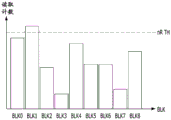
在存储器设备150中,对每个存储器块执行擦除操作。当擦除计数达到或超过磨损水平WOL时,当对对应的存储器块执行编程操作或读取操作时,发生错误的可能性就会增加。因此,具有擦除计数大于WOL的第二存储器块BLK1被认为是坏块BB,并且不再被使用。In
在这种情况下,可以通过将具有相对高擦除计数的第一存储器块 BLK0、第五存储器块BLK4和第九存储器块BLK8中存储的数据DAT 移动到具有相对低擦除计数的第四存储器块BLK3来有效地延长存储器设备150的寿命,如图7A所示。在这种情况下,第一存储器块BLK0、第五存储器块BLK4和第九存储器块BLK8(即,损耗均衡操作的对象)可以被称为BG操作的源块(或牺牲块)。根据本公开的实施例的存储器设备可以通过执行损耗均衡来提高存储器设备的可靠性,使得数据不被存储在坏块BB中,而是存储在正常存储器块中。In this case, the data DAT stored in the first memory block BLK0 , the fifth memory block BLK4 and the ninth memory block BLK8 having relatively high erase counts can be moved to the fourth memory having relatively low erase counts block BLK3 to effectively extend the life of the
物理块的物理地址可以是无效的,因为通过损耗均衡改变了物理地址,即与逻辑块相对应的数据的存储位置。在这种情况下,如图7D 所示,控制器130可以通过修改映射表从而将改变后的物理地址而不是无效的物理地址映射到逻辑地址,来将映射表保持在最新状态。因此,由于可以通过映射数据管理使用最新状态的映射表根据本公开的实施例对存储器设备执行存储器操作,因此可以提高存储操作速度。The physical address of the physical block may be invalid because the physical address, ie, the storage location of the data corresponding to the logical block, is changed by wear leveling. In this case, as shown in FIG. 7D, the
根据本公开的实施例的控制器130可以通过基于存储器设备150 的当前温度而不同地设定用于存储器设备150的损耗均衡的执行条件,来提高存储器系统110的可靠性,从而引起存储器设备150的温度上升或下降。参考图9至图10B对此进行详细描述。The
图7A是示出根据本公开的实施例的控制器130执行的读取回收操作的图。具体地,读取回收操作可以由图5所示的FTL 40执行。FIG. 7A is a diagram illustrating a read reclaim operation performed by the
读取回收包括通过将具有相对高读取计数的存储器块中存储的数据DAT复制到另一存储器块以改变存储位置从而实现数据安全性的操作。如果由于重复读取存储在给定块或给定页面中的数据而增加了读取次数,则所存储的数据中可能发生错误的可能性可能会增加。由于这个原因,当读取计数超过设定水平时,对应块的所有数据或仅有效数据可以被移动到另一块。Read reclamation includes an operation to achieve data security by copying data DAT stored in a memory block with a relatively high read count to another memory block to change storage locations. If the number of reads increases due to repeated reads of data stored in a given block or in a given page, the likelihood that errors may occur in the stored data may increase. For this reason, when the read count exceeds a set level, all data or only valid data of the corresponding block can be moved to another block.
在图7B中,横轴指示存储器设备150中包括的多个存储器块 BLK0至BLK8的数目。纵轴指示读取计数,即,已经对存储器设备 150中包括的多个存储器块中的每个执行读取操作的次数。In FIG. 7B, the horizontal axis indicates the number of the plurality of memory blocks BLK0 to BLK8 included in the
当读取计数等于或大于设定水平时,在对应的存储器块中存储的数据中可能发生错误的可能性增加。因此,读取计数等于或大于设定水平的第二存储器块BLK1被认为是坏块BB,并且不被使用。When the read count is equal to or greater than the set level, there is an increased possibility that an error may occur in the data stored in the corresponding memory block. Therefore, the second memory block BLK1 whose read count is equal to or greater than the set level is regarded as a bad block BB, and is not used.
在这种情况下,可以通过将具有相对高读取计数的第一存储器块 BLK0、第五存储器块BLK4和第九存储器块BLK8中存储的数据DAT 移动到具有相对低读取计数的第四存储器块BLK3来有效地延长存储器设备150的寿命,如图7B所示。在这种情况下,第一存储器块BLK0、第五存储器块BLK4和第九存储器块BLK8(即,读取回收操作的对象)可以被称为BG操作的源块(或牺牲块)。In this case, the data DAT stored in the first memory block BLK0 , the fifth memory block BLK4 and the ninth memory block BLK8 with relatively high read counts can be moved to the fourth memory with relatively low read counts block BLK3 to effectively extend the life of the
根据本公开的实施例的存储器设备可以通过执行读取回收来提高存储器设备的可靠性,使得数据不被存储在坏块BB中,而是存储在正常存储器块中。The memory device according to the embodiment of the present disclosure can improve the reliability of the memory device by performing read reclamation so that data is not stored in the bad block BB but in the normal memory block.
物理块的物理地址可以是无效的,因为通过读取回收改变了物理地址,即与逻辑块相对应的数据的存储位置。在这种情况下,如图7D 所示,控制器130可以通过修改映射表从而将改变后的物理地址而不是无效的物理地址映射到逻辑地址,来将映射表保持在最新状态。因此,由于可以通过映射数据管理使用最新状态的映射表根据本公开的实施例对存储器设备执行存储器操作,因此可以提高存储操作速度。The physical address of the physical block may be invalid because the physical address, ie, the storage location of the data corresponding to the logical block, is changed by read reclamation. In this case, as shown in FIG. 7D, the
根据本公开的实施例的控制器130可以通过基于存储器设备150 的当前温度来不同地设定存储器设备150的读取回收的执行条件,来提高存储器系统110的可靠性,从而引起存储器设备150的温度上升或下降。参考图9至图10B对此进行详细描述。The
图7C是示出了根据本公开的实施例的控制器130执行的垃圾收集的图。具体地,垃圾收集可以由图5所示的FTL 40执行。FIG. 7C is a diagram illustrating garbage collection performed by the
垃圾收集包括以下操作:将存储在其中分散有有效数据的存储器块中的数据移动到空闲存储器块并且然后擦除对应的存储器块。Garbage collection includes the operations of moving data stored in memory blocks in which valid data is scattered to free memory blocks and then erasing the corresponding memory blocks.
图7C所示的存储器设备150包括第一存储器块BLK1至第八存储器块BLK8,每个存储器块包括第一页面PAGE1至第五页面 PAGE5。The
参考图7C,第一存储器块BLK1至第四存储器块BLK4可以是已经存储有数据的关闭块,而第五存储器块BLK5至第八存储器块BLK8可以是未存储有数据的空闲块。Referring to FIG. 7C , the first to fourth memory blocks BLK1 to BLK4 may be closed blocks that have stored data, and the fifth to eighth memory blocks BLK5 to BLK8 may be free blocks that do not store data.
如图7C所示,有效数据和无效数据可能已经分散并且存储在第四存储器块BLK4的第一页面PAGE1至第五页面PAGE5中。As shown in FIG. 7C, valid data and invalid data may have been scattered and stored in the first to fifth pages PAGE1 to PAGE5 of the fourth memory block BLK4.
在这种情况下,控制器130可以通过将第四存储器块BLK4中存储的有效数据复制到第八存储器块BLK8(即,空闲块)、并且然后对第四存储器块BLK4执行擦除操作,来将第四存储器块BLK4确保为空闲块。此外,控制器130可以确保在存储第四存储器块BLK4的有效数据之后剩余的第八存储器块BLK8的空间作为空闲空间。在这种情况下,第四存储器块BLK4(即垃圾收集的对象)可以被称为BG 操作的源块(或受害者块)。此外,由于第四存储器块BLK4的有效数据已经被移至第八存储器块BLK8,所以可以通过擦除第四存储器块BLK4的所有数据来使第四存储器块BLK4成为空闲块。In this case, the
如上所述,将存储在其中已经分散有有效数据的存储器块中的数据移动到空闲块、并且然后擦除该存储器块的数据的操作可以被称为垃圾收集。As described above, the operation of moving data stored in a memory block in which valid data has been scattered to a free block and then erasing the data of the memory block may be referred to as garbage collection.
根据本公开的实施例的存储器设备可以通过执行垃圾收集以增加空闲块数来提高存储器设备的数据存储的效率。The memory device according to an embodiment of the present disclosure can improve the efficiency of data storage of the memory device by performing garbage collection to increase the number of free blocks.
物理块的物理地址可以是无效的,因为通过垃圾收集改变了物理地址,即与逻辑块相对应的数据的存储位置。在这种情况下,如图7D 所示,控制器130可以通过修改映射表从而将改变后的物理地址而不是无效的物理地址映射到逻辑地址来将映射表保持在最新状态。因此,根据本公开的实施例的存储器设备可以通过映射数据管理,通过使用处于最新状态的映射表执行存储操作来提高存储操作速度。The physical address of the physical block can be invalid because the physical address, ie, the storage location of the data corresponding to the logical block, is changed by garbage collection. In this case, as shown in FIG. 7D , the
根据本公开的实施例的控制器130可以通过基于存储器设备150 的当前温度来不同地设定存储器设备150的垃圾收集的执行条件来提高存储器系统110的可靠性,从而引起存储器设备150的温度上升或下降。参考图9至图10B对此进行详细描述。The
图7D是示出由图2的存储器设备执行的映射数据管理方法的图。映射数据管理包括通过修改映射表从而将改变后的物理地址而不是无效的物理地址映射到逻辑地址来将映射表保持在最新状态的操作。FIG. 7D is a diagram illustrating a map data management method performed by the memory device of FIG. 2 . Mapping data management includes the operation of keeping the mapping table up-to-date by modifying the mapping table to map changed physical addresses instead of invalid physical addresses to logical addresses.
如图7D所示,存储器系统110可以使用映射表来映射主机102 的逻辑块和存储器设备150的物理块。具体地,映射数据管理可以由图5所示的FTL 40中包括的映射数据管理器44执行。As shown in FIG. 7D ,
物理块的物理地址可以是无效的,因为通过损耗均衡、读取回收或垃圾收集改变了物理地址,即与逻辑块相对应的数据的存储位置。在这种情况下,如图7D所示,控制器130可以通过修改映射表从而将改变后的物理地址而不是无效的物理地址映射到逻辑地址来将映射表保持在最新状态。The physical address of a physical block may be invalid because the physical address, ie, the storage location of the data corresponding to the logical block, is changed by wear leveling, read collection or garbage collection. In this case, as shown in FIG. 7D , the
因为根据本公开的实施例的存储器设备可以通过映射数据管理使用最新状态的映射表来执行存储操作,所以可以提高存储操作速度。Since the memory device according to the embodiment of the present disclosure can perform the storage operation using the mapping table of the latest state by mapping data management, the storage operation speed can be improved.
根据本公开的实施例的控制器130可以通过基于存储器设备150 的当前温度来不同地设定映射数据管理的执行条件来提高存储器系统110的可靠性,从而引起存储器设备150的温度上升或下降。参考图9至图10B对此进行详细描述。The
在下文中,参考图8描述根据本公开的实施例的存储器系统改善数据可靠性的方法。具体地,图8示出了通过存储器系统对没有用于存储数据的坏块BB或备用存储器块执行伪操作来控制存储器设备的温度的方法。在该伪操作中,实际上执行针对存储器设备内的给定块的写入、读取或擦除数据的处理,但是不需要将对应的结果传输到外部。伪操作可以包括不需要验证数据是否已经被正常写入、读取或擦除的操作。图8所示的伪操作可以由图2至图5所示的存储器系统110 和存储器设备150来执行。坏块BB可以通过图6A和图6B所示的方法来指定。Hereinafter, a method of improving data reliability of a memory system according to an embodiment of the present disclosure is described with reference to FIG. 8 . Specifically, FIG. 8 illustrates a method of controlling the temperature of a memory device by the memory system performing pseudo operations on bad blocks BB or spare memory blocks that are not used for storing data. In this pseudo-operation, the process of writing, reading or erasing data for a given block within the memory device is actually performed, but the corresponding results need not be transmitted to the outside. Pseudo operations may include operations that do not require verification of whether data has been normally written, read, or erased. The pseudo operations shown in FIG. 8 may be performed by the
参考图2至图5和图8,温度传感器335可以周期性地检测存储器设备150的当前温度C_TEMP(S310a)。2 to 5 and 8, the
在本公开的实施例中,温度传感器335可以在控制器130的控制下检测当前温度C_TEMP。此外,温度传感器335可以将检测到的当前温度C_TEMP提供给控制器130。In an embodiment of the present disclosure, the
因此,控制器130通过将当前温度C_TEMP与参考温度T_REF 进行比较来确定当前温度C_TEMP所属的温度范围(S320a)。参考温度T_REF可以被设定并且存储在控制器130中。也就是说,控制器130确定当前温度C_TEMP是否低于参考温度T_REF(S320a)。Therefore, the
当作为步骤S320a的确定的结果,当前温度C_TEMP不低于参考温度T_REF(S320a中为“否”)时,控制器130可以确定当前温度 C_TEMP高于或等于参考温度T_REF。在这种情况下,因为存储器设备150的温度不低,所以控制器130可以确定当对存储器设备150执行编程操作或读取操作时未发生错误。When the current temperature C_TEMP is not lower than the reference temperature T_REF as a result of the determination in step S320a (NO in S320a), the
当作为步骤S320a的确定的结果,当前温度C_TEMP低于参考温度T_REF(S320a中为“是”)时,控制器130可以对坏块BB或备用存储器块执行伪操作(S360a)。When the current temperature C_TEMP is lower than the reference temperature T_REF as a result of the determination of step S320a (YES in S320a), the
根据本公开的实施例的伪操作包括对存储器设备中没有用于存储数据的存储器块执行的存储操作,并且可以在控制器130的控制下执行而无需来自主机的请求。伪操作可以包括擦除操作、读取操作和编程操作。执行根据本公开的实施例的伪操作以用于通过在低温状态下升高存储器设备150的温度来提高可靠性的目的。此外,控制器130 可以不考虑伪操作的执行结果以及坏块BB或备用存储器块可以被劣化的可能性,因为这样的块不再用于存储数据。此外,可以在存储器系统110的空闲状态下执行在步骤S360a执行的伪操作。可以在其中存储器系统110的状态很可能变为低温状态的空闲状态期间执行伪操作。此外,即使当存储器系统110不是空闲而是处于存储器系统执行正常操作的正常状态时,也可以在存储器系统110的状态为低温状态时执行伪操作。在这种情况下,可以在不妨碍存储器系统110的正常操作的范围内执行块操作。A pseudo operation according to an embodiment of the present disclosure includes a store operation performed on a memory block that is not used to store data in the memory device, and may be performed under the control of the
此外,当当前温度C_TEMP低于参考温度T_REF(S320a中为“是”)时,控制器130可以根据低温执行条件执行BG操作(S361a),如参考图1所述。BG操作可以包括垃圾收集、损耗均衡和/或读取回收。低温执行条件可以指示与非低温执行条件所指示的相比,对更多的存储器块并且在更长的时间段内更频繁地执行BG操作。因此,当当前温度C_TEMP低于参考温度T_REF时,由于根据低温执行条件进一步执行BG操作而导致从存储器系统110生成的热量增加。Also, when the current temperature C_TEMP is lower than the reference temperature T_REF (YES in S320a), the
也就是说,如图8所示的由存储器系统110控制当前温度 C_TEMP的方法可以包括检测存储器设备150的当前温度C_TEMP 的步骤S310a,以及当检测到的存储器设备150的当前温度C_TEMP 在低温范围内(S320a中为“是”)时,对没有用于存储数据的选择存储器块(例如,坏块BB或备用存储器块)执行伪操作的步骤S360a。伪操作可以包括编程操作、擦除操作和/或读取操作。此外,该方法还可以包括通过基于在步骤S310a中检测到的当前温度C_TEMP来改变对存储器块执行的BG操作的执行条件来执行BG操作的步骤 S361a。通过改变BG操作的执行条件来执行BG操作的步骤S361a 可以在执行伪操作的步骤S360a之前执行。此外,通过改变BG操作的执行条件来执行BG操作的步骤S361a可以在执行伪操作的步骤S360a之后执行。BG操作的执行条件可以包括执行时间、执行目标存储器块数和/或执行周期。That is, the method for controlling the current temperature C_TEMP by the
图9、图10A和图10B示出了由存储器系统通过基于存储器设备的当前温度来不同地设定在存储器设备中执行的内部操作的执行条件来控制存储器设备的温度的方法。FIGS. 9 , 10A and 10B illustrate a method of controlling the temperature of a memory device by a memory system by differently setting execution conditions of internal operations performed in the memory device based on the current temperature of the memory device.
内部操作可以包括对坏块BB或备用存储器块执行的伪操作和后台(BG)操作。伪操作可以包括编程、读取和/或擦除操作。此外, BG操作可以包括垃圾收集、损耗均衡、读取回收和/或映射数据管理,如参考图7A至7D所述。Internal operations may include pseudo operations and background (BG) operations performed on bad blocks BB or spare memory blocks. Dummy operations may include program, read and/or erase operations. Additionally, BG operations may include garbage collection, wear leveling, read reclamation, and/or map data management, as described with reference to Figures 7A-7D.
执行条件可以包括内部操作的执行时间、执行目标存储器块和执行周期。内部操作的执行时间、执行目标存储器块和执行周期是用于控制内部操作的执行频率和内部操作的执行时间的因素,但是本发明不限于这些特定因素。此外,可以通过控制内部操作的执行频率和内部操作的执行时间来控制从存储器设备生成的热量。最终,可以控制存储器设备的温度。The execution conditions may include the execution time of the internal operation, the execution target memory block, and the execution period. The execution time of the internal operation, the execution target memory block and the execution cycle are factors for controlling the execution frequency of the internal operation and the execution time of the internal operation, but the present invention is not limited to these specific factors. In addition, the heat generated from the memory device can be controlled by controlling the execution frequency and execution time of the internal operations. Ultimately, the temperature of the memory device can be controlled.
图9示出了由存储器系统110通过执行BG操作来控制存储器设备的温度的方法。图10A和图10B示出了由存储器系统110通过执行BG操作或伪操作来控制存储器设备的温度、并且还通过在存储器设备的状态为低温状态时附加地执行伪操作或BG操作来控制存储器设备的温度的方法。FIG. 9 illustrates a method by the
在下文中,参考图9描述由存储器系统110通过执行BG操作来控制存储器设备的温度的方法。Hereinafter, a method of controlling the temperature of a memory device by the
参考图9,温度传感器335可以周期性地检测存储器设备150的当前温度C_TEMP(S310b)。Referring to FIG. 9, the
在本公开的实施例中,温度传感器335可以在控制器130的控制下检测当前温度C_TEMP。此外,温度传感器335可以将检测到的当前温度C_TEMP提供给控制器130。In an embodiment of the present disclosure, the
因此,控制器130可以通过将当前温度C_TEMP与第一参考温度 T_REF1和第二参考温度T_REF2进行比较来确定当前温度C_TEMP 所属的温度范围。第一参考温度T_REF1和第二参考温度T_REF2可以被设定并且存储在控制器130中。控制器130确定当前温度 C_TEMP是否低于第一参考温度T_REF1(S320b)。Therefore, the
当作为步骤S320b的确定的结果,当前温度C_TEMP低于第一参考温度T_REF1(S320b中为“是”)时,控制器130确定存储器设备150的当前温度C_TEMP为在低温范围内。当当前温度C_TEMP 在低温范围内时,由于存储器设备150的当前温度为低,因此控制器 130可以确定在对存储器设备150执行编程操作或读取操作时发生错误。在这种情况下,控制器130可以在控制器130的控制下根据第二执行条件对需要BG操作的源块(或受害者块)执行BG操作(S350b)。When the current temperature C_TEMP is lower than the first reference temperature T_REF1 as a result of the determination in step S320b (YES in S320b), the
当作为步骤S320b的确定的结果,当前温度C_TEMP不低于第一参考温度T_REF1(S320b中为“否”)时,控制器130确定存储器设备150的当前温度C_TEMP在高温或常温范围内。因此,控制器 130确定当前温度C_TEMP是否高于第二参考温度T_REF2(S330b)。When the current temperature C_TEMP is not lower than the first reference temperature T_REF1 as a result of the determination in step S320b (NO in S320b), the
当作为步骤S330b的确定的结果,当前温度C_TEMP高于第二参考温度T_REF2(S330b中为“是”)时,控制器130确定存储器设备150的当前温度C_TEMP为在高温范围内。当当前温度C_TEMP 在高温范围内时,由于存储器设备150的当前温度为高,因此控制器 130可以确定在对存储器设备150执行编程操作或读取操作时发生错误。在这种情况下,控制器130可以在控制器130的控制下根据第三执行条件对需要BG操作的源块(或受害者块)执行BG操作(S370b)。When the current temperature C_TEMP is higher than the second reference temperature T_REF2 as a result of the determination in step S330b (YES in S330b), the
当作为步骤S330b的确定的结果,当前温度C_TEMP在第一参考温度T_REF1与第二参考温度T_REF2之间时,控制器130确定存储器设备150的当前温度C_TEMP在常温范围内。当当前温度C_TEMP 在常温范围内时,由于存储器设备150的当前温度适当,因此控制器130可以确定在对存储器设备150执行编程操作或读取操作时未发生错误。在这种情况下,控制器130可以根据第一执行条件对需要BG 操作的源块(或受害者块)执行BG操作(S390b)。When the current temperature C_TEMP is between the first reference temperature T_REF1 and the second reference temperature T_REF2 as a result of the determination in step S330b, the
在下文中,描述了基于在图9的步骤S310b中检测到的当前温度 C_TEMP来设定在步骤S350b、S370b和S390b中的每个中执行的BG 操作(例如,垃圾收集)的执行条件的方法。Hereinafter, a method of setting the execution conditions of the BG operation (for example, garbage collection) performed in each of steps S350b, S370b, and S390b based on the current temperature C_TEMP detected in step S310b of FIG. 9 is described.
当在步骤S310b中检测到的当前温度C_TEMP在常温范围内时,控制器130可以根据第一执行条件执行垃圾收集。When the current temperature C_TEMP detected in step S310b is within the normal temperature range, the
第一执行条件可以包括垃圾收集的执行时间(例如,当空闲块数 nFB为N或更少时)。此外,第一执行条件可以包括垃圾收集的执行目标(例如,无效页面数nIP为M或更多的存储器块)。此外,第一执行条件可以包括执行时间和执行目标两者。也就是说,当空闲块数nFB为N或更少时,可以对其中无效页面数nIP为M或更多的存储器块执行垃圾收集。The first execution condition may include the execution time of garbage collection (eg, when the number of free blocks nFB is N or less). In addition, the first execution condition may include an execution target of garbage collection (eg, memory blocks where the number of invalid pages nIP is M or more). Furthermore, the first execution condition may include both execution time and execution target. That is, when the number of free blocks nFB is N or less, garbage collection may be performed on memory blocks in which the number of invalid pages nIP is M or more.
例如,当当前温度C_TEMP被包括在常温范围内时,当空闲块数 nFB为100时,控制器130可以对其中无效页面数nIP为50或更多的存储器块执行垃圾收集。For example, when the current temperature C_TEMP is included in the normal temperature range, when the number of free blocks nFB is 100, the
此外,第一执行条件可以包括第一执行周期,即,垃圾收集的执行周期。也就是说,控制器130可以针对每个第一执行周期执行垃圾收集,而与执行时间和执行目标存储器块的数量无关。Furthermore, the first execution condition may include a first execution cycle, ie, an execution cycle of garbage collection. That is, the
当在步骤S310b中检测到的当前温度C_TEMP在低温范围内时,控制器130可以根据第二执行条件执行垃圾收集。在低温范围内,第二执行条件可以不比第一执行条件严格,以便与常温范围(第一)执行条件相比,增加执行垃圾收集的频率和垃圾收集的执行时间。When the current temperature C_TEMP detected in step S310b is within the low temperature range, the
第二执行条件可以包括垃圾收集的执行时间(例如,当空闲块数 nFB为K或更少时,其小于N)。此外,第二执行条件可以包括垃圾收集的执行目标(例如,其中无效页面数nIP为P或更多的存储器块,其小于M)。此外,第二执行条件可以包括执行时间和执行目标两者。也就是说,当空闲块数nFB为K或更少时,可以对其中无效页面数 nIP为P或更多的存储器块执行垃圾收集。The second execution condition may include the execution time of garbage collection (eg, less than N when the number of free blocks nFB is K or less). Additionally, the second execution condition may include an execution target for garbage collection (eg, memory blocks where the number of invalid pages nIP is P or more, which is less than M). Furthermore, the second execution condition may include both execution time and execution target. That is, when the number of free blocks nFB is K or less, garbage collection may be performed on memory blocks in which the number of invalid pages nIP is P or more.
例如,当当前温度C_TEMP在低温范围内时,尽管由于空闲块数 nFB为200而不需要执行垃圾收集,但是控制器130可以执行垃圾收集,并且可以对无效页面数nIP仅为10的存储器块执行垃圾收集。For example, when the current temperature C_TEMP is in the low temperature range, although it is not necessary to perform garbage collection because the number of free blocks nFB is 200, the
此外,第二执行条件可以包括比第一执行周期更短的第二执行周期。也就是说,控制器130可以针对每个第二执行周期执行垃圾收集,而与执行时间和可以包括目标存储器块数的执行目标数无关。Furthermore, the second execution condition may include a second execution period that is shorter than the first execution period. That is, the
可以设定在低温范围内根据第二执行条件的内部操作的执行时间,使得与根据第一执行条件的内部操作的执行时间相比,更频繁地执行根据第二执行条件的内部操作。因此,在低温范围内执行内部操作的频率可以高于在常温范围内执行内部操作的频率。此外,可以将根据第二执行条件的内部操作的执行目标数设定为大于根据第一执行条件的内部操作的执行目标数。因此,在低温范围内的内部操作的执行时间可以比在常温范围内的内部操作的执行时间更长。此外,可以将根据第二执行条件的内部操作的执行周期设定为比根据第一执行条件的内部操作的执行周期更短。因此,在高温范围内执行内部操作的频率可以高于在常温范围内执行内部操作的频率。总之,由于内部操作的执行时间和在低温范围内执行内部操作的频率,在低温范围内从存储器设备生成的热量可以大于在常温范围内从存储器设备生成的热量。因此,低温范围内的存储器设备的温度可以逐渐升高。The execution time of the internal operation according to the second execution condition in the low temperature range may be set so that the internal operation according to the second execution condition is executed more frequently than the execution time of the internal operation according to the first execution condition. Therefore, the frequency of performing the internal operation in the low temperature range may be higher than the frequency of performing the internal operation in the normal temperature range. Furthermore, the number of execution targets of the internal operations according to the second execution condition may be set to be larger than the number of execution targets of the internal operations according to the first execution condition. Therefore, the execution time of the internal operation in the low temperature range can be longer than the execution time of the internal operation in the normal temperature range. Furthermore, the execution cycle of the internal operation according to the second execution condition may be set to be shorter than the execution cycle of the internal operation according to the first execution condition. Therefore, the frequency of performing the internal operation in the high temperature range may be higher than the frequency of performing the internal operation in the normal temperature range. In conclusion, the heat generated from the memory device in the low temperature range may be greater than the heat generated from the memory device in the normal temperature range due to the execution time of the internal operation and the frequency of performing the internal operation in the low temperature range. Therefore, the temperature of the memory device in the low temperature range can be gradually increased.
如上所述,与常温范围内的第一执行条件相比,低温范围内的第二执行条件增加了执行垃圾收集的频率以及垃圾收集的执行时间。因此,根据本公开的实施例的存储器系统110的温度可以从低温范围升高到常温范围。如上所述,本公开可以提供如下效果:可以通过基于当前温度C_TEMP改变包括执行时间、执行目标存储器块和BG操作的执行周期在内的执行条件来提高存储器设备的可靠性。As described above, compared with the first execution condition in the normal temperature range, the second execution condition in the low temperature range increases the frequency of performing garbage collection and the execution time of garbage collection. Therefore, the temperature of the
当在步骤S310b中检测到的当前温度C_TEMP在高温范围内时,控制器130可以根据第三执行条件来执行垃圾收集。在高温范围内,第三执行条件可以比第一执行条件更宽松,以便与常温范围相比减少执行垃圾收集的频率和垃圾收集的执行时间。When the current temperature C_TEMP detected in step S310b is within the high temperature range, the
第三执行条件可以包括垃圾收集的执行时间(例如,当空闲块数 nFB为B或更少时,其小于N)。此外,第三执行条件可以包括垃圾收集的执行目标数量(例如,无效页面数nIP为G或更多的存储器块,其大于M)。此外,第三执行条件可以包括执行时间和执行目标两者。也就是说,当空闲块数nFB为B或更少时,可以对其中无效页面数 nIP为G或更多的存储器块执行垃圾收集。The third execution condition may include the execution time of garbage collection (eg, less than N when the number of free blocks nFB is B or less). In addition, the third execution condition may include the number of execution targets for garbage collection (eg, memory blocks where the number of invalid pages nIP is G or more, which is greater than M). Furthermore, the third execution condition may include both execution time and execution target. That is, when the number of free blocks nFB is B or less, garbage collection can be performed on memory blocks in which the number of invalid pages nIP is G or more.
例如,即使只有10个空闲块nFB,当当前温度C_TEMP在高温范围内时,控制器130也不执行垃圾收集。另外,控制器130可以不对几乎没有有效页面的存储器块执行垃圾收集。For example, even if there are only 10 free blocks nFB, when the current temperature C_TEMP is in the high temperature range, the
此外,只有10个空闲块nFB,当当前温度C_TEMP在高温范围内时,控制器130可以不执行垃圾收集。例如,第三执行条件可以包括比第一执行周期更长的第三执行周期周期。也就是说,控制器130 可以针对每个第三执行周期执行垃圾收集,而与执行时间和执行目标数无关。In addition, there are only 10 free blocks nFB, and when the current temperature C_TEMP is within the high temperature range, the
可以设定根据第三执行条件的内部操作的执行时间,使得与根据第一执行条件的内部操作的执行时间相比,执行内部操作的频率降低。因此,在高温范围内执行内部操作的频率可以低于在常温范围内执行内部操作的频率。此外,可以将根据第三执行条件的内部操作的执行目标数设定为小于根据第一执行条件的内部操作的执行目标数。因此,在低温范围内的内部操作的执行时间可以比在常温范围内的内部操作的执行时间更短。此外,可以将根据第三执行条件的内部操作的执行周期设定为比根据第一执行条件的内部操作的执行周期更长。因此,在高温范围内执行内部操作的频率可以低于在常温范围内进行的频率。总之,由于内部操作的执行时间和在高温范围内执行内部操作的频率,在高温范围内从存储器设备生成的热量可以小于在常温范围内从存储器设备生成的热量。因此,在高温范围内的存储器设备的温度可以逐渐下降。The execution time of the internal operation according to the third execution condition may be set such that the frequency of execution of the internal operation is reduced compared to the execution time of the internal operation according to the first execution condition. Therefore, the frequency of performing the internal operation in the high temperature range may be lower than the frequency of performing the internal operation in the normal temperature range. Furthermore, the number of execution targets of the internal operations according to the third execution condition may be set to be smaller than the number of execution targets of the internal operations according to the first execution condition. Therefore, the execution time of the internal operation in the low temperature range can be shorter than the execution time of the internal operation in the normal temperature range. Furthermore, the execution cycle of the internal operation according to the third execution condition may be set to be longer than the execution cycle of the internal operation according to the first execution condition. Therefore, the frequency of performing the internal operation in the high temperature range can be lower than that in the normal temperature range. In conclusion, the heat generated from the memory device in the high temperature range may be smaller than the heat generated from the memory device in the normal temperature range due to the execution time of the internal operations and the frequency of performing the internal operations in the high temperature range. Therefore, the temperature of the memory device in the high temperature range may gradually decrease.
此外,如图9所示的根据本公开的实施例的控制存储器系统110 的温度的方法可以包括以下步骤:当存储器设备150的当前温度 C_TEMP在低温范围内时,根据低温执行条件执行低温BG操作;当当前温度C_TEMP在常温范围内时,根据正常执行条件执行正常BG 操作,并且当当前温度C_TEMP在高温范围内时,根据高温执行条件执行高温BG操作。与正常执行条件相比,低温执行条件可以具有更大的执行目标数和更短的执行周期。与正常执行条件相比,高温执行条件可以具有更小的执行目标数和更长的执行周期。根据低温执行条件的BG操作的执行目标数和执行时间可以大于和长于根据正常执行条件的BG操作的执行目标数和执行时间。根据高温执行条件的BG 操作的执行目标数和执行时间可以小于和短于根据正常执行条件的 BG操作的执行目标数和执行时间。根据低温执行条件的BG操作中生成的热量可以大于根据正常执行条件的BG操作中生成的热量。根据高温执行条件的BG操作中生成的热量可以小于根据正常执行条件的BG操作中生成的热量。In addition, the method for controlling the temperature of the
正常BG操作可以包括当空闲块数为N或更少时执行的垃圾收集。低温BG操作可以包括当空闲块数为K或更少(小于N)时执行的垃圾收集。高温BG操作可以包括当空闲块数为B或更少(大于N) 时执行的垃圾收集。此外,正常BG操作可以包括对具有擦除计数为N或更多的存储器块执行的损耗均衡或读取回收。低温BG操作可以包括对具有擦除计数为K或更多(小于N)的存储器块执行的磨损均衡或读取回收。高温BG操作可以包括对擦除计数为B或更多(大于 N)的存储器块执行的磨损均衡或读取回收。Normal BG operations may include garbage collection performed when the number of free blocks is N or less. Low temperature BG operations may include garbage collection performed when the number of free blocks is K or less (less than N). High temperature BG operations may include garbage collection performed when the number of free blocks is B or less (greater than N). Additionally, normal BG operations may include wear leveling or read reclamation performed on memory blocks with erase counts of N or more. Low temperature BG operations may include wear leveling or read reclamation performed on memory blocks with erase counts of K or more (less than N). High temperature BG operations may include wear leveling or read reclamation performed on memory blocks with erase counts of B or more (greater than N).
如上所述,在高温范围内的第三执行条件下,与正常温度范围内的第一执行条件相比,执行时间、内部操作的执行频率、BG操作的执行目标和执行时间减少。因此,存储器系统110的温度可以从在高温范围内下降到在常温范围内。如上所述,本公开通过基于当前温度 C_TEMP改变包括BG操作的执行时间、执行目标和执行周期在内的执行条件来提高存储器设备的可靠性。As described above, in the third execution condition in the high temperature range, the execution time, the execution frequency of the internal operation, the execution target of the BG operation, and the execution time are reduced compared to the first execution condition in the normal temperature range. Therefore, the temperature of the
在下文中,参考图10A描述由存储器系统110通过执行BG操作和伪操作来控制存储器设备的温度的方法。具体地,图10A示出了由存储器系统110通过执行BG操作来控制存储器设备的温度、并且还通过在存储器设备处于低温状态时附加地执行伪操作来控制存储器设备的温度的方法。Hereinafter, a method of controlling the temperature of the memory device by the
参考图10A,温度传感器335可以周期性地检测存储器设备150 的当前温度C_TEMP(S310c)。Referring to FIG. 10A, the
在本公开的实施例中,温度传感器335可以在控制器130的控制下检测当前温度C_TEMP。此外,温度传感器335可以将检测到的当前温度C_TEMP提供给控制器130。In an embodiment of the present disclosure, the
因此,控制器130可以通过将当前温度C_TEMP与第一参考温度 T_REF1和第二参考温度T_REF2进行比较来确定当前温度C_TEMP 所属的温度范围。第一参考温度T_REF1和第二参考温度T_REF2可以被预先定义并且存储在控制器130中。控制器130确定当前温度 C_TEMP是否低于第一参考温度T_REF1(S320c)。Therefore, the
当作为步骤S320c的确定的结果,当前温度C_TEMP低于第一参考温度T_REF1(S320c中为“是”)时,控制器130确定存储器设备150的当前温度C_TEMP为在低温范围内。当当前温度C_TEMP 在低温范围内时,由于存储器设备150的当前温度为低,因此控制器130可以确定在对存储器设备150执行编程操作或读取操作时发生错误。在这种情况下,控制器130可以在控制器130的控制下根据第二执行条件对需要BG操作的源块(或受害者块)执行BG操作(S350c)。When the current temperature C_TEMP is lower than the first reference temperature T_REF1 as a result of the determination in step S320c (YES in S320c), the
此后,控制器130再次检测存储器设备150的当前温度C_TEMP (S355c)。控制器130确定在步骤S355c中检测到的当前温度 C_TEMP是否低于第一参考温度T_REF1(S357c)。After that, the
当作为步骤S357c的确定的结果,当前温度C_TEMP低于第一参考温度T_REF1(S357c中为“是”)时,控制器130确定存储器设备150的当前温度C_TEMP为仍然在低温范围内。因此,控制器130 附加地对坏块BB或备用存储器块执行伪操作(S360c)。When the current temperature C_TEMP is lower than the first reference temperature T_REF1 as a result of the determination in step S357c (YES in S357c), the
当作为步骤S357c的确定的结果,当前温度C_TEMP不低于第一参考温度T_REF1(S357c中为“否”)时,控制器130确定存储器设备150的当前温度C_TEMP根据在步骤S350c中执行的第二执行条件通过BG操作已经从低温范围偏离。然而,作为在步骤S350c中执行的BG操作的结果,在准备存储器设备150的当前温度C_TEMP 处于高温范围的情况下,控制器130确定当前温度C_TEMP是否高于第二参考温度T_REF2(S330c)。When the current temperature C_TEMP is not lower than the first reference temperature T_REF1 as a result of the determination in step S357c (NO in S357c), the
当作为步骤S320c的确定的结果,当前温度C_TEMP不低于第一参考温度T_REF1(S320c中为“否”)时,控制器130确定存储器设备150的当前温度C_TEMP在高温或常温范围内。因此,控制器 130确定当前温度C_TEMP是否高于第二参考温度T_REF2(S330c)。When the current temperature C_TEMP is not lower than the first reference temperature T_REF1 as a result of the determination in step S320c (NO in S320c), the
当作为步骤S330c的确定的结果,当前温度C_TEMP高于第二参考温度T_REF2(S330c中为“是”)时,控制器130确定存储器设备150的当前温度C_TEMP为在高温范围内。如果当前温度C_TEMP 在高温范围内,则由于存储器设备150的当前温度为高,控制器130 可以确定在对存储器设备150执行编程操作或读取操作时发生错误。在这种情况下,控制器130可以根据第三执行条件对需要BG操作的源块(或受害者块)执行BG操作(S370c)。When the current temperature C_TEMP is higher than the second reference temperature T_REF2 as a result of the determination in step S330c (YES in S330c), the
当作为步骤S330c的确定的结果,当前温度C_TEMP在第一参考温度T_REF1与第二参考温度T_REF2之间时,控制器130确定存储器设备150的当前温度C_TEMP在常温范围内。当当前温度C_TEMP 在常温范围内时,由于存储器设备150的当前温度适当,因此控制器130可以确定在对存储器设备150执行编程操作或读取操作时未发生错误。在这种情况下,控制器130可以根据第一执行条件对需要BG 操作的源块(或受害者块)执行BG操作(S390c)。When the current temperature C_TEMP is between the first reference temperature T_REF1 and the second reference temperature T_REF2 as a result of the determination in step S330c, the
已经参考图9描述了基于在步骤S310c中检测到的当前温度 C_TEMP,在步骤S350c、S370c和S390c中的每个处执行的BG操作的执行条件。The execution conditions of the BG operation performed at each of steps S350c, S370c, and S390c based on the current temperature C_TEMP detected in step S310c have been described with reference to Fig. 9 .
图10B示出了由存储器系统110通过执行伪操作来控制存储器设备的温度、并且还通过在存储器设备的状态为低时附加地执行BG操作来控制存储器设备的温度的方法。参考图10B描述图10A和图10B 之间仅技术上的区别。简而言之,在图10B的方法中,步骤S350c和360c相对于它们在图10A的流程图中的位置进行切换。10B shows a method by the
当作为步骤S320c的确定结果,当前温度C_TEMP低于第一参考温度T_REF1(S320c中为“是”)时,控制器130确定存储器设备 150的当前温度C_TEMP为在低温范围内。当当前温度C_TEMP在低温范围内时,由于存储器设备150的当前温度为低,因此控制器130 可以确定在对存储器设备150执行编程操作或读取操作时发生错误。在这种情况下,控制器130对坏块BB或备用存储器块执行伪操作 (S360c)。When the current temperature C_TEMP is lower than the first reference temperature T_REF1 as a result of the determination in step S320c (YES in S320c), the
此后,控制器130再次检测存储器设备150的当前温度C_TEMP (S355c)。控制器130确定在步骤S355c中检测到的当前温度 C_TEMP是否低于第一参考温度T_REF1(S357c)。After that, the
当作为步骤S357c的确定的结果,当前温度C_TEMP低于第一参考温度T_REF1(S357c中为“是”)时,控制器130确定存储器设备150的当前温度C_TEMP为仍然在低温范围内。因此,控制器130 可以根据第二执行条件对需要BG操作的源块(或受害者块)附加地执行BG操作(S350c)。When the current temperature C_TEMP is lower than the first reference temperature T_REF1 as a result of the determination in step S357c (YES in S357c), the
如上所述,图10A和图10B所示的本公开的实施例可以通过基于当前温度C_TEMP改变包括BG操作的执行时间和执行目标在内的执行条件来提高存储器系统110的可靠性。As described above, the embodiments of the present disclosure shown in FIGS. 10A and 10B can improve the reliability of the
此外,在低温状态下,图10A和图10B所示的存储器系统110 的温度可以变得高于图9所示的存储器系统110的温度,并且可以快速地从低温范围上升以使存储器系统110以正常范围内的温度进入正常状态。因此,进一步改进了图10A和图10B所示的存储器系统110的可靠性。Furthermore, in the low temperature state, the temperature of the
如上所述,基于参考图1、图8至图10A和图10B描述的不同实施例,可以提高存储器设备150的数据可靠性和数据存储效率。As described above, based on the different embodiments described with reference to FIGS. 1 , 8 to 10A and 10B, the data reliability and data storage efficiency of the
为此,根据本公开的实施例的存储器系统110基于存储器设备 150的当前温度来不同地设定内部操作的执行条件,并且执行内部操作以使得能够引起存储器设备150的温度上升或下降,因此存储器设备的温度可以保持常温范围。因此,根据本公开的实施例的存储器系统110可以有效地防止存储器设备的故障和存储器设备的数据中的错误的发生,并且提高存储数据的可靠性。To this end, the
在根据本公开的实施例的存储器系统及其驱动方法中,当存储器设备的温度被包括在低温范围或高温范围内时,存储器单元阵列的温度被诱导为通过控制内部操作(包括对数据安全性影响较小的BG操作或伪操作)分别上升或下降。因此,可以提高存储器设备的性能、数据可靠性和数据存储效率。In the memory system and the driving method thereof according to the embodiments of the present disclosure, when the temperature of the memory device is included in the low temperature range or the high temperature range, the temperature of the memory cell array is induced to be BG operations or pseudo-operations with less impact) rise or fall, respectively. Therefore, the performance, data reliability, and data storage efficiency of the memory device can be improved.
在根据本公开的实施例的存储器系统及其驱动方法中,基于存储器设备的温度来不同地设定内部操作的执行条件,使得存储器设备的温度保持常温范围。因此,根据本公开的实施例的存储器系统可以防止存储器设备的输入和输出性能、数据可靠性和数据存储效率劣化。In the memory system and the driving method thereof according to the embodiments of the present disclosure, the execution conditions of the internal operations are set differently based on the temperature of the memory device, so that the temperature of the memory device maintains the normal temperature range. Therefore, the memory system according to the embodiment of the present disclosure can prevent the input and output performance, data reliability, and data storage efficiency of the memory device from deteriorating.
在根据本公开的实施例的存储器系统及其驱动方法中,当存储器设备的温度被包括在低温范围内时,内部操作被附加地执行或提前执行,使得存储器设备的温度升高,因此存储器设备的温度保持常温范围。因此,根据本公开的实施例的存储器系统可以有效地提高存储器设备的性能、数据可靠性和数据存储效率。In the memory system and the driving method thereof according to the embodiments of the present disclosure, when the temperature of the memory device is included in the low temperature range, the internal operation is additionally performed or performed in advance, so that the temperature of the memory device increases, so the memory device The temperature is kept in the normal temperature range. Therefore, the memory system according to the embodiments of the present disclosure can effectively improve the performance, data reliability, and data storage efficiency of the memory device.
在根据本公开的实施例的存储器系统中,可以保持存储器系统的操作安全性,因为即使在诸如可以存储和处理大量数据的数据中心等周围温度可能升高的环境中,或者在诸如车辆等温度可能会变化的环境中,也可以自主地控制内部温度。In the memory system according to the embodiment of the present disclosure, the operational security of the memory system can be maintained even in an environment where the surrounding temperature may increase such as a data center where a large amount of data can be stored and processed, or in a temperature such as a vehicle The internal temperature can also be controlled autonomously in environments that may change.
尽管已经详细示出和描述了各种实施例,但是在不脱离本发明的范围的情况下,可以以各种方式修改本公开。因此,本发明的范围不应限于上述实施例,而不仅应当由权利要求书、而且还应当由其等同物限定。Although various embodiments have been shown and described in detail, the present disclosure could be modified in various ways without departing from the scope of the present invention. Therefore, the scope of the present invention should not be limited to the above-described embodiments, but should be defined not only by the claims, but also by the equivalents thereof.
Claims (20)
Applications Claiming Priority (2)
| Application Number | Priority Date | Filing Date | Title |
|---|---|---|---|
| KR1020190050297A KR102742676B1 (en) | 2019-04-30 | 2019-04-30 | Memory system and method of controllong temperature thereof |
| KR10-2019-0050297 | 2019-04-30 |
Publications (1)
| Publication Number | Publication Date |
|---|---|
| CN111857567A true CN111857567A (en) | 2020-10-30 |
Family
ID=72970835
Family Applications (1)
| Application Number | Title | Priority Date | Filing Date |
|---|---|---|---|
| CN201911367376.5A Withdrawn CN111857567A (en) | 2019-04-30 | 2019-12-26 | Memory system and method of controlling its temperature |
Country Status (3)
| Country | Link |
|---|---|
| US (1) | US11029888B2 (en) |
| KR (1) | KR102742676B1 (en) |
| CN (1) | CN111857567A (en) |
Cited By (2)
| Publication number | Priority date | Publication date | Assignee | Title |
|---|---|---|---|---|
| CN112786080A (en) * | 2020-12-31 | 2021-05-11 | 深圳大普微电子科技有限公司 | Method and device for reducing error rate of flash memory and solid state disk |
| CN119807086A (en) * | 2024-12-09 | 2025-04-11 | 苏州元脑智能科技有限公司 | Address mapping table manager, address mapping table management method and computer equipment |
Families Citing this family (14)
| Publication number | Priority date | Publication date | Assignee | Title |
|---|---|---|---|---|
| KR20220075684A (en) * | 2020-11-30 | 2022-06-08 | 에스케이하이닉스 주식회사 | Memory system and operating method of memory system |
| KR20220086934A (en) * | 2020-12-17 | 2022-06-24 | 에스케이하이닉스 주식회사 | Journaling apparatus and method in a non-volatile memory system |
| KR102344380B1 (en) * | 2021-06-02 | 2021-12-28 | 삼성전자주식회사 | Nonvolatile memory device, controller for controlling the same, storage device having the same, and operating method thereof |
| KR20230043525A (en) | 2021-09-24 | 2023-03-31 | 에스케이하이닉스 주식회사 | Semiconductor system and operating method of semiconductor system |
| US12253901B2 (en) * | 2021-09-30 | 2025-03-18 | Intel Corporation | Systems and methods for stable and elevated idle-mode temperature for assembled semiconductor devices |
| CN113986120B (en) * | 2021-10-09 | 2024-02-09 | 至誉科技(武汉)有限公司 | Bad block management method and system for storage device and computer readable storage medium |
| EP4390650A4 (en) | 2021-10-25 | 2024-12-25 | Samsung Electronics Co., Ltd. | ELECTRONIC DEVICE WITH UFS STORAGE DEVICE, METHOD, NON-TRANSITIOUS COMPUTER-READABLE STORAGE MEDIUM AND UFS CARD |
| WO2023075074A1 (en) * | 2021-10-25 | 2023-05-04 | 삼성전자 주식회사 | Electronic device including ufs storage device, method, non-transitory computer-readable storage medium, and ufs card |
| US12045482B2 (en) * | 2022-07-29 | 2024-07-23 | Micron Technology, Inc. | Wordline leakage test management |
| US12039189B2 (en) | 2022-08-31 | 2024-07-16 | Micron Technology, Inc. | Idle mode temperature control for memory systems |
| KR20240085474A (en) | 2022-12-08 | 2024-06-17 | 에스케이하이닉스 주식회사 | Storage device and operating method thereof |
| KR20240097589A (en) | 2022-12-20 | 2024-06-27 | 에스케이하이닉스 주식회사 | Memory system and temperature managing method thereof |
| KR20250007249A (en) * | 2023-07-05 | 2025-01-14 | 에스케이하이닉스 주식회사 | Storage deivce and operating method thereof |
| KR20250049062A (en) * | 2023-10-04 | 2025-04-11 | 삼성전자주식회사 | A storage device that selectively performs high reliability program operation based on temperature and method of operating the same |
Citations (5)
| Publication number | Priority date | Publication date | Assignee | Title |
|---|---|---|---|---|
| US20170027103A1 (en) * | 2015-07-29 | 2017-02-02 | Cnh Industrial America Llc | Boom adjustment system and method |
| US20170109062A1 (en) * | 2015-10-16 | 2017-04-20 | SK Hynix Inc. | Memory system |
| CN107591182A (en) * | 2016-07-07 | 2018-01-16 | 爱思开海力士有限公司 | Accumulator system and its operating method |
| US20180067678A1 (en) * | 2016-09-05 | 2018-03-08 | Sung-won Jeong | Nonvolatile memory device and method of throttling temperature of nonvolatile memory device |
| US20190035443A1 (en) * | 2017-07-28 | 2019-01-31 | SK Hynix Inc. | Controller and operating method thereof |
Family Cites Families (9)
| Publication number | Priority date | Publication date | Assignee | Title |
|---|---|---|---|---|
| US7917814B2 (en) * | 2005-04-08 | 2011-03-29 | Hewlett-Packard Development Company, L.P. | System and method of reporting error codes in an electronically controlled device |
| KR20080071366A (en) | 2007-01-30 | 2008-08-04 | 삼성전자주식회사 | Data backup device and method considering temperature of NAND flash in RAID system with NAND flash |
| US8873323B2 (en) * | 2012-08-16 | 2014-10-28 | Transcend Information, Inc. | Method of executing wear leveling in a flash memory device according to ambient temperature information and related flash memory device |
| US10475523B2 (en) * | 2013-05-31 | 2019-11-12 | Western Digital Technologies, Inc. | Updating read voltages triggered by the rate of temperature change |
| US9535614B2 (en) | 2013-11-21 | 2017-01-03 | Sandisk Technologies Llc | Temperature based flash memory system maintenance |
| KR20160008885A (en) * | 2014-07-15 | 2016-01-25 | 삼성전자주식회사 | Memory Managing Method and Electonic Device |
| EP3797997A1 (en) * | 2014-10-07 | 2021-03-31 | Videojet Technologies Inc. | System and method for remotely servicing an industrial printer |
| KR101725691B1 (en) | 2015-12-28 | 2017-04-12 | 성균관대학교산학협력단 | Non-volatile storage apparatus for storing data and method for controlling access to non-volatile storage apparatus considering heat |
| TWI670716B (en) * | 2018-09-26 | 2019-09-01 | 群聯電子股份有限公司 | Data access method,memory storage device and memory control circuit unit |
-
2019
- 2019-04-30 KR KR1020190050297A patent/KR102742676B1/en active Active
- 2019-12-20 US US16/722,856 patent/US11029888B2/en active Active
- 2019-12-26 CN CN201911367376.5A patent/CN111857567A/en not_active Withdrawn
Patent Citations (5)
| Publication number | Priority date | Publication date | Assignee | Title |
|---|---|---|---|---|
| US20170027103A1 (en) * | 2015-07-29 | 2017-02-02 | Cnh Industrial America Llc | Boom adjustment system and method |
| US20170109062A1 (en) * | 2015-10-16 | 2017-04-20 | SK Hynix Inc. | Memory system |
| CN107591182A (en) * | 2016-07-07 | 2018-01-16 | 爱思开海力士有限公司 | Accumulator system and its operating method |
| US20180067678A1 (en) * | 2016-09-05 | 2018-03-08 | Sung-won Jeong | Nonvolatile memory device and method of throttling temperature of nonvolatile memory device |
| US20190035443A1 (en) * | 2017-07-28 | 2019-01-31 | SK Hynix Inc. | Controller and operating method thereof |
Cited By (3)
| Publication number | Priority date | Publication date | Assignee | Title |
|---|---|---|---|---|
| CN112786080A (en) * | 2020-12-31 | 2021-05-11 | 深圳大普微电子科技有限公司 | Method and device for reducing error rate of flash memory and solid state disk |
| CN119807086A (en) * | 2024-12-09 | 2025-04-11 | 苏州元脑智能科技有限公司 | Address mapping table manager, address mapping table management method and computer equipment |
| CN119807086B (en) * | 2024-12-09 | 2026-05-01 | 苏州元脑智能科技有限公司 | Address mapping table manager, address mapping table management method and computer equipment |
Also Published As
| Publication number | Publication date |
|---|---|
| KR20200126533A (en) | 2020-11-09 |
| US20200348887A1 (en) | 2020-11-05 |
| US11029888B2 (en) | 2021-06-08 |
| KR102742676B1 (en) | 2024-12-16 |
Similar Documents
| Publication | Publication Date | Title |
|---|---|---|
| US11029888B2 (en) | Memory system and method of controlling operations on bad memory block based on temperature | |
| CN111435321B (en) | Apparatus and method for handling errors in volatile memory of memory system | |
| US10535410B2 (en) | Hybrid read disturb count management | |
| US11237742B2 (en) | Apparatus and method for controlling data stored in memory system | |
| CN107766257B (en) | Memory system and method of operation | |
| US10957411B2 (en) | Apparatus and method for managing valid data in memory system | |
| US20160139812A1 (en) | Hot-cold data separation method in flash translation layer | |
| US11526438B2 (en) | Memory system capable of increasing storage efficiency and operation method thereof | |
| US11815985B2 (en) | Apparatus and method for checking an operation status of a memory device in a memory system | |
| US11392322B2 (en) | Memory system for read operation and operating method thereof | |
| KR20190017550A (en) | Memory system and operating method of memory system | |
| KR20200032463A (en) | Apparatus for diagnosing memory system or data processing system and operating method of memory system or data processing system based on diagnosis | |
| KR102803713B1 (en) | Memory system and method of controllong temperature thereof | |
| US12112046B2 (en) | Memory system and operation method thereof | |
| US11269542B2 (en) | Memory system for distributing and reading data and operating method thereof | |
| CN111831218A (en) | Controller and how to operate it | |
| KR20190069806A (en) | Memory system and operating method of memory system | |
| KR102422032B1 (en) | Memory system and operating method of memory system | |
| KR20190069803A (en) | Memory system and operating method of memory system | |
| CN111739573A (en) | Memory system and method of operation | |
| CN111857818A (en) | Memory system and method of performing command operations via the same | |
| US11625195B2 (en) | Memory system and operating method of memory system storing doorbell information in the buffer memory | |
| CN111831577A (en) | Apparatus and method for determining characteristics of memory blocks in a memory system |
Legal Events
| Date | Code | Title | Description |
|---|---|---|---|
| PB01 | Publication | ||
| PB01 | Publication | ||
| SE01 | Entry into force of request for substantive examination | ||
| SE01 | Entry into force of request for substantive examination | ||
| WW01 | Invention patent application withdrawn after publication |
Application publication date: 20201030 |
|
| WW01 | Invention patent application withdrawn after publication |