CN111529309B - Medical neck joint rehabilitation training device - Google Patents

Medical neck joint rehabilitation training device Download PDF

Info

Publication number
CN111529309B
CN111529309B CN202010384773.XA CN202010384773A CN111529309B CN 111529309 B CN111529309 B CN 111529309B CN 202010384773 A CN202010384773 A CN 202010384773A CN 111529309 B CN111529309 B CN 111529309B
Authority
CN
China
Prior art keywords
seat
head
rehabilitation training
head fixing
training device
Prior art date
Legal status (The legal status is an assumption and is not a legal conclusion. Google has not performed a legal analysis and makes no representation as to the accuracy of the status listed.)
Expired - Fee Related
Application number
CN202010384773.XA
Other languages
Chinese (zh)
Other versions
CN111529309A (en
Inventor
蔡桂平
Current Assignee (The listed assignees may be inaccurate. Google has not performed a legal analysis and makes no representation or warranty as to the accuracy of the list.)
Shandong High Tech Chuangda Technology Entrepreneurship Service Co ltd
Original Assignee
Individual
Priority date (The priority date is an assumption and is not a legal conclusion. Google has not performed a legal analysis and makes no representation as to the accuracy of the date listed.)
Filing date
Publication date
Application filed by Individual filed Critical Individual
Publication of CN111529309A publication Critical patent/CN111529309A/en
Application granted granted Critical
Publication of CN111529309B publication Critical patent/CN111529309B/en
Expired - Fee Related legal-status Critical Current
Anticipated expiration legal-status Critical

Links

Images

Classifications

    • A—HUMAN NECESSITIES
    • A61—MEDICAL OR VETERINARY SCIENCE; HYGIENE
    • A61H—PHYSICAL THERAPY APPARATUS, e.g. DEVICES FOR LOCATING OR STIMULATING REFLEX POINTS IN THE BODY; ARTIFICIAL RESPIRATION; MASSAGE; BATHING DEVICES FOR SPECIAL THERAPEUTIC OR HYGIENIC PURPOSES OR SPECIFIC PARTS OF THE BODY
    • A61H1/00—Apparatus for passive exercising; Vibrating apparatus; Chiropractic devices, e.g. body impacting devices, external devices for briefly extending or aligning unbroken bones
    • A61H1/02—Stretching or bending or torsioning apparatus for exercising
    • A61H1/0292—Stretching or bending or torsioning apparatus for exercising for the spinal column
    • A61H1/0296—Neck
    • A—HUMAN NECESSITIES
    • A61—MEDICAL OR VETERINARY SCIENCE; HYGIENE
    • A61H—PHYSICAL THERAPY APPARATUS, e.g. DEVICES FOR LOCATING OR STIMULATING REFLEX POINTS IN THE BODY; ARTIFICIAL RESPIRATION; MASSAGE; BATHING DEVICES FOR SPECIAL THERAPEUTIC OR HYGIENIC PURPOSES OR SPECIFIC PARTS OF THE BODY
    • A61H2201/00—Characteristics of apparatus not provided for in the preceding codes
    • A61H2201/12—Driving means
    • A61H2201/1207—Driving means with electric or magnetic drive
    • A—HUMAN NECESSITIES
    • A61—MEDICAL OR VETERINARY SCIENCE; HYGIENE
    • A61H—PHYSICAL THERAPY APPARATUS, e.g. DEVICES FOR LOCATING OR STIMULATING REFLEX POINTS IN THE BODY; ARTIFICIAL RESPIRATION; MASSAGE; BATHING DEVICES FOR SPECIAL THERAPEUTIC OR HYGIENIC PURPOSES OR SPECIFIC PARTS OF THE BODY
    • A61H2201/00—Characteristics of apparatus not provided for in the preceding codes
    • A61H2201/16—Physical interface with patient
    • A61H2201/1602—Physical interface with patient kind of interface, e.g. head rest, knee support or lumbar support
    • A61H2201/1604—Head
    • A61H2201/1607—Holding means therefor
    • A—HUMAN NECESSITIES
    • A61—MEDICAL OR VETERINARY SCIENCE; HYGIENE
    • A61H—PHYSICAL THERAPY APPARATUS, e.g. DEVICES FOR LOCATING OR STIMULATING REFLEX POINTS IN THE BODY; ARTIFICIAL RESPIRATION; MASSAGE; BATHING DEVICES FOR SPECIAL THERAPEUTIC OR HYGIENIC PURPOSES OR SPECIFIC PARTS OF THE BODY
    • A61H2201/00—Characteristics of apparatus not provided for in the preceding codes
    • A61H2201/16—Physical interface with patient
    • A61H2201/1602—Physical interface with patient kind of interface, e.g. head rest, knee support or lumbar support
    • A61H2201/1614—Shoulder, e.g. for neck stretching
    • A61H2201/1616—Holding means therefor
    • A—HUMAN NECESSITIES
    • A61—MEDICAL OR VETERINARY SCIENCE; HYGIENE
    • A61H—PHYSICAL THERAPY APPARATUS, e.g. DEVICES FOR LOCATING OR STIMULATING REFLEX POINTS IN THE BODY; ARTIFICIAL RESPIRATION; MASSAGE; BATHING DEVICES FOR SPECIAL THERAPEUTIC OR HYGIENIC PURPOSES OR SPECIFIC PARTS OF THE BODY
    • A61H2201/00—Characteristics of apparatus not provided for in the preceding codes
    • A61H2201/50—Control means thereof
    • A61H2201/5058—Sensors or detectors
    • A61H2201/5071—Pressure sensors
    • A—HUMAN NECESSITIES
    • A61—MEDICAL OR VETERINARY SCIENCE; HYGIENE
    • A61H—PHYSICAL THERAPY APPARATUS, e.g. DEVICES FOR LOCATING OR STIMULATING REFLEX POINTS IN THE BODY; ARTIFICIAL RESPIRATION; MASSAGE; BATHING DEVICES FOR SPECIAL THERAPEUTIC OR HYGIENIC PURPOSES OR SPECIFIC PARTS OF THE BODY
    • A61H2205/00—Devices for specific parts of the body
    • A61H2205/04—Devices for specific parts of the body neck

Landscapes

  • Health & Medical Sciences (AREA)
  • Engineering & Computer Science (AREA)
  • Biomedical Technology (AREA)
  • Neurology (AREA)
  • Orthopedic Medicine & Surgery (AREA)
  • Epidemiology (AREA)
  • Pain & Pain Management (AREA)
  • Physical Education & Sports Medicine (AREA)
  • Rehabilitation Therapy (AREA)
  • Life Sciences & Earth Sciences (AREA)
  • Animal Behavior & Ethology (AREA)
  • General Health & Medical Sciences (AREA)
  • Public Health (AREA)
  • Veterinary Medicine (AREA)
  • Rehabilitation Tools (AREA)

Abstract

本发明公开了一种医用颈部关节康复训练装置,其包括支撑座、头部固定组件、支撑动力组件以及控制器,头部固定组件用于固定用户的头部;支撑动力组件连接所述支撑座与所述头部固定组件,并可驱动所述头部固定组件运转;控制器安装在所述支撑座上,且其与所述支撑动力组件电连接。本发明的医用颈部关节康复训练装置具备头部固定组件与支撑动力组件,控制器通过控制支撑动力组件运转可驱动头部固定组件作多轴运动,从而带动患者的头部进行运动,帮助患者的颈部进行活动以达到康复训练的目的。
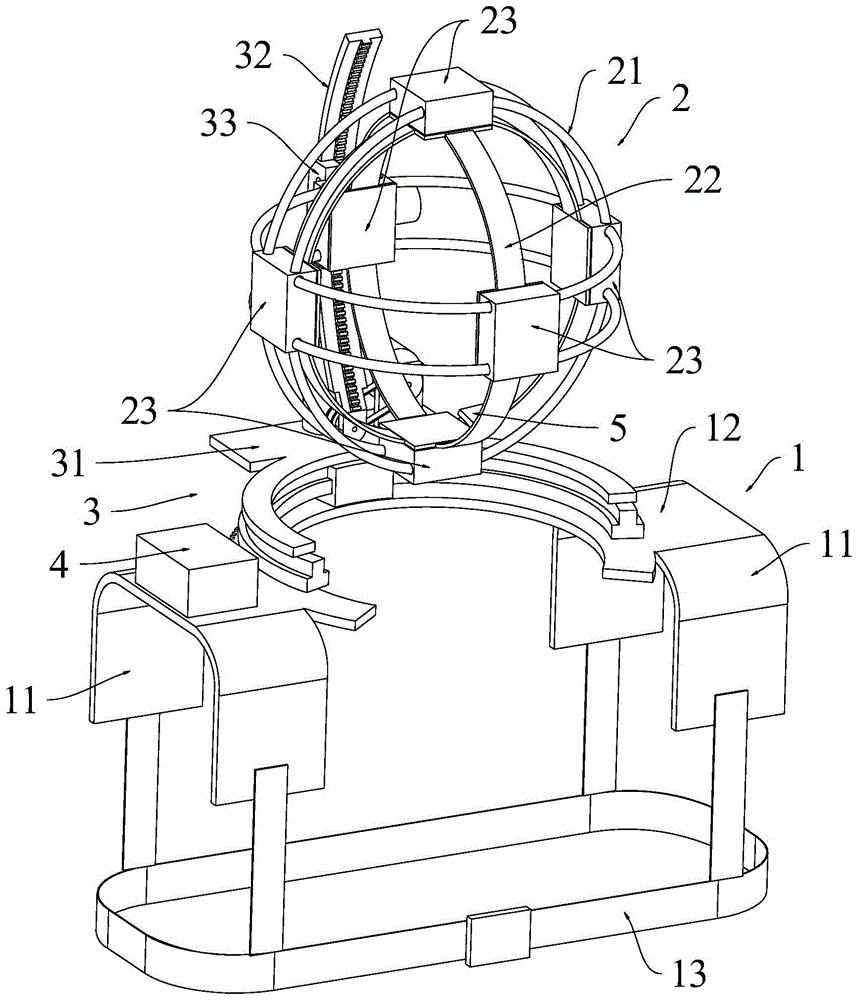
Figure 202010384773

The invention discloses a medical neck joint rehabilitation training device, which comprises a support seat, a head fixing component, a supporting power component and a controller. The head fixing component is used for fixing the user's head; the supporting power component is connected to the support The seat is connected to the head fixing assembly and can drive the head fixing assembly to operate; the controller is mounted on the support seat and is electrically connected with the support power assembly. The medical neck joint rehabilitation training device of the present invention includes a head fixing component and a supporting power component. The controller can drive the head fixing component to perform multi-axis motion by controlling the operation of the supporting power component, thereby driving the patient's head to move and helping the patient. The neck is active to achieve the purpose of rehabilitation training.

Figure 202010384773

Description

Medical neck joint rehabilitation training device
Technical Field
The invention relates to the field of medical rehabilitation instruments, in particular to a medical neck joint rehabilitation training device.
Background
In the field of medical rehabilitation, the number of instruments for the rehabilitation of neck joints of patients is small, and patients with neck joint obstacles are mainly treated by the rehabilitation training of doctors manually.
Disclosure of Invention
The invention aims to: in order to overcome the defects in the prior art, the invention provides a medical neck joint rehabilitation training device which can perform rehabilitation training on neck joints of patients.
The technical scheme is as follows: in order to achieve the above object, the present invention provides a medical neck joint rehabilitation training device, comprising:
a supporting seat;
a head securing assembly for securing a user's head;
the supporting power assembly is connected with the supporting seat and the head fixing assembly and can drive the head fixing assembly to operate; and
and the controller is arranged on the supporting seat and is electrically connected with the supporting power assembly.
Further, the supporting seat can be worn and fixed on the body below the neck of the user.
Furthermore, the supporting seat is provided with a left U-shaped part and a right U-shaped part which are symmetrically arranged.
Further, the head fixing assembly comprises a hard bracket connected with the supporting power assembly and a soft binding unit connected with the hard bracket.
Furthermore, the supporting power assembly is provided with three motion shafts, and the three motion shafts can respectively drive a user to rotate, nod and swing left and right.
Further, the supporting power assembly comprises a rotating seat, a swinging seat and a pitching seat; the upper end of the supporting seat is provided with a horizontally arranged mounting surface, the rotating seat can controllably rotate relative to the mounting surface, and the rotating shaft is vertical to the mounting surface; the lower end of the swinging seat is rotatably arranged relative to the rotating seat, and the relative motion of the swinging seat and the rotating seat is controllable; the pitching seat can move controllably relative to the swinging seat; the head fixing component is installed on the pitching seat.
Further, the swinging seat is in an arc strip shape, and when the rotating seat is in a positive state, the swinging seat is arranged on the rear side of the rotating seat; the pitching seat can controllably slide along the swinging seat so as to enable the head fixing component to carry out controllable pitching motion.
Has the advantages that: the medical neck joint rehabilitation training device provided by the invention is provided with the head fixing component and the supporting power component, and the controller can drive the head fixing component to do multi-axis motion by controlling the supporting power component to operate, so that the head of a patient is driven to move, and the neck of the patient is helped to move to achieve the purpose of rehabilitation training.
Drawings
FIG. 1 is a first perspective view of a medical cervical joint rehabilitation training device;
FIG. 2 is a second perspective view of the medical cervical joint rehabilitation training device;
fig. 3 is a structural view of the elastic support unit.
In the figure: 1-a support seat; 11-U-shaped portion; 12-a mounting surface; 13-binding band; 2-a head fixation assembly; 21-a hard stent; 22-soft binding unit; 23-an elastic support unit; 231-a connecting seat; 232-pressure spring; 233-deformation sensor; 3-supporting the power assembly; 31-a rotating base; 32-a swing seat; 33-a pitch seat; 4-a controller; 5-bite unit; 6-a manipulation unit.
Detailed Description
The present invention will be further described with reference to the accompanying drawings.
The medical neck joint rehabilitation training device shown in the attached figures 1-2 comprises a supporting seat 1, a head fixing component 2, a supporting power component 3 and a controller 4; the head fixing component 2 is used for fixing the head of a user; the supporting power assembly 3 is connected with the supporting seat 1 and the head fixing assembly 2 and can drive the head fixing assembly 2 to operate; the controller 4 is installed on the supporting base 1 and is electrically connected with the supporting power assembly 3 to control the operation of the supporting power assembly 3. The supporting power assembly 3 is provided with three motion shafts which are respectively driven by three driving motors to operate, and the three motion shafts can respectively drive a user to perform head turning, head pointing and left-right head swinging actions.
The supporting seat 1 can be worn and fixed on the body below the neck of a user, and in the embodiment, the supporting seat 1 can be worn and fixed on the shoulder of the user.
When using above-mentioned medical neck joint rehabilitation training device, the head at the patient is fixed to head fixed subassembly 2, and 3 operations of power component are supported through control to controller 4, support power component 3 and drive the operation of head fixed subassembly 2 again so that the patient head follows the operation to reach the purpose of carrying out the rehabilitation training to patient's neck joint.
The support base 1 is provided with a left U-shaped part 11 and a right U-shaped part 11 which are symmetrically arranged, the U-shaped parts 11 are used for straddling two shoulders of a user, and preferably, two ends of the U-shaped parts 11 are connected with binding bands 13, and the binding bands 13 can be fixed on the upper limb of the patient so that the U-shaped parts 11 can be stably fixed relative to the shoulders of the user.
The head fixing component 2 comprises a hard bracket 21 connected with the supporting power component 3 and a soft binding unit 22 connected with the hard bracket 21. A rigid support 21 is provided around the head of the patient and can be opened in two parts for access by the patient's head.
The supporting power assembly 3 comprises a rotating seat 31, a swinging seat 32 and a pitching seat 33; the upper end of the supporting seat 1 is provided with a horizontal mounting surface 12, the rotating seat 31 can controllably rotate relative to the mounting surface 12, and the rotating shaft is vertical to the mounting surface 12; the lower end of the swing seat 32 is rotatably mounted relative to the rotating seat 31, and the relative movement between the swing seat and the rotating seat is controllable, specifically, the swing seat 32 is in an arc strip shape, and when the rotating seat 31 is in a positive state, the swing seat 32 is arranged at the rear side of the rotating seat 31; the pitching seat 33 can move controllably relative to the swinging seat 32; the head restraint assembly 2 is mounted on the pitch mount 33. Specifically, the pitch seat 33 is controllably slidable along the swing seat 32 to controllably pitch the head restraint assembly 2.
By adopting the structure layout, the head trainer has the advantages of simple structure and low cost, and can effectively drive the head of a user to do compound motions of pitching, horizontal swinging, horizontal rotating and the three motions, thereby carrying out multi-degree-of-freedom exercise on the head of the patient.
The soft binding unit 22 is connected to the hard support 21 through a plurality of elastic supporting units 23, all the elastic supporting units 23 are dispersedly arranged on the hard support 21, so that after the head of the patient is fixed on the soft binding unit 22, the front side, the rear side, the left side, the right side, the upper side and the lower side (the front side, the rear side, the left side, the right side, the upper side and the lower side are not limited to the facing direction, and can include an oblique front side, an oblique rear side, an oblique left side, an oblique right side, an oblique upper side and an oblique lower side) of the head of the patient are all provided with the elastic supporting units 23, the hard support 21 transmits power to the head of the patient through the elastic supporting units 23 to push the head of the patient to move, the elastic supporting units 23 have an elastic buffering effect, so that a certain buffering allowance is reserved between the head fixing component 2 and the hard support 21, and can play a buffering effect in an emergency situation, reducing the damage to the patient.
Preferably, as shown in fig. 3, the elastic supporting unit 23 includes two connection seats 231, the two connection seats 231 respectively connect the hard bracket 21 and the soft binding unit 22, a plurality of compression springs 232 are disposed between the two connection seats 231, and a deformation sensor 233 is further disposed between the two connection seats 231, the deformation sensor 233 is used for monitoring the relative displacement of the two connection seats 231, and the deformation sensor 233 is connected to the controller 4. Thus, when the supporting power assembly 3 operates abnormally, the abnormal deformation acceleration of one or more deformation sensors 233 can be reflected, and the controller 4 can adjust the operating condition of the supporting power assembly 3 or stop the operation of the supporting power assembly 3 according to the abnormal condition, so as to avoid secondary damage to the patient. In addition, due to the existence of the pressure spring 232, the change of the motion acceleration of the hard support 21 is transmitted to the head of the patient after a delay, and before the head of the patient has the same motion acceleration, the controller 4 adjusts the control strategy in time or stops the operation of the elastic support unit 23, so that the influence on the neck joint caused by the abnormal acceleration generated on the head of the user can be effectively avoided.
In addition, still install the controllable user on the stereoplasm support 21 and contain the mouth and sting unit 5 in the mouth, be equipped with pressure sensor in the mouth and sting unit 5, pressure sensor connection controller 4, when the patient is carrying out the in-process of neck rehabilitation training, if feel painful beyond the tolerance limit, can bite the pressure sensor that the cleft closes the tooth and act on in the mouth and sting unit 5 naturally to pressure sensor produces the pressure value that surpasss the settlement threshold value, and controller 4 judges that the pressure value surpasses and can make support power component 3 stop the operation when setting for the threshold value, thereby plays the guard action. The setting of the triggering condition of the mouth biting unit 5 meets the instinct of a user, and a common patient feels pain and bites the bite of the gum immediately to trigger the sudden stop.
In addition, the medical neck joint rehabilitation training device also comprises an operation unit externally arranged on the supporting seat 1, wherein the operation unit is provided with operation elements such as a button and a control rocker, a user can select an exercise intensity, an exercise gear, an exercise mode (such as an automatic mode and a manual mode) and the like through the button, and the control rocker is used for enabling the user to automatically control the supporting power assembly 3 to operate in the manual mode.
The invention also provides a medical neck joint rehabilitation training process which is applied to the controller 4 of the medical neck joint rehabilitation training device, and the process comprises the following steps S701-S705:
step S701, controlling the support power assembly 3 to operate according to a control command;
in this step, the control instruction may be an automatic operation instruction or a manual operation instruction, and when the control instruction is the automatic operation instruction, the controller 4 controls the operation of the support power assembly 3 according to a preset control motion rule according to the motion mode and the motion gear information included in the control instruction, where the preset control motion rule includes a rotation speed control curve for driving the motor to each motion axis of the support power assembly 3; when the control instruction is a manual operation instruction, the controller 4 controls the support power assembly 3 to operate according to the operation instruction of the control unit.
Step S702, acquiring the real-time relative displacement detected by each deformation sensor 234;
in this step, the relative displacement is the relative displacement between the two connection seats 231;
step S703 of calculating displacement acceleration from the relative displacement of each of the deformation sensors 234;
in this step, when the supporting power assembly 3 drives the head of the patient to move at a uniform speed, the value of the relative displacement between the two connecting seats 231 floats very little or remains unchanged, and the change of the acceleration of the displacement also floats very little or remains 0; when the supporting power assembly 3 runs in an accelerating way, due to the speed difference between the hard support 21 and the head of the patient, when the hard support 21 drives the head of the patient to accelerate, one or more pressure springs 232 of the elastic supporting unit 23 are compressed first, so that the accelerated running of the supporting power assembly 3 is reflected by the increase of the displacement acceleration of one or more deformation sensors 234, so that the displacement acceleration can be used as a reference parameter for reflecting the running condition of the supporting power assembly 3, and because the deformation sensors 234 are closest to the human body, the displacement acceleration calculated according to the measured data can reflect the stress change condition of the head of the patient more than the rotation speed data of 3 moving shaft driving motors of the supporting power assembly which are directly detected, and the adjustment strategy made according to the data can effectively ensure the safety of the patient.
Step S704, determining whether the displacement acceleration corresponding to each of the deformation sensors 234 exceeds a first set threshold, if yes, proceeding to step S705;
step S705, executing a preset strategy to make the support power assembly 3 run down or stop running.
With the driving method of steps S701-S705 above, the adjustment strategy for the support power assembly 3 based on the deformation acceleration can effectively ensure the safety of the user, and in addition, the controller 4 should simultaneously monitor the rotation speeds of the 3 moving shaft driving motors of the support power assembly 3 to monitor the operation speeds of the 3 moving shafts of the support power assembly 3, so as to prevent the speeds from being too high.
The above steps S701-S705 ensure that the supporting power assembly 3 does not suddenly accelerate and malfunction only by external parameters, and the controller 4 cannot know whether the pain felt by the patient during the rehabilitation training is in a tolerable range, so in a preferred embodiment, the steps S701 are followed by steps S801-S803:
step S801, acquiring a pressure value detected by a pressure sensor;
step S802, judging whether the pressure value exceeds a third set threshold value, if so, entering step S803;
and step S803, controlling the support power assembly 3 to stop operating.
The above steps S801 to S803 judge the perception of the user to the pain through the magnitude of the biting force applied by the user' S teeth to the pressure sensor, when the user feels the pain beyond the tolerance range, the user naturally bites the articulatory, and the magnitude of the pressure detected by the pressure sensor becomes suddenly larger, so that the controller 4 controls the operation stop delay of the supporting power assembly 3 to be short, thereby minimizing the damage to the user caused by the out-of-control of the supporting power assembly 3.
Further, the executing of the preset strategy in the step S705 to make the support power assembly 3 operate at a reduced speed or stop operating includes the following steps S901 to S903:
step S901, determining whether the displacement acceleration exceeds a second set threshold;
step S902, when the displacement acceleration is between a first set threshold and a second set threshold, adjusting control parameters and controlling the support power assembly 3 to operate by the updated control parameters;
and step S903, when the displacement acceleration exceeds the second set threshold, controlling the support power assembly 3 to stop running.
In the above steps S901-S903, by introducing the second set threshold to distinguish the deceleration operation situation from the shutdown situation, a balance can be obtained between the training continuity and the patient safety.
Preferably, before the step S701 is executed to control the operation of the supporting power assembly 3 according to the control command, the following steps a1-a2 are also included:
step A1, acquiring user data of a patient, wherein the user data comprises basic information and disability level of a user;
in this step, the disability level is evaluated by a doctor or a professional.
Step a2, determining the first set threshold and the second set threshold according to the disability level.
In this step, the controller 4 is provided with a mapping table of a first set threshold and a second set threshold corresponding to the disability level, and the first set threshold and the second set threshold corresponding to the disability level can be searched by comparing the mapping table with the disability level of the user.
Further, the adjusting the control parameters and controlling the operation of the supporting power assembly 3 with the updated control parameters in step S902 includes the following steps B1-B2:
step B1, multiplying the maximum angular acceleration value of each movement axis of the supporting power assembly 3 by an adjusting coefficient less than 1 to obtain a new maximum angular acceleration value corresponding to each movement axis;
and step B2, controlling the support power assembly 3 to operate according to the new maximum angular acceleration value corresponding to each motion axis.
The steps B1-B2 are mainly applicable to manual control by users, and because the rocking habits of each patient on the control rocker are different, and people are accustomed to slowly rocking and quickly rocking, the acceleration of the operation of the support power assembly 3 can be maintained within a normal range by interfering with the operation speed of the users by using the adjustment coefficient.
The medical neck joint rehabilitation training device provided by the invention is provided with the head fixing component and the supporting power component, and the controller can drive the head fixing component to do multi-axis motion by controlling the supporting power component to operate, so that the head of a patient is driven to move, and the neck of the patient is helped to move to achieve the purpose of rehabilitation training.
The above description is only of the preferred embodiments of the present invention, and it should be noted that: it will be apparent to those skilled in the art that various modifications and adaptations can be made without departing from the principles of the invention and these are intended to be within the scope of the invention.

Claims (4)

1.一种医用颈部关节康复训练装置,其特征在于,其包括:1. a medical neck joint rehabilitation training device, is characterized in that, it comprises: 支撑座;Support base; 头部固定组件,其用于固定用户的头部;a head fixing assembly for fixing the user's head; 支撑动力组件,其连接所述支撑座与所述头部固定组件,并能够驱动所述头部固定组件运转;以及a support power assembly, which connects the support base and the head fixing assembly, and can drive the head fixing assembly to operate; and 控制器,其安装在所述支撑座上,且其与所述支撑动力组件电连接;a controller mounted on the support base and electrically connected to the support power assembly; 所述支撑动力组件具有三个运动轴,三个运动轴能够分别带动用户进行转头、点头以及左右摆头动作;The support power assembly has three motion axes, and the three motion axes can respectively drive the user to perform head-turning, nodding, and left-right swinging movements; 所述支撑动力组件包括旋转座、摆动座以及俯仰座;所述支撑座的上端具备平置的安装面,所述旋转座能够相对于所述安装面可控转动,且转动轴垂直于所述安装面;所述摆动座的下端相对于所述旋转座转动安装,且两者的相对运动可控;所述俯仰座能够相对于所述摆动座作可控运动;所述头部固定组件安装在所述俯仰座上;The supporting power assembly includes a rotating seat, a swinging seat and a pitching seat; the upper end of the supporting seat is provided with a flat mounting surface, the rotating seat can be controllably rotated relative to the mounting surface, and the rotation axis is perpendicular to the mounting surface. installation surface; the lower end of the swing seat is rotatably installed relative to the rotation seat, and the relative movement of the two is controllable; the pitch seat can be controlled to move relative to the swing seat; the head fixing assembly is installed on said pitch seat; 所述摆动座呈弧形条带状,当所述旋转座处于正置状态时,所述摆动座置于所述旋转座的后侧;所述俯仰座可沿着所述摆动座可控滑动以使所述头部固定组件作可控俯仰运动。The swing seat is in the shape of an arc strip, and when the swing seat is in an upright position, the swing seat is placed on the rear side of the swing seat; the pitch seat can controllably slide along the swing seat so as to make the head fixing assembly perform a controllable pitching motion. 2.根据权利要求1所述的医用颈部关节康复训练装置,其特征在于,所述支撑座能穿戴固定在用户颈部以下的身体上。2 . The medical neck joint rehabilitation training device according to claim 1 , wherein the support base can be worn and fixed on the body below the user's neck. 3 . 3.根据权利要求2所述的医用颈部关节康复训练装置,其特征在于,所述支撑座具备左、右两个对称设置的U形部。3 . The medical neck joint rehabilitation training device according to claim 2 , wherein the support base has two symmetrically arranged U-shaped parts on the left and the right. 4 . 4.根据权利要求1所述的医用颈部关节康复训练装置,其特征在于,所述头部固定组件包括与所述支撑动力组件连接的硬质支架以及与所述硬质支架连接的软质捆绑单元。4 . The medical neck joint rehabilitation training device according to claim 1 , wherein the head fixing component comprises a hard bracket connected with the support power component and a soft bracket connected with the hard bracket. 5 . bundled unit.
CN202010384773.XA 2020-04-24 2020-05-09 Medical neck joint rehabilitation training device Expired - Fee Related CN111529309B (en)

Applications Claiming Priority (2)

Application Number Priority Date Filing Date Title
CN2020103299241 2020-04-24
CN202010329924 2020-04-24

Publications (2)

Publication Number Publication Date
CN111529309A CN111529309A (en) 2020-08-14
CN111529309B true CN111529309B (en) 2022-05-27

Family

ID=71970647

Family Applications (1)

Application Number Title Priority Date Filing Date
CN202010384773.XA Expired - Fee Related CN111529309B (en) 2020-04-24 2020-05-09 Medical neck joint rehabilitation training device

Country Status (1)

Country Link
CN (1) CN111529309B (en)

Families Citing this family (3)

* Cited by examiner, † Cited by third party
Publication number Priority date Publication date Assignee Title
CN112107457B (en) * 2020-09-22 2022-11-22 上海交通大学医学院附属第九人民医院 Intelligent mouth opening rehabilitation device
CN116211568B (en) * 2023-02-10 2026-04-14 江苏科技大学 Cervical vertebra rehabilitation robot
CN118001685B (en) * 2024-01-30 2026-03-31 中国人民解放军陆军军医大学第一附属医院 A neck rehabilitation training device after thyroid surgery

Citations (10)

* Cited by examiner, † Cited by third party
Publication number Priority date Publication date Assignee Title
WO2002089923A1 (en) * 2001-05-10 2002-11-14 Physiotech Aps Apparatus for cervical region diagnostics and training
CN106767897A (en) * 2016-11-17 2017-05-31 燕山大学 Arc orbit formula imaginary axis three-axle table
CN206677967U (en) * 2017-04-05 2017-11-28 北京海风智能科技有限责任公司 A kind of Robot neck device
CN107571281A (en) * 2017-09-13 2018-01-12 航天科工智能机器人有限责任公司 A kind of neck joint drive mechanism of anthropomorphic robot
CN108478393A (en) * 2018-05-27 2018-09-04 北京工业大学 Contain submissive joint wearable neck recovering aid mechanism
CN108926456A (en) * 2018-06-14 2018-12-04 芜湖易泽中小企业公共服务股份有限公司 A kind of robot for neck rehabilitation
CN109953804A (en) * 2017-12-26 2019-07-02 北京基因树科技有限公司 Puncture needle angle adjustment device
CN110353871A (en) * 2019-08-06 2019-10-22 邢守军 A kind of intelligence cervical vertebra healing therapeutic apparatus
CN110538018A (en) * 2019-08-27 2019-12-06 张继涛 Neck joint rehabilitation training device
CN110897832A (en) * 2019-12-28 2020-03-24 张守良 Rehabilitation device based on isometric contraction exercise of muscle group behind neck

Family Cites Families (1)

* Cited by examiner, † Cited by third party
Publication number Priority date Publication date Assignee Title
US11273069B2 (en) * 2016-01-12 2022-03-15 The Trustees Of Columbia University In The City Of New York Wearable apparatuses, methods, and systems for diagnosis, analysis, therapy and other uses

Patent Citations (10)

* Cited by examiner, † Cited by third party
Publication number Priority date Publication date Assignee Title
WO2002089923A1 (en) * 2001-05-10 2002-11-14 Physiotech Aps Apparatus for cervical region diagnostics and training
CN106767897A (en) * 2016-11-17 2017-05-31 燕山大学 Arc orbit formula imaginary axis three-axle table
CN206677967U (en) * 2017-04-05 2017-11-28 北京海风智能科技有限责任公司 A kind of Robot neck device
CN107571281A (en) * 2017-09-13 2018-01-12 航天科工智能机器人有限责任公司 A kind of neck joint drive mechanism of anthropomorphic robot
CN109953804A (en) * 2017-12-26 2019-07-02 北京基因树科技有限公司 Puncture needle angle adjustment device
CN108478393A (en) * 2018-05-27 2018-09-04 北京工业大学 Contain submissive joint wearable neck recovering aid mechanism
CN108926456A (en) * 2018-06-14 2018-12-04 芜湖易泽中小企业公共服务股份有限公司 A kind of robot for neck rehabilitation
CN110353871A (en) * 2019-08-06 2019-10-22 邢守军 A kind of intelligence cervical vertebra healing therapeutic apparatus
CN110538018A (en) * 2019-08-27 2019-12-06 张继涛 Neck joint rehabilitation training device
CN110897832A (en) * 2019-12-28 2020-03-24 张守良 Rehabilitation device based on isometric contraction exercise of muscle group behind neck

Also Published As

Publication number Publication date
CN111529309A (en) 2020-08-14

Similar Documents

Publication Publication Date Title
JP4665945B2 (en) Massage machine
US10980468B2 (en) Vertigo diagnosis and treatment system
KR101722640B1 (en) Mandibular advancement device
EP2055287B1 (en) Walking assistance device
KR101689079B1 (en) Wrist Rehabilitation robot
CN111529309A (en) Medical neck joint rehabilitation training device
JP4623119B2 (en) Massage machine
JP2001515431A (en) Apparatus and method for adjusting the position of a seat support element
CN111067769A (en) Massaging machine
CN111529310B (en) Medical neck joint rehabilitation training device
JPH1119150A (en) Massage machine
US20230144236A1 (en) Position/force control system, position/force control apparatus, position/force control method, and storage medium
CN113230086B (en) Prevent osteoporosis's exercise device
JP2022007422A (en) Dental handpiece system
CN121337577A (en) A Multi-Sensory Feedback Fusion Exoskeleton Robot Training System for Stroke Rehabilitation
TWM584672U (en) Rehabilitation machine
JP6607443B2 (en) Massage machine
KR20160001914A (en) Automatic posture change system for care-bed users
TWI702070B (en) Rehabilitation machine and control method thereof
JP5779478B2 (en) Force imparting device and control method thereof
JP2007244855A (en) Massage machine
CN111538156B (en) Head posture tracking method of head-mounted VR equipment
JP6504582B2 (en) Jaw vibration traction treatment device
JP7001269B2 (en) Massage device
WO2017193866A1 (en) Operating device and operating method

Legal Events

Date Code Title Description
PB01 Publication
PB01 Publication
SE01 Entry into force of request for substantive examination
GR01 Patent grant
GR01 Patent grant
TR01 Transfer of patent right

Effective date of registration: 20221212

Address after: 272000 105, Digital Economy Innovation Center, No. 69, Haichuan Road, Liuhang Street, High tech Zone, Jining City, Shandong Province

Patentee after: Jining Weibao Network Technology Co.,Ltd.

Address before: No.288, Yuhu North Road, Yushan Town, Kunshan City, Suzhou City, Jiangsu Province

Patentee before: Cai Guiping

TR01 Transfer of patent right

Effective date of registration: 20250115

Address after: 272000 No.52 Jinyu Road, high tech Zone, Jining City, Shandong Province

Patentee after: Shandong High-tech Chuangda Technology Entrepreneurship Service Co.,Ltd.

Country or region after: China

Address before: 272000 105, Digital Economy Innovation Center, No. 69, Haichuan Road, Liuhang Street, High tech Zone, Jining City, Shandong Province

Patentee before: Jining Weibao Network Technology Co.,Ltd.

Country or region before: China

CF01 Termination of patent right due to non-payment of annual fee

Granted publication date: 20220527