Composition and kit for detecting nucleic acid of measles virus, rubella virus and mumps virus based on melting curve
Technical Field
The invention belongs to the technical field of in-vitro diagnosis of viruses, and particularly relates to a composition and a kit for detecting nucleic acid of measles virus, rubella virus and mumps virus based on a melting curve.
Background
Measles Virus (MV), a genus of Paramyxoviridae, the genus morbillivirus, has a genome of single-stranded negative-strand RNA Virus with a total length of about 15894 nucleotides. Although measles virus has only one serotype, currently, the world health organization has identified 23 genotypes. Measles is a highly contagious viral infectious disease, most commonly occurring in children, and is characterized by fever, cough, rhinitis, conjunctivitis, mucosal rash on the oral mucosa, and papules that spread from beginning to end. Rubella Virus (RV) belongs to the family of Togaviridae, the genus Rubella, whose genome is a single-stranded positive-strand RNA Virus, and has a total length of about 9757 nucleotides. Rubella is a contagious viral infectious disease that can cause adenosis, skin rash, and general symptoms are usually mild and transient. Infection early in pregnancy may result in spontaneous abortion, stillbirths or congenital defects. Mumps Virus (Mumps Virus) belongs to the family Paramyxoviridae, the genus Paramyxoviridae, whose genome is a single negative strand RNA Virus, and has a full length of about 15384 nucleotides. Mumps virus can be classified into 8 genotypes such as A, B, C, D, E, F, G, H. Epidemic parotitis is a viral infectious disease affecting the whole body and infected by acute contact, usually causes salivary gland pain, most commonly parotid gland, is bilateral or unilateral parotid gland inflammation, and can have fever, headache, myalgia and anorexia at the initial stage of onset, and is frequently seen in children. Complications may include orchitis, meningoencephalitis, and pancreatitis.
The laboratory diagnosis methods of measles virus, rubella virus and mumps virus mainly comprise IgM antibody detection method, IgG antibody detection method, virus separation culture and virus nucleic acid detection. The virus nucleic acid detection comprises the technologies of a common PCR method, a fluorescence PCR method (Real-Time PCR, RT-PCR), an isothermal amplification method and the like. RT-PCR has the outstanding advantages of high speed, high flux, high sensitivity, strong specificity and the like, thereby becoming a clinical diagnosis method of the most main means, and assisting virus isolation culture and serological virus detection (acute phase specific antibody). Although the detection sensitivity of the RT-PCR method is higher than that of other detection means, the traditional single-channel detection method has low detection flux, and multiple groups of primer and probe combinations are required to be used for detecting the same sample for multiple times to determine the virus type. There are also virus nucleic acid detection kits based in part on TaqMan or MGB probes labeled with different color groups, but such kits all require probes labeled with different color groups (for example, CN 201210015448.1), and there is no kit capable of simultaneously detecting currently known measles virus, rubella virus and mumps virus in the same fluorescence channel in one reaction system.
The information disclosed in this background section is only for enhancement of understanding of the general background of the invention and should not be taken as an acknowledgement or any form of suggestion that this information forms the prior art already known to a person skilled in the art.
Disclosure of Invention
The invention aims to provide a composition and a kit for detecting nucleic acid of measles virus, rubella virus and mumps virus based on a melting curve.
In order to achieve the above objects, the present invention provides a composition for nucleic acid detection of measles virus, rubella virus and mumps virus based on a melting curve, the composition comprising nucleic acid sequences for detecting measles virus, rubella virus and mumps virus, wherein the sequences for primers for measles virus, rubella virus and mumps virus are as follows:
measles virus primers: SEQ ID NO. 1: gacaaaccacccattacatcaggatccgg and SEQ ID NO. 2: catgtgaaaagtattggtccgcctcatcct, respectively;
rubella virus primers: SEQ ID NO. 3: attctgcaacacgccgcacggacaact and SEQ ID NO. 4: tggcccccacgagccgcgagcagtcag, respectively;
mumps virus primers: SEQ ID No. 5: ccaaaatgacttcagagtacagccactaca and SEQ ID NO. 6: aattgggggtagtttgatcatgtcagtgat are provided.
The invention further defines the technical scheme as follows:
preferably, in the above technical scheme, the concentration of the measles virus primer, the rubella virus primer and the mumps virus primer is 0.1-0.6 μmol/L.
The invention also discloses a kit for detecting nucleic acid of measles virus, rubella virus and mumps virus based on the melting curve, which comprises the composition for detecting nucleic acid of measles virus, rubella virus and mumps virus based on the melting curve.
The invention further defines the technical scheme as follows:
preferably, the technical scheme further comprises an RT-PCR reaction solution, an enzyme mixed solution, a positive control and a blank control.
Preferably, in the above technical solution, the RT-PCR reaction solution comprises: buffer solution, Mg2+、dNTPs。
Preferably, in the above technical solution, the enzyme mixture solution includes: rnase inhibitors, DNA polymerases, reverse transcriptases.
Preferably, in the above technical scheme, the positive control is an artificially synthesized gene.
Preferably, in the above technical scheme, the blank control is sterilized water with RNA removed.
A method of use using a kit as hereinbefore described comprising the steps of:
(1) extracting RNA of a sample to be detected;
(2) and (3) taking the RNA of a sample to be detected as a template, adding the reaction solution of SEQ ID NO.1 to SEQ ID NO.6, the enzyme mixed solution and the RT-PCR reaction reagent to prepare an RT-PCR reaction system, and performing amplification reaction and melting curve analysis.
The invention further defines the technical scheme as follows:
preferably, in the above technical scheme, the conditions of the amplification reaction are as follows: 10-30min at 42-50 ℃; 5-10min at 93-95 ℃; performing 45 cycles of 93-95 deg.C for 10-15s and 55-60 deg.C for 40-60 s; the melting curve analysis conditions are as follows: 93-95 ℃ for 10-15 s; 30-60s at 40-45 ℃; the melting curve analysis program was run starting from 60-65 ℃.
Compared with the prior art, the invention has the following beneficial effects:
1. all three viruses of measles virus, rubella virus and mumps virus which are known at present can be detected simultaneously in the same fluorescent channel in a reaction system, and the three viruses can be detected simultaneously by one-time detection;
2. the detection can be finished without expensive probe synthesis, and the kit provided by the invention is simple and convenient to operate, good in adaptability and low in cost;
3. no cross reaction exists when other pathogens are detected, and the specificity is very strong; the detection limit of measles virus is 1000copies/mL, the detection limit of rubella virus is 1000copies/mL, the detection limit of mumps virus is 1000copies/mL, the detection limit is low, and the sensitivity is high; the method can be widely applied to fever eruption monitoring/detection laboratories of all levels of medical and health institutions, can be used for identifying suspicious fever eruption viruses in various samples such as clinical diagnosis, crowd screening and the like, and has the advantage of being suitable for various samples.
Description of the drawings:
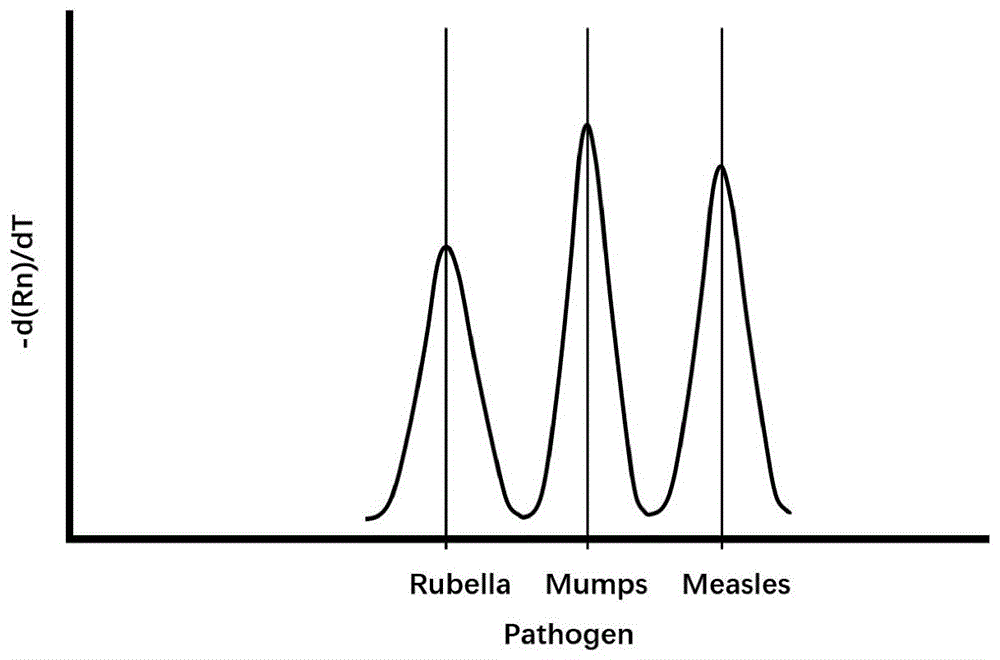
FIG. 1 is a schematic diagram of the melting curve applied to nucleic acid detection and identification of measles virus, rubella virus and mumps virus in example 1.
FIG. 2 is a graph showing the amplification curves of the specificity test of the kit for nucleic acid detection of measles virus, rubella virus and mumps virus based on the melting curve in example 2.
FIG. 3 is a graph showing the melting curves of measles virus, rubella virus and mumps virus nucleic acid detection kit-specific test positive samples of measles virus in example 2 based on the melting curves.
FIG. 4 is a melting curve diagram of rubella virus in a positive sample of a kit-specific test based on the melting curve for nucleic acid detection of measles virus, rubella virus and mumps virus in example 2.
FIG. 5 is a melting curve diagram of mumps virus in a positive sample of the kit-specific test based on the melting curve for nucleic acid detection of measles virus, rubella virus and mumps virus in example 2.
The specific implementation mode is as follows:
the following detailed description of specific embodiments of the invention is provided, but it should be understood that the scope of the invention is not limited to the specific embodiments.
Throughout the specification and claims, unless explicitly stated otherwise, the word "comprise", or variations such as "comprises" or "comprising", will be understood to imply the inclusion of a stated element or component but not the exclusion of any other element or component.
A nucleic acid detection kit for measles virus, rubella virus and mumps virus based on a melting curve is a kit which can simultaneously detect nucleic acid RNA of measles virus, rubella virus and mumps virus in the same reaction system through the same fluorescent channel, and can be applied to detection of various sample types such as human clinical samples, microorganism/virus culture samples and the like.
Screening gene conservation regions of measles virus, rubella virus and mumps virus by using a bioinformatics analysis technical means, designing a specific primer pair according to a conservation region sequence, determining the melting temperature of an amplification product and a detection program of an optimal reaction system, and performing performance verification on the sensitivity, specificity and stability of the detection method and clinical sample detection.
The composition for detecting nucleic acid of measles virus, rubella virus and mumps virus based on the melting curve comprises primer sequences for detecting measles virus, rubella virus and mumps virus, and the concentration of each primer sequence is 0.1-0.6 mu mol/L.
The primer sequences for detecting measles virus are SEQ ID NO.1 and SEQ ID NO.2 respectively;
the primer sequences for detecting the rubella virus are respectively SEQ ID NO.3 and SEQ ID NO. 4;
the primer sequences for detecting the mumps virus are respectively SEQ ID NO.5 and SEQ ID NO. 6;
table 1 composition of measles, rubella and mumps virus nucleic acid detection based on melting curves:
the kit for detecting nucleic acid of measles virus, rubella virus and mumps virus based on a melting curve comprises a composition for detecting nucleic acid of measles virus, rubella virus and mumps virus based on the melting curve, RT-PC reaction liquid, enzyme mixed liquid, blank control and positive control, wherein the RT-PCR reaction liquid comprises buffer solution, dNTPs and Mg2+, the enzyme mixed liquid comprises RNase inhibitor, DNA polymerase and reverse transcriptase, and the positive control is artificially synthesized gene. Blank control was sterilized, RNase-free water.
Compared with the existing fluorescent PCR method detection based on TaqMan or MGB probes, the kit provided by the invention can complete detection without expensive probe synthesis on the basis of the same detection performance, and has the advantages of simple operation, good adaptability and low cost.
No cross reaction exists when other pathogens are detected, and the specificity is very strong; the detection limit of measles virus is 1000copies/mL, the detection limit of rubella virus is 1000copies/mL, the detection limit of mumps virus is 1000copies/mL, the detection limit is low, and the sensitivity is high; the method can be widely applied to fever eruption monitoring/detection laboratories of all levels of medical and health institutions, can be used for identifying suspicious fever eruption viruses in various samples such as clinical diagnosis, crowd screening and the like, and has the advantage of being suitable for various samples.
Example 1 establishment of nucleic acid detection kit for measles virus, rubella virus and mumps virus based on melting curve
1. Sample nucleic acid was extracted using QIAamp Viral RNA Mini Kit from Qiagen to prepare a sample nucleic acid RNA volume of 60. mu.L.
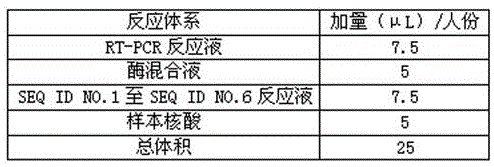
2. The reagent reaction system is prepared to be 25 mu L, and the composition of the reaction system is shown in Table 2:
table 2 reagent reaction system of kit:
3. program for setting fluorescent PCR amplification and melting curve
RT-PCR amplification was performed according to the following procedure: 10-30min at 42-50 ℃; 5-10min at 93-95 ℃; performing 45 cycles of 93-95 deg.C for 10-15s and 55-60 deg.C for 40-60 s;
melting curve analysis was performed according to the following procedure: 93-95 ℃ for 10-15 s; 30-60s at 40-45 ℃; the melting curve analysis program was run starting from 60-65 ℃.
4. Determination of results
(1) Positive and negative determination
The amplification curve is S-shaped, and the Ct value is less than or equal to 35, and the amplification curve is judged to be positive; the Ct value is more than or equal to 38, and the result is judged to be negative; ct value is more than 35 and less than 38, the sample is judged to be suspicious and needs to be detected repeatedly.
When the negative control detection is negative and the positive control detection is positive, if the sample to be detected is positive, the result is judged to be positive; when the negative control detection is negative and the positive control detection is positive, if the sample to be detected is negative, the result is judged to be virus nucleic acid negative; in all other cases, the detection needs to be repeated if the detection is suspicious or fails.
(2) Virus type determination
Detecting positive sample aiming at virus nucleic acid, and judging that the measles virus nucleic acid is positive when the peak value of a melting curve is 84.0 +/-0.5 ℃; when the peak value of the melting curve is 76.5 +/-0.5 ℃, judging that the mumps virus nucleic acid is positive; judging that the rubella virus nucleic acid is positive when the peak value of the melting curve is 70.5 +/-0.5 ℃; when the melting curve peak is out of all the above ranges, the detection is failed, and the detection is repeated. As shown in FIG. 1, FIG. 1 is a schematic view of melting curves applied to the determination of nucleic acid typing of measles virus, rubella virus and mumps virus, showing the different peak patterns and the differentiation of the melting curves.
Example 2 specific analysis of kits for nucleic acid detection of measles, rubella and mumps viruses based on melting curves
The nucleic acid detection kits for measles virus, rubella virus and mumps virus, which were established in example 1, were used to detect enterovirus 71, coxsackievirus a16, adenovirus, varicella-zoster virus, rhinovirus, herpes simplex virus, dengue virus, influenza a virus, influenza b virus, parainfluenza virus, respiratory syncytial virus and coronavirus, respectively. As shown in FIG. 2, FIG. 2 is a diagram showing the amplification curve of the reagent kit specificity test for detecting nucleic acid of measles virus, rubella virus and mumps virus, wherein curve 1 is the measles virus amplification curve, and curve 2 is the rubella virus amplification curve; curve 3 is the mumps virus amplification curve; curves 4-12 are amplification curves for Enterovirus 71, Coxsackie virus A16, adenovirus, varicella-zoster virus, rhinovirus, herpes simplex virus, dengue virus, influenza A virus, influenza B virus, parainfluenza virus, respiratory syncytial virus, and coronavirus. As shown in fig. 3, fig. 3 is a melting curve diagram of measles virus in a positive sample of a specific test, and the peak of the melting curve of measles virus in the positive sample is 84.0 in fig. 3; as shown in fig. 4, fig. 4 is a melting curve graph of rubella virus of the positive sample of the specificity test, and the peak value of the melting curve of rubella virus of the positive sample is 70.5 in fig. 4; as shown in fig. 5, fig. 5 is a melting curve graph of mumps in a positive sample of a specific test, and a peak value of a melting curve of mumps virus in the positive sample is 76.5 in fig. 5. The detection results of the specific test of the kit for detecting nucleic acid of measles virus, rubella virus and mumps virus are shown in table 3, and the kit has no cross reaction and strong specificity when detecting other pathogens.
Table 3 kit specific validation of measles, rubella and mumps virus nucleic acid detection:
| sample name
|
The result of the detection
|
Sample name
|
The result of the detection
|
| Rubella virus
|
Positive for
|
Enterovirus 71
|
Negative of
|
| Measles virus
|
Positive for
|
Coxsackie virus type A16
|
Negative of
|
| Mumps virus
|
Positive for
|
Adenoviral vectors
|
Negative of
|
| -
|
-
|
Varicella-zoster virus
|
Negative of
|
| -
|
-
|
Rhinovirus
|
Negative of
|
| -
|
-
|
Herpes simplex virus
|
Negative of
|
| -
|
-
|
Dengue virus
|
Negative of
|
| -
|
-
|
Influenza A virus
|
Negative of
|
| -
|
-
|
Influenza B virus
|
Negative of
|
| -
|
-
|
Parainfluenza virus
|
Negative of
|
| -
|
-
|
Respiratory syncytial virus
|
Negative of
|
| -
|
-
|
Coronavirus (coronavirus)
|
Negative of |
Example 3 confirmation of minimum detection limits for measles, rubella and mumps viruses based on melting curve nucleic acid detection kits for measles, rubella and mumps viruses
The measles virus, rubella virus and mumps virus nucleic acid detection kits established in example 1 were used to detect samples with different concentrations of measles virus, rubella virus and mumps virus, and the results are shown in tables 4, 5 and 6, wherein table 4 shows confirmation of detection limits of measles virus, rubella virus and mumps virus by the nucleic acid detection kits for measles virus, rubella virus and mumps virus, table 5 shows confirmation of detection limits of rubella virus by the nucleic acid detection kits for measles virus, rubella virus and mumps virus, and table 6 shows confirmation of detection limits of mumps virus by the nucleic acid detection kits for measles virus, rubella virus and mumps virus. The results in tables 4, 5 and 6 show that the lowest detection Limit (LOD) of the detection method is 1000copies/mL of measles virus, 1000copies/mL of rubella virus and 1000copies/mL of mumps virus.
Table 4 confirmation of minimum detection limit for measles virus, rubella virus and mumps virus detection by nucleic acid detection kit:
| sample concentration (copies/mL)
|
Detecting the number of repetitions
|
Number of positive test
|
Rate of positive detection
|
| 10
|
20
|
4
|
20.0%
|
| 100
|
20
|
16
|
80.0%
|
| 1000
|
20
|
20
|
100.0%
|
| 10000
|
20
|
20
|
100.0% |
Table 5 determination of minimum detection limit for measles virus, rubella virus and mumps virus by nucleic acid detection kit:
| sample concentration (copies/mL)
|
Detecting the number of repetitions
|
Number of positive test
|
Rate of positive detection
|
| 10
|
20
|
5
|
25.0%
|
| 100
|
20
|
13
|
65.0%
|
| 1000
|
20
|
20
|
100.0%
|
| 10000
|
20
|
20
|
100.0% |
Table 6 confirmation of minimum detection limit for mumps virus by nucleic acid detection kit for measles virus, rubella virus and mumps virus:
| sample concentration (copies/mL)
|
Detecting the number of repetitions
|
Number of positive test
|
Rate of positive detection
|
| 10
|
20
|
2
|
10.0%
|
| 100
|
20
|
8
|
40.0%
|
| 1000
|
20
|
20
|
100.0%
|
| 10000
|
20
|
20
|
100.0% |
The foregoing descriptions of specific exemplary embodiments of the present invention have been presented for purposes of illustration and description. It is not intended to limit the invention to the precise form disclosed, and obviously many modifications and variations are possible in light of the above teaching. The exemplary embodiments were chosen and described in order to explain certain principles of the invention and its practical application to enable one skilled in the art to make and use various exemplary embodiments of the invention and various alternatives and modifications as are suited to the particular use contemplated. It is intended that the scope of the invention be defined by the claims and their equivalents.
Sequence listing
<110> Guangzhou disease prevention and control center
<120> composition and kit for nucleic acid detection of measles virus, rubella virus and mumps virus based on melting curve
<130>P20190075
<141>2019-12-30
<160>6
<170>SIPOSequenceListing 1.0
<210>1
<211>29
<212>DNA
<213> Artificial Sequence (Artificial Sequence)
<400>1
gacaaaccac ccattacatc aggatccgg 29
<210>2
<211>30
<212>DNA
<213> Artificial Sequence (Artificial Sequence)
<400>2
catgtgaaaa gtattggtcc gcctcatcct 30
<210>3
<211>27
<212>DNA
<213> Artificial Sequence (Artificial Sequence)
<400>3
attctgcaac acgccgcacg gacaact 27
<210>4
<211>27
<212>DNA
<213> Artificial Sequence (Artificial Sequence)
<400>4
tggcccccac gagccgcgag cagtcag 27
<210>5
<211>30
<212>DNA
<213> Artificial Sequence (Artificial Sequence)
<400>5
ccaaaatgac ttcagagtac agccactaca 30
<210>6
<211>30
<212>DNA
<213> Artificial Sequence (Artificial Sequence)
<400>6
aattgggggt agtttgatca tgtcagtgat 30