CN110892891A - Process for preparing composite preparation of metaldehyde and tea saponin - Google Patents
Process for preparing composite preparation of metaldehyde and tea saponin Download PDFInfo
- Publication number
- CN110892891A CN110892891A CN201910322337.7A CN201910322337A CN110892891A CN 110892891 A CN110892891 A CN 110892891A CN 201910322337 A CN201910322337 A CN 201910322337A CN 110892891 A CN110892891 A CN 110892891A
- Authority
- CN
- China
- Prior art keywords
- metaldehyde
- tea saponin
- percent
- pesticide
- sodium
- Prior art date
- Legal status (The legal status is an assumption and is not a legal conclusion. Google has not performed a legal analysis and makes no representation as to the accuracy of the status listed.)
- Pending
Links
- 241001122767 Theaceae Species 0.000 title claims abstract description 74
- 239000001397 quillaja saponaria molina bark Substances 0.000 title claims abstract description 72
- 229930182490 saponin Natural products 0.000 title claims abstract description 72
- 150000007949 saponins Chemical class 0.000 title claims abstract description 67
- 239000005956 Metaldehyde Substances 0.000 title claims abstract description 65
- GKKDCARASOJPNG-UHFFFAOYSA-N metaldehyde Chemical compound CC1OC(C)OC(C)OC(C)O1 GKKDCARASOJPNG-UHFFFAOYSA-N 0.000 title claims abstract description 65
- 238000002360 preparation method Methods 0.000 title claims abstract description 33
- 239000002131 composite material Substances 0.000 title description 3
- 238000004519 manufacturing process Methods 0.000 title description 2
- 239000000575 pesticide Substances 0.000 claims abstract description 38
- 239000000203 mixture Substances 0.000 claims abstract description 35
- 238000009472 formulation Methods 0.000 claims abstract description 23
- 150000001875 compounds Chemical class 0.000 claims abstract description 18
- 239000004563 wettable powder Substances 0.000 claims abstract description 16
- XLYOFNOQVPJJNP-UHFFFAOYSA-N water Substances O XLYOFNOQVPJJNP-UHFFFAOYSA-N 0.000 claims abstract description 15
- 239000004530 micro-emulsion Substances 0.000 claims abstract description 13
- 239000004562 water dispersible granule Substances 0.000 claims abstract description 12
- 239000000839 emulsion Substances 0.000 claims abstract description 6
- 239000000375 suspending agent Substances 0.000 claims abstract description 6
- LYCAIKOWRPUZTN-UHFFFAOYSA-N Ethylene glycol Chemical compound OCCO LYCAIKOWRPUZTN-UHFFFAOYSA-N 0.000 claims description 33
- CSCPPACGZOOCGX-UHFFFAOYSA-N Acetone Chemical compound CC(C)=O CSCPPACGZOOCGX-UHFFFAOYSA-N 0.000 claims description 20
- -1 polyoxyethylene Polymers 0.000 claims description 16
- VTYYLEPIZMXCLO-UHFFFAOYSA-L Calcium carbonate Chemical compound [Ca+2].[O-]C([O-])=O VTYYLEPIZMXCLO-UHFFFAOYSA-L 0.000 claims description 12
- OOCMUZJPDXYRFD-UHFFFAOYSA-L calcium;2-dodecylbenzenesulfonate Chemical compound [Ca+2].CCCCCCCCCCCCC1=CC=CC=C1S([O-])(=O)=O.CCCCCCCCCCCCC1=CC=CC=C1S([O-])(=O)=O OOCMUZJPDXYRFD-UHFFFAOYSA-L 0.000 claims description 12
- 229920005552 sodium lignosulfonate Polymers 0.000 claims description 10
- DMAXMXPDVWTIRV-UHFFFAOYSA-N 2-(2-phenylethyl)phenol Chemical compound OC1=CC=CC=C1CCC1=CC=CC=C1 DMAXMXPDVWTIRV-UHFFFAOYSA-N 0.000 claims description 9
- 229920003171 Poly (ethylene oxide) Polymers 0.000 claims description 9
- DBMJMQXJHONAFJ-UHFFFAOYSA-M Sodium laurylsulphate Chemical compound [Na+].CCCCCCCCCCCCOS([O-])(=O)=O DBMJMQXJHONAFJ-UHFFFAOYSA-M 0.000 claims description 9
- 239000002671 adjuvant Substances 0.000 claims description 9
- 229940051841 polyoxyethylene ether Drugs 0.000 claims description 9
- 229920000056 polyoxyethylene ether Polymers 0.000 claims description 9
- XEGMDUOAESTQCC-UHFFFAOYSA-N 1-(naphthalen-1-ylmethyl)naphthalene;sodium Chemical compound [Na].C1=CC=C2C(CC=3C4=CC=CC=C4C=CC=3)=CC=CC2=C1 XEGMDUOAESTQCC-UHFFFAOYSA-N 0.000 claims description 6
- 239000005995 Aluminium silicate Substances 0.000 claims description 6
- DGAQECJNVWCQMB-PUAWFVPOSA-M Ilexoside XXIX Chemical compound C[C@@H]1CC[C@@]2(CC[C@@]3(C(=CC[C@H]4[C@]3(CC[C@@H]5[C@@]4(CC[C@@H](C5(C)C)OS(=O)(=O)[O-])C)C)[C@@H]2[C@]1(C)O)C)C(=O)O[C@H]6[C@@H]([C@H]([C@@H]([C@H](O6)CO)O)O)O.[Na+] DGAQECJNVWCQMB-PUAWFVPOSA-M 0.000 claims description 6
- CDBYLPFSWZWCQE-UHFFFAOYSA-L Sodium Carbonate Chemical compound [Na+].[Na+].[O-]C([O-])=O CDBYLPFSWZWCQE-UHFFFAOYSA-L 0.000 claims description 6
- 235000012211 aluminium silicate Nutrition 0.000 claims description 6
- BFNBIHQBYMNNAN-UHFFFAOYSA-N ammonium sulfate Chemical compound N.N.OS(O)(=O)=O BFNBIHQBYMNNAN-UHFFFAOYSA-N 0.000 claims description 6
- 229910052921 ammonium sulfate Inorganic materials 0.000 claims description 6
- 235000011130 ammonium sulphate Nutrition 0.000 claims description 6
- 229910000019 calcium carbonate Inorganic materials 0.000 claims description 6
- NLYAJNPCOHFWQQ-UHFFFAOYSA-N kaolin Chemical compound O.O.O=[Al]O[Si](=O)O[Si](=O)O[Al]=O NLYAJNPCOHFWQQ-UHFFFAOYSA-N 0.000 claims description 6
- LCRMGUFGEDUSOG-UHFFFAOYSA-N naphthalen-1-ylsulfonyloxymethyl naphthalene-1-sulfonate;sodium Chemical compound [Na].C1=CC=C2C(S(=O)(OCOS(=O)(=O)C=3C4=CC=CC=C4C=CC=3)=O)=CC=CC2=C1 LCRMGUFGEDUSOG-UHFFFAOYSA-N 0.000 claims description 6
- 229920002545 silicone oil Polymers 0.000 claims description 6
- 239000011734 sodium Substances 0.000 claims description 6
- 229910052708 sodium Inorganic materials 0.000 claims description 6
- BDHFUVZGWQCTTF-UHFFFAOYSA-M sulfonate Chemical compound [O-]S(=O)=O BDHFUVZGWQCTTF-UHFFFAOYSA-M 0.000 claims description 6
- 239000000230 xanthan gum Substances 0.000 claims description 6
- 229920001285 xanthan gum Polymers 0.000 claims description 6
- 229940082509 xanthan gum Drugs 0.000 claims description 6
- 235000010493 xanthan gum Nutrition 0.000 claims description 6
- 125000000217 alkyl group Chemical group 0.000 claims description 5
- CKMCMIZAFKDKAN-UHFFFAOYSA-N naphthalene;phosphoric acid Chemical compound OP(O)(O)=O.C1=CC=CC2=CC=CC=C21 CKMCMIZAFKDKAN-UHFFFAOYSA-N 0.000 claims description 5
- 229920002134 Carboxymethyl cellulose Polymers 0.000 claims description 3
- 239000004372 Polyvinyl alcohol Substances 0.000 claims description 3
- 239000000440 bentonite Substances 0.000 claims description 3
- 229910000278 bentonite Inorganic materials 0.000 claims description 3
- SVPXDRXYRYOSEX-UHFFFAOYSA-N bentoquatam Chemical compound O.O=[Si]=O.O=[Al]O[Al]=O SVPXDRXYRYOSEX-UHFFFAOYSA-N 0.000 claims description 3
- 239000001768 carboxy methyl cellulose Substances 0.000 claims description 3
- 235000010948 carboxy methyl cellulose Nutrition 0.000 claims description 3
- 239000008112 carboxymethyl-cellulose Substances 0.000 claims description 3
- 229920002401 polyacrylamide Polymers 0.000 claims description 3
- 229920002451 polyvinyl alcohol Polymers 0.000 claims description 3
- 150000003839 salts Chemical class 0.000 claims description 3
- 229910000029 sodium carbonate Inorganic materials 0.000 claims description 3
- 235000017550 sodium carbonate Nutrition 0.000 claims description 3
- TVFWYUWNQVRQRG-UHFFFAOYSA-N 2,3,4-tris(2-phenylethenyl)phenol Chemical compound C=1C=CC=CC=1C=CC1=C(C=CC=2C=CC=CC=2)C(O)=CC=C1C=CC1=CC=CC=C1 TVFWYUWNQVRQRG-UHFFFAOYSA-N 0.000 claims description 2
- YDEXUEFDPVHGHE-GGMCWBHBSA-L disodium;(2r)-3-(2-hydroxy-3-methoxyphenyl)-2-[2-methoxy-4-(3-sulfonatopropyl)phenoxy]propane-1-sulfonate Chemical compound [Na+].[Na+].COC1=CC=CC(C[C@H](CS([O-])(=O)=O)OC=2C(=CC(CCCS([O-])(=O)=O)=CC=2)OC)=C1O YDEXUEFDPVHGHE-GGMCWBHBSA-L 0.000 claims description 2
- WGCNASOHLSPBMP-UHFFFAOYSA-N hydroxyacetaldehyde Natural products OCC=O WGCNASOHLSPBMP-UHFFFAOYSA-N 0.000 claims 3
- IWOUTIHKEQOMCY-UHFFFAOYSA-N 2-ethyl-3,4,5-triphenylphenol Chemical compound C1(=CC=CC=C1)C=1C(=C(C(=C(C1)O)CC)C1=CC=CC=C1)C1=CC=CC=C1 IWOUTIHKEQOMCY-UHFFFAOYSA-N 0.000 claims 2
- 238000010586 diagram Methods 0.000 claims 2
- 239000003090 pesticide formulation Substances 0.000 claims 1
- 241000237858 Gastropoda Species 0.000 abstract description 19
- 230000000694 effects Effects 0.000 abstract description 13
- 230000002195 synergetic effect Effects 0.000 abstract description 4
- 238000002474 experimental method Methods 0.000 abstract description 3
- 206010059866 Drug resistance Diseases 0.000 abstract description 2
- 230000002265 prevention Effects 0.000 abstract description 2
- 238000012827 research and development Methods 0.000 abstract description 2
- 230000001934 delay Effects 0.000 abstract 1
- 230000007613 environmental effect Effects 0.000 abstract 1
- 244000144972 livestock Species 0.000 abstract 1
- 241000238557 Decapoda Species 0.000 description 11
- 241000237852 Mollusca Species 0.000 description 10
- 241000534460 Ampullaria Species 0.000 description 7
- 241000565675 Oncomelania Species 0.000 description 6
- 239000003814 drug Substances 0.000 description 6
- 230000000361 pesticidal effect Effects 0.000 description 6
- 235000019333 sodium laurylsulphate Nutrition 0.000 description 6
- 231100000053 low toxicity Toxicity 0.000 description 5
- ABPYVNPDRFJZEU-UHFFFAOYSA-N 2-(2,2,2-triphenylethyl)phenol Chemical compound OC1=CC=CC=C1CC(C=1C=CC=CC=1)(C=1C=CC=CC=1)C1=CC=CC=C1 ABPYVNPDRFJZEU-UHFFFAOYSA-N 0.000 description 4
- 241000251468 Actinopterygii Species 0.000 description 4
- 244000144974 aquaculture Species 0.000 description 4
- 238000009360 aquaculture Methods 0.000 description 4
- 239000002552 dosage form Substances 0.000 description 4
- 231100000572 poisoning Toxicity 0.000 description 4
- 230000000607 poisoning effect Effects 0.000 description 4
- UHOVQNZJYSORNB-UHFFFAOYSA-N Benzene Chemical compound C1=CC=CC=C1 UHOVQNZJYSORNB-UHFFFAOYSA-N 0.000 description 3
- 244000068988 Glycine max Species 0.000 description 3
- 235000010469 Glycine max Nutrition 0.000 description 3
- 244000061176 Nicotiana tabacum Species 0.000 description 3
- 235000002637 Nicotiana tabacum Nutrition 0.000 description 3
- 240000007594 Oryza sativa Species 0.000 description 3
- 235000007164 Oryza sativa Nutrition 0.000 description 3
- 241000607479 Yersinia pestis Species 0.000 description 3
- 240000008042 Zea mays Species 0.000 description 3
- 235000005824 Zea mays ssp. parviglumis Nutrition 0.000 description 3
- 235000002017 Zea mays subsp mays Nutrition 0.000 description 3
- 235000005822 corn Nutrition 0.000 description 3
- 210000003097 mucus Anatomy 0.000 description 3
- 230000002685 pulmonary effect Effects 0.000 description 3
- 235000009566 rice Nutrition 0.000 description 3
- 235000013311 vegetables Nutrition 0.000 description 3
- 208000003643 Callosities Diseases 0.000 description 2
- RTZKZFJDLAIYFH-UHFFFAOYSA-N Diethyl ether Chemical compound CCOCC RTZKZFJDLAIYFH-UHFFFAOYSA-N 0.000 description 2
- LFQSCWFLJHTTHZ-UHFFFAOYSA-N Ethanol Chemical compound CCO LFQSCWFLJHTTHZ-UHFFFAOYSA-N 0.000 description 2
- 206010020649 Hyperkeratosis Diseases 0.000 description 2
- 241000361919 Metaphire sieboldi Species 0.000 description 2
- 230000009471 action Effects 0.000 description 2
- 201000010099 disease Diseases 0.000 description 2
- 208000037265 diseases, disorders, signs and symptoms Diseases 0.000 description 2
- 230000000857 drug effect Effects 0.000 description 2
- 230000001804 emulsifying effect Effects 0.000 description 2
- 230000002401 inhibitory effect Effects 0.000 description 2
- 230000007794 irritation Effects 0.000 description 2
- 230000001737 promoting effect Effects 0.000 description 2
- 238000010298 pulverizing process Methods 0.000 description 2
- 210000002784 stomach Anatomy 0.000 description 2
- 239000000126 substance Substances 0.000 description 2
- VCNKUCWWHVTTBY-UHFFFAOYSA-N 18alpha-Oleanane Natural products C1CCC(C)(C)C2CCC3(C)C4(C)CCC5(C)CCC(C)(C)CC5C4CCC3C21C VCNKUCWWHVTTBY-UHFFFAOYSA-N 0.000 description 1
- KCCUBRRTVWFOGF-UHFFFAOYSA-N 2-tritylphenol Chemical compound OC1=CC=CC=C1C(C=1C=CC=CC=1)(C=1C=CC=CC=1)C1=CC=CC=C1 KCCUBRRTVWFOGF-UHFFFAOYSA-N 0.000 description 1
- MIJYXULNPSFWEK-GTOFXWBISA-N 3beta-hydroxyolean-12-en-28-oic acid Chemical compound C1C[C@H](O)C(C)(C)[C@@H]2CC[C@@]3(C)[C@]4(C)CC[C@@]5(C(O)=O)CCC(C)(C)C[C@H]5C4=CC[C@@H]3[C@]21C MIJYXULNPSFWEK-GTOFXWBISA-N 0.000 description 1
- 240000001548 Camellia japonica Species 0.000 description 1
- 235000006467 Camellia japonica Nutrition 0.000 description 1
- 241000526900 Camellia oleifera Species 0.000 description 1
- 241000222122 Candida albicans Species 0.000 description 1
- 241000196324 Embryophyta Species 0.000 description 1
- 241000588724 Escherichia coli Species 0.000 description 1
- 206010017533 Fungal infection Diseases 0.000 description 1
- 241000238631 Hexapoda Species 0.000 description 1
- 206010061218 Inflammation Diseases 0.000 description 1
- 241001465754 Metazoa Species 0.000 description 1
- 208000031888 Mycoses Diseases 0.000 description 1
- 241000244206 Nematoda Species 0.000 description 1
- 229910019142 PO4 Inorganic materials 0.000 description 1
- 208000003251 Pruritus Diseases 0.000 description 1
- OIPILFWXSMYKGL-UHFFFAOYSA-N acetylcholine Chemical compound CC(=O)OCC[N+](C)(C)C OIPILFWXSMYKGL-UHFFFAOYSA-N 0.000 description 1
- 229960004373 acetylcholine Drugs 0.000 description 1
- 230000001887 anti-feedant effect Effects 0.000 description 1
- 230000002528 anti-freeze Effects 0.000 description 1
- 239000012752 auxiliary agent Substances 0.000 description 1
- 230000009286 beneficial effect Effects 0.000 description 1
- 235000012216 bentonite Nutrition 0.000 description 1
- 210000001124 body fluid Anatomy 0.000 description 1
- 239000010839 body fluid Substances 0.000 description 1
- 238000009395 breeding Methods 0.000 description 1
- 230000001488 breeding effect Effects 0.000 description 1
- 229940095731 candida albicans Drugs 0.000 description 1
- 150000001732 carboxylic acid derivatives Chemical class 0.000 description 1
- 239000000969 carrier Substances 0.000 description 1
- 239000003795 chemical substances by application Substances 0.000 description 1
- 238000004140 cleaning Methods 0.000 description 1
- 239000012459 cleaning agent Substances 0.000 description 1
- 239000006184 cosolvent Substances 0.000 description 1
- 239000013078 crystal Substances 0.000 description 1
- 239000008367 deionised water Substances 0.000 description 1
- 229910021641 deionized water Inorganic materials 0.000 description 1
- 230000003111 delayed effect Effects 0.000 description 1
- 238000001514 detection method Methods 0.000 description 1
- 230000003467 diminishing effect Effects 0.000 description 1
- 239000007884 disintegrant Substances 0.000 description 1
- 239000002270 dispersing agent Substances 0.000 description 1
- 239000006185 dispersion Substances 0.000 description 1
- 229940079593 drug Drugs 0.000 description 1
- 235000013399 edible fruits Nutrition 0.000 description 1
- 238000004945 emulsification Methods 0.000 description 1
- 239000003995 emulsifying agent Substances 0.000 description 1
- 239000000945 filler Substances 0.000 description 1
- 238000005187 foaming Methods 0.000 description 1
- 229930182470 glycoside Natural products 0.000 description 1
- SIOMFBXUIJKTMF-UHFFFAOYSA-N hypoglauterpenic acid Natural products C1CC(O)C(C)(C)C2=CCC3(C)C4(C)CCC5(C(O)=O)CCC(C)(C)CC5C4=CCC3C21C SIOMFBXUIJKTMF-UHFFFAOYSA-N 0.000 description 1
- 230000004054 inflammatory process Effects 0.000 description 1
- 239000003446 ligand Substances 0.000 description 1
- 239000007788 liquid Substances 0.000 description 1
- 230000007774 longterm Effects 0.000 description 1
- 210000004072 lung Anatomy 0.000 description 1
- 238000000034 method Methods 0.000 description 1
- 238000012986 modification Methods 0.000 description 1
- 230000004048 modification Effects 0.000 description 1
- 210000005036 nerve Anatomy 0.000 description 1
- 239000002736 nonionic surfactant Substances 0.000 description 1
- BPAWXSVOAOLSRP-UHFFFAOYSA-N oleanane Natural products CCCCCCCCCCCCCCCC(=O)OC1CCC2(C)C(CCC3(C)C2CC=C4C5CC(C)(C)CCC5(C)C(O)CC34C)C1(C)C BPAWXSVOAOLSRP-UHFFFAOYSA-N 0.000 description 1
- 150000002966 pentacyclic triterpenoids Chemical class 0.000 description 1
- NBIIXXVUZAFLBC-UHFFFAOYSA-K phosphate Chemical compound [O-]P([O-])([O-])=O NBIIXXVUZAFLBC-UHFFFAOYSA-K 0.000 description 1
- 239000010452 phosphate Substances 0.000 description 1
- 235000019422 polyvinyl alcohol Nutrition 0.000 description 1
- 230000008569 process Effects 0.000 description 1
- 238000012545 processing Methods 0.000 description 1
- 238000011160 research Methods 0.000 description 1
- 208000017520 skin disease Diseases 0.000 description 1
- 235000002639 sodium chloride Nutrition 0.000 description 1
- 239000002689 soil Substances 0.000 description 1
- 230000000638 stimulation Effects 0.000 description 1
- 235000013616 tea Nutrition 0.000 description 1
- 230000001225 therapeutic effect Effects 0.000 description 1
- 239000002562 thickening agent Substances 0.000 description 1
- 239000000080 wetting agent Substances 0.000 description 1
Images


Classifications
-
- A—HUMAN NECESSITIES
- A01—AGRICULTURE; FORESTRY; ANIMAL HUSBANDRY; HUNTING; TRAPPING; FISHING
- A01N—PRESERVATION OF BODIES OF HUMANS OR ANIMALS OR PLANTS OR PARTS THEREOF; BIOCIDES, e.g. AS DISINFECTANTS, AS PESTICIDES OR AS HERBICIDES; PEST REPELLANTS OR ATTRACTANTS; PLANT GROWTH REGULATORS
- A01N43/00—Biocides, pest repellants or attractants, or plant growth regulators containing heterocyclic compounds
- A01N43/02—Biocides, pest repellants or attractants, or plant growth regulators containing heterocyclic compounds having rings with one or more oxygen or sulfur atoms as the only ring hetero atoms
- A01N43/24—Biocides, pest repellants or attractants, or plant growth regulators containing heterocyclic compounds having rings with one or more oxygen or sulfur atoms as the only ring hetero atoms with two or more hetero atoms
-
- A—HUMAN NECESSITIES
- A01—AGRICULTURE; FORESTRY; ANIMAL HUSBANDRY; HUNTING; TRAPPING; FISHING
- A01N—PRESERVATION OF BODIES OF HUMANS OR ANIMALS OR PLANTS OR PARTS THEREOF; BIOCIDES, e.g. AS DISINFECTANTS, AS PESTICIDES OR AS HERBICIDES; PEST REPELLANTS OR ATTRACTANTS; PLANT GROWTH REGULATORS
- A01N43/00—Biocides, pest repellants or attractants, or plant growth regulators containing heterocyclic compounds
- A01N43/02—Biocides, pest repellants or attractants, or plant growth regulators containing heterocyclic compounds having rings with one or more oxygen or sulfur atoms as the only ring hetero atoms
- A01N43/04—Biocides, pest repellants or attractants, or plant growth regulators containing heterocyclic compounds having rings with one or more oxygen or sulfur atoms as the only ring hetero atoms with one hetero atom
- A01N43/14—Biocides, pest repellants or attractants, or plant growth regulators containing heterocyclic compounds having rings with one or more oxygen or sulfur atoms as the only ring hetero atoms with one hetero atom six-membered rings
- A01N43/16—Biocides, pest repellants or attractants, or plant growth regulators containing heterocyclic compounds having rings with one or more oxygen or sulfur atoms as the only ring hetero atoms with one hetero atom six-membered rings with oxygen as the ring hetero atom
Landscapes
- Life Sciences & Earth Sciences (AREA)
- Agronomy & Crop Science (AREA)
- Pest Control & Pesticides (AREA)
- Plant Pathology (AREA)
- Health & Medical Sciences (AREA)
- Engineering & Computer Science (AREA)
- Dentistry (AREA)
- General Health & Medical Sciences (AREA)
- Wood Science & Technology (AREA)
- Zoology (AREA)
- Environmental Sciences (AREA)
- Agricultural Chemicals And Associated Chemicals (AREA)
Abstract
The invention discloses a novel pesticide prepared by combining various effective pesticides, in particular to a metaldehyde and tea saponin pesticide compound preparation. The invention describes five pesticide preparation Wettable Powder (WP), a suspending agent (SC), a Microemulsion (ME), an emulsion in water (EW), a water dispersible granule (WG) and the like. The pesticide preparation has different formulations, has synergistic effect in prevention and treatment effect, can effectively reduce the respective dosage of metaldehyde and tea saponin, reduces or delays the generation of drug resistance, has stable product quality, and is convenient to prepare various preparations. The invention specifically exemplifies the implementation of the compound preparation, and compares the effects of the implementation of the river snail experiment. The pesticide compound preparation has the characteristics of convenient use, high efficiency, durability, safety to crops, human and livestock, environmental friendliness and the like, and is low in cost. The whole pesticide compound preparation embodies the characteristics of science, practicality, economy, novelty and the like, has a plurality of technical breakthroughs and special designs, and is a successful research and development project.
Description
Technical Field
The invention belongs to the field of pesticides, and relates to a pesticide composition which comprises metaldehyde and tea saponin, wherein the tea saponin is expressed by effective content. The combined pesticide is a specific medicine, and is a novel medicament combined by multiple effects. The present invention also relates to a pesticidal preparation prepared from the above pesticidal composition.
Background
Metaldehyde is a white needle-like crystal, which is thermally unstable, insoluble in water, and easily soluble in ethanol, ether, acetone and benzene. The chemical name is 2.4.6.8-tetramethyl-1.3.5.7-tetraoxacyclooctane, and the experimental formula is C8H16O4The relative molecular mass is 176.21 (according to 2005 international relative atomic mass), and the molecular structure is shown in figure 1 of the attached drawings of the specification.
Metaldehyde is a specific medicine for killing mollusks with lung such as snail and slug, and is a new type of medicine for killing mollusks such as snail, slug, ampullaria gigas and oncomelania with high efficiency, and its action mode is contact poisoning and stomach poisoning. The pesticide has low toxicity to aquatic organisms such as fish, shrimps and crabs, has no irritation to eyes and skin, has no three-cause effect, has low toxicity to non-target organisms, is safe to crops, and is suitable for preventing and treating snail, rice and aquaculture areas, oncomelania and ampullaria gigas in crops such as vegetables, corns, soybeans and tobacco in dry farmland and breeding water areas. It can be used for artificial rainfall, making safety match, colour candle and fireworks.
Tea saponin, also known as tea saponin, is a natural glycoside compound contained in plants of Theaceae (such as tea, Camellia japonica, Camellia oleifera), and is widely present in roots, stems, leaves, flowers, and fruits of Theaceae. From seven ligands (C)30H50O6) (Sapgening), four kinds of lobe bodies (Aglyevn) and two kinds of organic carboxylic acid, and the molecular structure of the oleanane type pentacyclic triterpenoid saponin compound is shown in the attached figure 2 of the specification.
Tea saponin is a saccharide-type compound extracted from seeds of Theaceae plants, and belongs to saponin class, and is a natural nonionic surfactant. The detection proves that the tea saponin has good functions of emulsification, dispersion, foaming, moistening and the like, and has the functions of diminishing inflammation, easing pain, resisting permeation and the like. The environment-friendly pond cleaning agent prepared by taking the tea saponin as a main body can be used for cleaning ponds before prawn culture and killing enemy fishes in the culture process, can promote prawn shelling and stimulate prawn growth, and can well kill nematodes and polypide attached to crabs to achieve the purpose of treating crab diseases.
The metaldehyde and the tea saponin are compounded in the metaldehyde and tea saponin compound pesticide preparation, so that the pulmonary mollusks such as snails and slugs are effectively killed, the metaldehyde and tea saponin compound pesticide preparation is a novel medicament for efficiently killing various mollusks such as snails, slugs, ampullaria gigas and oncomelania, and the action mode is contact poisoning and stomach poisoning. When the snail, ampullaria gigas and other soft body moving foot objects contact or eat the metaldehyde and tea saponin compound pesticide preparation, the mollusk animal foot contact preparation can promote the mollusk animal foot contact preparation to release a large amount of acetylcholine, destroy special mucus in the body, rapidly dehydrate the mucus, paralyze the nerve and secrete the mucus, and the mollusk animal foot contact preparation can be poisoned and killed rapidly in a short time due to the loss of a large amount of body fluid and the damage of cells. The metaldehyde and tea saponin compound pesticide preparation has low toxicity to aquatic organisms such as fishes, shrimps, crabs and the like, has no stimulation to eyes and skin, has no 'three-cause' effect, has low toxicity to non-target organisms, is safe to crops, and is widely applied to prevention and control of snails, rice, aquaculture areas, oncomelania, ampullaria gigas and the like which are crops such as vegetables, corns, soybeans, tobaccos and the like in dry farmland.
The company finds that pure metaldehyde and the effective component tea saponin have synergistic effect when used together through long-term hard research, thereby not only reducing the dosage of metaldehyde in the compound pesticide, but also obtaining better effect. The invention improves the compound formula of the pesticide in order to improve the trapping effect. The processed metaldehyde and tea saponin jointly take effect, and the drug effect is exerted together, so that the drug effect is doubled, the drug amount is reduced, and the cost is reduced. The pesticide preparation prepared from the pesticide composition has various dosage forms, and is suitable for different application conditions. The processing route embodies the characteristics of science, practicality, economy, novelty and the like, and is a successful research and development project.
Disclosure of Invention
The technical problem to be solved by the invention is to provide a pesticide composition, wherein metaldehyde and tea saponin have a synergistic effect, and the dosage of metaldehyde can be effectively reduced.
In particular, in a first aspect, the present invention provides a pesticidal composition comprising metaldehyde and tea saponin. "pesticides" herein have the meaning well known in the art. Effectively kill snail, slug and other pulmonary mollusk pests. Wherein, the metaldehyde is a pure product which is produced by the company. When the tea saponin is used, the effective content is expressed, namely the content of the tea saponin sold in the market is 80%, the weight of the tea saponin is 10%, and the effective content is 8%.
The invention provides a pesticide preparation which comprises the pesticide composition described in the first aspect and a pesticide acceptable auxiliary agent. The pesticide preparation is a tangible product and can be Wettable Powder (WP), a suspending agent (SC), Microemulsion (ME), emulsion in water (EW), water dispersible granules (WG) and the like. As used herein, "pesticidally acceptable adjuvant" refers to an adjuvant that can be added to a pesticide to formulate a formulation. Adjuvants are typically agents that are not resistant to pests and diseases, including carriers or fillers (such as water), wetting agents, dispersants, thickeners, defoamers, emulsifiers, antifreeze, cosolvents, disintegrants, and the like. Typical adjuvants include sodium lauryl sulfate, sodium methylene dinaphthalene sulfonate, kaolin polyacrylamide, bentonite, salt, soda ash, polyvinyl alcohol, carboxymethylcellulose, sodium lignosulfonate, sodium methylene dinaphthalene sulfonate, xanthan gum, silicone oil, acetone, calcium dodecylbenzene sulfonate, phenethyl phenol polyoxyethylene ether, ethylene glycol, calcium dodecylbenzene sulfonate, tristyrylphenol polyoxyethylene, sodium alkylnaphthalene phosphate, ammonium sulfate, calcium carbonate, and the like. In the formulation of the present invention, it is preferable that the adjuvant used is selected from several of sodium dodecyl sulfate, sodium methylene dinaphthalene sulfonate, kaolin, sodium lignin sulfonate, sodium methylene dinaphthalene sulfonate, xanthan gum, polyacrylamide, bentonite, salt, soda ash, polyvinyl alcohol, carboxymethyl cellulose, silicone oil, acetone, calcium dodecylbenzene sulfonate, phenethyl phenol polyoxyethylene ether, ethylene glycol, calcium dodecylbenzene sulfonate, trityl phenol polyoxyethylene, sodium alkyl naphthalene phosphate, ammonium sulfate, calcium carbonate, etc.
The pesticidal formulation of the second aspect of the present invention is a formulation selected from the following formulations.
The formulation of the formulation, metaldehyde + tea saponin Wettable Powder (WP), comprises the following components in parts by weight: metaldehyde 0.5-85% tea saponin 0.1-40%; 2 percent of sodium dodecyl sulfate; 4% of sodium lignosulfonate; 5% of methylene dinaphthalene sodium sulfonate; and kaolin to make up to 100%.
The formulation of metaldehyde and tea saponin suspending agent (SC) comprises the following components in parts by weight: metaldehyde 0.5-40%; 0.1-40% of tea saponin; 3% of sodium lignosulfonate; 2% of methylene dinaphthalene sodium sulfonate; 4% of ethylene glycol; 0.2% of xanthan gum; 0.3 percent of silicone oil and water are added to make up to 100 percent.
The formulation of the dosage form of metaldehyde and tea saponin Microemulsion (ME) comprises the following components in parts by weight: metaldehyde 0.5-40%; 0.1-40% of tea saponin; 30% of acetone; 4% of calcium dodecyl benzene sulfonate; 6% of phenethyl phenol polyoxyethylene ether; 5% of triphenylethylphenol polyoxyethylene; 4% of ethylene glycol; and water to make up to 100%.
The formulation of metaldehyde-theasaponin aqueous Emulsion (EW) comprises the following components in parts by weight: metaldehyde 0.5-40%; 0.1-40% of tea saponin; 30% of acetone: 4.5 percent of calcium dodecyl benzene sulfonate; 5.5 percent of phenethyl phenol polyoxyethylene ether; 5% of triphenylethylphenol polyoxyethylene; 4% of ethylene glycol; and water to make up to 100%.
The formulation of the dosage form pentametaldehyde and tea saponin water dispersible granule (WG) comprises the following components in parts by weight: metaldehyde 0.5-40%; 0.1-40% of tea saponin; 4% of sodium alkyl naphthalene phosphate; 8% of sodium lignosulfonate; 2 percent of sodium dodecyl sulfate; 5 percent of ammonium sulfate; and calcium carbonate to make up to 100%.
The following examples are given.
The formulation of the 60% metaldehyde and 25% tea saponin Wettable Powder (WP) comprises the following components in parts by weight: 60% of metaldehyde; 25% of tea saponin; 2 percent of sodium dodecyl sulfate; 4% of sodium lignosulfonate; 5% of methylene dinaphthalene sodium sulfonate; and kaolin to make up to 100%, and pulverizing into wettable powder.
The formulation of the formulation II comprises 30 percent metaldehyde and 15 percent tea saponin suspending agent (SC) and the weight parts thereof: 30% of metaldehyde; 15% of tea saponin; 3% of sodium lignosulfonate; 2% of methylene dinaphthalene sodium sulfonate; 4% of ethylene glycol; 0.2% of xanthan gum; 0.3 percent of silicone oil and deionized water are added to make up to 100 percent.
The formulation of 30 percent metaldehyde and 15 percent tea saponin Microemulsion (ME) comprises the following components in parts by weight: 30% of metaldehyde; 15% of tea saponin; 30% of acetone; 4% of calcium dodecyl benzene sulfonate; 6% of phenethyl phenol polyoxyethylene ether; 5% of triphenylethylphenol polyoxyethylene; 4% of ethylene glycol; and water to 100%, emulsifying to obtain uniform liquid, and forming microemulsion.
The formulation comprises the following components in percentage by weight: 30% of metaldehyde; 5% of tea saponin; 30% of acetone: 4.5 percent of calcium dodecyl benzene sulfonate; 5.5 percent of phenethyl phenol polyoxyethylene ether; 5% of triphenylethylphenol polyoxyethylene; 4% of ethylene glycol; adding water to 100%, and emulsifying to obtain water emulsion.
The formulation of the dosage form five 50% metaldehyde and 25% tea saponin water dispersible granule (WG) comprises the following components in parts by weight: 50% of metaldehyde; 25% of tea saponin; 4% of sodium alkyl naphthalene phosphate; 8% of sodium lignosulfonate; 2 percent of sodium dodecyl sulfate; 5 percent of ammonium sulfate; and calcium carbonate to make up to 100%, pulverizing.
In a third aspect, the invention provides the use of a composition according to the first aspect of the invention or a pesticide preparation according to the third aspect of the invention for controlling snail and rice, aquaculture areas and aquaculture areas, oncomelania and ampullaria gigas which are crops of vegetables in upland fields, such as dry land, corn, soybean and tobacco, and which are crops of tea saponin and metaldehyde. The invention preferably provides the use of a composition according to the first aspect of the invention or a pesticidal formulation according to the third aspect of the invention to effectively kill pulmonary mollusks such as snails and slugs, and to effectively kill a variety of mollusks such as snails, slugs, ampullaria gigas and oncomelania.
The invention has the following beneficial effects: the control effect has a synergistic effect, and the respective dosages of metaldehyde and tea saponin can be effectively reduced; the generation of drug resistance is reduced or delayed; the product quality is stable; can be prepared into various preparations for convenient use. The composite pesticide preparation of metaldehyde and tea saponin has low toxicity to aquatic organisms such as fishes, shrimps and crabs, has no irritation to eyes and skin, and has no three-cause effect. Has inhibitory effect on Candida albicans and Escherichia coli; has therapeutic effect on superficial fungal infection; it can be used for inhibiting various dermatoses and pruritus. Can stimulate the growth of tea seedlings and promote the yield increase of tea. Has better embodied in the aspect of promoting the growth of the animals on the aspect of promoting the growth of the prawns. Also can kill snail and earthworm, and has antifeedant and growth-influencing effects on certain insects. It is used as pesticide for garden flowers to prevent and control soil pests and kill earthworm.
For ease of understanding, the following will be described in specific detail. It is specifically noted that these descriptions are merely illustrative descriptions. The discussion of the specification should not be construed to limit the scope of the invention. Many variations and modifications of the present invention will be apparent to those skilled in the art in light of the teachings of this specification.
In addition, the present invention incorporates a public literature. These documents are included in part by reference herein for the purpose of more clearly describing the invention.
And (5) implementing a pesticide effect experiment of the compound pesticide.
We compared the performance of the specific examples. Two formulations of 60% metaldehyde +25% tea saponin Wettable Powder (WP) and 30% metaldehyde +15% tea saponin suspending agent (SC) of the first formulation and 80% metaldehyde wettable powder of Xuzhou Note chemical industry Co., Ltd are selected as a contrast to carry out 30 groups of experiments for killing the escargots.
The control effects of the compound preparation and the wettable powder are shown in table 1:
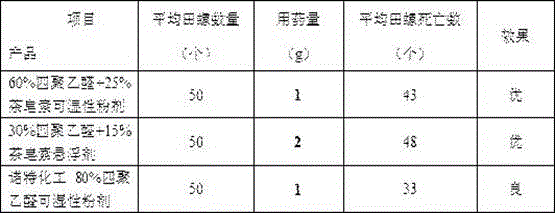
the experimental table of the compound preparation and the wettable powder for preventing and killing the escargots shows that the compound preparation has better use effect. Therefore, the compound preparation can be safely popularized and used.
Claims (8)
1. A pesticide composition containing metaldehyde and tea saponin is provided, wherein the metaldehyde and tea saponin are contained, the molecular structure diagram of the metaldehyde is shown in figure 1, and the molecular structure diagram of the tea saponin is shown in figure 2.
2. The metaldehyde and tea saponin pesticide compound preparation as claimed in claim 1, which contains metaldehyde and tea saponin with content of 0.1-90% and tea saponin with content of 0.1-50%.
3. The adjuvant for the pesticide formulation of claim 1, wherein the adjuvant is a pesticide acceptable adjuvant, and preferably the adjuvant is one or more selected from sodium dodecyl sulfate, sodium methylene dinaphthalene sulfonate, kaolin polyacrylamide, bentonite, salt, soda ash, polyvinyl alcohol, carboxymethyl cellulose, sodium lignin sulfonate, sodium methylene dinaphthalene sulfonate, xanthan gum, silicone oil, acetone, calcium dodecyl benzene sulfonate, phenethyl phenol polyoxyethylene ether, ethylene glycol, calcium dodecyl benzene sulfonate, tristyrylphenol polyoxyethylene, sodium alkyl naphthalene phosphate, ammonium sulfate and calcium carbonate.
4. The composition and the weight parts of the metaldehyde and tea saponin pesticide compound preparation metaldehyde + tea saponin Wettable Powder (WP) formula as claimed in claim 1: metaldehyde 0.5-85% tea saponin 0.1-40%; 0.1 to 10 percent of sodium dodecyl sulfate; 0.1 to 10 percent of sodium lignosulfonate; 0.1 to 10 percent of methylene dinaphthalene sodium sulfonate; and kaolin to make up to 100%.
5. The metaldehyde and tea saponin pesticide compound preparation metaldehyde + tea saponin suspending agent (SC) formulation as claimed in claim 1, wherein the formulation comprises the following components in parts by weight: metaldehyde 0.5-40%; 0.1-40% of tea saponin; 0.1 to 10 percent of sodium lignosulfonate; 0.1 to 10 percent of methylene dinaphthalene sodium sulfonate; 0.1 to 10 percent of glycol; 0.1-10% of xanthan gum; 0.1-10% of silicone oil and water to 100%.
6. The metaldehyde and tea saponin pesticide combination preparation metaldehyde + tea saponin Microemulsion (ME) formula as claimed in claim 1, wherein the metaldehyde + tea saponin Microemulsion (ME) formula comprises the following components in parts by weight: metaldehyde 0.5-40%; 0.1-40% of tea saponin; 1-60% of acetone; 0.1 to 10 percent of calcium dodecyl benzene sulfonate; 0.1 to 10 percent of phenethyl phenol polyoxyethylene ether; 0.1 to 10 percent of triphenyl ethylphenol polyoxyethylene; 0.1 to 10 percent of glycol; and water to make up to 100%.
7. The composition and weight of the metaldehyde and tea saponin pesticide compound preparation metaldehyde + tea saponin aqueous Emulsion (EW) formula of claim 1, wherein the composition and weight of the metaldehyde + tea saponin aqueous Emulsion (EW) formula are as follows: metaldehyde 0.5-40%; 0.1-40% of tea saponin; 1-60% of acetone: 0.1 to 10 percent of calcium dodecyl benzene sulfonate; 0.1 to 10 percent of phenethyl phenol polyoxyethylene ether; 0.1 to 10 percent of triphenyl ethylphenol polyoxyethylene; 0.1 to 10 percent of glycol; and water to make up to 100%.
8. The metaldehyde and tea saponin pesticide compound preparation metaldehyde + tea saponin water dispersible granule (WG) formula as claimed in claim 1, wherein the metaldehyde + tea saponin water dispersible granule (WG) formula comprises the following components in parts by weight: metaldehyde 0.5-40%; 0.1-40% of tea saponin; 4% of sodium alkyl naphthalene phosphate; 0.1 to 10 percent of sodium lignosulfonate; 0.1 to 10 percent of sodium dodecyl sulfate; 0.1 to 10 percent of ammonium sulfate; and calcium carbonate to make up to 100%.
Priority Applications (1)
| Application Number | Priority Date | Filing Date | Title |
|---|---|---|---|
| CN201910322337.7A CN110892891A (en) | 2019-04-22 | 2019-04-22 | Process for preparing composite preparation of metaldehyde and tea saponin |
Applications Claiming Priority (1)
| Application Number | Priority Date | Filing Date | Title |
|---|---|---|---|
| CN201910322337.7A CN110892891A (en) | 2019-04-22 | 2019-04-22 | Process for preparing composite preparation of metaldehyde and tea saponin |
Publications (1)
| Publication Number | Publication Date |
|---|---|
| CN110892891A true CN110892891A (en) | 2020-03-20 |
Family
ID=69785584
Family Applications (1)
| Application Number | Title | Priority Date | Filing Date |
|---|---|---|---|
| CN201910322337.7A Pending CN110892891A (en) | 2019-04-22 | 2019-04-22 | Process for preparing composite preparation of metaldehyde and tea saponin |
Country Status (1)
| Country | Link |
|---|---|
| CN (1) | CN110892891A (en) |
Citations (4)
| Publication number | Priority date | Publication date | Assignee | Title |
|---|---|---|---|---|
| CN106614592A (en) * | 2016-12-16 | 2017-05-10 | 张宗斌 | Ampullaria gigas-killing granules containing metaldehyde and tea saponin |
| CN107318843A (en) * | 2017-07-10 | 2017-11-07 | 江苏师范大学 | The formula and preparation of the methaldehyde and Tea Saponin or tea cake complex biological agricultural chemicals |
| CN107372512A (en) * | 2017-07-10 | 2017-11-24 | 江苏师范大学 | Biological pesticide molluscicide and preparation method thereof |
| CN108849902A (en) * | 2017-05-09 | 2018-11-23 | 徐州诺特化工有限公司 | A kind of methaldehyde and Tea Saponin granular pesticide producing process |
-
2019
- 2019-04-22 CN CN201910322337.7A patent/CN110892891A/en active Pending
Patent Citations (4)
| Publication number | Priority date | Publication date | Assignee | Title |
|---|---|---|---|---|
| CN106614592A (en) * | 2016-12-16 | 2017-05-10 | 张宗斌 | Ampullaria gigas-killing granules containing metaldehyde and tea saponin |
| CN108849902A (en) * | 2017-05-09 | 2018-11-23 | 徐州诺特化工有限公司 | A kind of methaldehyde and Tea Saponin granular pesticide producing process |
| CN107318843A (en) * | 2017-07-10 | 2017-11-07 | 江苏师范大学 | The formula and preparation of the methaldehyde and Tea Saponin or tea cake complex biological agricultural chemicals |
| CN107372512A (en) * | 2017-07-10 | 2017-11-24 | 江苏师范大学 | Biological pesticide molluscicide and preparation method thereof |
Non-Patent Citations (2)
| Title |
|---|
| 石亮俭: "四聚乙醛杀灭长角涵螺和纹沼螺效果的观察 ", 《动物学杂志》 * |
| 韩金多等: "茶皂素和茶粕对泥鳅、田螺及蚯蚓的急性毒性研究 ", 《上饶师范学院学报》 * |
Similar Documents
| Publication | Publication Date | Title |
|---|---|---|
| Girish et al. | Neem–a green treasure | |
| CN103548895B (en) | Botanical vegetable insecticide | |
| ES2778844T3 (en) | Complemented fish feed | |
| CN101856029B (en) | Pesticide combination containing etoxazole and abamectin | |
| JP7008140B2 (en) | Insecticides and their applications | |
| CN107006535A (en) | Organic vegetable prevention and control of plant diseases, pest control medicine and preparation method thereof | |
| CN102696641A (en) | Molluscicide for Pomacea canaliculata and production method for molluscicide | |
| CN105407725B (en) | Compositions and methods for selectively controlling invasive species | |
| CN103283767A (en) | Spirotetramat-containing pesticidal composition | |
| CN101317572B (en) | Mixed plant source insecticide | |
| CN105052952A (en) | Seed treatment agent | |
| CN104839181A (en) | Pesticide composition for vegetables | |
| CN108041083A (en) | A kind of plant source pesticide synergist and its application | |
| CN103719084B (en) | Application of beta-aminobutyric acid in inducing tea tree to generate resistance on tea geometrid | |
| CN100431424C (en) | Preparation method and use of a fish toxic made of tea saponin | |
| Gopi | Weeds: wealth of the world, not a waste | |
| CN105475292A (en) | Insecticidal composition containing tolfenpyrad and tea saponin and application thereof | |
| CN105123712A (en) | Seed dormancy breaking composition | |
| CN111265538B (en) | Application of periplocin in preparing medicine for killing fish ectoparasite | |
| RU2637856C2 (en) | Molluscicidal means for combating with helminthosis pathogens and method for its production | |
| CN105994275A (en) | Pesticide composition containing chromafenozide and biogenic sources | |
| CN108484281A (en) | One group of novel peanut special medicated fertilizer for containing phoxim and carbaryl | |
| CN102792963A (en) | Insecticidal composition containing guadipyr and buprofezin | |
| CN102792972A (en) | Insecticide compound comprising guadipyr and metarrhizium anisopliae | |
| CN101371663B (en) | Composition containing Nitenpyram and Buprofezin and method thereof for resisting pest |
Legal Events
| Date | Code | Title | Description |
|---|---|---|---|
| PB01 | Publication | ||
| PB01 | Publication | ||
| SE01 | Entry into force of request for substantive examination | ||
| SE01 | Entry into force of request for substantive examination | ||
| WD01 | Invention patent application deemed withdrawn after publication | ||
| WD01 | Invention patent application deemed withdrawn after publication |
Application publication date: 20200320 |