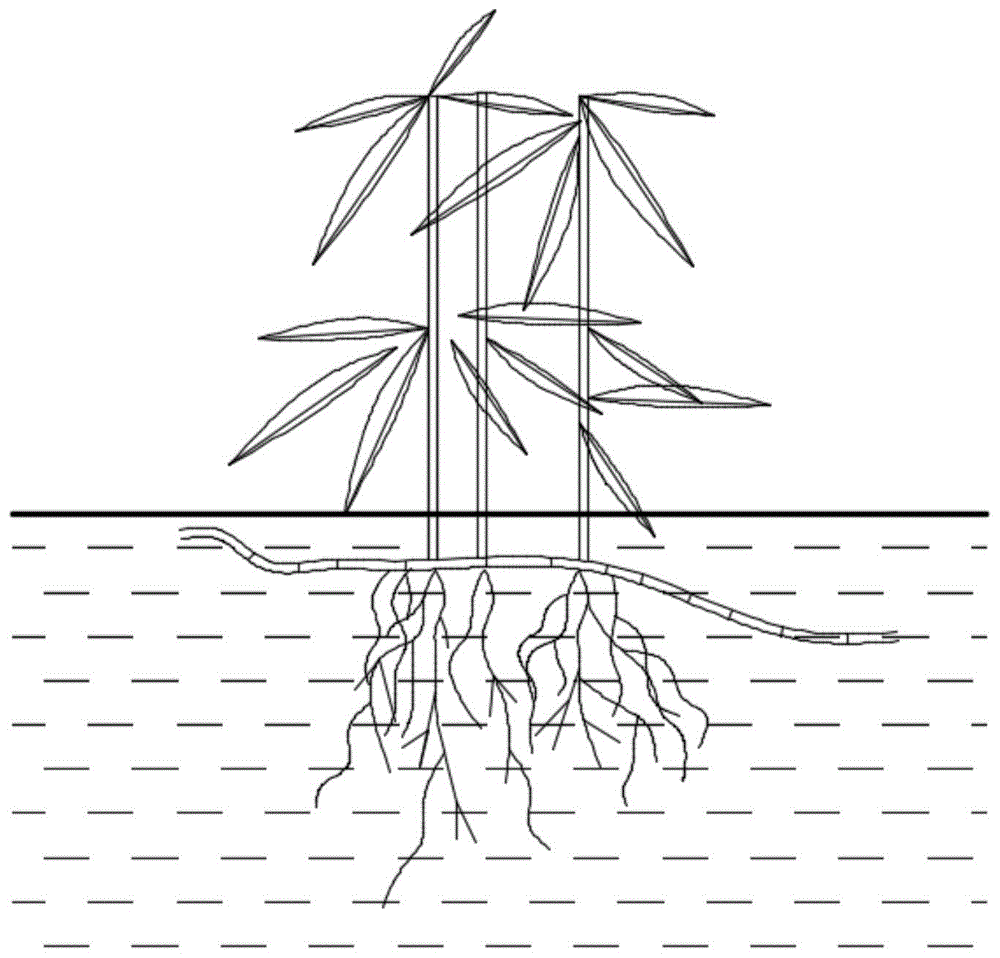
Ground cover bamboo water culture cultivation method and cultivation device suitable for laboratory research
Technical Field
The invention relates to the technical field of ground cover bamboo cultivation, in particular to a ground cover bamboo water culture cultivation method and a cultivation device thereof, which are suitable for research and research in laboratories.
Background
Hydroponics is a soilless plant cultivation mode, and the core is that the root system of a plant is directly soaked in nutrient solution, and the nutrient solution can replace soil and provide growth factors such as water, nutrients, oxygen and the like for the plant, so that the plant can normally grow. The main principle of the water culture technology is that the original genetic material of the plant is not changed, and the expression of the plant rooting gene is promoted and the plant rooting gene is rooted only by adding exogenous growth hormone or increasing environmental stress and the like. Theoretically, almost all kinds of plants can be used for water culture, but most plant varieties belong to xerophytes, and the aquatic root system needs to be induced firstly for normal growth and development in water. At present, 8 series of hydroponic plants of more than 400 varieties, such as woody plants, flower-looking plants, leaf-looking plants, hydroponic vegetables and the like, are successfully cultivated in China.
Compared with the soil culture condition, the growth rate of the plant is higher under the water culture condition, and various scientific researches are facilitated. The ground cover ornamental bamboo has the characteristics of perennial, vegetative propagation, annual shoot taking and shoot sprouting, large biomass, developed rhizome, strong covering capability, difficult rotting and easy harvesting of overground parts, capability of resource sharing and risk sharing among plants, high ornamental value and the like, and has a complex organ structure compared with other plants and high scientific research value.
At present, the water culture of the on-site bamboo has the following defects especially for research and research in laboratories:
1. the bamboo plants are mostly bred by cutting or plant division, the organ structures of the plants are complex, the underground parts of the rhizomes and the roots are developed, the rhizomes grow transversely, and the rhizomes take roots on the rhizomes, so that the method is different from the root system of common plants. The traditional water culture device is mainly suitable for soilless culture of direct root plants of vegetables and herbaceous flowers with simple root systems, is not suitable for ground cover bamboo, and mainly solves the problems that the ground cover bamboo plants are complex in structure and difficult to fix and plant.
2. The ground cover bamboo plant has good research value, the traditional soil cultivation mode is not beneficial to the material drawing test of each organ of the ground cover bamboo, a reasonable and complete soilless cultivation method is not provided at present, particularly a water cultivation system for scientific research, and the wider scientific research application of the ground cover bamboo in a laboratory is limited.
Disclosure of Invention
The technical problem to be solved by the invention is that scientific research personnel can only adopt the traditional soil cultivation technology due to the root characteristics of the prior ground cover bamboo, the cultivation method is not beneficial to the sampling test of various organs of the ground cover bamboo, limits the wider scientific research application in the laboratory, it aims to provide a water culture cultivation method and a cultivation device of ground cover bamboos suitable for research and research in laboratories, the cultivation method and the cultivation device can realize the water culture of the ground cover bamboo, and a whole set of water culture cultivation system aiming at the ground cover bamboo is provided from the stage of the bamboo seedling emergence to the stage of the whole transplanting process of the ground cover bamboo in the water culture device, so that the method is beneficial to the material drawing test of each organ of the ground cover bamboo during cultivation, the wider scientific research application of the ground cover bamboo in a laboratory is enlarged, the problems that the plant structure of the ground cover bamboo is complex and the field planting is difficult to realize are solved by the cultivation device, and the nutrient required by the root and rhizome absorption plant can be effectively ensured.
The invention is realized by the following technical scheme: the water culture cultivation method of the ground cover bamboo suitable for research in laboratories comprises the following steps:
(1) the cultivation device is manufactured, the cultivation device mainly comprises a water culture bucket and a fixing device, the fixing device can be arranged in the water culture bucket, in order to facilitate easy assembly of the water culture device in the implementation process, convenient material taking in the scientific research experiment process and the like, in fact, the cultivating device comprises a water culture barrel, a fixing device and a ventilating device, the fixing device is arranged in the water culture barrel, the fixing device is preferably a fixing plate, the fixing plate is in seamless contact with the inner cavity wall surface of the water culture barrel, so that the plant can be planted in a fixed manner, the fixing plate is provided with a clamping groove which is E-shaped and is made of black pearl cotton with the thickness of 15mm, the E-shaped clamping groove of the special black fixing plate can effectively fix the vertical bamboo shoots, the water culture bucket and the fixing plate are made of light-tight materials, and the root system can be centralized and upright when the water culture bucket and the fixing plate are cultivated by the bamboo.
Breather is including ventilating grit, breather pipe and breather pump, and the breather pump setting is outside at water planting bucket, and the grit setting of ventilating is sent at the inside fixed plate that just is located of water planting bucket, breather pipe one end and breather pump intercommunication, and the other end setting is in the grit department of ventilating, and according to the demand of ventilating, the breather pump adopts 60W can satisfy the demand, can realize the oxygen supply of root system.
This breeding device is the simple and easy device of independent water planting, and the volume is less, independent combination, equipment and removal in the laboratory of being convenient for. Each independent culture device can be used as a processing repetition of scientific research experiments, and the manufacturing steps of the culture devices are as follows:
(a) a light-tight square barrel with the capacity of 10L (the length of the upper outer opening is 25cm, the length of the lower outer opening is 21cm, and the height is 25cm) is prepared, and a mark (10 cm away from the barrel bottom) is marked at the water level of 5L of the square barrel to serve as a water culture barrel body.
(b) And cutting the black pearl cotton according to the size of the 5L water level of the water culture bucket to ensure that the black pearl cotton can be just fixed at the 5L water level of the water culture bucket. As the ground quilt bamboo rhizome grows transversely, in order to stabilize the ground quilt bamboo rhizome on the fixing plate, E-shaped clamping grooves (shown in figure 3) need to be cut on the black fixing plate in advance, the number of the E-shaped clamping grooves can be properly increased and decreased according to the size of the bamboo seedling, and the clamping grooves are arranged in parallel (shown in figure 1).
(c) 1 group of vent pipes connected with vent sand stones are placed in each independent water culture barrel body, a 60w vent pump is connected externally, the vent sand stones are placed in the middle of the bottom of the barrel, and oxygen can be uniformly supplied to the barrel (see figure 2).
The nutrient mother liquor is prepared, the formula of the nutrient mother liquor in the scheme is improved by referring to a special nutrient solution (Yoshida nutrient solution) for rice of the International Rice institute, and the formula is shown in the following table 1:
TABLE 1 improved water culture nutrient solution mother liquor of ground cover bamboo
The nutrient mother solution formula in the scheme is improved Yoshiada nutrient solution special for international rice institute rice, and NH in the original formula4NO3Adding Ca (NO) to provide N element required for hydroponics culture of ground cover bamboo as dangerous agent3)·4H2And replacing O, and adding Ca element beneficial to the growth of the bamboo plant stalks.
In the preparation and storage of the actual nutrient solution mother liquor, in order to avoid precipitation caused by ion interaction, the mother liquor is divided into Ca salt mother liquor, other macroelement mother liquor, microelement mother liquor and chelated iron mother liquor and stored respectively.
The preparation of the Ca salt mother liquor comprises all the Ca element-containing reagents in the table. Mixing Ca (NO)3)·4H2O(134.83g)、CaCl2(44.3g) are respectively and fully dissolved by deionized water, mixed evenly and fixed to the volume of 1L, and then the mixture is placed in a glass bottle to be sealed and stored at 4 ℃ for standby.
Other macroelement mother liquor configurations, including all P, K, Mg element-containing reagents of the above table. Reacting NaH with2PO4·2H2O(201.5g)、K2SO4(33.57g)、MgSO4·7H2And dissolving O (81g) in deionized water respectively, uniformly mixing, metering to 1L, and storing in a glass bottle at 4 ℃ in a sealed manner for later use.
The preparation of the microelement mother liquor comprises the reagents of all the microelements in the table. Mixing MnSO4·H2O(0.75g)、(NH4)MO7O24·4H2O(0.037g)、H3BO3(0.467g)、ZnSO4·7H2O(0.0175g)、CuSO4·5H2O (0.0155g) and citric acid monohydrate (5.95g) are respectively and fully dissolved by deionized water, uniformly mixed and fixed to the volume of 1L, and the mixture is placed in a glass bottle to be sealed and stored at the temperature of 4 ℃ for later use.
A chelated iron mother liquor configuration comprising the reagents contained in table 1. Heating 500ml of distilled water to 60-70 ℃, and weighing EDTA2Na 1.865g is dissolved in 300ml of warm distilled water, stirred until the Na is completely dissolved, and then the rest distilled water is added and stirred uniformly. Weighing FeSO4·7H2O1.39g was dissolved in another 500ml of distilled water and stirred well. The two solutions are mixed and stirred evenly, thus obtaining 0.005mmol/L of chelated iron solution. The prepared nutrient solution mother solution can be stored for 1 month at 4 ℃, the chelated iron needs to be regularly observed during the storage period, and the preparation needs to be carried out again if turbid deterioration is found. The components involved in the scheme are all existing components and can be directly configured or purchased.
(2) After the nutrient solution mother liquor is prepared, the actual concentration of the nutrient solution mother liquor exceeds the concentration absorbed by the growth of the ground bamboos, and the nutrient solution needs to be diluted to form working nutrient solution, and the working nutrient solution is uniformly mixed according to the mother liquor 2000 times of the diluent (namely 1/2Yoshida working nutrient solution proportion) in the table 1. And adjusting the pH value of the nutrient solution to 5.0-5.5 by using 1mol/LNaOH and 1 mol/LHCl. The working nutrient solution can be prepared on site or 1-2 days in advance, the prepared working nutrient solution needs to be stored in shade and not in the shade, and is not easy to store for a long time, and 5L of water working nutrient solution is added into each barrel according to the size of the water culture barrel.
The field planting is needed for the ground cover bamboo seedlings, the field planting time is that the ground cover bamboo grows vigorously and is suitable for division of plants because the number of the ground cover bamboo is 8-9 months, and the survival rate of soil culture to water culture is relatively high. In order to reduce plant transpiration and water dissipation and promote seedling revival, the transplanting time is selected to be carried out at the evening as much as possible.
(3) Selecting soil culture bamboo plants required by the experiment (if the plant type is too large, proper plant division can be carried out before transplanting to a water culture device), gently shaking off the original soil of the root system, repeatedly washing the root system with clear water, and paying attention to the cleaning process without damaging the root. The method comprises the steps of fixing the overground parts (stalks and leaves) of the cleaned ground cover bamboo above the clamping grooves of the black pearl cotton fixing plate of the water culture device, placing the underground parts (roots and penis) below the fixing plate, and enabling the distance between the base parts of the stalks and the lower surface of the fixing plate to be about 1-2 cm. The black fixing plate and the bamboo seedlings are placed into a water culture barrel together, and the fixing plate is fixed above the water level of the working nutrient solution by about 1cm, so that the ground cover bamboo rhizome is completely immersed into the working nutrient solution.
Each barrel of plant-planted tree is determined according to the plant type of the bamboo species, 10-15 plants/barrel of small-sized bamboo species (such as green bamboo, ground bamboo, Ficus white bamboo and Ficus yellow bamboo) are planted, 8-12 plants/barrel of medium-sized bamboo species (such as white grain bamboo grass and sloganum angustifolia) and 5-8 plants/barrel of large-sized bamboo species (such as Indocalamus tessellatus, broad leaf indocalamus calamus and goose mao bamboo) are planted, and the using amount of the working nutrient solution of the large-sized bamboo species is properly increased.
The conversion of ground cover bamboo from soil culture to water culture is mainly the process of updating the original soil-cultured root system and inducing the aquatic root system. The original root system is gradually aged, inactivated and finally killed under the condition that the original root system is not suitable for water culture, the aquatic root system is gradually induced and can quickly grow to replace the original soil culture root system, mineral elements of nutrient solution are absorbed, and the ground cover bamboo can normally and physiologically grow. According to different stages of water culture, the key points of post-cultivation maintenance management are as follows:
(4) in the stage of replacement of an original soil culture root system and induction of a new water culture root system, the pH is adjusted to be between 5.0 and 5.5, the aeration time in the culture process is 24 hours, the aeration is continuously carried out, the illumination intensity is 2000-3000lx, the culture temperature is 28 +/-2 ℃, the relative humidity of the environment is 70 to 80 percent, the temperature of the working nutrient solution is controlled to be 25 +/-2 ℃, the root-inducing growth condition is preferably observed every 2 days in the stage, old roots and bad roots which are not suitable for the water culture environment are removed in time, and the working nutrient solution is replaced every 4 days in the stage;
(5) in the growth stage of the aquatic root system, the pH value is adjusted to be 5.0-5.5, the aeration time in the culture process is 24 hours, the aeration is continuously carried out, the illumination intensity is 2000-;
(6) the nutrient solution in the water culture barrel is observed regularly every day, the specific time can be adjusted properly according to the type and the weather condition, the nutrient solution is observed at 1 day intervals in practice, and if the nutrient solution is lower than the initial scale mark by more than 1cm, the working nutrient solution needs to be supplemented to the scale mark position.
At present, two water culture and soil culture modes are provided for plant cultivation, wherein the water culture is a mode for soilless plant cultivation, the core of the mode is that the root system of the plant is directly soaked in nutrient solution, and the nutrient solution can replace soil and provide growth factors such as moisture, nutrients, oxygen and the like for the plant so that the plant can normally grow. The main principle of the water culture technology is that the original genetic material of the plant is not changed, and the expression of the plant rooting gene is promoted and the plant rooting gene is rooted only by adding exogenous growth hormone or increasing environmental stress and the like. Theoretically, almost all kinds of plants can be used for water culture, but most plant varieties belong to xerophytes, and the aquatic root system needs to be induced firstly for normal growth and development in water.
Soil cultivation is a cultivation test using soil as a plant growth medium, a plough layer soil is adopted in the soil cultivation test, nutrients in the soil are not easy to leak out when the soil is filled in a pot, the soil is generally ground, sieved and then potted, and compared with field soil, the soil has larger difference in physical properties. The soil culture test is easy to control the temperature, the moisture and the nutrients, the plant growth environment condition is easy to control, and the effect analysis on influencing factors is more accurate than that of a field test. In the soil culture test, the size of the pots needs to be determined according to actual needs, the pots need to be placed in random arrangement, and the positions of the pots are changed periodically.
Compared with the soil culture condition, the growth rate of the plant is higher under the water culture condition, and various scientific researches are facilitated. Particularly, the ground ornamental bamboos have the characteristics of perennial, vegetative propagation, annual shoot taking and shoot sprouting, large biomass, developed penis and root, strong covering capability, difficult rotting and easy harvesting of overground parts, capability of resource sharing and risk sharing among the plants, high ornamental value and the like, and the organ structure of the ground ornamental bamboos is complex compared with other plants, so that the ground ornamental bamboos have high scientific research value.
However, the existing ground cover bamboo cultivation adopts a soil cultivation mode, bamboo plants are mostly bred in a cuttage or plant division mode, plant organ structures of the plants are complex, underground parts of penis and root are developed, the penis grows transversely, the penis takes roots, the bamboo plants are different from a root system of a common plant, the root system is easy to damage by the soil cultivation mode, the root system cannot extend freely, meanwhile, the ground cover bamboo plant has good research value, the traditional soil cultivation mode is not favorable for taking material tests of various organs of the ground cover bamboo, due to technical limitation, a reasonable and complete soilless cultivation method is not provided at present, particularly, a water cultivation system which can be used for scientific research limits wider scientific research application in a laboratory, the developed root system of the ground cover bamboo is inconvenient to observe, and the ground cover bamboo with higher scientific research value is selected as a material by the scheme based on the defects, the water culture device is utilized, and a proper water culture nutrient solution proportion, the pH value of the nutrient solution and the oxygen introducing time are combined, so that a whole set of water culture system suitable for the ground cover bamboo is provided, technical reference is provided for the experimental indoor scientific research application of the water culture system, the technical problem is solved, the water from the ground cover bamboo can be domesticated well in a short time to root, the water is adaptive to the aquatic environment, the whole plant of the bamboo plant can be obtained easily, and the water culture device is more suitable for the research and research of the laboratory scientific research of certain specific needs.
Compared with the prior art, the invention has the following advantages and beneficial effects:
(1) the invention provides a water culture method suitable for ground cover bamboos, soil culture is a traditional culture method of the ground cover bamboos, and a research blank exists for the water culture method of the ground cover bamboos.
(2) The invention discloses a simple water culture device suitable for ground cover bamboos, and provides a simple water culture device suitable for ground cover bamboos, which is matched with a water culture method for solving the problems of complex structure, difficult field planting and the like of ground cover bamboo plants. The innovative E-shaped clamping groove on the black pearl cotton fixing plate can effectively fix the overground part of the bamboo seedling on the water surface of the nutrient solution, and the underground part is immersed in the nutrient solution, so that the rhizomes can be guaranteed to absorb nutrients required by plants. Simultaneously, according to the requirement of experiment, the field planting problem that ground quilt bamboo species plant water planting was cultivated has been solved to draw-in groove quantity and position on the adjustable fixed plate.
(3) The invention excavates more comprehensive research and research values of the ground cover bamboo, limits scientific research of the ground cover bamboo in a laboratory to a certain extent due to the current soil culture mode of the ground cover bamboo plant, is particularly not beneficial to the material taking of each organ of the plant, and is an important cultivation method for excavating more comprehensive research and research values of the ground cover bamboo for more comprehensively researching each organ of the ground cover bamboo plant and facilitating the material taking of plant materials.
Drawings
The accompanying drawings, which are included to provide a further understanding of the embodiments of the invention and are incorporated in and constitute a part of this application, illustrate embodiment(s) of the invention and together with the description serve to explain the principles of the invention. In the drawings:
FIG. 1 is a schematic view of the planting mode of ground cover bamboo;
FIG. 2 is a top view of the incubation device;
fig. 3 is a schematic view of an "E" shaped card slot.
Reference numbers and corresponding part names in the drawings:
1-water culture bucket, 2-fixed plate, 3-upper opening of water culture bucket, 4-breather pipe, 5-breather pump.
Detailed Description
In order to make the objects, technical solutions and advantages of the present invention more apparent, the present invention is further described in detail below with reference to examples and accompanying drawings, and the exemplary embodiments and descriptions thereof are only used for explaining the present invention and are not meant to limit the present invention.
Example 1:
selecting soil potted plant and ground-paving bamboos as materials in experimental greenhouses of Wuzhi laboratory building of Sichuan university in 2018, removing soil, cleaning, transplanting and planting in a water culture device, and performing post-planting maintenance management according to different root inducing stages, wherein 10 plants are planted in each barrel. Meanwhile, soil pot seedlings with the caliber of 24cm are used as a control group, 2kg of soil is contained in each pot, and 10 seedlings are contained in each pot. The hydroponic component is prepared by the following steps:
1. manufacturing a cultivation device:
(1) preparing a water culture barrel 1: an opaque square barrel with a capacity slightly larger than 5L (the upper opening of the water culture barrel is 25cm in diameter, the lower outer opening is 21cm in diameter and 25cm in height) is prepared, and a mark (10 cm away from the barrel bottom) is marked at the water level of 5L of the square barrel (see figure 3) to serve as a water culture device barrel body.
(2) Cutting a black fixing plate 2: and cutting the black pearl cotton according to the size of the 5L water level of the water culture bucket to ensure that the black pearl cotton can be just fixed at the 5L water level. The plant type of the ground-laying bamboo seedlings is relatively small, 2E-shaped clamping grooves can be cut on each black fixing plate 2, and the 2 clamping grooves are parallel. (see FIG. 1).
(3) Connecting a ventilation device: 1 group of vent pipes 4 connected with vent sand stones and a 60w vent pump 5 are arranged in each independent water culture barrel body, and the vent sand stones are arranged in the middle of the bottom of the barrel body to uniformly supply oxygen to the barrel (see figure 2).
2. Preparing a nutrient solution mother solution and a working nutrient solution:
the nutrient solution mother liquor is prepared according to the table 1, and the working nutrient solution is obtained by uniformly mixing the mother liquor with 2000 times of diluent (namely 1/2Yoshida working nutrient solution proportion). The pH value of the working nutrient solution is 5.0-5.5.
3. Planting the soil-cultured bamboo seedlings:
(1) the planting time is as follows: and selecting the overgrown bamboos which grow vigorously and are suitable for being transplanted in 8-9 months for water culture transplanting, wherein the transplanting time is selected in the evening.
(2) Hydroponic working nutrient solution: diluting the nutrient solution mother liquor shown in the table 1 into working nutrient solution, adding 5L of water into each barrel of the working nutrient solution,
(3) a planting process: selecting strong-growing ground bamboo required by the experiment (if the plant cluster is too large, appropriate division can be carried out before transplanting to a water culture device, the number of plants in each barrel is controlled to be 10-15), gently shaking off the original soil of the root system, repeatedly washing the root system with clean water, and paying attention to no damage to the root in the cleaning process. The method comprises the steps of fixing the ground bamboo overground parts (stalks and leaves) which are cleaned to be paved above a black pearl cotton fixing plate clamping groove of a water culture device, arranging the underground parts (roots and penis) below the fixing plate, and enabling the distance between the base parts of the stalks and the lower surface of the fixing plate to be about 1-2 cm. The black fixing plate and the bamboo seedlings are placed into a water culture barrel together, and the fixing plate is fixed above the water level of the working nutrient solution by about 1cm, so that the rhizomes are completely immersed into the working nutrient solution.
4. Post-planting maintenance management
According to different water culture stages, the cultivation of the ground bamboo is carried out by the following maintenance management:
(1) replacement of original soil culture root system and induction of new water root system (within 15d after water culture): the working nutrient solution formulation was a modified 1/2Yoshida nutrient solution formulation. Adjusting the pH value to 5.0-5.5, continuously ventilating for 24h in the culture process, wherein the illumination intensity is 2000-3000lx, the culture temperature is 28 +/-2 ℃, the relative humidity of the environment is 70-80%, and the temperature of the working nutrient solution is controlled to be 25 +/-2 ℃. In the stage, the growth condition of the induced roots needs to be regularly observed every two days, and old roots and bad roots which are not suitable for the water culture environment are removed in time. The working nutrient solution is replaced every 4 days in the stage.
(2) And (3) the growth stage of the aquatic root system (15-30 d after water culture): the formula of the working nutrient solution is an improved 1/2Yoshida nutrient solution formula (table 1), the pH is adjusted to be 5.0-5.5, the aeration time in the culture process is 24 hours, the aeration is continued, the illumination intensity is 3000-4000 lx, the culture temperature is 28 +/-2 ℃, the temperature of the working nutrient solution is controlled to be 28 +/-2 ℃, and the relative humidity of the environment is 60-80%. The working nutrient solution is replaced every 5-7 days in the stage.
(3) And (3) observing the working nutrient solution in the water culture barrel at regular intervals every day, preferably observing once every day, and if the working nutrient solution is lower than the scale mark by more than 1cm, supplementing the working nutrient solution to the position of the scale mark.
After the ground cover bamboo is subjected to water culture cultivation according to the specific implementation method of water culture cultivation of ground cover bamboo, the ground cover bamboo can normally grow in a water culture environment after the replacement of an original soil cultivation root system, the induction stage of a new aquatic root system and the growth stage of an aquatic root system are completed within 30 days. By taking out the ground bamboo together with the fixing plate and then comparing it with the ground cover bamboo, the comparison conditions as shown in tables 2 and 3 below were obtained:
TABLE 2 comparison of overground part growth of two cultivation methods of bamboo
Note: the data in the table are the average values of the respective measurement indices (n is 3), and the same is as follows.
TABLE 3 comparison of the growth conditions of the whole plant in two cultivation methods of the bamboo
Note: the data in the table are the average values of the respective measurement indices (n is 3), and the new root length is the average value of the longest length of the new root (n is 3) for each treatment repetition, and the same is applied below.
As can be seen from Table 2, in the experimental contrast observation period of 30d, the number of new bamboos and the number of new leaves of the ground bamboo are significantly different in the two cultivation modes. No new bamboo grows in the first 10 days of soil-culture ground-paved bamboos, new bamboos grow out (0.33 plants/barrel) in the 5 th day under the water culture condition, new bamboos appear in the soil-culture ground-paved bamboos (0.33 plants/barrel) in the 15 th day, the number of the new bamboos grown in the water culture ground-paved bamboos is 1 plant/barrel, the method is obviously higher than that of the soil-culture mode, and the number of the new bamboos grown in the water culture ground-paved in the 20 th day, the 25 th day and the 30 th day is higher than that of the soil. The number of new leaves is higher than that of the leaves cultured in soil except for 10 th and 20 th days when the water culture is equal to that of the leaves cultured in soil.
As can be seen from Table 3, the growth of the whole plant of the ground bamboo was different after the cultivation for 30 days using 2 cultivation methods. The water culture is carried out through the replacement of original soil culture root systems and the induction of new water root systems, the total number of new roots reaches 30.33 per bucket, the number of new roots cultured by soil culture is only 9.67 per pot, and the length of the new roots cultured by water culture is also obviously longer than that of the new roots cultured by soil. The activity of the new root system cultivated by water culture is 16.14 mug.g.h-1Compared with the soil culture, the yield is improved by 74.30%.
In addition, when the water culture of the ground bamboo is carried out to the 7 th day, the bamboo shoots are inoculated on the stems, the number of the bamboo shoots is gradually increased along with the prolonging of the water culture time, and no new bamboo shoot is found in the ground bamboo in the whole contrast culture stage.
In combination with the above, in the water culture mode of the ground bamboo, the number of new bamboo leaves is higher than that of the new bamboo leaves in the soil culture treatment, the morphological index and the physiological index of new roots are superior to those of the soil culture mode, the water culture can effectively promote the seedling growth in a short time, and particularly the growth of the new roots and the new leaves of the ground bamboo. The water culture mode is favorable for obtaining the whole bamboo plant, and is more suitable for the research of the scientific research of some laboratories with specific requirements.
Example 2:
selecting soil potted Indocalamus tessellatus as a material in a laboratory greenhouse of a Wuzhi laboratory building of Sichuan university in 2018, removing soil, cleaning, transplanting and planting in a water culture device, and performing post-planting maintenance management according to different root inducing stages, wherein 5 plants are planted in each barrel. Meanwhile, soil pot seedlings with the caliber of 24cm are taken as a control group, 2kg of soil is contained in each pot, and 5 plants are contained in each pot. The preparation procedure for hydroponic modules was the same as in example 1 and the hydroponic process was the same as in example, resulting in the data in tables 4 and 5:
TABLE 4 comparison of overground part growth of two cultivation methods of Indocalamus Millettii
TABLE 5 comparison of the growth of the whole plant in two cultivation methods of Indocalamus Millettii
As can be seen from table 4, within the experimental contrast observation period of 30d, the number of new bamboos and the number of new leaves of indocalamus marmoreus have significant differences in the two cultivation methods. No new bamboo grows in the first 10 days of soil culture, new bamboo grows out in the 10 th day (1 plant/barrel) under the water culture condition, new bamboo grows out in the 15 th day of soil culture and ground bamboo grows out (0.33 plant/barrel), the number of the new bamboo grown in the water culture and ground bamboo is 1 plant/barrel, the method is obviously higher than the soil culture mode, and the number of the new bamboo cultured in the 20 th day and the 30 th day of the water culture is higher than the number of the new bamboo cultured in the soil culture. The number of new leaves is slightly lower than that of the leaves cultured in soil except for the 30 th day, and the number of the new leaves is higher than that of the leaves cultured in soil in all other time periods.
As can be seen from Table 5, the growth of the entire Indocalamus tessellatus plant was different after 2 cultivation methods were used for 30 days. The water culture is carried out through the processes of replacing the original soil culture root system and inducing a new water root system, the total number of new roots reaches 40.33 per bucket, the number of new roots cultured by the soil culture is only 24.67 per pot, and the length of the new roots cultured by the water culture is also obviously higher than that of the new roots cultured by the soil. The activity of the new root system cultivated by water culture is 17.60 mug.g.h-1Compared with soil culture, the yield is improved by 42.14%.
In addition, when the water culture of the calabash bambusicola is carried out to the 10 th day, bamboo shoot buds are bred on the penis, the number of the bamboo shoot buds is gradually increased along with the prolonging of the water culture time, and a small amount of new bamboo shoot buds are found in the soil culture of the calabash bambusicola in the whole contrast culture stage.
In combination with the above, in the water culture mode of the Indocalamus Millettii, the number of new leaves of the new Indocalamus Millettii is higher than that of the new leaves of the new bamboo, the morphological index and the physiological index of the new root are better than those of the new root, and the water culture can effectively promote the growth of the seedling in a short time, especially the growth of the new root of the Indocalamus Millettii. The water culture mode is favorable for obtaining the whole bamboo plant, and is more suitable for the research of the scientific research of some laboratories with specific requirements.
The above-mentioned embodiments are intended to illustrate the objects, technical solutions and advantages of the present invention in further detail, and it should be understood that the above-mentioned embodiments are merely exemplary embodiments of the present invention, and are not intended to limit the scope of the present invention, and any modifications, equivalent substitutions, improvements and the like made within the spirit and principle of the present invention should be included in the scope of the present invention.