Summary of the invention
The objective of the invention is at above-mentioned existing in prior technology defective, one provides the heat-reflecting heat-insulating inorganic material of a kind of safety non-toxic, stable, the easy prolonged preservation of chemical property, heat-reflecting heat-insulating stable performance, two provide this preparation methods that a kind of technology is simple, with low cost, energy-conserving and environment-protective reach suitable suitability for industrialized production, and three provide a kind of application of material of the present invention.
For solving the problems of the technologies described above, technical scheme of the present invention is as follows:
Heat-reflecting heat-insulating inorganic material provided by the invention is to be matrix with the weisspiessglanz, is doped with the micro-/ nano material of one or more elements in zinc, yttrium, cerium, tin, aluminium, the bismuth.
Doped element among the present invention can exist by simple substance form, also can exist by compound form, or the form of simple substance and compound coexistence exists; And doped element can be doped in the lattice of weisspiessglanz, also can free state and weisspiessglanz and deposit, or a part is doped in the lattice of weisspiessglanz, another part is with free state and weisspiessglanz and deposit.
The preparation method of heat-reflecting heat-insulating inorganic material of the present invention, concrete steps are as follows:
A) take by weighing the inorganic salt of antimony and the inorganic salt of doped element, make the mol ratio of the inorganic salt of the inorganic salt of antimony and doped element be (1~99): 1;
B) add an amount of dehydrated alcohol, make mixing salt strength of solution be 0.1~0.5mol/L;
C) at room temperature stir 0.5~2 hour, make colourless transparent solution;
D) dripping concentration while stirring in solution is the alkaline solution of 0.1mol/L~5mol/L, to regulate pH=7~8;
E) at room temperature continue to stir 1~3 hour, make oyster white emulsion;
F) filter, washing, with the oyster white filter cake that obtains in 90~110 ℃ of vacuum-dryings 3~5 hours;
G) cooled dry cake is placed agate mortar ground 10~30 minutes.
The preparation method's of described heat-reflecting heat-insulating inorganic material a preferred version, be in step b), to add an amount of dispersion agent simultaneously, 1~10% of the preferred mixing salt total mass of the add-on of dispersion agent, the preferred cetyl trimethylammonium bromide of described dispersion agent, sodium lauryl sulphate, polyoxyethylene glycol or polyvinylpyrrolidone.
The preferred butter of antimony of the inorganic salt of described antimony.
The arbitrary composition of one or more in the preferred zinc chloride of the inorganic salt of described doped element, Yttrium trinitrate, cerous nitrate, tin tetrachloride, aluminum chloride, the Bismuth trinitrate.
The preferred aqueous sodium hydroxide solution of described alkaline solution, the hexamethylenetetramine aqueous solution or ammonia soln.
Use heat-reflecting heat-insulating inorganic material of the present invention can prepare heat-reflecting insulating coating, with thermal insulation coat as thermal insulation coat, buildings and the automotive glazing of waterproof and heat-insulating coating, container and the pipeline of the surperficial heat insulating coat of external wall roof and exterior wall, textile fibres.
Compared with prior art, the present invention has following beneficial effect:
1) having made first with the weisspiessglanz is the heat-reflecting heat-insulating inorganic material of matrix, its reflectivity to invisible heat can reach more than 90%, can effectively prevent the thermal radiation of the sun and the thermal radiation of other infrared sources, and can also absorb ultraviolet ray, has uvioresistant injury function, for heat-reflecting heat-insulating class material has increased new variety;
2) product of the present invention is the solid inorganic material that does not contain organic solvent, has safety non-toxic, beneficial effects such as prolonged preservation, heat-reflecting heat-insulating stable performance are stablized, are easy to chemical property;
3) preparation technology of the present invention is simple to operation, and raw material is cheap and easy to get, and reaction process does not have three industrial wastes substantially, has characteristics such as environmental protection, less energy-consumption, high benefit, is fit to suitability for industrialized production.
Embodiment
The invention will be further described below by embodiment, and its purpose only is better to understand content of the present invention and unrestricted protection scope of the present invention.
Embodiment 1
The preparation method of the heat-reflecting heat-insulating inorganic material that present embodiment provides, concrete steps are as follows:
A) take by weighing 2.7090g (11.875mmol) butter of antimony (SbCl
3) and 0.0852g (0.625mmol) zinc chloride (ZnCl
2), make the inorganic salt (SbCl of antimony
3) and the inorganic salt (ZnCl of doped element
2) mol ratio be 19: 1;
B) add the 100mL dehydrated alcohol, make mixing salt strength of solution be 0.125mol/L;
C) at room temperature stir 1 hour, make colourless transparent solution;
D) dripping concentration while stirring in solution is the aqueous sodium hydroxide solution of 1mol/L, to regulate pH=7~8;
E) at room temperature continue to stir 2 hours, make oyster white emulsion;
F) filter, washing, with the oyster white filter cake that obtains in 100 ℃ of vacuum-dryings 4 hours;
G) cooled dry cake is placed agate mortar ground 20 minutes.
Fig. 1 is the ultraviolet-visible-near-infrared reflection spectrogram of the prepared heat-reflecting heat-insulating inorganic material of present embodiment, as seen from the figure: the gained material to the reflectivity of near infrared invisible heat more than 90%.
Fig. 2 is the uv absorption spectra of the prepared heat-reflecting heat-insulating inorganic material of present embodiment, and as seen from the figure: the gained material has very strong absorption in the ultraviolet region, has uvioresistant injury function.
Fig. 3 is the X-ray diffractogram of the prepared heat-reflecting heat-insulating inorganic material of present embodiment, and as seen from the figure: the principal phase of gained material is a weisspiessglanz, that is, be as matrix with weisspiessglanz.
Fig. 4 is the electron scanning micrograph of the prepared heat-reflecting heat-insulating inorganic material of present embodiment, and as seen from the figure: the gained material is that thickness is the sheet structure of 100~200 nanometers.
Embodiment 2
The preparation method of present embodiment is described identical with embodiment 1, and difference is to add the 50mL dehydrated alcohol in step b), make mixing salt strength of solution be 0.25mol/L.
The analytical results of the ultraviolet-visible of the heat-reflecting heat-insulating inorganic material that present embodiment is prepared-near-infrared reflection spectrogram, uv absorption spectra, X-ray diffractogram and electron scanning micrograph is all described identical with embodiment 1.
Embodiment 3
The preparation method of present embodiment is described identical with embodiment 1, and difference is to add the 25mL dehydrated alcohol in step b), make mixing salt strength of solution be 0.5mol/L.
The analytical results of the ultraviolet-visible of the heat-reflecting heat-insulating inorganic material that present embodiment is prepared-near-infrared reflection spectrogram, uv absorption spectra, X-ray diffractogram and electron scanning micrograph is all described identical with embodiment 1.
Embodiment 4
The preparation method of present embodiment is described identical with embodiment 1, and difference is to take by weighing 1.4258g (6.25mmol) butter of antimony (SbCl in step a)
3) and 0.852g (6.25mmol) zinc chloride (ZnCl
2), make the inorganic salt (SbCl of antimony
3) and the inorganic salt (ZnCl of doped element
2) mol ratio be 1: 1.
The analytical results of the ultraviolet-visible of the heat-reflecting heat-insulating inorganic material that present embodiment is prepared-near-infrared reflection spectrogram, uv absorption spectra, X-ray diffractogram and electron scanning micrograph is all described identical with embodiment 1.
Embodiment 5
The preparation method of present embodiment is described identical with embodiment 1, and difference is to take by weighing 2.2813g (10mmol) butter of antimony (SbCl in step a)
3) and 0.3408g (2.5mmol) zinc chloride (ZnCl
2), make the inorganic salt (SbCl of antimony
3) and the inorganic salt (ZnCl of doped element
2) mol ratio be 4: 1.
The analytical results of the ultraviolet-visible of the heat-reflecting heat-insulating inorganic material that present embodiment is prepared-near-infrared reflection spectrogram, uv absorption spectra, X-ray diffractogram and electron scanning micrograph is all described identical with embodiment 1.
Embodiment 6
The preparation method of present embodiment is described identical with embodiment 1, and difference is to take by weighing 2.5665g (11.25mmol) butter of antimony (SbCl in step a)
3) and 0.1704g (1.25mmol) zinc chloride (ZnCl
2), make the inorganic salt (SbCl of antimony
3) and the inorganic salt (ZnCl of doped element
2) mol ratio be 9: 1.
The analytical results of the ultraviolet-visible of the heat-reflecting heat-insulating inorganic material that present embodiment is prepared-near-infrared reflection spectrogram, uv absorption spectra, X-ray diffractogram and electron scanning micrograph is all described identical with embodiment 1.
Embodiment 7
The preparation method of present embodiment is described identical with embodiment 1, and difference is to take by weighing 2.7945g (12.25mmol) butter of antimony (SbCl in step a)
3) and 0.034g (0.25mmol) zinc chloride (ZnCl
2), make the inorganic salt (SbCl of antimony
3) and the inorganic salt (ZnCl of doped element
2) mol ratio be 49: 1.
The analytical results of the ultraviolet-visible of the heat-reflecting heat-insulating inorganic material that present embodiment is prepared-near-infrared reflection spectrogram, uv absorption spectra, X-ray diffractogram and electron scanning micrograph is all described identical with embodiment 1.
Embodiment 8
The preparation method of present embodiment is described identical with embodiment 1, and difference is to take by weighing 2.8227g (12.375mmol) butter of antimony (SbCl in step a)
3) and 0.017g (0.125mmol) zinc chloride (ZnCl
2), make the inorganic salt (SbCl of antimony
3) and the inorganic salt (ZnCl of doped element
2) mol ratio be 99: 1.
The analytical results of the ultraviolet-visible of the heat-reflecting heat-insulating inorganic material that present embodiment is prepared-near-infrared reflection spectrogram, uv absorption spectra, X-ray diffractogram and electron scanning micrograph is all described identical with embodiment 1.
Embodiment 9
The preparation method of present embodiment is described identical with embodiment 1, and difference is the zinc chloride (ZnCl with the 0.625mmol in the step a)
2) replace with the Yttrium trinitrate of 0.625mmol.
The analytical results of the ultraviolet-visible of the heat-reflecting heat-insulating inorganic material that present embodiment is prepared-near-infrared reflection spectrogram, uv absorption spectra, X-ray diffractogram and electron scanning micrograph is all described identical with embodiment 1.
Embodiment 10
The preparation method of present embodiment is described identical with embodiment 1, and difference is the zinc chloride (ZnCl with the 0.625mmol in the step a)
2) replace with the cerous nitrate of 0.625mmol.
The analytical results of the ultraviolet-visible of the heat-reflecting heat-insulating inorganic material that present embodiment is prepared-near-infrared reflection spectrogram, uv absorption spectra, X-ray diffractogram and electron scanning micrograph is all described identical with embodiment 1.
Embodiment 11
The preparation method of present embodiment is described identical with embodiment 1, and difference is the zinc chloride (ZnCl with the 0.625mmol in the step a)
2) replace with the tin tetrachloride of 0.625mmol.
The analytical results of the ultraviolet-visible of the heat-reflecting heat-insulating inorganic material that present embodiment is prepared-near-infrared reflection spectrogram, uv absorption spectra, X-ray diffractogram and electron scanning micrograph is all described identical with embodiment 1.
Embodiment 12
The preparation method of present embodiment is described identical with embodiment 1, and difference is the zinc chloride (ZnCl with the 0.625mmol in the step a)
2) replace with the aluminum chloride of 0.625mmol.
The analytical results of the ultraviolet-visible of the heat-reflecting heat-insulating inorganic material that present embodiment is prepared-near-infrared reflection spectrogram, uv absorption spectra, X-ray diffractogram and electron scanning micrograph is all described identical with embodiment 1.
Embodiment 13
The preparation method of present embodiment is described identical with embodiment 1, and difference is the zinc chloride (ZnCl with the 0.625mmol in the step a)
2) replace with the Bismuth trinitrate of 0.625mmol.
The analytical results of the ultraviolet-visible of the heat-reflecting heat-insulating inorganic material that present embodiment is prepared-near-infrared reflection spectrogram, uv absorption spectra, X-ray diffractogram and electron scanning micrograph is all described identical with embodiment 1.
Embodiment 14
The preparation method of present embodiment is described identical with embodiment 1, and difference is to add 0.2g sodium lauryl sulphate dispersion agent simultaneously in step b).
The analytical results of the ultraviolet-visible of the heat-reflecting heat-insulating inorganic material that present embodiment is prepared-near-infrared reflection spectrogram, uv absorption spectra, X-ray diffractogram and electron scanning micrograph is all described identical with embodiment 1.
Embodiment 15
The preparation method of present embodiment is described identical with embodiment 1, and difference is to add 0.2g polyoxyethylene glycol dispersion agent simultaneously in step b).
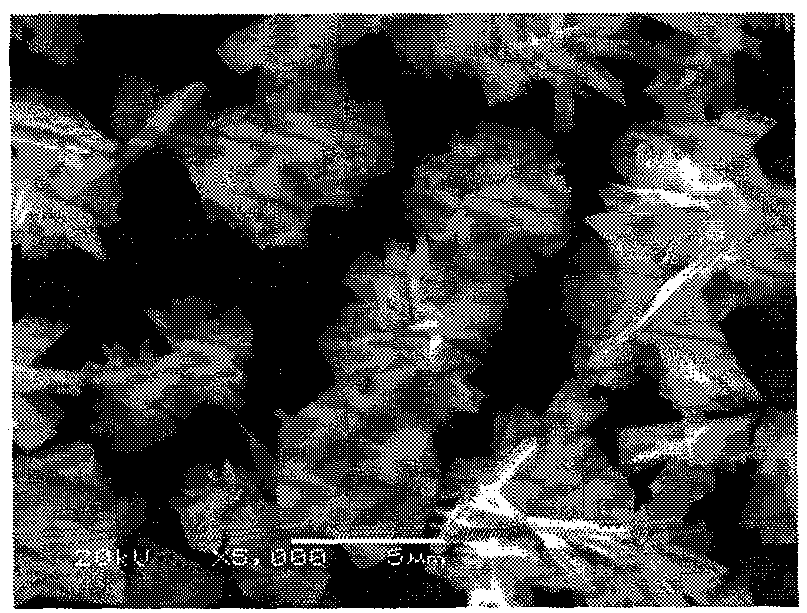
The ultraviolet-visible of the heat-reflecting heat-insulating inorganic material that present embodiment is prepared-near-infrared reflection spectrogram, uv absorption spectra, X-ray diffractogram are all described identical with embodiment 1, but electron scanning micrograph shows: the gained material is the diamond structure (seeing shown in Figure 5) of the about 4 μ m of the length of side.
Embodiment 16
The preparation method of present embodiment is described identical with embodiment 1, and difference is to add 0.2g cetyl trimethylammonium bromide dispersion agent simultaneously in step b).
The ultraviolet-visible of the heat-reflecting heat-insulating inorganic material that present embodiment is prepared-near-infrared reflection spectrogram, uv absorption spectra, X-ray diffractogram are all described identical with embodiment 1, but electron scanning micrograph shows: the gained material is the club shaped structure (seeing shown in Figure 6) of about 1~2 μ m of diameter.
Embodiment 17
The preparation method of present embodiment is described identical with embodiment 1, and difference is to add 0.2g polyvinylpyrrolidone dispersion agent simultaneously in step b).
The ultraviolet-visible of the heat-reflecting heat-insulating inorganic material that present embodiment is prepared-near-infrared reflection spectrogram, uv absorption spectra, X-ray diffractogram are all described identical with embodiment 1, but electron scanning micrograph shows: the gained material is the square tabular structure (seeing shown in Figure 7) of the about 5 μ m of the length of side, the about 1 μ m of thickness.
Embodiment 18
The preparation method of present embodiment is described identical with embodiment 1, and difference is to use the ammonia soln of 1mol/L to replace the aqueous sodium hydroxide solution of the 1mol/L in the step d).
The analytical results of the ultraviolet-visible of the heat-reflecting heat-insulating inorganic material that present embodiment is prepared-near-infrared reflection spectrogram, uv absorption spectra, X-ray diffractogram and electron scanning micrograph is all described identical with embodiment 1.
Embodiment 19
The preparation method of present embodiment is described identical with embodiment 1, and difference is to use the hexamethylenetetramine aqueous solution of 1mol/L to replace the aqueous sodium hydroxide solution of the 1mol/L in the step d).
The analytical results of the ultraviolet-visible of the heat-reflecting heat-insulating inorganic material that present embodiment is prepared-near-infrared reflection spectrogram, uv absorption spectra, X-ray diffractogram and electron scanning micrograph is all described identical with embodiment 1.
Embodiment 20
The preparation method of present embodiment is described identical with embodiment 1, and difference is that the concentration with the aqueous sodium hydroxide solution in the step d) replaces with 5mol/L by 1mol/L.
The analytical results of the ultraviolet-visible of the heat-reflecting heat-insulating inorganic material that present embodiment is prepared-near-infrared reflection spectrogram, uv absorption spectra, X-ray diffractogram and electron scanning micrograph is all described identical with embodiment 1.
Embodiment 21
The preparation method of present embodiment is described identical with embodiment 1, and difference is that the concentration with the aqueous sodium hydroxide solution in the step d) replaces with 0.1mol/L by 1mol/L.
The analytical results of the ultraviolet-visible of the heat-reflecting heat-insulating inorganic material that present embodiment is prepared-near-infrared reflection spectrogram, uv absorption spectra, X-ray diffractogram and electron scanning micrograph is all described identical with embodiment 1.
In addition, experimental results show that: the inorganic salt of described doped element can be any several compositions that form with arbitrary proportion in zinc chloride, Yttrium trinitrate, cerous nitrate, tin tetrachloride, aluminum chloride, the Bismuth trinitrate.
Experiment is proof also: use heat-reflecting heat-insulating inorganic material of the present invention can prepare heat-reflecting insulating coating, with the thermal insulation coat as thermal insulation coat, buildings and the automotive glazing of waterproof and heat-insulating coating, container and the pipeline of the surperficial heat insulating coat of external wall roof and exterior wall, textile fibres.