CN101386445A - A pump-driven baffled internal circulation bioreactor and its application method - Google Patents
A pump-driven baffled internal circulation bioreactor and its application method Download PDFInfo
- Publication number
- CN101386445A CN101386445A CNA2008102018023A CN200810201802A CN101386445A CN 101386445 A CN101386445 A CN 101386445A CN A2008102018023 A CNA2008102018023 A CN A2008102018023A CN 200810201802 A CN200810201802 A CN 200810201802A CN 101386445 A CN101386445 A CN 101386445A
- Authority
- CN
- China
- Prior art keywords
- water
- reactor
- district
- sewage
- side wall
- Prior art date
- Legal status (The legal status is an assumption and is not a legal conclusion. Google has not performed a legal analysis and makes no representation as to the accuracy of the status listed.)
- Pending
Links
Classifications
-
- Y—GENERAL TAGGING OF NEW TECHNOLOGICAL DEVELOPMENTS; GENERAL TAGGING OF CROSS-SECTIONAL TECHNOLOGIES SPANNING OVER SEVERAL SECTIONS OF THE IPC; TECHNICAL SUBJECTS COVERED BY FORMER USPC CROSS-REFERENCE ART COLLECTIONS [XRACs] AND DIGESTS
- Y02—TECHNOLOGIES OR APPLICATIONS FOR MITIGATION OR ADAPTATION AGAINST CLIMATE CHANGE
- Y02W—CLIMATE CHANGE MITIGATION TECHNOLOGIES RELATED TO WASTEWATER TREATMENT OR WASTE MANAGEMENT
- Y02W10/00—Technologies for wastewater treatment
- Y02W10/10—Biological treatment of water, waste water, or sewage
Landscapes
- Purification Treatments By Anaerobic Or Anaerobic And Aerobic Bacteria Or Animals (AREA)
Abstract
本发明系利用生物膜技术对废水进行脱氮除磷的一种反应器及其使用方法。一种水泵驱动式折流内循环生物反应器,在箱体内分隔成上方平流区和下方折流区,在折流区内交替伸出折流板(3),并开设补料口(6)和监测与取样口(8);箱体左侧外部配置循环水泵(10),吸水管和进水管分别连接左侧壁(11)。所述装置的使用方法,待处理污水输入箱体,根据废水性质调节进出水流量以控制停留时间,从监测与取样口(8)测试溶解氧,调节循环水泵(10)的流量,控制溶解氧浓度,在折流区内分别形成好氧区和厌氧区,从排放口(7)放出多余的生物膜;经过处理的水从出水口(2)或排放口(7)排出。通过生物膜实现废水生物脱氮和除磷,反应器和工艺便于操作,减少污泥产生量利于推广应用。
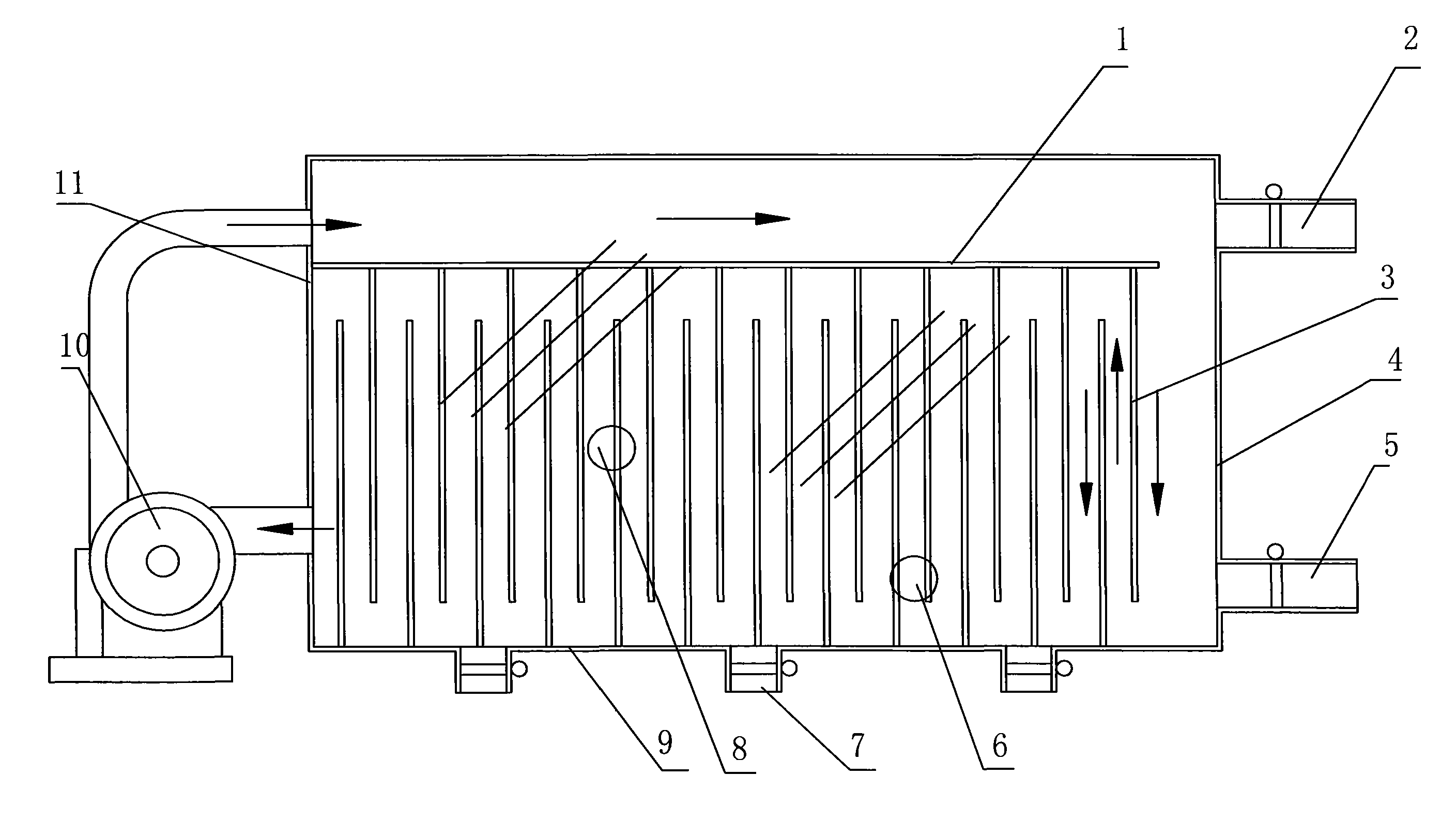
The invention relates to a reactor for denitrification and dephosphorization of waste water by using biofilm technology and its application method. A pump-driven baffled internal circulation bioreactor, which is divided into an upper advection area and a lower baffled area in the box, and baffles (3) protrude alternately in the baffled area, and a feeding port (6) is provided and a monitoring and sampling port (8); a circulating water pump (10) is arranged outside the left side of the casing, and a water suction pipe and a water inlet pipe are respectively connected to the left side wall (11). The method of using the device is to input the sewage to be treated into the tank, adjust the inflow and outflow flow according to the nature of the waste water to control the residence time, test the dissolved oxygen from the monitoring and sampling port (8), adjust the flow rate of the circulating water pump (10), and control the dissolved oxygen Concentration, an aerobic zone and an anaerobic zone are respectively formed in the baffle zone, and excess biofilm is released from the discharge port (7); the treated water is discharged from the water outlet (2) or the discharge port (7). Biological denitrification and dephosphorization of wastewater are realized through biofilm, the reactor and process are easy to operate, and the reduction of sludge generation is conducive to popularization and application.
Description
(一)技术领域 (1) Technical field
本发明涉及环境工程、生化反应工程、环境生物技术和水处理技术,具体系一种利用生物膜技术对废水进行脱氮除磷的一种生物膜反应器。The invention relates to environmental engineering, biochemical reaction engineering, environmental biotechnology and water treatment technology, in particular to a biofilm reactor for denitrification and phosphorus removal of waste water by using biofilm technology.
(二)背景技术 (2) Background technology
公知,随着社会经济的快速发展,许多富含氮、磷元素的工业废水大量产生,而这些废水的任意排放或未经深度处理而排放,导致许多天然河流、湖泊、景观水域地表水,甚至饮用水源都受到了污染,许多天然水体或多或少地形成了富营养化,主要表现为水体中氮、磷元素严重超标。这些污染导致河流、湖泊及景观水域等天然水体的诸多功能受到了破坏,尤其是饮用水源受到的污染对人们的正常生产和生活都造成了极大的影响。因此开发一种新型的生物反应器对富含氮元素的工业废水进行深度处理是十分必要的。It is well known that with the rapid development of social economy, a lot of industrial wastewater rich in nitrogen and phosphorus is produced in large quantities, and the random discharge of these wastewater or discharge without advanced treatment has resulted in many natural rivers, lakes, landscape water surface water, and even Drinking water sources have been polluted, and many natural water bodies have more or less formed eutrophication, mainly manifested in the serious excess of nitrogen and phosphorus elements in water bodies. These pollutions lead to the destruction of many functions of natural water bodies such as rivers, lakes and landscape waters, especially the pollution of drinking water sources, which has a great impact on people's normal production and life. Therefore, it is necessary to develop a new type of bioreactor for advanced treatment of nitrogen-rich industrial wastewater.
目前对富含氮元素的工业废水的处理方法还是以生物处理方法为主,在此方面国内已开发了不少新技术和装备,但还存在一些需要克服的缺点。例如发明专利《多级内循环硝化-反硝化生物脱氮反应器》申请号:200710048302.6,通过在反应器内部形成循环强化了传质过程,具有较好的脱氮效果。但该反应器还是基于流化床的原理,存在能耗较高,操作过程复杂等缺点。专利《循环流环型生物脱氮除磷工艺》申请号:200710039886.0,也采用了循环型生物脱氮除磷工艺,但主要以活性污泥为主,该种反应器在运行过程中由于污泥产生量较大,也存在一些污泥处置工作量大和易产生二次污染等问题。At present, the treatment method of industrial wastewater rich in nitrogen is still mainly biological treatment. In this regard, many new technologies and equipment have been developed in China, but there are still some shortcomings that need to be overcome. For example, the invention patent "multi-stage internal circulation nitrification-denitrification biological denitrification reactor" application number: 200710048302.6, through the formation of circulation inside the reactor to strengthen the mass transfer process, it has a better denitrification effect. However, this reactor is still based on the principle of a fluidized bed, which has disadvantages such as high energy consumption and complicated operation process. The application number of the patent "circulating flow loop biological denitrification and phosphorus removal process" is 200710039886.0, and the circulation type biological denitrification and phosphorus removal process is also adopted, but it is mainly based on activated sludge. The amount of production is relatively large, and there are also some problems such as heavy workload of sludge disposal and easy to produce secondary pollution.
(三)发明内容 (3) Contents of the invention
本发明的目的是要提供一种针对富含氮、磷元素的工业废水进行高效脱氮除磷的反应器装置和操作方法,该反应器具有结构简单,操作方便,污泥产生量少的特点。The purpose of the present invention is to provide a reactor device and operation method for efficient denitrification and dephosphorization of industrial wastewater rich in nitrogen and phosphorus elements. The reactor has the characteristics of simple structure, convenient operation and less sludge generation .
本发明的目的是由如下结构来实现的。The object of the present invention is achieved by the following structure.
一种水泵驱动式折流内循环生物反应器,其特征在于:A pump-driven baffle internal circulation bioreactor, characterized in that:
在一个左右方向长的矩形箱体内,由一水平分隔板1分隔成上方的平流区和下方的折流区,分隔板1的宽度与箱体等宽,分隔板1的左端与箱体的左侧壁11紧贴连接,分隔板1右端与箱体的右侧壁4留有间隙;In a long rectangular box in the left and right directions, a horizontal partition 1 is divided into an upper advection area and a lower baffle area. The width of the partition 1 is equal to the width of the box. The left side wall 11 of the body is closely connected, and there is a gap between the right end of the partition plate 1 and the right side wall 4 of the box body;
在折流区的下部右侧壁4开设进水口5,在平流区的右侧壁4开设出水口2;A water inlet 5 is provided on the lower right side wall 4 of the baffle area, and a water outlet 2 is provided on the right side wall 4 of the advection area;
在折流区内,由箱体底板9向上,由分隔板1向下交替伸出宽度与箱体宽度相等,高度低于底板9至分隔板1下板面距离的折流板3,形成从右至左一条呈多个连贯横S的曲折流道;In the baffle area, from the bottom plate 9 of the box body upwards, the baffle plate 3 extending downwards from the partition plate 1 alternately has a width equal to the width of the box body, and a height lower than the distance from the bottom plate 9 to the lower surface of the partition plate 1, Form a zigzag flow channel with multiple continuous horizontal S from right to left;
在折流区内,在前和/或后面板上,在右侧1/3处的下方开设补料口6,在左侧1/3处的中部开设监测与取样口8;In the baffle area, on the front and/or rear panel, a feed port 6 is provided below the right 1/3, and a monitoring and sampling port 8 is provided in the middle of the left 1/3;
在箱体的左侧外部配置循环水泵10,循环水泵10的吸水管连接折流区的左侧壁11,循环水泵10的进水管接入平流区左侧壁11;A circulating water pump 10 is arranged outside the left side of the box, the suction pipe of the circulating water pump 10 is connected to the left side wall 11 of the baffle area, and the water inlet pipe of the circulating water pump 10 is connected to the left side wall 11 of the advection area;
在箱体底板9开设数个排放口7。Several discharge ports 7 are opened on the bottom plate 9 of the box body.
所述折流区内折流板3为偶数,自右向左的第一块折流板3是由分隔板1向下伸出的。The number of baffles 3 in the baffle area is even, and the first baffle 3 from right to left protrudes downward from the partition 1 .
所述在箱体底板9开设排放口7的个数为均匀间距2~3个。The number of discharge ports 7 provided on the bottom plate 9 of the box body is 2 to 3 at an even interval.
所述上下交替伸出折流板3端部的高度差为5至20厘米,相邻两折流板3之间距离为2至20厘米。The height difference between the ends of the baffles 3 protruding alternately up and down is 5 to 20 centimeters, and the distance between two adjacent baffles 3 is 2 to 20 centimeters.
所述分隔板1与右侧壁4的间隙为2至15厘米。The gap between the partition plate 1 and the right side wall 4 is 2 to 15 cm.
所述的左、右为右、左。Described left and right are right and left.
一种如所述水泵驱动式折流内循环生物反应器的使用方法,其特征在于:A method for using the pump-driven baffled internal circulation bioreactor, characterized in that:
采用间歇方法处理废水:Treatment of wastewater by batch method:
①运行之前将待处理水注满反应器;① Fill the reactor with water to be treated before operation;
②启动循环水泵10,将折流区的污水通过循环水泵10的吸水管吸入再送入上方平流区,又经过分隔板1右端与箱体右侧壁4留有的间隙再进入折流区,形成内循环;② Start the circulating water pump 10, suck the sewage in the baffle area through the suction pipe of the circulating water pump 10, and then send it to the upper advection area, and then enter the baffle area through the gap left between the right end of the partition plate 1 and the right side wall 4 of the box body, form an inner loop;
③从监测与取样口8测试水中溶解氧浓度或取样分析相关参数,调节循环水泵10的流量,即控制污水的溶解氧浓度,在折流区内自右向左分别形成好氧区、厌氧区;③Test the dissolved oxygen concentration in the water from the monitoring and sampling port 8 or take samples to analyze relevant parameters, adjust the flow rate of the circulating water pump 10, that is, control the dissolved oxygen concentration of the sewage, and form an aerobic zone and an anaerobic zone from right to left in the baffle area. district;
④经过一定时间的处理,达到所规定的指标后,处理后的水经过排放口7全部排放出;④ After a certain period of treatment, after reaching the specified index, the treated water is completely discharged through the discharge port 7;
⑤运行一定的周期,视生物膜脱落的程度,多余的生物膜从排放口7排出。一种如所述水泵驱动式折流内循环生物反应器的使用方法,其特征在于:采用连续方法处理废水:⑤ Run for a certain cycle, depending on the degree of biofilm shedding, the excess biofilm will be discharged from the discharge port 7. A method for using a pump-driven baffle internal circulation bioreactor, characterized in that: the waste water is treated in a continuous manner:
①待处理污水通过动力或自然高位差经进水口5输入箱体,根据待处理废水的性质,调节进出水流量,以控制水力停留时间;① The sewage to be treated is input into the box through the water inlet 5 through power or natural height difference, and the water flow in and out is adjusted according to the nature of the waste water to be treated to control the hydraulic retention time;
②启动循环水泵10,将折流区的污水通过循环水泵10的吸水管吸入再送入上方平流区,又经过分隔板1右端与箱体右侧壁4留有的间隙再进入折流区,形成连续不断的内循环;② Start the circulating water pump 10, suck the sewage in the baffle area through the suction pipe of the circulating water pump 10, and then send it to the upper advection area, and then enter the baffle area through the gap left between the right end of the partition plate 1 and the right side wall 4 of the box body, Form a continuous internal circulation;
③从监测与取样口8测试水中溶解氧浓度或取样分析相关参数,调节循环水泵10的流量,即控制污水的溶解氧浓度,在折流区内自右向左分别形成好氧区、厌氧区;③Test the dissolved oxygen concentration in the water from the monitoring and sampling port 8 or take samples to analyze relevant parameters, adjust the flow rate of the circulating water pump 10, that is, control the dissolved oxygen concentration of the sewage, and form an aerobic zone and an anaerobic zone from right to left in the baffle area. district;
④在运行过程中,视生物膜脱落的程度,多余的生物膜从排放口7排出;④ During operation, depending on the degree of biofilm shedding, the excess biofilm is discharged from the discharge port 7;
⑤连续运行时,经过一定的停留时间处理并达标的水从出水口2连续排出。⑤ During continuous operation, the water that has been treated for a certain residence time and reaches the standard is continuously discharged from the water outlet 2.
如上所述的使用方法,其特征在于:The method of use as described above is characterized in that:
根据污水性质由补料口6向反应器内补充碳源,提高污水总氮去除效率;According to the nature of the sewage, the carbon source is replenished from the feeding port 6 to the reactor to improve the total nitrogen removal efficiency of the sewage;
根据污水性质由补料口6向反应器内补充絮凝剂,提高污水中磷的去除率。According to the nature of the sewage, the flocculant is replenished from the feeding port 6 to the reactor to increase the removal rate of phosphorus in the sewage.
如上所述的使用方法,其特征在于:The method of use as described above is characterized in that:
生物膜的培养采用自然形成的方法或接种污泥的方法,The cultivation of biofilm adopts the method of natural formation or the method of inoculating sludge,
所述自然形成的方法:分隔板1和折流板3接触到待修复或处理的水后,在正常操作条件下,在好氧区形成高活性的好氧生物膜,在厌氧区形成厌氧生物膜;The method of natural formation: After the partition plate 1 and the baffle plate 3 contact the water to be repaired or treated, under normal operating conditions, a highly active aerobic biofilm is formed in the aerobic zone, and a highly active aerobic biofilm is formed in the anaerobic zone. anaerobic biofilm;
所述接种污泥的方法:将驯化好的污泥加入反应器内启动反应器间歇运行1~7天,分隔板1和折流板3上形成生物膜。The method for inoculating the sludge: adding the acclimatized sludge into the reactor to start the intermittent operation of the reactor for 1-7 days, and biofilms are formed on the partition plate 1 and the baffle plate 3 .
采用本技术方案,待处理的水由位于下箱体的下部的管状进水口进入反应器箱体,在循环水泵的驱动下,反应器内的水分别经过好氧区和厌氧区形成循环流动,好氧区内的溶解氧浓度控制在4mg·L-1以下,废水中的溶解氧在好氧区内流动过程中进行硝化反应,逐步消耗完溶解氧后流入厌氧区,在厌氧区内沿着折流板上下流动,并同时进行反硝化反应。从而实现在一个反应器内同时发生硝化和反硝化反应,实现氨氮、硝酸盐氮、亚硝酸盐氮以及总氮的有效去除,然后再进入好氧区。With this technical scheme, the water to be treated enters the reactor box through the tubular water inlet located at the lower part of the lower box, and driven by the circulating water pump, the water in the reactor passes through the aerobic zone and the anaerobic zone respectively to form a circulating flow , the dissolved oxygen concentration in the aerobic zone is controlled below 4 mg·L -1 , the dissolved oxygen in the wastewater undergoes nitrification reaction during the flow process in the aerobic zone, gradually consumes dissolved oxygen and then flows into the anaerobic zone. The inside flows up and down along the baffle, and the denitrification reaction is carried out at the same time. In this way, nitrification and denitrification reactions can occur simultaneously in one reactor, and ammonia nitrogen, nitrate nitrogen, nitrite nitrogen and total nitrogen can be effectively removed, and then enter the aerobic zone.
对于某些缺少碳源,并含氮量较高的工业废水,设置1~2个补充碳源入口。在反应器的侧面,同时设置若干个监测与取样口,以便于掌握反应器的运行情况并进行控制。For some industrial wastewater that lacks carbon sources and has high nitrogen content, set up 1 to 2 supplementary carbon source inlets. On the side of the reactor, several monitoring and sampling ports are set at the same time, so as to grasp and control the operation of the reactor.
本发明的有益效果:本专利则主要根据这一情况,提出一种新型的生物膜反应器和水处理的工艺方法。采用水泵驱动式折流内循环生物反应器及其使用方法,通过生物膜来实现废水的生物脱氮作用。该反应器和工艺既便于操作,又减少污泥的产生量,以利于实际推广应用。该反应器和工艺方法还可扩展应用到富营养化的地表水体的生物修复方面。Beneficial effects of the present invention: this patent mainly proposes a novel biofilm reactor and water treatment process based on this situation. The water pump-driven baffle internal circulation bioreactor and its use method are used to realize the biological denitrification of wastewater through biofilm. The reactor and process are not only convenient to operate, but also reduce the generation of sludge, so as to facilitate practical popularization and application. The reactor and the process method can also be extended and applied to the bioremediation of eutrophic surface water bodies.
(四)附图说明 (4) Description of drawings
图1为本发明一种水泵驱动式折流内循环生物反应器的结构示意图。Figure 1 is a schematic structural view of a pump-driven baffled internal circulation bioreactor of the present invention.
图中,1是分隔板,2是出水口,3是折流板,4是右侧壁,5是进水口,6是补料口,7是排放口,8是取样口,9是底板,10是水泵,11是左侧壁。In the figure, 1 is the partition plate, 2 is the water outlet, 3 is the baffle plate, 4 is the right side wall, 5 is the water inlet, 6 is the feeding port, 7 is the discharge port, 8 is the sampling port, and 9 is the bottom plate , 10 is a water pump, and 11 is a left side wall.
(五)具体实施方法(5) Specific implementation methods
以下结合附图进一步详细说明本发明的应用。The application of the present invention will be further described in detail below in conjunction with the accompanying drawings.
实施例1:Example 1:
利用水泵10驱动的折流式内循环生物反应器连续处理某种工业废水。该废水的氨氮浓度为20~25mg·L-1,总氮浓度约35mg·L-1,NaCl浓度在3000~8000mg·L-1范围。该废水基本不含可生物利用的有机碳源。处理前,先取活性污泥进行驯化培养,然后将含有嗜盐微生物污泥接种于反应器内,24小时之内就在折流板上形成活性很高的生物膜。处理时从补料口6中按比例流加葡萄糖溶液或甲醇作为外加有机碳源,对高盐分废水进行处理。该反应器能在3小时的停留时间内使氨氮的去除效率达到99%以上,总氮去除率达到75%以上。A baffle type internal circulation bioreactor driven by a water pump 10 is used to continuously treat certain industrial waste water. The ammonia nitrogen concentration of the wastewater is 20-25 mg·L -1 , the total nitrogen concentration is about 35 mg·L -1 , and the NaCl concentration is in the range of 3000-8000 mg·L -1 . The wastewater is substantially free of bioavailable organic carbon sources. Before the treatment, first take the activated sludge for acclimatization and cultivation, and then inoculate the sludge containing halophilic microorganisms into the reactor, and a highly active biofilm will be formed on the baffle within 24 hours. During treatment, glucose solution or methanol is fed in proportion from the feeding port 6 as an additional organic carbon source to treat high-salt wastewater. The reactor can make the removal efficiency of ammonia nitrogen reach more than 99% and the removal rate of total nitrogen reach more than 75% within the residence time of 3 hours.
实施例2:Example 2:
利用水泵驱动式折流内循环生物反应器进行城市河道水的生物修复。河道水中氨氮浓度为5~20mg·L-1,总氮浓度为10~35mg·L-1,将河道水泵入该反应器内,采用间歇运行方式,每天更换1~2次反应器内的水,经过5天左右运行,可形成活性很好的生物膜。然后再开始连续运行,在连续运行中,控制进水流量,使水力停留时间在1~5小时,水中氨氮的去除率达到99%以上,总氮的去除达到85%以上。Bioremediation of urban river water using a pump-driven baffled internal circulation bioreactor. The concentration of ammonia nitrogen in the river water is 5-20 mg·L -1 , and the concentration of total nitrogen is 10-35 mg·L -1 . The river water is pumped into the reactor, and the water in the reactor is replaced 1 or 2 times a day by intermittent operation. , after about 5 days of operation, a biofilm with good activity can be formed. Then start continuous operation. During the continuous operation, control the water flow rate so that the hydraulic retention time is 1 to 5 hours. The removal rate of ammonia nitrogen in water reaches more than 99%, and the removal rate of total nitrogen reaches more than 85%.
实施例3:Example 3:
利用水泵驱动式折流内循环生物反应器对城市污水处理厂出水连续进行深度处理。经过城市污水处理厂处理的出水,氨氮浓度为10~15mg·L-1,总氮浓度为20~30mg·L-1,总磷浓度为0.5~1.0mg·L-1,将该出水连续输入反应器中,控制进水流量,使水力停留时间在1~2小时,在运行过程中,按比例连续流加絮凝剂,经过该反应器的处理,水中氨氮的去除率达到90%以上,总氮的去除达到80%以上,总磷去除率达75%以上。该反应器的出水再经过灭菌后可以作为中水进行回用。A pump-driven baffle internal circulation bioreactor is used for continuous advanced treatment of effluent from urban sewage treatment plants. The effluent treated by the urban sewage treatment plant has an ammonia nitrogen concentration of 10-15 mg·L -1 , a total nitrogen concentration of 20-30 mg·L -1 , and a total phosphorus concentration of 0.5-1.0 mg·L -1 , and the effluent is input continuously In the reactor, the influent flow rate is controlled so that the hydraulic retention time is 1 to 2 hours. During the operation, the flocculant is continuously fed in proportion. After the treatment of the reactor, the removal rate of ammonia nitrogen in the water reaches more than 90%, and the total The removal rate of nitrogen reaches more than 80%, and the removal rate of total phosphorus reaches more than 75%. The effluent from the reactor can be reused as reclaimed water after being sterilized.
实施例4:Example 4:
利用水泵驱动式折流内循环生物反应器连续处理某食品废水。该食品废水氨氮浓度为50~100mg·L-1,总氮浓度为100~150mg·L-1,总磷浓度为3~10mg·L-1,COD为400~600mg·L-1。将该出水连续输入反应器中,控制进水流量,使水力停留时间在24~48小时。在运行过程中,按比例连续流加絮凝剂,经过该反应器的处理,水中氨氮的去除率达到95%以上,总氮的去除达到90%以上,总磷去除率达95%以上,COD去除率达到90%以上。A pump-driven baffle internal circulation bioreactor is used to continuously treat certain food wastewater. The food wastewater has an ammonia nitrogen concentration of 50-100 mg·L -1 , a total nitrogen concentration of 100-150 mg·L -1 , a total phosphorus concentration of 3-10 mg·L -1 , and a COD of 400-600 mg·L -1 . The effluent water is continuously input into the reactor, and the flow rate of the influent water is controlled so that the hydraulic retention time is 24 to 48 hours. During the operation, the flocculant is continuously fed in proportion. After the treatment of the reactor, the removal rate of ammonia nitrogen in water reaches more than 95%, the removal rate of total nitrogen reaches more than 90%, the removal rate of total phosphorus reaches more than 95%, and the removal rate of COD The rate reaches more than 90%.
Claims (10)
Priority Applications (1)
| Application Number | Priority Date | Filing Date | Title |
|---|---|---|---|
| CNA2008102018023A CN101386445A (en) | 2008-10-27 | 2008-10-27 | A pump-driven baffled internal circulation bioreactor and its application method |
Applications Claiming Priority (1)
| Application Number | Priority Date | Filing Date | Title |
|---|---|---|---|
| CNA2008102018023A CN101386445A (en) | 2008-10-27 | 2008-10-27 | A pump-driven baffled internal circulation bioreactor and its application method |
Publications (1)
| Publication Number | Publication Date |
|---|---|
| CN101386445A true CN101386445A (en) | 2009-03-18 |
Family
ID=40476152
Family Applications (1)
| Application Number | Title | Priority Date | Filing Date |
|---|---|---|---|
| CNA2008102018023A Pending CN101386445A (en) | 2008-10-27 | 2008-10-27 | A pump-driven baffled internal circulation bioreactor and its application method |
Country Status (1)
| Country | Link |
|---|---|
| CN (1) | CN101386445A (en) |
Cited By (9)
| Publication number | Priority date | Publication date | Assignee | Title |
|---|---|---|---|---|
| CN102951735A (en) * | 2012-11-01 | 2013-03-06 | 杭州市农业科学研究院 | Composite flow baffling water treatment biomembrane reactor |
| CN103145242A (en) * | 2011-12-06 | 2013-06-12 | 王炜 | Biofilm reactor for treating outfall sewage of rivers and lakes and sewage treatment process |
| CN103395874A (en) * | 2013-07-15 | 2013-11-20 | 上海师范大学 | Improved structure of deflection type internal circulation biomembrane reactor |
| CN104150572A (en) * | 2014-01-10 | 2014-11-19 | 广东金明环保科技有限公司 | Efficient reaction sedimentation device for water treatment |
| CN107601671A (en) * | 2017-11-10 | 2018-01-19 | 东北大学 | The Waste Water Treatment and method of non-aeration deflector type synchronous nitration and denitrification |
| CN107902760A (en) * | 2017-12-04 | 2018-04-13 | 宝武集团环境资源科技有限公司 | Interior circulating biological membrane reactor and its black and odorous water processing system and processing method |
| CN111285536A (en) * | 2018-12-06 | 2020-06-16 | 国投生物科技投资有限公司 | Device and method for recovering nitrogen and phosphorus in residual bait and excrement generated in aquaculture |
| CN114477443A (en) * | 2022-04-18 | 2022-05-13 | 北京涞澈科技发展有限公司 | Biological frame based inserting plate type baffling anaerobic tank and sewage denitrification method |
| CN115465940A (en) * | 2022-09-16 | 2022-12-13 | 江苏坤奕环境技术股份有限公司 | Biological membrane wastewater treatment reactor and treatment method |
-
2008
- 2008-10-27 CN CNA2008102018023A patent/CN101386445A/en active Pending
Cited By (12)
| Publication number | Priority date | Publication date | Assignee | Title |
|---|---|---|---|---|
| CN103145242A (en) * | 2011-12-06 | 2013-06-12 | 王炜 | Biofilm reactor for treating outfall sewage of rivers and lakes and sewage treatment process |
| CN102951735A (en) * | 2012-11-01 | 2013-03-06 | 杭州市农业科学研究院 | Composite flow baffling water treatment biomembrane reactor |
| CN102951735B (en) * | 2012-11-01 | 2014-05-21 | 杭州市农业科学研究院 | Composite flow baffling water treatment biomembrane reactor |
| CN103395874A (en) * | 2013-07-15 | 2013-11-20 | 上海师范大学 | Improved structure of deflection type internal circulation biomembrane reactor |
| CN103395874B (en) * | 2013-07-15 | 2014-12-17 | 上海师范大学 | An improved structure of a baffled internal circulation biofilm reactor |
| CN104150572A (en) * | 2014-01-10 | 2014-11-19 | 广东金明环保科技有限公司 | Efficient reaction sedimentation device for water treatment |
| CN107601671A (en) * | 2017-11-10 | 2018-01-19 | 东北大学 | The Waste Water Treatment and method of non-aeration deflector type synchronous nitration and denitrification |
| CN107601671B (en) * | 2017-11-10 | 2024-01-26 | 东北大学 | Non-aerated baffled simultaneous nitrification and denitrification wastewater treatment system and method |
| CN107902760A (en) * | 2017-12-04 | 2018-04-13 | 宝武集团环境资源科技有限公司 | Interior circulating biological membrane reactor and its black and odorous water processing system and processing method |
| CN111285536A (en) * | 2018-12-06 | 2020-06-16 | 国投生物科技投资有限公司 | Device and method for recovering nitrogen and phosphorus in residual bait and excrement generated in aquaculture |
| CN114477443A (en) * | 2022-04-18 | 2022-05-13 | 北京涞澈科技发展有限公司 | Biological frame based inserting plate type baffling anaerobic tank and sewage denitrification method |
| CN115465940A (en) * | 2022-09-16 | 2022-12-13 | 江苏坤奕环境技术股份有限公司 | Biological membrane wastewater treatment reactor and treatment method |
Similar Documents
| Publication | Publication Date | Title |
|---|---|---|
| CN102276103B (en) | Integrated in-situ denitrification culture wastewater biological treatment device and treatment method | |
| CN201268652Y (en) | Integral sewage treating device | |
| CN105330108B (en) | Utilize anaerobism-catalytic oxidation biofilm reactor processing sanitary sewage method and processing unit | |
| CN201068420Y (en) | A gas-liquid mixed lifting biological fluidized bed reactor | |
| CN103601293B (en) | Tower-type bioreactor synchronously removing carbon, nitrogen and sulfur | |
| CN102153232A (en) | Side-flow circulation BAF (Biological Aerated Filter) intensified dephosphorization system and method for treating urban sewage with the dephosphorization system | |
| CN103214150B (en) | Complete self-backflow well type anabroeic-anoxic-oxic (AAO) sewage treatment method | |
| CN106495328B (en) | A kind of group technology and system of efficient process coal chemical industrial waste water | |
| CN102180560B (en) | Device and method for continuously and biologically treating urban sewage | |
| CN104973688A (en) | Anaerobic-aerobic bio-filter coupled sewage processing device and sewage processing method | |
| CN205501033U (en) | A compound improved generation purifier for distributed rural domestic sewage treatment system | |
| CN205710291U (en) | MULTI CONTACT point source sewage disposal system | |
| CN102951731B (en) | Airlift oxidation ditch type membrane bioreactor | |
| CN202390287U (en) | Internal iron-carbon UASB-SBR (Upflow Anaerobic Sludge Blanket-Sequencing Batch Reactor) coupling system for treatment of printing and dyeing wastewater | |
| CN202265459U (en) | A-CASS sewage processing system | |
| CN2616530Y (en) | Micro-power domestic sewage treatment integrating apparatus | |
| CN207998522U (en) | A kind of packing type country sewage integrated treatment unit | |
| CN101386446A (en) | An air-lift baffled internal circulation bioreactor and its application method | |
| CN108341495B (en) | Three-phase overflow efficient oxygen supplementing wetland system | |
| CN212127682U (en) | A Circulating Mobile Carrier Biofilm Reactor | |
| CN109775936B (en) | Low-energy-consumption domestic sewage treatment system | |
| CN105948409A (en) | Novel method for treating industrial wastewater through combined processes | |
| CN105948411A (en) | Novel industrial wastewater treatment process | |
| CN212269816U (en) | Aged landfill leachate non-concentrated solution treatment system | |
| CN116573754A (en) | Equipment and method for sewage treatment by non-foaming aerobic biological method based on hydraulic agitation |
Legal Events
| Date | Code | Title | Description |
|---|---|---|---|
| C06 | Publication | ||
| PB01 | Publication | ||
| C10 | Entry into substantive examination | ||
| SE01 | Entry into force of request for substantive examination | ||
| C12 | Rejection of a patent application after its publication | ||
| RJ01 | Rejection of invention patent application after publication |
Open date: 20090318 |